FMGE Jan 2026: Exam Date, Schedule, Eligibility, and Preparation
Making the correct career choice after earning an international medical degree is important to Indian and OCI graduates intending to practise in India. The Foreign Medical Graduate Examination (FMGE) is a compulsory screening test administered twice a year by the National Board of Examinations in Medical Sciences (NBEMS) to assess candidates on core MBBS subjects and determine their eligibility to practise medicine in the country.
This detailed guide contains all the information related to the FMGE January 2026 exam date, the admit card date, eligibility, structure, marking, and other related aspects of the study, as well as the necessary preparation knowledge.
Keep reading to achieve a confident, well-planned FMGE preparation!
What is the FMGE June 2026 Exam Date & Schedule?
The Exam date for FMGE June 2026 is out. It will be taken on 28, June 2026, and the NBEMS bulletin will be published soon. Registration will start on the official website after the NBEMS bulletin is released. Admit cards will be issued approximately a week before the exam, and the results date will be announced in the information bulletin.
The FMGE (Foreign Medical Graduate Examination) for the June 2026 session will be held on 28 June 2028. This is a computer-based test, administered by NBEMS, and is compulsory for Indian or OCI graduates who have completed a medical course outside India and desire to be registered in India. It is conducted twice a year and examines fundamental MBBS subjects.
Here are the key FMGE Jun 2026 exam dates:
| Event | Date & Time 2026 |
| Information Bulletin released | April 21, 2026 |
| Online Application starts | April 21, 2026 |
| Online Application ends | May 11, 2026 |
| Issue of Admit Card | Date to be announced soon |
| FMGE Exam Date | 28 June 2026 |
| Result declaration (Tentative) | July 28, 2026 |
- Candidates need to visit the official NBEMS site frequently to obtain updated information and changes in these dates.
- As indicated in the information bulletin, the NBEMS application link is available through Digitalm or a direct portal link.
What are the Eligibility Criteria for FMGE June 2026?
Only those candidates who fulfil the NBEMS/NMC regulations are eligible. They need to be Indian nationals or OCI and hold a foreign MBBS degree recognised by the Indian Embassy, and take the final MBBS exam and pass it by the cut-off date. There is no age restriction, although an NMC Eligibility Certificate may be needed.
Key eligibility points:
| Nationality | Indian nationals or OCI/foreigners are ineligible |
| Medical Degree | Primary medical qualification (MBBS or equivalent) earned in a college other than in India and recognised by the concerned Indian Embassy. |
| Internship | Should have at least one year of internship (or equivalent) before the cut-off date. |
| Attempts | There is no limit on the number of attempts. You may sit for as many FMGE sessions as needed until you pass. |
Note: Get the NMC Eligibility Certificate as soon as possible, even before registering, if your medical college is in a country where the certificate is mandatory (indicating that your degree is accepted in that country). The specifics are available on the NMC webpage.
What is the Application Process for FMGE June 2026?
Registration is completely internet-based through NBEMS. Applicants must review the formal bulletin and then complete the online application on the NBEMS portal. Payment of the application fee is done online as part of this process.
To go through the registration process without any difficulties, follow the official FMGE application process as outlined below:
- Step 1: Read the Information Bulletin
Review the complete instructions, including the course fees and requirements, and download the FMGE June 2026 bulletin once it is released.
- Step 2: Register/Login
In the NBEMS FMGE 2026 section, register as a new user. You will need to create a username and a password.
- Step 3: Fill Application Form
Register and enter personal information, academic qualifications, and a passport-sized photo/signature within the specified requirements. Always ensure you post the most recent, clear pictures.
- Step 4: Upload Documents
Scan and upload the required documents (MBBS certificate/provisional certificate, internship completion certificate, passport/OCI card, etc.) in the required format.
- Step 5: Pay Fee
You should pay the application fee via the online payment gateway (credit/debit card or net banking). The cost is ₹6,195 for all candidates (exam fee, in addition to GST). This fee is non-refundable.
- Step 6: Submit and Print
Make a payment and submit the form. Save the confirmation. You should print a copy of the completed application form and the receipt of the application fees.
Application-related procedures – filling out forms, uploading documents, paying fees, and finally submitting the application – must be completed by the announced date. NBEMS clearly states that any form whose deadline is missed will not be accepted.
In the event of any technical failure, such as inability to log in, inability to pay, or portal difficulties, a candidate may contact NBEMS Candidate Care Support at +91-7996165333 or file a complaint via the official support portal.
What is the Exam Pattern & Syllabus for FMGE June 2026?
FMGE is a computer-based examination consisting of 300 MCQs, divided into Part A and Part B, each comprising 150 questions, with a duration of 2.5 hours. It examines preclinical, paraclinical, and clinical MBBS, and this examination is administered in English.
The FMGE June 2026 exam pattern that the candidates should be aware of is:
- Total Questions: 300 multiple-choice questions (4 options, one of which is correct)
- Parts: Paper 1 and Paper 2 each consisted of 150 questions. Part A is usually done during the morning shift, and Part B is conducted later (see the schedule on the admit card).
- Duration: 150 minutes (2 hours 30 minutes) for Part A plus 150 minutes for Part B. Between the two parts, a 30-minute break is provided.
- Marking Scheme: 1 point to be awarded to each correct answer; no negative marking for incorrect answers.
- Passing Criteria: Minimum 150 marks out of 300 (50%). The NBEMS typically posts the marks achieved by each candidate online after the results are announced.
- Subjects Covered: Entire MBBS curriculum. Pharmacology, Microbiology, Pathology, Obstetrics and Gynaecology, Paediatrics, Medicine, and Surgery rank high on the list of heavy topics. (See complete subject-by-topic syllabus in the NBEMS bulletin available on the NMC website.)
FMGE Syllabus Highlights:
The syllabus of FMGE is grounded on the Graduate Medical Regulations (by MCI/NMC). It broadly includes:
- Pre-clinical: Anatomy, Physiology, and Biochemistry
- Para-clinical: Pathology, Pharmacology, Microbiology, Forensic Medicine, and Community Medicine
- Clinical: General Medicine, General Surgery, Obstetrics & Gynaecology, Paediatrics, Orthopaedics, Ophthalmology, ENT, Psychiatry, Dermatology, Radiology, Anaesthesiology, etc.
It is recommended that candidates focus on fundamental concepts and clinical reasoning. Previous year’s FMGE questions and mock tests should also be practised.
What are the Exam Day Guidelines for FMGE June 2026?
Candidates need to report early at the test centre on the exam day. Biometric verification (fingerprint/face ID) will be conducted before commencing. Comply with all NBEMS regulations and exam hall regulations.
Candidates are expected to abide by the rules and instructions issued by NBEMS to ensure a stress-free, smooth experience on the day of the exam. The following are the important guidelines to consider:
- Admit Card: Download from the BEMS portal when released (usually around May 2026). Print on white A4 paper (single-sided). Make sure you have all the information (name, photo, examination centre, etc.). No admit card means no entry.
- Documents: In addition to the admit card, you need to bring one government-issued ID (ideally the identity proof that you used when registering), e.g., a passport or OCI card. The name and the photo should be clear.
- Reporting Time: Be at the exam centre at least 1 hour before the exam. NBEMS typically requires candidates to report early (indicated in the sample schedule in the bulletin) to be verified and biometrically registered.
- Stationery and Gear: Nothing but simple pens (blue/black) are required. Do not bring any electronic gadgets (mobile phones, smartwatches, or calculators) or study resources to the centre. It is all right to have a transparent bottle of water and a hand sanitiser (when permitted). Wearing jewellery or a thick watch can interfere with biometric scanning.
- Attendance and Bio-ID: Before the commencement of the exam, your thumb finger impression or face image will be captured. Wipe off dirty fingers, no bandages. Signing again will be done after the exam.
- Exam Conduct: Exam rules are to be strictly adhered to. Any form of misconduct (cheating, impersonation) results in the cancellation and potential prohibition. Pay attention to the centre staff’s instructions.
- Emergency: Any discrepancy (ID mismatch, system error) should be reported immediately to the invigilator. Don’t move out of the centre unless permitted to do so.
What are the Results & Certification for FMGE June 2026?
The FMGE outcomes will be published on the NBEMS site after the exams are completed. Passing candidates will be issued a Screening Test Pass Certificate, which is necessary to seek provisional or permanent registration by the NMC or State Medical Councils.
Once the exam is complete, candidates await their FMGE results with anticipation, as the results determine their eligibility to pursue further medical registration in India. All results, the scorecard, and the pass certificate are issued through the established NBEMS channels, and every stage is significant in progressing toward further NMC registration.
- Result Declaration: Date to be announced soon
- Scorecard: The official scorecard/hall ticket printout can typically be accessed either via login or by mail on the NBEMS site, under the Results section. The statement of your score (out of 300) and pass or fail will be displayed.
- Pass Certificate: Upon passing FMGE, NBEMS will issue you a Pass Certificate (after a photo/biometric authentication), indicating that you have passed the screening test. To be registered with the National Medical Council (NMC) or any State Medical Council, this certificate is needed.
- Failed Candidates: Having fewer than 150 marks will result in a Fail status. You have to wait until the next session (June 2026) re-emerges, but be sure to remedy any inadequacies in preparation.
- NMC Registration: Once you pass FMGE, you may request provisional/permanent registration with NMC. In addition to the FMGE Pass Certificate, you will need your original foreign medical degree, proof of internship fulfilment, and NMC eligibility certificate.
What are the Preparation Tips for FMGE June 2026?
A structured study plan focusing on high-yield topics, regular revision, and mock tests is key. Make use of reliable FMGE preparation resources (good textbooks, NBEMS bulletins, Q-banks) and study a lot with questions from the last few years.
FMGE demands a dedicated approach and practice to prepare well. The time between the closing of registration and the exam date is limited, and candidates have to strategise their studies. The following are some of the tips that you have to practise to make the most out of your performance:
- Create a Study Plan
You have about a month between submitting the form and the exam (June 2026), so you need to draw a day-by-day revision plan. Dedicate additional time to weak points and strike a balance between preclinical, paraclinical, and clinical subjects.
- Prioritise Important Topics
Stick to high-weight subject areas in FMGE: Pharmacology, Microbiology, Pathology, Obstetrics and Gynaecology, Paediatrics, Medicine, and Surgery. Do not overlook fundamentals – e.g., Physiology and Anatomy still have a few questions.
- Practise MCQs
Do as many MCQs of the FMGE format as possible. Look through previous FMGE questions. Time yourself to speed up and be precise. Analyse mistakes thoroughly.
- Make Revision Notes
Write concise notes or points, or make flashcards, so that you can quickly memorise facts (drug names, pathway steps, diagnostics, etc.). Over the last few weeks, focus on revisions rather than learning the new.
- Take Mock Tests
Do full-length mock tests under exam conditions. This develops endurance and time management. Go through all the mock tests and determine errors in the pattern.
- Stay Healthy
Maintain a good routine (sleep, exercise, and nutrition). Sleep and short breaks are very important to memory during intense prep. Maintain low stress by staying positive and confident.
- Take Out Time for Document Preparation
Ensure your application information and documents (eligibility certificate, degree, internship proof) are in order. Scan multiple copies of essential docs as backup.
- Study Official Instructions
Re-read the NBEMS guidelines in the information bulletin, particularly on image specifications and examination day regulations, to preclude disqualification over matters of technicalities.
FAQs about FMGE June 2026
- When will the FMGE Jan 2026 results be declared?
The results should be expected by 17 February 2026, approximately a month after the exam.
- Are there any exemptions for FMGE 2026?
Yes. Graduates from Australia, Canada, New Zealand, the UK, and the USA are exempt because the National Medical Commission recognises their degrees.
- Can I take the FMGE exam if my internship is incomplete?
Yes, you may be allowed to do so, provided you have obtained your degree, but you are required to complete an internship before seeking registration with the NMC.
- What subjects carry more weight in FMGE?
Medicine, Surgery, Obstetrics and Gynaecology, Paediatrics, and Community Medicine are examples of clinical subjects that tend to carry greater weightage.
- What happens after qualifying for FMGE?
To practise in India, FMGE-qualified candidates must complete an internship (if pending) and then apply for permanent registration with the National Medical Commission (NMC).
- Who is eligible for the January 2026 FMGE?
Candidates must be Indian citizens or Overseas Citizens of India (OCI) with a primary medical qualification (MBBS) from a recognised institution outside India.
- What documents are mandatory for the January 2026 FMGE??
A printed copy of the Admit Card with a photo affixed, and a valid original photo ID proof (Passport, PAN Card, Voter ID, or Aadhaar).
- When can I apply for the FMGE 2026?
The application process starts 2-3 months before the exam date. The exam is held in June and December. Start checking the official website a few months before this for the application notice.
- How many times can I attempt FMGE?
There is no limit on the number of attempts. You can appear for the exam as many times as needed until you qualify.
- Can I get into medical PG after clearing the FMGE 2026?
Yes. After qualifying the FMGE, you become eligible to appear for the NEET-PG examination, through which you can apply for postgraduate medical courses in India.
Conclusion
The FMGE is not only an examination but also a gateway for foreign medical graduates to practise in India legally. Discipline, proper planning, revision, and clarity of exam rules and preparation strategy are the keys to success. With the appropriate focus and approach, candidates will be able to achieve the qualifying score and proceed to clinical practice with confidence.
When you pass and receive your Screening Test Pass Certificate, opportunities will open to register provisionally or permanently with the NMC or State Medical Councils, and you will be able to start your medical career proudly and purposefully in India. Keep in mind that each hour of preparation is crucial; be regular, practise mock tests, and cover the syllabus based on weightage.
To support organised learning for aspirants, DocTutorials offers FMGE-oriented courses, subject-based MCQs, doubt groups, and mock tests. It assists students in packing. This helps you get pro-level guidance and develop an exam strategy to learn smarter and achieve better results.
FMGE preparation simplified by DocTutorials!

Latest Blogs
-
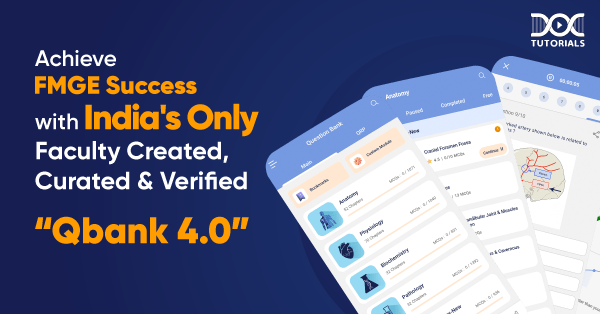
Achieve FMGE Success with “Qbank 5.0”
Successfully clearing the FMGE is one of the toughest challenges for foreign medical graduates like you, who are planning to…