Venous Drainage of the Upper and Lower Limbs: Anatomy, Functions, and Clinical Insights
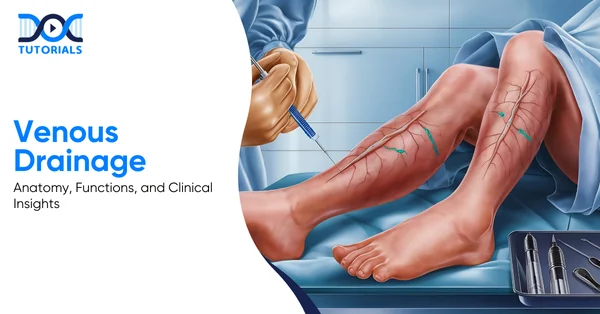
Understanding the venous drainage of the upper and lower limbs and the function of major superficial and deep veins, their connections, and valves is key to procedures such as venipuncture, catheterisation, and the management of venous disorders. Abnormalities or blockages in limb veins can cause varicose veins, deep vein thrombosis, and chronic venous insufficiency, posing significant health risks.
This guide covers the anatomy, functions of limb venous drainage, and clinical relevance techniques to assist students and healthcare professionals in developing a solid knowledge base.
Keep reading to learn more!
What is Venous Drainage?
Venous drainage is the return of oxygen-poor blood from body tissues, particularly the arms and legs, to the heart. It depends on one-way valves and muscle movement to push blood upward against gravity. Together, superficial and deep veins support healthy circulation and prevent blood pooling or tissue congestion.
The venous vessels channel deoxygenated blood from the tissues and drain it back into the heart. In limbs, venous drainage refers to the return flow from the arms and legs. The veins are responsible for pumping oxygen-depleted blood to the heart, with the help of a one-directional valve and the pumping effects of the muscles.
The venous system in each of the limbs has been bisected into the superficial veins (the veins beneath the superficial fascia, or directly beneath the skin) and the deep veins (that is, veins beneath the deep fascia). Collectively, they preserve the circulatory balance through the draining of the blood in the muscles, skin, and bones into the central circulation.
The differences between veins and arteries are that the arteries pump the blood away under high pressure, whereas the veins pump it back under low pressure. Veins have valves (more particularly leg veins) that do not allow the blood to be pushed back, and skeletal muscles squeeze deep veins as pumps force the blood upwards. Proper venous drainage is essential to avoid the stagnation of blood and congestion of the tissue.
Anatomy and Functions of Venous Drainage in Upper and Lower Limbs
There are complex venous systems in both the lower and upper extremities. Major superficial veins are located within the subcutaneous tissue, whereas paired deep veins accompany major arteries found beneath the deep fascia.
The venous drainage systems in the upper and lower limbs are connected to each other through perforating veins. One-way flow towards the heart is guaranteed by valves, and pumping is facilitated by muscle movements. This anatomy aids in the explanation of how blood is brought back to the extremities as well as the relevance of some veins in clinical practices.
Here is a detailed overview:
Upper Limb Venous Anatomy
The veins in the arm have a superficial network (basilic and cephalic) and arterial veins. The cephalic vein and the axillary/subclavian vein are lateral to one another, but the basilic vein is used as the median of the two, and the brachial veins are linked with these two veins to create the axillary vein. They are united by the median cubital vein at the elbow, which is a usual venous access site.
Superficial veins of the upper extremity consist of the medial basilic vein and the lateral cephalic vein, which are joined together at the elbow by the median cubital vein. The basilic vein originates in the dorsal venous arch of the hand and runs up the medial forearm, underneath the fascia close to the arm, to join the brachial veins to form the axillary vein.
The cephalic vein originates at the hand, passes along the anterolateral side of the forearm and arm, over the deltoid and pectoralis major muscles, and empties into the axillary or subclavian vein. The cubital fossa in the basilic vein is a junction between the basilic and distal veins and is a popular site of venous access.
- Major Superficial Veins (upper limb): The primary superficial veins of the arm are the cephalic (lateral) and basilic (medial) veins and are directly beneath the skin. The cephalic vein empties into the axillary vein above the shoulder, and the basilic vein is deep and empties into the axillary vein above the shoulder. They are connected to each other at the elbow by a position known as the median cubital vein.
- Deep Veins (upper limb): The deep veins are venae comitantes, which accompany arteries under the fascia. As an illustration, the brachial veins go hand in hand with the brachial artery. These extensive veins are sustained by the arm muscles and end up joining to produce the axillary vein. Notably, the pulses in arteries aid in the movement of blood in such veins.
- Connections (perforators): In the arm, small perforating veins connect the deep and superficial ones, through which the blood enters the deep veins. The upper limb venous system offers a good way of blood drainage throughout the hand and the forearm. The deep veins are the ones of high capacity, and the superficial veins, which are numerous in valves, play important clinical roles in venipuncture and grafting.
Mechanisms Aiding Venous Return
The veins of the upper limbs depend on a number of factors to be drained efficiently:
- Muscle Pump: The muscles on the forearm and arm contract, causing veins to squeeze, forcing blood back upwards.
- Venous Valves: One-way valves avoid back-flow during relaxation of muscles.
- Gravity Assistance: As the arm is moved or raised up, gravity will assist in pumping the blood to the heart.
Lower Limb Venous Anatomy
The veins in the leg comprise the superficial (great and small saphenous) and the deep (tibial, popliteal, and femoral) veins. The dorsal venous arch supplies the great saphenous and small saphenous veins, respectively, and empties into the popliteal and femoral veins. Deep veins follow the arteries, and the valves, muscles, and calf pump assist in the effective circulation of blood.
The view of the upper thigh (femoral triangle) demonstrates the great saphenous vein in the middle and the femoral vein under the inguinal ligament. The longest vein in the body is the great saphenous, which begins at the dorsal venous arch of the foot and proceeds along the medial leg and medial thigh and empties into the femoral vein below the inguinal ligament. The small saphenous vein is a dorsal lateral vein of the foot, which develops behind the lateral malleolus distal to the calf into the popliteal vein at the knee.
- Superficial Veins (lower limb): The great saphenous (medial) and small saphenous (posterior) are the main components of the superficial leg veins that are located right beneath the skin of the lower limb above the deep fascia. They drain the foot and superficial tissues, and the great saphenous vein empties into the femoral vein, and the small saphenous vein empties into the popliteal vein.
- Deep Veins (lower limb): Deep veins are located isotopically to the deep fascia and are typically accompanied by arteries. Posterior tibial, fibular, and anterior tibial veins are located correspondingly to the arteries and converge at the knee, forming the popliteal vein that joins the femoral vein in the thigh. The profunda femoris vein empties into the distal section of the femoral vein, known as the external iliac vein. The superior gluteal vein and the inferior gluteal vein empty into the internal iliac vein in the pelvis and the gluteal region, respectively.
- Venous Valves and Calf Pump: The veins in the legs contain a higher number and stronger valves than those in the arms to prevent backflow caused by gravity. Calf muscles are a sort of muscle pump that contracts, compressing deep veins to push the blood upwards, but relaxes to allow the backflow to be prevented by valves. The venous return of the legs depends on this mechanism.
- Pressure Gradients: Breathing movements also help the leg venous return: the lowered thoracic pressure and the increased abdominal pressure, which occur in the course of inspiration, promote the flow of blood in the legs towards the chest.
Superficial and Deep Veins of the Upper and Lower Limbs: Key Differences
The deep veins accompany the arteries and are the primary high-capacitance pathway since they occur within the subcutaneous tissue, whereas superficial veins run in isolation within subcutaneous tissue and tend to support thermoregulation. Superficial veins get emptied into a deep system, which is under the fascia.
The following is a comparison between the superficial and deep venous systems in the limbs:
| Aspect | Superficial Veins | Deep Veins |
| Location | Just under the skin (subcutaneous) | Muscles followed beneath the deep fascia |
| Relationship to Arteries | No independent course of association | Major arteries have venae comitantes, which accompany them |
| Function | Drain the skin and subcutaneous structures; thermoregulation. | Drain distribution of muscle and bone; principal recapillary, facilitated by the movements of the arteries |
| Examples (Upper Limb) | Cephalic, Basilic | Brachial Vectors, Axillary Vein |
| Examples (Lower Limb) | Great and Small Saphenous | Posterior/Anterior Tibial, Popliteal, Femoral veins |
Functions of the Limb Venous System
The limb venous system carries deoxygenated blood back to the heart, stores blood, and helps regulate body temperature. It depends on muscle movement, one-way valves, breathing-related pressure changes, and perforator veins to maintain smooth, upward blood flow from the limbs to the central circulation.
The major role of the limb venous system is to pump the deoxygenated blood into the heart to be oxygenated. Veins are also used as reservoirs of blood within the limbs and assist in maintaining body temperature (superficial veins are capable of dilating to get rid of the heat). In veins, there are venous valves that ensure unidirectional movement, which is an essential attribute in the low-pressure venous system.
Mechanisms involved are functional, and they include:
- Muscle Contraction: The contraction of limb muscles (particularly, calf muscles in the legs) squeezes neighbouring deep veins, forcing the blood towards the heart. This type of muscle pump is one of the significant sources of venous return during activity.
- Venous Valves: The walls of each segment of the veins include valves, which close as the blood attempts to fall backwards, to maintain a unidirectional flow towards the heart. Numerous valves are available in the legs to counter the force of gravity.
- Pressure Gradients: The variations in thoracic and abdominal pressures at inhalation produce suction that pulls venous blood to the chest.
- Perforator Veins: The limbs have the perforating veins that interconnect the superficial and deep veins and carry blood in the superficial reservoirs to the larger deep veins to maintain the proper flow of blood.
The combination of these characteristics ensures that blood returns to the central circulation, even at the opposite end of a hand or foot.
Common Disorders of the Limb Venous System
Disorders of limb veins are characterised by clots or dystrophy of valves, such as DVT, varicose veins, and chronic venous insufficiency. Reasons are stagnant flow, incompetence of the valve, or trauma, causing swelling, pain, and potential complications.
Limb vein disorders are frequent and may vary between superficial and severe complications, which may be life-threatening. They are usually caused by stagnation of blood flow, valve failure, or vessel damage, leading to pain, swelling, and permanent complications. It is imperative to understand these conditions to detect them early, prevent them, and manage them effectively.
Here is a detailed overview:
- Deep Vein Thrombosis (DVT): A DVT is the clotting of blood in a deep vein of a limb, mostly the legs. It impedes blood flow in veins, resulting in pain, swelling, and tenderness. Among risk factors are immobility, surgery, or hypercoagulability. Pulmonary embolism is the primary risk, where a piece of clot is carried to the lungs, and this may be fatal. Management aims at anticoagulation, compression, and prevention, and high-risk patients are subjected to prophylaxis.
- Varicose Veins: Varicose veins are dilations of twisted superficial veins that typically occur in the lower extremities due to chronic failure of valves, which cause an accumulation of blood and elevation of pressure. The symptoms are painful, heavy, itchy, and bulging veins. These include risk factors such as heredity, pregnancy, obesity, and prolonged standing. When left unattended, they may lead to chronic venous insufficiency, skin alterations, and ulcers. Therapy involves compression stockings, endovenous ablation, or vein stripping.
- Chronic Venous Insufficiency (CVI): CVI is long-term impaired venous return, often after DVT or chronic varicose veins. Ruptured valves result in blood stasis, which results in ankle ulcers, swelling of the legs, and discolouration of the skin. Approximately 20-50 % of patients with DVT develop post-thrombotic syndrome (a type of CVI) several years later. Treatment involves leg raising, compression, and ulcer management.
- Other Conditions: Superficial thrombophlebitis (clot in a superficial vein) may be known to cause local pain and redness, but it is typically not as harmful as DVT. Venous disease may be connected with lymphoedema (however, the condition does not involve veins but lymph vessels). Another thing to note is that there are certain systemic pathologies (e.g., heart failure) that may cause generalised venous oedema in the extremities.
The typical symptoms of venous disorders are pain in the legs, swelling, cramping, heaviness, and skin changes (itching, hyperpigmentation, and ulcers), and can be detected through a reflux vein patency test (e.g., Doppler ultrasound). The goals of treatment of venous disorders usually include the restoration of valves or removal/occlusion of diseased veins and the prevention of clot formation.
FAQs about Venous Drainage
- Why do limb veins have valves?
Valves maintain the flow of blood towards the heart, and they prevent pooling and reverse movement. They play a significant role in the legs, where the blood opposes gravity. Muscle contractions push blood upward, and valves close during relaxation to stop backflow. Sitting or standing might result in oedema without valves.
- Why is the great saphenous vein clinically important?
The great saphenous vein (GSV) is the longest superficial vein, and it has a course that runs down the medial leg and the thigh and empties into the femoral vein. It is commonly utilised as a bypass graft to the coronary artery, and it is a common location for varicose veins. Its anatomy knowledge is useful in leg and groin surgeries.
- What is the median cubital vein used for?
At the inner elbow, the cephalic and basilic veins are joined together in order to form the median cubital vein. It is superficial, large, and easily accessible, and thus, suitable for venipuncture and insertion of IV.
- Can veins become diseased?
Yes. Some of the common issues are thrombosis (DVT in deep veins, superficial thrombophlebitis in superficial veins) and valve failure to the point of reflux and varicose veins. This could cause chronic venous insufficiency and leg ulcers with time.
- How does venous return differ in arms vs. legs?
Mechanisms are similar, but leg veins face higher hydrostatic pressure. Legs have more valves and rely on the calf muscle pump, while arm veins experience less gravity and are less prone to varicosities.
Conclusion
The venous drainage of the upper and lower limbs is a well-organised system of superficial (cephalic, basilic, great and small saphenous) and deep veins (brachial, femoral, etc.) that efficiently return blood to the heart. Valves and muscle pumps maintain one-way flow, while disruptions can cause conditions like DVT and varicose veins. A solid understanding of limb venous anatomy is essential for medical students and clinicians for procedures like vein grafting and managing venous disorders.
DocTutorials offers structured resources—concise notes, case-based Qbanks, flashcards, and expert mentorship—designed to help students master limb venous anatomy, clinical correlations, and procedural skills. Leverage these tools to strengthen your clinical knowledge, enhance practical skills, and confidently navigate exams and patient care.
Check out our NEET PG study materials for more such content!


| > Bed Sores | > Pruritus |
| > Polycythemia Vera | > Corticosteroids |
| > Biomedical Waste Management | > Hot Flashes |
| > Tinea Versicolor | > Xerostomia |
| > Kwashiorkor | > Narcolepsy |
Latest Blogs
-

INI CET Exam 2026: Your Roadmap to Success – Key Topics, Strategies, and Lessons from Last Year’s Papers
The INI CET exam is more than just a test; it’s a significant milestone for many medical students aiming to…
-

INI CET Exam Success: Previous Year Question Papers & Ultimate Guide – INI CET PYQ
One can feel overwhelmed while preparing for the INI CET (Institute of National Importance Combined Entrance Test). A vast syllabus,…
-

NEET PG 2026 Preparation with Live Power Pack: Your Path to Success in 2026
Preparing for the NEET PG 2026 can be an overwhelming journey because of its vast syllabus and the pressure to…