How to Revise Faster Without Forgetting Concepts for NEET PG
You spend hours reading thick textbooks and standard notes. You understand everything perfectly today. But when you try to remember the same topic two weeks later, your mind goes completely blank. Do not worry, this is totally normal. Our brain is designed to delete information that we do not use daily.
However, you can completely change how your brain stores this huge amount of medical data. You just need a solid NEET PG revision strategy. Let us look at some proven and highly effective ways to revise faster and remember concepts for a much longer time.
Get free, handwritten-style notes covering the most high-yield NEET PG topics!
The Science of Memory: Why Do We Forget?
Before we jump to the solutions, it helps to understand the real root cause. Back in 1885, a psychologist named Hermann Ebbinghaus found the Forgetting Curve. His research showed that if we do not actively review new information, we lose almost 50 percent of it within just one hour. After one week, we remember only about 20 percent.
Now, think about the 19 huge subjects you need to master for your NEET PG preparation. Just reading passively will never work. We have to break this forgetting curve. And here is exactly how you can do that very easily.
1. Active Recall is Your Best Friend
Most students just read their highlighted notes again and again. This gives a false feeling of safety. It feels familiar, so you think you know it. Instead, you need to practice active recall.
Close your book. Take a blank white paper. Now, try to write down everything you remember about the pathology of Heart Failure. When your brain struggles to find the answer, it actually makes the memory very strong. This makes the concept stick in your head permanently.
2. Implement Spaced Repetition
The Spaced Repetition System is a total game changer. Instead of mugging up a subject all at once, you revise it at increasing time gaps. You revise a topic on Day 1, then Day 3, Day 7, Day 15, and so on. Every time you are just about to forget the concept, you review it again. This tricks your brain into putting the information straight into your long-term memory.
Quick Question and Answer
Question: How many times should I revise the entire NEET PG syllabus before the final exam?
Answer: Ideally, you should aim for at least three to four complete revisions. The first reading naturally takes the maximum time. But here is the good news. The next rounds become incredibly fast if you use short notes, active recall, and highly focused on question banks.
Practical Strategies for Fast NEET PG Revision
To revise faster without forgetting, your study plan needs a clear and simple structure. Let us break it down.
3. Mix Your Subjects Together
Do not study Anatomy for ten days continuously. Your brain will get tired and stop absorbing new information. Instead, mix related subjects together. Study Physiology and Pathology side by side. Connect the concepts. When you mix your learning, you understand the real reason behind the clinical symptoms. This kind of system based learning makes your clinical thinking extremely strong.
4. Use Mind Maps and Flashcards
Long paragraphs are very hard to remember during the exam. Flowcharts, tables, and mind maps are much easier to recall visually. If you are trying to remember drug interactions or complex diseases, flashcards are brilliant. They give you quick and visual bursts of knowledge.
5. Solve Clinical Questions and Previous Year Questions
Theory is great, but applying it is everything. Solving Previous Year Questions and clinical cases gives you the exact exam practice you need. When you get an answer wrong during practice, read the detailed explanation carefully. You will never forget that concept again.
A Complete Setup for Smart Revision
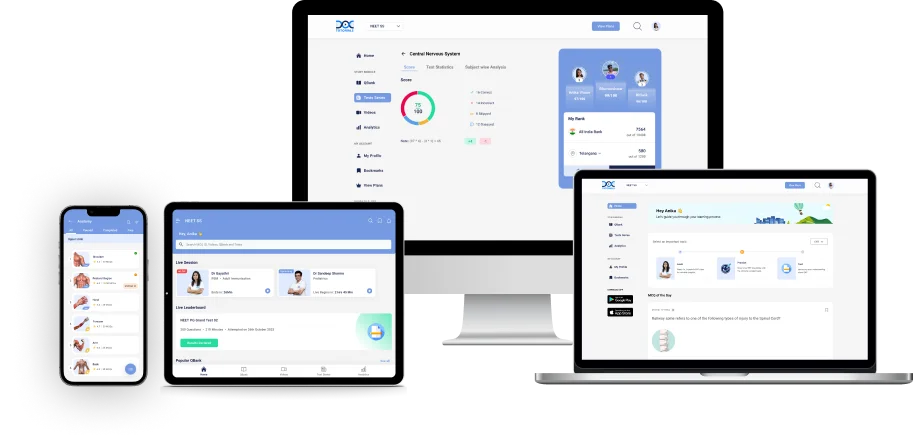
Making all these mind maps, flashcards, and timetables on your own takes a lot of time. Having the right tools makes a huge difference. If you are looking for an all in one study setup that uses all these scientific methods perfectly, the DocTutorials NEET PG Power Pack is a very helpful choice.
Instead of just giving you videos, it provides a proper path to clear your concepts and revise efficiently in the last minute.
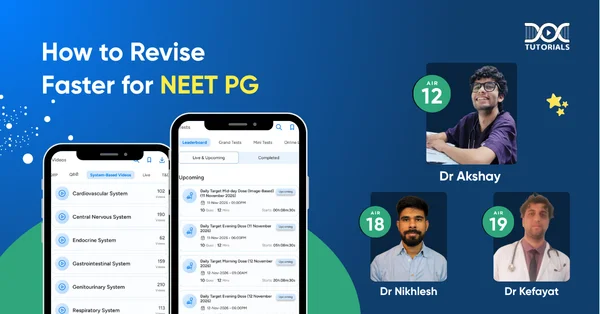
- V6 Videos and System Based Learning: You get completely new and short V6 video classes. Plus, their integrated system based videos help you connect topics across different subjects easily.
- V6 QBank: This is India’s most trusted question bank with over 20,000 multiple choice, image based, and video based questions. It has a Custom Module to create your own personalized tests, so you can easily fix your weak areas.
- Quick Revision Program (QRP V6): Over 500 high yield Hinglish videos made specially for fast recall right before the exam.
- Flashcards and Mindmaps: Built exactly for active recall and visual learning. Perfect for revising drugs, signs, and formulas on the go.
- Special INI CET Focus: For those aiming higher, it has special mock tests and study modules made exactly in AIIMS, JIPMER, and NIMHANS styles.
It is basically a complete setup designed to help you remember concepts longer and build real confidence.
Active vs Passive Revision: The Real Difference
To give you a clear picture, here is how smart active revision saves your time compared to passive revision.
Passive Revision (Not Recommended)
- Main Method: Just reading highlighted textbooks again and again.
- Brain Activity: Very low. It feels easy but you forget everything very fast.
- Time Taken: Takes a lot of time because you have to study it all over again.
- Clinical Thinking: Very weak. You will struggle to solve combined clinical cases.
- Confidence Level: Very low. Causes high exam fear and panic.
Active Revision (Highly Recommended)
- Main Method: Solving clinical questions and using flashcards.
- Brain Activity: Very high. It takes some effort, but it builds a very strong memory.
- Time Taken: Highly efficient. Concepts stay fresh in your head for a very long time.
- Clinical Thinking: Excellent. You can easily connect concepts across all 19 subjects.
- Confidence Level: Very high. You are completely ready for the real exam software.
By changing just a few simple habits, you can make your whole NEET PG preparation a very happy experience. You are completely capable of keeping all this knowledge in your head. Just trust the process, stay positive, and study smartly.
10 Frequently Asked Questions on NEET PG Revision
1. How to revise faster without forgetting the concepts?
Use active recall and spaced repetition. Do not just read passively. Make sure you test yourself regularly using a good question bank and flashcards to lock it safely into your long term memory.
2. When to start my first NEET PG Revision?
Ideally, you should start revising the moment you start preparing. Spend your whole weekend reviewing whatever you studied during the weekdays.
3. Is it enough to revise from the previous year questions?
While past questions are very important to understand what the examiner likes, you must combine them with high yield revision videos and clinical cases for complete mastery.
4. How many hours should I spend on revision each day?
In the starting months, give about 20 to 30 percent of your daily study time strictly to revision. As the exam comes closer, this should increase to 70 to 80 percent.
5. What are the best ways to remember concepts in pharmacology?
Make smart flashcards and mind maps for drug classes. Doing 15 minutes of active recall every day is much better than studying pharmacology for hours continuously.
6. Should I make my own notes for quick revision?
Writing your own notes is great when you are learning for the first time. But for quick last minute revision, professionally made short notes and Quick Revision Program videos save you a lot of precious time.
7. How can I avoid confusing similar clinical diseases?
The answer is mixing your practice. Create simple tables to compare similar diseases side by side. You should clearly highlight the unique points that make them different from each other.
8. Are the grand tests important for revision?
Yes, absolutely. Grand Tests give you the exact feel of the real NEET PG exam software. They help you master time management, recognize patterns, and find out exactly which weak areas you need to study again.
9. Can I use the same revision strategy to crack NEET PG and INI CET?
Mostly yes, but INI CET needs special focus. Make sure your study setup has specific mock tests for AIIMS, JIPMER, and NIMHANS question styles, and focuses heavily on image based learning.
10. How to use the last 30 days for NEET PG preparation?
Concentrate only on high yield fast recall. Do not read any heavy new material. Stick to Quick Revision Program videos, check your bookmarked questions, read your flashcards, and stay wonderfully positive

Latest Blogs
-

INI CET Exam 2026: Your Roadmap to Success – Key Topics, Strategies, and Lessons from Last Year’s Papers
The INI CET exam is more than just a test; it’s a significant milestone for many medical students aiming to…
-

INI CET Exam Success: Previous Year Question Papers & Ultimate Guide – INI CET PYQ
One can feel overwhelmed while preparing for the INI CET (Institute of National Importance Combined Entrance Test). A vast syllabus,…
-

NEET PG 2026 Preparation with Live Power Pack: Your Path to Success in 2026
Preparing for the NEET PG 2026 can be an overwhelming journey because of its vast syllabus and the pressure to…