Mastering Endocrine Surgery: A High-Yield Guide for PG Residents
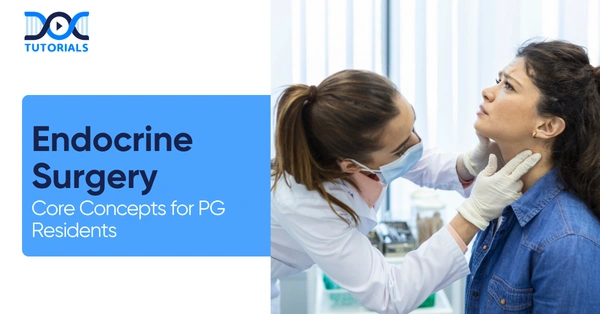
Navigating the complexities of endocrine surgery requires a deep understanding of oncological principles, genetic syndromes, and intricate anatomical relationships. This detailed guide is meticulously crafted for PG residents aiming to master the diagnostic and operative nuances of endocrine surgery, ensuring better outcomes and robust clinical decision-making.
Get High Quality, High Yield Endocrine Surgery PG Residency Notes for Free!
Breast Cancer Management Protocols in Endocrine Surgery
Understanding modern breast oncology is a fundamental component of endocrine surgery training. The evolution of breast cancer management relies heavily on precise staging and molecular profiling. The TNM prognostic staging framework categorizes the disease into Early Breast Cancer (Stage I, IIa, IIb), Locally Advanced (Stage IIIa, IIIb, IIIc), and Stage IV for metastatic spread.
Molecular Subtype Matrix
Systemic therapies in endocrine surgery are heavily influenced by the tumor’s receptor profile. Understanding the molecular subtype matrix is essential for guiding treatment.
| Subtype Receptor Profile | Key Markers |
| Luminal A | ER/PR(+), HER2 (-); Low Ki-67 (Low risk) |
| Luminal A (Variant) | ER/PR (+), HER2 (-); High Ki-67 (High risk) |
| Luminal B | ER/PR(+), HER2 (+/-); High proliferation markers |
| Triple Positive | ER/PR(+), HER2 (+) |
| HER2 Overexpressed | ER/PR(-), HER2 (+) |
| Triple Negative (TNBC) | ER(-), PR(-), HER2 (-); Aggressive Phenotype |
Neoadjuvant Chemotherapy and Surgical Staging
In the realm of endocrine surgery, Neoadjuvant Chemotherapy (NACT) is a powerful tool. Mandatory indications for NACT include T4 tumors with skin or chest wall infiltration, large tumors (7-10 cm), bulky axillary nodes (N2/N3), and inflammatory carcinoma. Strategic indications involve HER2 Positive, Triple Negative (TNBC), tumors greater than 2 cm or node positive, and a large tumor-to-small breast ratio to enable Breast Conservation Surgery (BCS).
The standard chemotherapy regimen timeline involves a two-step process. Step 1 utilizes Anthracyclines (Doxorubicin + Cyclophosphamide) for 4 cycles. This is followed by Step 2 utilizing Taxanes (Paclitaxel or Docetaxel) for 4 cycles. For residual disease, HER2+ cases receive TDM-1 for 14 cycles, while TNBC cases receive Capecitabine for 6 months.
When performing surgical management of the primary tumor, BCS requires margins with no tumor on ink for invasive disease and greater than 2mm for DCIS. Mastectomy (MRM) includes the Nipple-Areola Complex, Pectoralis Major Fascia, and Level I/II Nodes. Axillary surgical boundaries include the axillary vein inferiorly, latissimus dorsi laterally, and pectoralis major medially, with the intercostobrachial nerve passing superiorly.
Navigating Multiple Endocrine Neoplasia (MEN) Syndromes in Endocrine Surgery
For any resident studying endocrine surgery, the MEN syndromes represent a critical area of focus. These genetic conditions dictate aggressive screening and preemptive endocrine surgery interventions.
MEN1 (Wermer Syndrome) Essentials
MEN1 is linked to the MEN1 gene on Chromosome 11q13, affecting the Menin protein. It is characterized by the “3Ps”. Parathyroid disease is the most common, presenting with a prevalence greater than 95% due to multiglandular hyperplasia. Screening for parathyroid disease starts at age 8 with Calcium and PTH levels.
Pancreatic issues (50-75% prevalence) involve gastrinomas, which have malignant potential, insulinomas, and non-functional PNETs, with screening starting at age 20. Pituitary tumors (30-35% prevalence) are primarily prolactinomas (60%) or GH-secreting tumors leading to acromegaly, with screening initiated at age 5 via prolactin and MRI. Diagnostic criteria require two or more of the three major components, or one major component alongside a family history.
What is the most critical clinical rule to follow before performing endocrine surgery on a patient with MEN2 or MEN3?
The pheochromocytoma must absolutely be managed first with alpha-blockade followed by beta-blockade prior to any thyroid endocrine surgery to prevent a catastrophic hypertensive crisis.
MEN2 and MEN3 Strategies
Endocrine surgery management for MEN2 and MEN3 hinges on the RET Proto-Oncogene mutations. These mutations dictate the timing of prophylactic thyroidectomy.
| Risk Level | Mutation & Syndrome | Prophylactic Thyroidectomy Surgical Deadline |
| Highest Risk | M918T / MEN3 (MEN2B) | Neonatal period (First months of life) |
| High Risk | C634 / MEN2A | Before Age 5 |
| Moderate Risk | Various / FMTC/other | Monitor calcitonin (Operate if elevated) |
MEN2A features Medullary Thyroid Carcinoma (MTC), Pheochromocytoma in approximately 50% of cases, and Parathyroid Hyperplasia in 20-30% of cases. Conversely, MEN3 (MEN2B) presents with MTC in 100% of cases, Pheochromocytoma in 50%, Marfanoid habitus, and mucosal neuromas, notably without parathyroid disease.
Parathyroid and Thyroid Management Strategies in Endocrine Surgery
Primary Hyperparathyroidism and Glandular Anatomy
In endocrine surgery, managing primary hyperparathyroidism begins with biochemical confirmation followed by localization imaging using Ultrasound and a Sestamibi Scan. If both studies concordantly localize to the same gland, a focused parathyroidectomy with intraoperative PTH (IOPTH) monitoring is indicated. If the results are discordant or negative, a bilateral neck exploration is required, which is also indicated for familial disease (MEN1) or lithium use.
Understanding the embryological descent is vital for endocrine surgery. The superior parathyroid glands originate from the 4th pharyngeal pouch, starting high and falling posterior and deep, positioned dorsal to the recurrent laryngeal nerve (RLN). Their ectopic sites include the retro-esophageal space, para-esophageal space, and posterior mediastinum.
The inferior glands originate from the 3rd pharyngeal pouch with the thymus, starting low and falling anterior, positioned ventral to the RLN. Ectopic sites for inferior glands include the thyrothymic ligament and anterior/superior mediastinum.
During endocrine surgery, normal parathyroid glands exhibit a “gliding sign,” moving within fat, whereas abnormal glands do not. For multi-gland disease, endocrine surgery options include subtotal parathyroidectomy (excising 3.5 glands and leaving a 50mg vascularized remnant) or total parathyroidectomy with autotransplantation of 10-20 fragments into the brachioradialis of the non-dominant forearm.
Thyroiditis and Pregnancy Targets
Thyroiditis classification is crucial for decision-making in endocrine surgery. Acute infectious thyroiditis is typically bacterial (Staph/Strep) and can be hematogenous or due to a pyriform sinus fistula from the 4th branchial pouch, more commonly on the left side. Treatment requires IV antibiotics, drainage, and excision of the fistula tract.
Subacute painful thyroiditis (Granulomatous / De Quervain’s) exhibits a toxic phase for the first 0-6 weeks with low scan uptake, a hypothyroid phase from 2-6 months, and euthyroid recovery after 6 months.
Chronic forms include Hashimoto’s and Riedel’s. Hashimoto’s is a lymphocytic, autoimmune T-cell driven disease marked by Anti-TPO (>95%) and Anti-Tg antibodies, with histology showing lymphocytic infiltration, germinal centers, and Hurthle cells. It carries an 80x risk for B-cell lymphoma and a 30% risk for papillary carcinoma.
Riedel’s is an IgG4-related chronic fibrosing disease presenting as a woody hard goiter fixed to strap muscles, often associated with retroperitoneal fibrosis. Endocrine surgery is hazardous in Riedel’s due to invasion, and management primarily involves tamoxifen and steroids.
For pregnancy in the context of endocrine surgery, strict TSH upper limits are enforced. The target is strictly less than 2.5mIU/L for the 1st trimester and less than 3.0mIU/L for the 2nd and 3rd trimesters.
Frequently Asked Questions (FAQs)
- What is the primary indication for Neoadjuvant Chemotherapy in early breast cancer?
Neoadjuvant chemotherapy is strategically indicated for HER2 Positive or Triple Negative breast cancers to facilitate breast conservation during endocrine surgery.
- Which parathyroid glands are located dorsal to the recurrent laryngeal nerve?
The superior parathyroid glands, derived from the 4th pharyngeal pouch, are positioned dorsal to the recurrent laryngeal nerve.
- What is the standard radiotherapy dose for a whole breast treatment?
The standard whole breast radiotherapy dose is 50 Gy.
- When is a tumor bed boost indicated in radiotherapy?
A tumor bed boost of +10-18 Gy is conditionally indicated for close or positive margins to reduce local recurrence.
- Which genetic mutation demands a prophylactic thyroidectomy within the first months of life?
The M918T mutation, associated with MEN3 (MEN2B), requires a prophylactic thyroidectomy in the neonatal period.
- What defines the boundaries for the low-level axillary sampling area?
The area is bounded by the intercostobrachial nerve superiorly, the latissimus dorsi laterally, the axillary vein inferiorly, and the pectoralis major medially.
- How does acute infectious thyroiditis commonly present anatomically?
Acute infectious thyroiditis, often linked to a pyriform sinus fistula, is more commonly found on the left side.
- What histological findings are characteristic of Hashimoto’s thyroiditis?
Histology typically reveals lymphocytic infiltration, germinal centers, and Hurthle cells.
- In endocrine surgery for multi-gland parathyroid disease, what is autotransplanted?
Following a total parathyroidectomy, 10-20 fragments are implanted into the brachioradialis muscle of the non-dominant forearm.
- What is the TSH target for a patient in her first trimester of pregnancy?
The non-negotiable upper limit for TSH during the first trimester is less than 2.5mIU/L.
Latest Blogs
-

NEET SS Exam 2024: Analysis, Key Dates, Counselling
The NEET SS 2024 exam kicked off on March 29, 2025. Over two days and two slots, candidates across 13…
-
INI SS Topper: 1 Dream, 1 Study Buddy, 1 Rank – The Journey of Dr. Prithivi Raaj, CML 1 & (AIIMS) AML 1 in DM Cardiology
Achieving the top rank in a competitive exam like the INI SS DM Cardiology requires tireless dedication, a structured approach,…
-

INI SS Results: Merit List, Exam Insights, and What Comes Next
The INI SS results for October 2024 are just around the corner. This is a life-changing moment for thousands of…