mbbs-curriculum Archives -

Best Pediatrics Book for MBBS: Top Recommendations & Study Guide 

Pediatrics

With the NMC pushing Competency-Based Medical Education (CBME), Pediatrics is no longer that tiny, low-stakes subject you can casually mug-up in two weeks before final exams. It just isn’t. The clinical weightage is heavy, bedside postings actually demand real diagnostic instincts, and NEET-PG integration will catch you off guard if your basics are shaky. 

Pick your books early. Seriously. Walking into the pediatric ward without knowing what to read guarantees last-minute panic. 

Here is a realistic breakdown of the standard textbooks, bedside manuals, and a practical study roadmap built for how Indian medical colleges actually test you. 

Top 5 Textbooks: Picking the Right Fit 

Every med student processes information differently. Some need crisp bullet points and ready-made flowcharts for university papers. Others want deep pathophysiology. Pick what suits your style. 

1. Ghai Essential Pediatrics (O.P. Ghai, Paul, Bagga) 

The undisputed gold standard across Indian medical colleges. If you buy only one theory book, make it this one. 

  • Why it works: It maps directly to the Indian curriculum. The chapters on national health programs, Indian immunization schedules, malnutrition (SAM/MAM), and tropical infections reflect exactly what examiners look for on paper. 
  • Best for: Core theory, university professional exams, and everyday conceptual groundwork. 

2. Clinical Methods in Pediatrics by Meharban Singh 

Theory won’t help you when you’re standing in front of a crying infant during rounds. Meharban Singh’s clinical guide fixes that. 

  • Why it works: Clear, step-by-step guidance on neonatal reflexes, developmental milestone checks, anthropometric measurements, and systemic bedside exams. 
  • Best for: Ward postings, case presentations, and clearing your clinical practicals without blanking out. 

3. Nelson Textbook of Pediatrics (The Reference Heavyweight) 

Nelson is the global holy grail of pediatric medicine. That said, treat it with caution. 

  • Why it works: Unmatched depth. From rare genetic syndromes to nuanced pathophysiology and international treatment algorithms, it has everything. 
  • Best for: Targeted reference reading on tough topics and post-graduate prep. Do not try to read this cover-to-cover for MBBS—you’ll burn out. 

4. Piyush Gupta’s Essential Pediatric Clinical Examination 

A massive favorite among undergrads when practical exams loom near. 

  • Why it works: Structured case proformas, expected viva questions, and high-yield examination steps condensed into clean layouts. 
  • Best for: Rapid case discussion prep right before final-year practicals. 

5. Lakshmanaswamy’s Clinical Pediatrics 

A handy bedside companion that bridges clinical signs with viva expectations. 

  • Why it works: Generous photo plates of physical signs, organized differential diagnosis flowcharts, and easy-to-digest case outlines. 
  • Best for: Daily ward rounds, quick bedside reads, and ward-end assessments. 

Quick Comparison: Which Book Should You Pick? 

Book Name Primary Focus Best Suited For Reading Level 
Ghai Essential Pediatrics Theory & National Guidelines University Theory & Core Foundation Intermediate 
Meharban Singh (Clinical) History & Bedside Exam Ward Postings & Practical Exams Beginner to Intermediate 
Nelson Pediatrics Comprehensive Reference Reference for Complex Topics Advanced 
Piyush Gupta (Clinical) Case Presentations & Viva Practical Viva & Exam Revision Beginner 
Lakshmanaswamy Clinical Cases & Viva Rapid Ward-Round Prep Intermediate 

How to Tackle Pediatrics: A Practical Study Roadmap 

Children are not small adults. Their baseline physiology, fluid dynamics, and drug dosages shift dramatically as they grow. You have to adapt your study approach. 

1. Master Growth and Milestones Early 

Milestones will follow you everywhere—in ward clinics, table viva, and theory papers. 

  • Don’t just skim them. Break developmental milestones down by domains (gross motor, fine motor, social, and language) across specific milestones: 3, 6, 9, 12, 18 months, and through 5 years. 
  • Practice plotting WHO and IAP growth charts by hand. You must know how to spot stunting, wasting, and microcephaly immediately. 

2. Nail Neonatology and Emergency Protocols 

Neonatology makes up a massive chunk of both theory marks and bedside long cases. Focus your energy on: 

  • NRP Algorithms: Know resuscitation steps cold. 
  • Neonatal Jaundice: Differentiating physiological from pathological jaundice, plus phototherapy and exchange transfusion thresholds. 
  • Respiratory Distress: Clinical features distinguishing RDS, TTN, and Meconium Aspiration Syndrome. 

3. Lock Down Immunization Schedules 

Learn both the National Immunization Schedule (NIS) and the Indian Academy of Pediatrics (IAP) recommendations. Examiners love asking about cold-chain dynamics, open-vial policies, vaccine contraindications, and catch-up rules for missed doses. 

High-Yield Topic Weightage for University Exams 

Subject Module Core High-Yield Topics Key Exam Focus 
Neonatology Neonatal Sepsis, Jaundice, Birth Asphyxia, HIE Long Questions, OSCE Stations 
Growth & Milestones Developmental Delays, Short Stature, Microcephaly Case Presentations, Growth Charts 
Nutrition & Deficiencies SAM, Rickets, Scurvy, Vitamin A Deficiency Short Notes, Management Steps 
Infectious Diseases Measles, Diphtheria, Dengue, Pediatric TB Differential Diagnosis, Protocols 
Systemic Pediatrics Nephrotic Syndrome, Cyanotic Heart Defects (TOF, TGA) Long Questions, Viva Voce 

Subject Struggle: Where Pre-Clinical Gaps Bite You 

Q: Where do MBBS students struggle most when applying microbiology to pediatric infections? 

Most students memorize bugs for second-year exams and forget how those pathogens behave in young hosts. Bedside application trips people up in three main ways: 

  1. Age-Specific Pathogen Shifts: Neonatal meningitis is caused by bugs like Group B Strep, E. coli, and Listeria. Once an infant passes a few months of age, the culprits shift entirely to Streptococcus pneumoniae and H. influenzae. Mixing these up in an exam or case presentation is an instant red flag to examiners. 
  1. Vaccine Immunology Realities: Rote learning vaccine strains isn’t enough. You need to understand how maternal antibodies interfere with early live vaccines, why booster intervals matter, and why an immunocompromised child can’t take BCG or OPV. 
  1. Interpreting Diagnostic Tests in Malnourished Children: Severe Acute Malnutrition blunts typical inflammatory responses. A septic child might show no fever, minimal leukocytosis, and vague symptoms. Relying strictly on classic textbook lab findings without clinical context leads to missed diagnoses. 

Practical Habits for a University Distinction 

  • Keep a 1-page case template book: Maintain your own clinical notes for classic ward cases: Nephrotic Syndrome, SAM/Kwashiorkor, Congenital Heart Disease (like TOF), and Hydrocephalus. 
  • Practice drug and fluid math: Don’t lose easy marks. Master the Holliday-Segar method for maintenance fluids and get comfortable calculating pediatric doses by weight (mg/kg). 
  • Drill milestones and vaccine tables weekly: Don’t leave these for the final revision month. Spend ten minutes charting them out on blank paper every week so they become second nature. 

Pair one solid theory text like Ghai with a dependable bedside handbook like Meharban Singh. Show up to your clinical postings, actually examine the kids, and review the related chapter that same evening. That consistent loop is what turns a stressful subject into an easy distinction. 

Frequently Asked Questions on Pediatrics Books 

1. Which is the single best pediatrics book for MBBS university exams in India? 

Ghai Essential Pediatrics. It aligns directly with Indian university question patterns, local epidemiological data, and national guidelines. 

2. Do I really need Nelson in final year MBBS? 

No. Nelson is a reference masterpiece, but trying to read it for undergraduate exams is an inefficient use of time. Stick to Ghai and consult Nelson in the library only when a specific mechanism isn’t clear. 

3. Which clinical book is best for pediatric bedside postings? 

Meharban Singh’s Pediatric Clinical Methods is the traditional gold standard. If you want something more exam-case-oriented, Piyush Gupta’s clinical handbook is an equally solid choice. 

4. How much time do I need to finish Pediatrics for final year? 

About 1.5 to 2 months of focused, consistent reading alongside regular ward postings is plenty of time to cover the syllabus thoroughly. 

5. What cases are most commonly assigned in final-year practicals? 

Expect Nephrotic Syndrome, Severe Acute Malnutrition (SAM), Tetralogy of Fallot (TOF), Thalassemia, and Cerebral Palsy. 

6. Why are there two different immunization schedules (NIS vs. IAP)? 

The National Immunization Schedule (NIS) is the government-funded public health program covering essential universal vaccines. The IAP schedule includes additional vaccines recommended by the pediatric academy (such as Varicella, Pneumococcal conjugate, and Hepatitis A) for individual clinical practice. 

7. What is the smartest way to memorize developmental milestones? 

Group them by domains (Gross Motor, Fine Motor, Language, Social) across set anchor ages: 3, 6, 9, 12, 18 months, followed by yearly brackets up to age 5. Testing yourself domain-by-domain sticks much better than trying to memorize raw, unorganized lists. 

8. Are foreign author books necessary for MBBS Pediatrics in India? 

Generally, no. Indian texts do a far better job covering tropical infections, nutritional deficiencies, and national health programs that make up the bulk of Indian university papers. 

9. Which resource is best for Neonatology? 

The neonatology chapters in Ghai provide sufficient depth for undergraduate theory. If you want dedicated reading for NICU postings, Meharban Singh’s Care of the Newborn is the benchmark. 

10. Do growth charts really matter in practical exams? 

Yes, absolutely. Examiners regularly ask students to plot height, weight, and head circumference on WHO/IAP charts, assess percentiles, calculate mid-parental height, and diagnose nutritional failure on the spot.
DocTutorials App Download Now

Latest Blogs

Best Ophthalmology Book for MBBS: Top Textbooks and Preparation Guide 

Ophthalmology

Picking the right Ophthalmology book for MBBS? It’s honestly one of the most critical choices you’ll make during your clinical years. Under the NMC’s CBME curriculum, you tackle Ophthalmology in Phase 3 (Part 1 of Final Prof). And let me tell you, it’s intense. It’s a high-yield clinical subject demanding serious theoretical depth, plus sharp diagnostic skills. 

Want to nail your university exams? Or maybe you’re already eyeing a solid NEET-PG foundation? Either way, the right textbook saves you a massive amount of time. It cuts through the confusion. Let’s break down the best books, top-tier prep tips, how to revise effectively, and where most students hit a wall.

Why Choosing the Right Ophthalmology Book for MBBS Matters 

Ophthalmology is unique. It bridges surgical techniques, basic optics, systemic medicine, and microscopic anatomy all at once. Relying on a standard book ensures you actually grasp: 

  • The pathophysiology behind common ocular disorders (think cataracts, glaucoma, and corneal ulcers). 
  • Clinical diagnostics. You need to know your way around a slit lamp, direct and indirect ophthalmoscopy, and retinoscopy. 
  • Systemic associations, like diabetic or hypertensive retinopathy. 
  • Emergency management for ocular trauma and chemical injuries. 

A well-structured Ophthalmology book doesn’t just help you pass. It helps you balance those lengthy theoretical answers for university exams with the practical reality of clinical case presentations. 

Here’s the rundown of the most reliable, widely read textbooks floating around Indian medical colleges. 

1. Comprehensive Ophthalmology by A.K. Khurana 

Let’s be real. A.K. Khurana is the go-to Ophthalmology book for MBBS in India. Why? Because it’s literally built for our university exam patterns. You get clean headings. Flowcharts. Anatomical diagrams. Surgical summaries. Plus, the review booklet it comes with makes pre-exam cramming so much easier. 

2. Parson’s Diseases of the Eye 

Parson’s is the gold-standard conceptual textbook. Written with exceptional clarity, it builds deep clinical intuition. If you want a thorough understanding of ocular pathology and clinical signs, this is the book to choose alongside standard lecture notes. 

3. Clinical Ophthalmology: A Systematic Approach by Jack J. Kanski 

Okay, so Kanski is technically a postgraduate atlas and reference book. But for undergrads? It’s a goldmine. The high-resolution clinical photographs are unmatched. If you want to absolutely crush fundus photograph spotters, slit lamp findings, and visual vivas, you need to flip through Kanski. 

4. Ophthalmology at a Glance / Exam Preparatory Manuals 

Sometimes you just need to pass. Concise manuals are lifesavers during that final month before professional exams. They give you bulleted answers, clinical case scenarios, and quick memory aids perfect for long and short questions. 

Comparative Overview of Textbooks 

Book Name Primary Focus Best Suited For Key Strength 
Comprehensive Ophthalmology (A.K. Khurana) Theory & Exam Prep University Exams & CBME Core Clean flowcharts, standard diagrams, structured answers 
Parson’s Diseases of the Eye Concepts & Diagnostics Standard Reference & Understanding In-depth pathology, clear clinical explanations 
Kanski’s Clinical Ophthalmology Visual Atlas & Case Findings Vivas, Spotters, Practical Exams High-quality clinical images and fundus photographs 
Exam Prep Manuals (Various Authors) Rapid Review Last-Minute Revision High-yield question-answer formats 

How to Prepare and Score High in MBBS Ophthalmology 

You can’t just memorize an Ophthalmology book cover to cover and expect to score well. It takes a solid, structured plan. 

  • Master the Basics First: Start with ocular anatomy, the physiology of vision, and optics/refraction. If you skip optics, things like astigmatism, myopia, and hypermetropia will just leave you confused later on. 
  • Focus on High-Yield Chapters: Be smart about your time. Corneal diseases, Cataracts, Glaucoma, Uveitis, Retinopathy, and Ocular Injuries? These will make up the bulk of your theory paper. 
  • Attend Clinical Postings Seriously: Show up to the wards. Actually learn how to use a torchlight properly. Practice visual acuity testing with Snellen charts, check pupillary reflexes, and get your hands on a direct ophthalmoscope. 
  • Draw Labeled Diagrams: Examiners love diagrams. Clear sketches of the corneal layers, visual pathways, or the steps of cataract surgery will fetch you maximum marks in theory papers. 

High-Yield Topic Weightage and Important Concepts 

Topic Category Key Concepts to Master Exam Weightage 
Cornea & Conjunctiva Bacterial/Fungal Corneal Ulcers, Trachoma, Keratoconus High 
Lens Types of Cataract, Topic Category 
Key Concepts to Master 
Exam Weightage 
Cornea & Conjunctiva 
Bacterial/Fungal Corneal Ulcers, Trachoma, Keratoconus 
High 
Lens 
Types of Cataract, Phacoemulsification, SICS, Complications 
Very High 
Glaucoma 
Open-Angle vs Angle-Closure Glaucoma, Tonometry, Medical/Surgical Therapy 
Very High 
Retina & Neuro-Ophthalmology 
Diabetic Retinopathy, Retinal Detachment, Papilledema, Visual Field Defects 
High 
Optics & Refraction 
Myopia, Hypermetropia, Astigmatism, Presbyopia, Retinoscopy 
Medium to High 
Ocular Emergencies 
Chemical Burns, Acute Angle-Closure Glaucoma, Endophthalmitis 
High Phacoemulsification, SICS, Complications 
Very High 
Glaucoma Open-Angle vs Angle-Closure Glaucoma, Tonometry, Medical/Surgical Therapy Very High 
Retina & Neuro-Ophthalmology Diabetic Retinopathy, Retinal Detachment, Papilledema, Visual Field Defects High 
Optics & Refraction Myopia, Hypermetropia, Astigmatism, Presbyopia, Retinoscopy Medium to High 
Ocular Emergencies Chemical Burns, Acute Angle-Closure Glaucoma, Endophthalmitis High  

High-Yield Revision Strategy for MBBS Ophthalmology Exams 

  • Active Recall and Flashcards: Make one-page summary sheets. You’ll thank yourself later when trying to remember drug dosages for antiglaucoma drops, mydriatics/cycloplegics, or topical antibiotics. 
  • Clinical Instrument Checklists: Two days before your practical exam? Go over the common instruments. Wire speculum, cystotome, crescent blade, slit lamp lenses. Know them by heart. 
  • Previous Years’ Question Papers (PYQs): Don’t skip this. Solve the last 5 to 10 years of university papers. You’ll quickly spot the recurring long questions and short notes. 

Where Do MBBS Students Struggle Most in Ophthalmology? 

Q: Which theoretical areas in Ophthalmology do students find most confusing? 

A: Optics and Refraction, hands down. Calculating lens power, wrapping your head around cylindrical corrections, and figuring out the interval of Sturm can be a nightmare for most undergrads. Right after that? Visual Field Defects. It takes time to correlate lesions along the optic tract with specific field cuts, like bitemporal hemianopia. 

Q: How should students tackle clinical case presentations and practical vivas? 

A: In practical, examiners care about your system. They want to see systematic case taking—do you know how to differentiate a painless vs. painful loss of vision? They’ll watch your slit lamp examination steps, listen to your fundus descriptions, and ask about darkroom procedures like retinoscopy. The fix? Practice structured case presentations during your ward postings. It completely kills exam anxiety. 

Conclusion 

Selecting the right Ophthalmology book for MBBS forms the backbone of your preparation. For most students, using A.K. Khurana as your primary textbook, supplemented by Parson’s for challenging conceptual chapters and Kanski for visual spotters, provides an ideal balance. Pair your reading with regular clinical ward postings and consistent PYQ practice to score high in your MBBS Ophthalmology examinations. 

Frequently Asked Questions (FAQs) 

1. Which is the best Ophthalmology book for MBBS university exams? 

A.K. Khurana’s Comprehensive Ophthalmology. It’s basically the undisputed champion for Indian university exams because of its structured, exam-oriented format and easy-to-reproduce diagrams. 

2. Is Parson’s Diseases of the Eye necessary for MBBS students? 

Strictly compulsory? No. But is it amazing for building a rock-solid conceptual foundation and clinical clarity? Absolutely. 

3. How much time is needed to complete the MBBS Ophthalmology syllabus? 

Usually, a solid 4 to 6 weeks. If you study consistently alongside your clinical postings, that’s enough time to cover and revise the whole undergraduate syllabus. 

4. Which topics are most important for MBBS Ophthalmology theory papers? 

Focus heavily on Cataracts (especially SICS and Phacoemulsification), Glaucoma (Angle-Closure and POAG), Corneal Ulcers, and Diabetic Retinopathy. Those are your massive point-scorers. 

5. How can I prepare for Ophthalmology clinical spotters? 

Get your hands on visual atlases like Kanski. Standard online image banks are also great for practicing how to identify clinical photographs, fundus signs, X-rays, and surgical instruments. 

6. What instruments are commonly asked in Ophthalmology practical vivas? 

They almost always ask about the Wire Speculum, Crescent Blade, Keratome, Simcoe Cannula, Desmarres Lid Retractor, and Schiotz Tonometer. 

7. How important are diagrams in Ophthalmology exams? 

Massive. A neat, labeled anatomical or pathological diagram (like corneal ulcer stages or visual pathway lesions) can bump up your score significantly in theory answers. Never skip them. 

8. How is Ophthalmology tested under the NMC CBME curriculum? 

You’ll face a mix. Think Phase 3 theory papers, clinical case presentations, OSCE/OSPE stations, logbooks, and the dreaded viva voce. 

9. Should I read Kanski during undergraduate MBBS? 

Don’t use it as your main reading book. It’s best used purely as a visual reference atlas for clinical images rather than a primary textbook. 

10. How do I balance Ophthalmology with other Phase 3 subjects? 

The best hack? Dedicate 1 to 2 hours every day during your Ophthalmology postings to read the exact chapters related to the patients you just examined. It makes everything click faster. 

DocTutorials App Download Now

Latest Blogs

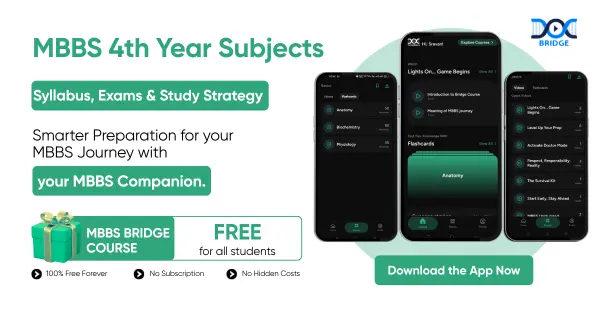
MBBS 4th Year Subjects: Syllabus, Exams & Study Strategy 

MBBS 4th Year Subjects

The final year of medical college has become a crucial milestone for Indian students seeking to become successful doctors. With intense clinical postings, advanced medical topics, and crucial practical exams, it offers a transformative experience for aspiring physicians. This guide covers the core MBBS 4th Year Subjects, the official syllabus, expected exam dates, paper patterns, and the best study plan for your medical journey. 

Start Your MBBS With Confidence. Join DocTutorials Bridge Course For Free! 

What Are The Core MBBS 4th Year Subjects? 

The final phase of your medical degree focuses completely on clinical skills and patient care. The main MBBS 4th Year Subjects you will study include General Medicine, General Surgery, Obstetrics and Gynaecology, and Pediatrics. These form the absolute foundation of your daily practice as a future doctor.  

Understanding The MBBS 4th Year Syllabus 

As you step into this phase, things get very real. You move from reading basic textbooks in a quiet library to actually interacting with patients in a bustling hospital ward. The MBBS 4th Year Syllabus is specifically designed by the National Medical Commission to make you a competent and confident physician. Let us look at what you will actually learn. 

General Medicine is the absolute heart of your 4th Year Subjects MBBS. You will learn to diagnose and treat everyday fevers, complex heart issues, and breathing problems. This subject teaches you how to look at a patient and connect their symptoms to a real disease. 

General Surgery is where you will finally understand how surgical procedures work. You will learn how to manage wounds, how to handle medical emergencies, and the basics of operating room protocols. 

Obstetrics And Gynaecology covers everything related to women health, pregnancy, and bringing new life into the world safely. It is a beautiful and highly practical subject.  

Paediatrics is also a major part of the MBBS 4th Year Syllabus. Treating children is completely different from treating adults. Here, you learn about infant care, child growth, and child nutrition.  

Official Important Dates and Expected Costs 

Every medical student must plan their schedule and finances well in advance. Knowing what is coming helps you stay prepared and relaxed. Here is an official important dates table highlighting key events and expected financial planning numbers during your final phase. 

Event Name Tentative Timeline Expected Amount Involved 
University Registration January First Week 30,000 Rupees 
Internship Stipend March Onwards 1 lakh Rupees Total 
Advanced Study Resources April Second Week 4 lakhs Rupees 
Final Clearances June Last Week 5,000 Rupees 

Demystifying The MBBS Final Year Exam Pattern 

Exams in the final phase are entirely different from your early college days. The MBBS Final Year Exam Pattern tests your actual clinical knowledge rather than just your memory.  

You will face two major components. First is the theory paper. This includes multiple choice questions and long answers. The focus is always on problem solving and clinical cases. The examiners want to see if you can think like a real doctor.  

Second is the practical exam. Your professors will test how well you talk to patients, diagnose their condition, and suggest treatments. Mastering the MBBS Final Year Exam Pattern means spending as much time in the hospital wards as you do in your room studying. 

Tracking The MBBS Final Year Exam Date 

Knowing your timeline is half the battle won. The MBBS Final Year Exam Date usually falls around the end of the academic session, typically between December and January for most universities in India. However, with new national systems stepping in, the MBBS Final Year Exam Date schedules might shift slightly to align with central standards. Always keep a close watch on your college notice board, so you never miss a deadline. 

Creating The Perfect Final Year MBBS Study Plan 

A good strategy changes everything. Since the MBBS 4th Year Subjects are so vast, you cannot leave things for the last minute. Here is how you can build a solid Final Year MBBS Study Plan. 

First, integrate your reading with your hospital postings. If you see a patient with asthma in the morning, read about it in your General Medicine book that same evening. 

Second, solve past question papers. This is the golden rule of any successful Final Year MBBS Study Plan. It tells you exactly what the examiners care about most. 

Third, form a small study group. Discussing cases with your friends makes remembering the 4th Year Subjects MBBS much easier and far less boring. 

Quick Breakdown of Exam Marks 

Here is a quick look at how marks are generally distributed across the main subjects. 

Subject Name Theory Marks Practical Marks 
General Medicine 200 100 
General Surgery 200 100 
Obstetrics And Gynaecology 200 100 
Pediatrics 100 100 

Frequently Asked Questions 

  1. What are the main MBBS 4th Year Subjects? 

The main MBBS 4th Year Subjects are General Medicine, General Surgery, Pediatrics, and Obstetrics, and Gynecology. 

  1. Is the MBBS 4th Year Syllabus very tough? 

It is definitely vast, but it is also the most interesting part of your degree because you finally treat real patients. 

  1. When is the MBBS Final Year Exam Date announced? 

The MBBS Final Year Exam Date is usually announced two months before the exams, which mostly happen in December or January. 

  1. How should I prepare my Final Year MBBS Study Plan? 

Your Final Year MBBS Study Plan should strictly combine textbook reading with daily hospital ward visits to understand real cases. 

  1. What is the MBBS Final Year Exam Pattern like? 

The MBBS Final Year Exam Pattern includes written theory papers and a heavy focus on clinical practical exams with real patients. 

  1. Are there any other 4th Year Subjects MBBS students must study? 

Yes, along with the core subjects, you will also apply the knowledge from allied fields like Psychiatry and Dermatology during your clinical postings. 

  1. Do we need to read new books for the MBBS 4th Year Syllabus? 

Yes, you will need standard clinical textbooks for medicine and surgery to cover the complete MBBS 4th Year Syllabus properly. 

  1. Will the MBBS Final Year Exam Pattern include multiple choice questions? 

Yes, with the new guidelines, the MBBS Final Year Exam Pattern includes multiple choice questions focusing on clinical scenarios. 

  1. How many hours a day does a Final Year MBBS Study Plan require? 

A good Final Year MBBS Study Plan requires around four to six hours of self-study every day along with your regular college classes. 

  1. Why are the MBBS 4th Year Subjects so important? 

The MBBS 4th Year Subjects are incredibly important because they cover the exact medical knowledge you need to safely treat patients in your future clinic. 

DocTutorials App Download Now

Latest Blogs

MBBS Duration in India: How Many Years to Become a Doctor?

MBBS Duration in India

Choosing a career in medicine takes years of hard work, learning, and dedication. One common question students ask is, “How many years does MBBS take to become a doctor?” Even though the course lasts 5.5 years, becoming a doctor involves much more than that.

This blog post will provide you with a comprehensive overview of the MBBS course, the duration, eligibility, admission, fees, and the overall time it takes to become a doctor in India. Continue reading for a detailed insight.

MBBS Course Duration: MBBS How Many Years?

In India, the MBBS degree lasts 5.5 years and consists of 4.5 years of medical subjects, followed by a 1-year mandatory internship, during which students gain hands-on practice in hospital settings to better prepare them to start their medical careers.

India’s MBBS course is structured as follows:

  • 4.5 years of study
  • 1 year of mandatory rotation through every major medical area (internship)

So, the total period required to complete MBBS in India is 5.5 years. The educational portion is arranged by semester, each concentrating on some specific aspect of medicine. The final rotation (internship) allows you to apply your classroom learning as you gain first-hand experience working with patients in hospitals, under supervision.

By breaking the MBBS into 2 phases (theory/theoretical coursework, then hands-on), you will have the opportunity to combine theoretical knowledge with the practical skills needed to treat patients.

Detailed Breakdown of MBBS Duration

The MBBS curriculum comprises four main components (preclinical, paraclinical, clinical, and internship) that systematically develop students’ abilities. It happens by gradually building on their learning of basic medical sciences and progressing to applying these skills in a clinical setting, where they treat patients under supervision.

Having a clearer understanding of how this 5.5-year programme will be structured will help you fully understand what you will be doing throughout the programme. The Medical Education System has 3 phases: Pre-Clinical Phase, Para-Clinical Phase, and Clinical Phase.

1. Pre-Clinical Phase (1st Year)

The 1st Year establishes a foundation for the remainder of your medical education, consisting of the following subjects:

  • Anatomy (The Study of the Human Body Structure)
  • Physiology (The Study of the Function of Humans)
  • Biochemistry (The Study of Chemical Processes Involved in the Human Body)

In the Pre-Clinical Phase, you will develop a conceptual understanding of how the human body works. Therefore, you will need excellent memorisation and analytical skills to understand complex systems (e.g., the cardiovascular and respiratory systems) and structures (e.g., muscles).

2. Para-Clinical Phase (2nd Year)

The Para-Clinical Phase serves as the bridge between the basic and clinical sciences. The following subjects will be delivered in this phase:

  • Pathology (The Study of Diseases)
  • Pharmacology (The Study of Drugs and Drug Actions)
  • Microbiology (The Study of Microorganisms and Infections)

During the Para-Clinical Phase, you will begin to understand how diseases develop and how drugs can be used to treat diseases. You will also begin to think diagnostically.

3. Clinical Phase (3rd Year to 5th Year)

This is the most rigorous and practical part of the programme. You will study the following disciplines:

  • General Medicine
  • General Surgery
  • Pediatrics
  • Obstetrics and Gynaecology
  • Orthopedics
  • Dermatology

In the Clinical Phase, you are assigned to hospitals and given the opportunity to interact with patients, observe treatments, and assist doctors. You will gain significant clinical exposure, which will help you connect the dots between theoretical and practical education.

4. Compulsory Internship (Last Year)

After completing 4.5 years of academic education, you will be required to complete a 1-year compulsory hospital-based internship. During your internship, you will:

  • Rotate through various departments
  • Obtain a significant amount of hands-on experience in the management of patient care
  • Learn to manage real-life medical situations

You will complete your Internship and prepare to graduate as an entry-level physician.

Total Time Required to Become a Doctor in India

It is required to complete 5.5 years of undergraduate education to become a practising physician, but if one chooses to pursue graduate degrees after completing medical school, it can take an additional 8-12+ years, depending on one’s goals of pursuing either a speciality or a superspeciality degree.

To earn an MBBS, it takes a total of 5.5 years of study; however, many students opt to continue with a speciality, meaning that your final timeline may vary based on the path that you take:

  • MBBS 5.5 years
  • MD/MS (Completion of Residency) 3 years
  • Super speciality (DM/MCh)- 2-3 years

So the total duration is 8 to 12+ years. However, if your ultimate goal is to become a specialist or super-specialist, you should be prepared for a longer academic journey ahead.

What are the Career Opportunities after Pursuing MBBS?

Graduates of an MBBS degree are able to choose from a wide array of career options, which include clinical practice, government services, higher education, and other related fields such as research or healthcare administration.

With so many available career paths, individuals who have graduated from the MBBS program can select a path that aligns with their interests and long-term career aspirations.

After completing MBBS, graduates can explore a wide range of career paths across clinical, academic, and administrative domains depending on their interests and long-term goals. Check out the table below:

Career PathOpportunities
Clinical PracticeWork as a General Physician; Join hospitals or clinics
Government JobsOpportunities in public healthcare systems; Work in rural or urban health centres
Armed ForcesServe as a doctor in the military services
Private PracticeStart your own clinic
Higher StudiesPursue an MD/MS for specialisation
Alternative CareersMedical research; Healthcare management; Public health

MBBS Duration in India: After Postgraduate

Doctors who have completed their MBBS will have the opportunity to continue their education further through various postgraduate and super-specialisation programs in clinical practice.

Advanced levels of postgraduate clinical training include areas such as internal medicine, surgery, cardiology, and neurology. This allows doctors to gain more experience and further develop their expertise within their chosen areas of speciality. It enhances the opportunities for career advancement in their respective areas of practice.

For those who want to specialise, the journey continues after MBBS with advanced studies and focused clinical training:

StageDurationSpecialisations / Fields
MD/MS (Postgraduate Degree)3 YearsGeneral Medicine, Surgery, Pediatrics, Dermatology
Super-Specialisation2-3 YearsCardiology, Neurology, Oncology

FAQs about MBBS Duration in India

1. How many years does it take to complete the course in India after doing MBBS?

MBBS in India takes 5.5 years, including a mandatory internship in recognised hospitals.

2. Is an internship mandatory for MBBS?

Yes, an internship or dissertation is mandatory if you want to get a medical physician’s license and gain experience through a clinical Internship (operations).

3. Can MBBS graduates work as general practitioners?

Yes, after you have completed Medical School (MBBS) and your one year internship in a hospital (having completed your internship), you will have the necessary qualifications to practice medicine as a General Practitioner.

4. What is the total duration to become a doctor and become a specialist doctor?

Becoming a doctor will take you approximately 8-10 years (including 5 years for the Doctor of Medicine), plus an additional 3+ years for your postgraduate studies/fellowships (medical speciality). 5 to 7 years are required after your current study (Master’s) if you wish to be a specialist with a doctorate.

5. Is NEET a requirement for admission into medical school in India?

Yes, it is required to take the NEET exam in order to gain admission into any institute providing MBBS training in India (including Government, Private, and Deemed Medical Colleges).

6. What is the age limit to apply for MBBS?

The minimum age for MBBS is 17 years old. No maximum age limit; however, you must meet specific (different) age restrictions depending on the guidelines/regulations of different institutes.

7. What are the 3 main subjects required for MBBS?

Physics, chemistry, and biology are the 3 required subjects to be qualified to apply for MBBS.

8. Is studying for MBBS hard?

Yes, you will need to study and practice every day to complete the program, but if you plan, are disciplined, and use continuing strategies to keep yourself accountable, you will do well in medical school.

9. How long is the duration of MBBS programs outside of India?

The duration of MBBS programs outside of India typically ranges from 5-6 years; it is determined by the country, the institute, and the length of each course.

10. What options do MBBS graduates have after completing their studies?

You can practice as a physician, do a residency in your speciality as a physician, or pursue other positions: teaching, performing research, administrative positions, or working in the healthcare management field.

Conclusion

The MBBS course duration in India is 5.5 years, including the internship. It can take longer if you choose to specialise later. Becoming a doctor is a long process, but with proper guidance and preparation, it can be managed more effectively.

For structured academic support, DocTutorials can be your study partner. We offer 3D & 2D animated videos, CBME-based video lectures, and structured mentorship and guidance by experts. This ensures aspirants gain complete clarity over complex medical concepts.

Join DocTutorials today and explore our MBBS curriculum to excel in your medical career.

DocTutorials App Download Now

Latest Blogs

MBBS 1st Year: Self Assessment and Review of Biochemistry Guide

MBBS 1st year Guide

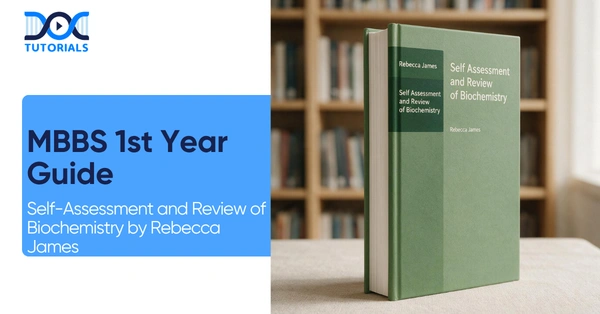
For 1st-year MBBS students, studying biochemistry is essential to build a strong foundation in medical science. In this regard, the Biochemistry Rebecca James book, widely known as Self Assessment and Review of Biochemistry, is a popular resource that helps students understand complex biochemical concepts in a simplified and exam-oriented manner.

Keep reading to learn more about why the Self Assessment and Review of Biochemistry by Rebecca James is considered a helpful study companion for MBBS students.

Overview of the Self Assessment and Review of Biochemistry

Rebecca James biochemistry book simplifies core biochemistry topics through structured sections and a clinical approach. It helps MBBS students understand metabolism, molecular biology, and key biochemical processes while preparing effectively for examinations.

The Self Assessment and Review of Biochemistry by Rebecca James is designed to help students focus on concept-based learning and self-evaluation in biochemistry. Since biochemistry is a vast and evolving field with growing importance in genetics and medical research, this book helps students understand its applications in modern medicine.

The Rebecca James Biochemistry book is organised into 5 sections and eighteen chapters covering key topics such as amino acids, carbohydrates, lipids, nucleotides, molecular biology, vitamins, minerals, and metabolism.

Written in a review-style format with a clinical approach, it enables students to understand concepts clearly and answer exam questions with ease.

Key Features of the Rebecca James Biochemistry Book

The Rebecca James biochemistry book includes chapter-wise concept study, recent exam questions, image-based learning, standard textbook references, strong clinical correlations, and high-yield mnemonics. It has tables, quick revision tools, updated content, author support, and recommendations from PG entrance exam toppers.

The Biochemistry Rebecca James book is designed as a concept-oriented review resource that helps students understand and revise important biochemistry topics efficiently. Its structured approach and exam-focused content make it highly useful for medical entrance examinations. Here are the key features:

  • Chapter-wise Concept-Based Study

It is structured into chapters where the students can learn the concepts of biochemistry systematically with proper references and structured explanations.

  • Coverage of Recent Exam Questions 

The book covers approximately 99% of recent questions and 96% of questions asked in major exams between 2019 and 2024, as it can help students learn crucial exam patterns.

  • Image-Based Learning 

The chapters are also accompanied by picture-based data and graphs that could help the students visualise the complicated biochemical processes.

  • Standard Reference-Based Reviews

Chapter reviews are based on well-known textbooks such as Harper’s Biochemistry (32nd edition), Lehninger Principles of Biochemistry (9th edition), and Robbins Pathologic Basis of Disease (10th edition).

  • Strong Clinical Correlation

The references to the Principles of Internal Medicine (21st edition), Nelson Textbook of Paediatrics (22nd edition), and Current Medical Diagnosis and Treatment (CMDT 2024) are used to integrate the clinical insights.

  • High-Yield Study Aids

The book has high-yield points, mnemonics, and tables are provided so that the students can remember fast information when preparing for exams.

  • Quick Revision Tools

Reviews of the book are given at the end of each chapter, revision checklists are given, and the book also gives concise summaries, which make it easier to revise the book at the last moment.

  • Updated and Exam-Oriented Content

The most recent one has been completely updated with reference and is relevant in the present-day PG medical entrance test.

  • Author and Peer Learning Support

The online author assistance and the enormous community in studying are also beneficial to students, as they have over 80,000 members in the social media study group to discuss and clarify.

  • Trusted by PG Entrance Aspirants

The book is highly reviewed by toppers in the medical entrance exam PCG, and is authored by a professional subject expert who is an active participant in post-graduate training programs.

Self Assessment and Review of Biochemistry: Table of Contents Overview

The book is structured into five sections and eighteen chapters covering biomolecules, metabolism, molecular genetics, and clinical biochemistry topics, helping students understand core concepts systematically while preparing for medical examinations.

The book is organised to provide a clear and systematic review of important biochemistry topics for medical students. It is divided into five sections comprising 18 chapters, covering fundamental biochemical concepts along with their clinical relevance.

The structured layout helps students understand theory while preparing effectively for examinations. Here is an overview of the table of contents:

Section I: Amino Acids & Proteins

  • Chapter 1: Chemistry and Metabolism of Amino Acids
  • Chapter 2: Proteins
  • Chapter 3: Enzymes

Section II: Carbohydrates

  • Chapter 4: Chemistry of Carbohydrates
  • Chapter 5: Metabolism of Carbohydrates

Section III: Lipids

  • Chapter 6: Chemistry of Lipids
  • Chapter 7: Metabolism of Lipids

Section IV: Molecular Genetics

  • Chapter 8: Chemistry and Metabolism of Nucleotides
  • Chapter 9: Organisation and Structure of DNA
  • Chapter 10: DNA Replication
  • Chapter 11: Transcription
  • Chapter 12: Translation
  • Chapter 13: Regulation of Gene Expression
  • Chapter 14: Molecular Biology Techniques

Section V: Miscellaneous

  • Chapter 15: Vitamins and Minerals
  • Chapter 16: Heme Metabolism and Haemoglobins
  • Chapter 17: TCA Cycle and Biological Oxidation
  • Chapter 18: Free Radicals, Xenobiotics, Metabolism of Alcohol, Biomembranes and Cell Organelles

How Does the Rebecca James Biochemistry Book Help Medical Students?

The book supports medical students through exam-oriented questions, concept-based chapter organisation, image-based learning, and references from standard textbooks. High-yield points and mnemonics make revision easier, making it a reliable resource for PG entrance exam preparation.

The Rebecca James Biochemistry book supports medical students in understanding key biochemical concepts. It strengthens exam preparation and improves the ability to apply biochemistry in clinical and academic contexts. Here’s how:

  • Exam-Oriented Question Practice: The book includes multiple-choice and short-answer questions, as well as case-based scenarios grounded in clinical practice. It closely mirrors the format of MBBS and PG entrance examinations to help students practise and assess their preparation.
  • Concept-Based Chapter-Wise Learning: The material is arranged chapter by chapter, with detailed references. The students may learn biochemistry in an orderly manner and solidify their conceptual knowledge of key biochemical concepts.
  • Image-Based and Visual Learning: Image-based information and questions presented in each chapter review aim to help students visualise biochemical structures and pathways. It enhances conceptual clarity and prepares them to solve image-based questions during medical exams.
  • Based on Standard Medical Textbooks: The material covered in the review is consistent with familiar reference books such as Harper, Biochemistry; Lehninger, Principles of Biochemistry; and Robbins, Pathologic Basis of Disease, thus providing reliable and academically relevant information.
  • High-Yield Revision Support: The book provides high-yield points, mnemonics, and tables. This helps students quickly remember important biochemical concepts during revision and memorisation for exams.
  • Trusted Resource for PG Entrance Preparation: Written by an experienced subject expert and recommended by many PG entrance exam toppers, the book serves as a valuable study resource for medical students preparing for postgraduate medical entrance examinations.

FAQs about Self Assessment and Review of Biochemistry

  1. Who should use Self Assessment and Review of Biochemistry?

The book is mainly designed for MBBS students and medical graduates preparing for postgraduate medical entrance examinations such as NEET PG, INI-CET, and other PGMEEs.

  1. What are the features of Self Assessment and Review of Biochemistry that make it useful for medical students?

The book focuses on concept-based learning and exam-oriented preparation. It includes MCQs, clinical scenarios, high-yield points, and structured chapter reviews to help MBBS students effectively revise key biochemistry topics.

  1. What type of questions are included in the Self Assessment and Review of Biochemistry?

The book contains multiple-choice questions, short-answer questions, and clinically oriented case-based questions designed to reflect the pattern commonly seen in MBBS and postgraduate medical entrance examinations.

  1. Does Self Assessment and Review of Biochemistry include image-based questions?

Yes, each chapter review includes image-based information and questions that help students prepare for diagram-based and visual questions often asked in medical entrance exams.

  1. Which standard textbooks are referenced in Self Assessment and Review of Biochemistry?

The review content in Self Assessment and Review of Biochemistry is based on well-known medical textbooks such as Harper’s Biochemistry, Lehninger’s Principles of Biochemistry, and Robbins Pathologic Basis of Disease. This ensures reliable and academically relevant information for students.

  1. How is the content structured in Self Assessment and Review of Biochemistry?

The book is organised into 5 major sections and 18 chapters, covering core biochemistry topics such as amino acids, carbohydrates, lipids, molecular genetics, and other clinically relevant biochemical concepts.

  1. Is the Self Assessment and Review of Biochemistry updated with recent references?

Yes, the latest edition of the book has been thoroughly revised with updated references and exam-relevant information. This makes it useful for current PG medical entrance examinations.

  1. How many recent exam questions are covered in Self Assessment and Review of Biochemistry?

The book includes around 99% of recent questions and 96% of questions asked in major medical entrance exams between 2019 and 2024, helping students understand important exam trends and frequently tested topics.

  1. How can Self Assessment and Review of Biochemistry help students during last-minute revision?

The book provides concise summaries, high-yield points, and quick revision tools to help students efficiently review key biochemical concepts before examinations.

  1. Does Self Assessment and Review of Biochemistry cover important metabolic pathways? 

Yes, the book covers major metabolic pathways, including carbohydrate, lipid, and amino acid metabolism. It also explains key processes such as the TCA cycle and biological oxidation, which are essential topics in medical biochemistry.

Conclusion

Self Assessment and Review of Biochemistry by Rebecca James Perumcheril is a trusted review resource for MBBS students and PG aspirants. It simplifies complex biochemical concepts through structured chapters, exam-oriented questions, high-yield points, and image-based learning for effective revision.

For structured academic support, DocTutorials can be your study partner. We offer 3D & 2D animated videos, CBME-based video lectures, and structured mentorship and guidance by experts. This ensures aspirants gain complete clarity over complex medical concepts.

Join DocTutorials today and explore our MBBS curriculum to excel in your medical career!

DocTutorials App Download Now

Latest Blogs

MBBS 1st Prof Exam Preparation: Tips and Strategies 

mbbs 1st prof Exam

The first professional MBBS exam can feel overwhelming because of the vast syllabus and complex concepts. It’s also a time when many students start doubting themselves. Most early struggles are not due to a lack of ability or effort, but because of poor study methods. 

Medical studies require a structured approach and regular revision. Building these habits early makes the journey much easier. This guide is designed to help first-year MBBS students understand what the exam demands and how to prepare for it in a sustainable and effective manner. Keep reading to know more. 

Overview of the MBBS 1st Prof Exam 

The MBBS course lasts 5.5 years and is divided into three stages. The first professional exam is held at the end of the first year, after the pre-clinical phase, and is an important step before moving to the next stage. 

The MBBS course is a rigorous 5.5-year programme comprising 4.5 years of academic study and 1 year of compulsory internship. It has three primary stages: 

  • Pre-clinical (first year) 
  • Para-clinical (second year) 
  • Clinical (third year onwards) 

At the end of this pre-clinical phase is the 1st professional examination. The pre-clinical stage comprises two semesters of 6 months each. The MBBS first prof exam is conducted at the end of the second semester. 

Subjects Covered in the MBBS 1st Prof Exam 

In the first year of MBBS, you focus on three core subjects: Anatomy, Physiology, and Biochemistry. Together, they help you understand the human body, how it works, and the basic processes that keep it running, forming the base for everything you’ll learn later. 

The three core subjects evaluated in the MBBS Exam that form the foundation of the 1st Prof examination are: 

  • Anatomy: The study of the structure and organisation of the human body, covering gross anatomy, microanatomy, embryology, genetics, and neuroanatomy. It is the largest and most detail-intensive subject, often dominating the MBBS Exam Question Paper
  • Physiology: The study of how the body functions, covering cardiovascular, respiratory, renal, neurological, and gastrointestinal systems, among others. It bridges structure and function and forms a conceptual foundation for clinical reasoning. 
  • Biochemistry: The study of the chemical and molecular basis of life, including biomolecules, enzymes, metabolic pathways, and their clinical correlations. 

Pattern of the MBBS 1st Prof Exam 

The MBBS 1st Prof exam in India includes theory papers, practical/clinical exams, and a viva to test both knowledge and skills. Each subject usually has two theory papers and a practical exam. 

In India, at the end of the professional year, all medical students are evaluated through a theory paper, practical and clinical exams, and a viva voce to assess their skills and knowledge. According to the MBBS Exam Pattern, most subjects have two theory papers of 100 marks each, which consist of long answer type, short answer type, and MCQ questions. 

Each subject also has a practical exam worth 100 marks to test practical skills such as specimen identification, laboratory experiments, and demonstrations. 

It is to be noted that the internal assessment marks throughout the year, such as unit tests, practical records, assignments, etc., are counted separately but contribute to eligibility for the university examination. So, the best way to help the students is to be consistent throughout the year and not prepare at the last moment. 

MBBS 1st Prof Exam Preparation Tips and Strategies 

Preparing for the MBBS 1st Prof exam is about staying consistent, understanding concepts clearly, and revising regularly. Focus on the basics, practice well, and take care of your health along the way. 

Below are a few preparation tips and strategies for the MBBS 1st Prof exam: 

1. Understand the Syllabus Before You Start Studying: Before memorising a textbook, every student should have a clear picture of what needs to be covered. Students must understand the MBBS Prof syllabus and allocate time to each subject. 

The 1st Prof syllabus is divided across three subjects, each with its own breadth and internal structure: Anatomy is the largest and most detail-intensive section, heavily featured in any MBBS Exam Question Paper. The syllabus covers four main areas: 

  • Gross Anatomy is the study of the upper and lower limbs, thorax, abdomen, pelvis, head, and neck in different parts of the body. 
  • Microanatomy (Histology) is the study of the microscopic structure of organs and tissues. 
  • Embryology and Genetics encompass human development from fertilization to organogenesis, as well as fundamental principles of medical genetics. 
  • Neuroanatomy is the study of the structure of the central and peripheral nervous systems, including their tracts and nuclei, with clinical correlations. 

Physiology studies how the body’s major systems work. Some important areas are: 

  • General physiology is the study of the cell membrane, how things move around, and body fluids. 
  • Cardiovascular physiology includes the cardiac cycle, cardiac output, and the regulation of blood pressure. 
  • Respiratory physiology includes the study of the mechanics of breathing, gas exchange, and transport. 
  • Renal physiology encompasses filtration, reabsorption, and fluid homeostasis. 
  • Neurophysiology encompasses nerve conduction, synaptic transmission, and specialized sensory modalities. 
  • Physiology of the gastrointestinal, endocrine, and reproductive systems. 

Biochemistry is the study of the chemical and molecular basis of life. Below are the main topics: 

  • Biomolecules include carbohydrates, proteins, lipids, and nucleic acids. 
  • Enzymes: types, how they work, and how to stop them. 
  • Metabolic pathways include glycolysis, the Krebs cycle, oxidative phosphorylation, gluconeogenesis, and lipid metabolism. 
  • Molecular biology includes DNA replication, transcription, translation, and recombinant DNA technology. 
  • Clinical biochemistry, genetic errors in metabolism, vitamins, minerals, and not getting enough nutrients. 

At the start of the year, students should map out the entire syllabus so they can plan their time wisely, identify high-yield topics early, and avoid the common mistake of spending too much time on some areas while neglecting others. 

2. Build a Realistic and Consistent Study Schedule: A study schedule is only useful if you can stick to it. Schedules that are too ambitious and fall apart in the first week do more harm than good because they make people feel like they have failed, which hurts their motivation. 

  • Instead of spending whole days on one subject, set aside specific times each day for each subject. 
  • Students need to study for at least 8 hours a week so that they can go over everything in depth and have time to review. 
  • Start including weekly review sessions at the beginning of the year, not just the weeks before the test. 
  • Include short breaks and days off to keep your productivity up over the long preparation period. 

3. Prioritise Conceptual Understanding Over Rote Memorisation: The most common mistake first-year students make is to treat medicine as a memorisation exercise. Emphasize conceptual learning rather than rote memorisation of facts. Know the why behind each process. This is particularly true of Physiology and Biochemistry, where learning the mechanism behind a process is much easier to remember and apply than memorising a list of facts. In Anatomy, although some memorisation is inevitable, knowing the functional and clinical relevance of structures improves recall. 

4. Use the Right Study Resources for Each Subject: Choosing appropriate textbooks and supplementary resources for each subject matter greatly. Sometimes students waste a lot of time on books that are either too detailed or too superficial for exams. 

Below are a few book suggestions for each subject: 

  • Anatomy: BD Chaurasia’s Human Anatomy remains the standard reference for Indian medical students, offering detailed regional coverage. Grey’s Anatomy for Students is a strong supplementary resource for conceptual clarity. 
  • Physiology: Ganong’s Review of Medical Physiology and Guyton and Hall’s Medical Physiology are both widely used and examination relevant. 
  • Biochemistry: Satyanarayana and Chakrapani’s Biochemistry is particularly well-suited to the Indian curriculum and examination pattern. 

Alongside standard textbooks, video lectures, particularly for complex topics in Physiology and Biochemistry, can significantly improve understanding and reduce the time needed to grasp difficult concepts. 

5. Make Diagrams, Flowcharts, and Notes a Daily Habit: Students can use mnemonics to learn anatomical structures and flashcards to memorise factual information. These techniques aid better learning and retention. Memorising flowcharts and mind maps to correlate topics simplifies the given information. 

After each lecture or study session, students should summarize key points in their own words. It can be done through short notes, diagrams, or flowcharts. This dramatically improves long-term retention. This habit also makes revision considerably faster and more effective in the weeks leading up to the examination. 

6. Take Practicals Seriously: First-year students often make the mistake of considering practical work less important than theory. Indeed, practical examinations constitute a major part of the marks, and the skills acquired from dissection, laboratory work, and demonstrations are directly tested in the university examination. Students can consider the following tips: 

  • Attend all practical sessions and maintain accurate, neat laboratory records. 
  • Practice identifying specimens, slides, and models regularly throughout the year. 
  • Use practical sessions as opportunities to consolidate theoretical knowledge by observing real structures and processes. 

7. Solve Previous Years’ Question Papers: Regular review of previous years’ papers and question banks is helpful for checking recall of facts. Essay and short-answer questions should be written in a clear, concise style that highlights the major points. 

Solving past papers has many advantages. It familiarizes students with the examination format, exposes them to frequently tested topics, and helps identify areas of weakness to work on. Practising under timed conditions also helps you learn to write clearly and completely within the time constraints of the actual exam. 

8. Revise Regularly and Do Not Leave it to the End: Revision should not be left to the last few weeks before the examination. The 1st Prof, with a syllabus so vast, can make the topics studied in the first semester fade away easily until the exam comes, if not revisited periodically. Weekly revision of completed topics makes a significant difference to retention and examination performance. 

9. Study in Groups: Learning with classmates and friends helps consolidate understanding. If anyone gets stuck on a topic, others can help to clear the concept and move on with the subject. Group study is best for revision-based discussions and for clearing doubts. It’s not great if you’re a first-time learner who needs focused, individual work. 

When students discover the right sort of balance between independent study and collaborative revision, they are learning a skill that will stand them in good stead throughout the MBBS course. 

10. Take Care of Physical and Mental Well-being: Preparation for any professional examination is demanding, and the first year of MBBS is particularly so because students are simultaneously adjusting to a new academic environment, a new city, and an entirely new way of learning. Neglecting physical health and rest in favour of additional study hours is counterproductive. 

  • Maintain regular sleep, as memory consolidation occurs during rest. 
  • Eat balanced meals and avoid long periods without food during study sessions. 
  • Seek support from seniors, faculty, or counsellors if the pressure becomes overwhelming. 

FAQs about MBBS 1st Prof Exam Preparation 

  1. What are the subjects in the MBBS 1st Prof Exam?  

The MBBS 1st Professional Examination covers three pre-clinical subjects: Anatomy, Physiology, and Biochemistry. These subjects, which are a major focus of the MBBS Exam, educate students about the structure and function of a healthy human body and form the foundation on which all subsequent clinical learning is built. 

  1. When is the MBBS 1st Prof Exam conducted?  

The MBBS first professional exam is conducted at the end of the second semester of the medical course. The pre-clinical phase lasts for a total of two semesters, with each semester lasting six months. The exact dates vary by university, but are typically announced on the official college or university website. 

  1. What is the passing criteria for the MBBS 1st Prof Exam?  

A candidate shall obtain a cumulative 50% marks in the university-conducted examination, including theory and practical, and not less than 40% separately in theory and in practical, to be declared as passed in that subject. Under the standard MBBS Exam Pattern for subjects that have two papers, the learner must secure a minimum of 40% marks in aggregate across both theory papers together. 

  1. How many attempts are allowed for the MBBS 1st Prof Exam?  

No student shall be allowed more than four attempts for the first year of the first professional MBBS. In these four years, the maximum number of attempts permitted shall be four. Students who are unable to clear within this limit are required to leave the MBBS programme. 

  1. What is the minimum attendance required to appear for the 1st Prof Exam?  

At least 75% attendance in theory and 80% in practical or clinical training is mandatory for MBBS students to appear in the supplementary examination following the regular annual examination. Students falling short of these thresholds must attend remedial classes and sit the examination with the next academic batch. 

  1. Which subject typically has the most difficult MBBS Exam Question Paper?  

Anatomy is generally considered to have the most challenging MBBS Exam Question Paper. It encompasses a huge amount of factual information, diagrams, spatial visualization, and memorisation. It becomes difficult for most students to memorise the complex structures of the human body. That said, difficulty varies from student to student depending on individual strengths. 

  1. How many hours should a student study daily for the 1st Prof Exam?  

On average, six to eight hours of focused study is sufficient if done consistently. The amount of time dedicated to each subject should depend on the student’s individual proficiency, allocating more time to weaker subjects whilst maintaining regular contact with stronger ones. 

  1. What happens if a student fails the 1st Prof Exam?  

If any candidate fails the supplementary examination as well, he or she shall join the batch of the next academic year. There shall be no supplementary batches. A student who fails in the first professional examination shall not be allowed to join the second professional phase until all subjects are cleared. 

  1. Does performance in the 1st Prof Exam affect NEET PG eligibility?  

Yes. The marks scored in each professional year examination are taken into account when calculating the academic score used in NEET PG and certain postgraduate admission processes. Beyond marks, a thorough understanding of 1st Prof subjects directly supports NEET PG preparation, as these subjects form the conceptual basis of many high-yield clinical topics tested in postgraduate entrance examinations. 

  1.  Are internal assessment marks added to the final university examination score?  

Internal assessment shall not be added to summative assessment. However, internal assessment marks in absolute marks should be displayed under a separate column in a detailed marks card. Internal assessments do, however, determine eligibility to sit the university examination and reflect continuous academic performance throughout the year. 

Conclusion 

The MBBS 1st Prof Examination is challenging, but it is not beyond the reach of any student who approaches it with consistency, clarity, and the right strategy. Knowing the exam pattern, having a steady study plan, focusing on understanding concepts, and revising regularly are key habits. 

For added guidance, DocTutorials can be your study partner. We offer 3D & 2D animated videos, CBME-based video lectures, and expert mentorship. This helps ensure aspirants gain complete clarity over complex medical concepts to excel in the exam. 

Join DocTutorials and explore our MBBS curriculum to stay ahead in your medical career! 

DocTutorials App Download Now

Latest Blogs


Best NEET Exam Books for 2027: Subject Wise Guide to Crack NEET 

The syllabus of NEET looks massive, and millions of students are competing alongside you. But do not worry, because having the right guidance simplifies everything. You do not need to read every textbook in existence. You simply need clear direction, a disciplined routine, and the right study resources to help you clear the exam and secure your seat. 

Start Your MBBS With Confidence. Join DocTutorials Bridge Course for Free!  

What Are The Best NEET Exam Books for Beginners? 

The absolute best place to start is your NCERT textbooks for class 11 and class 12. Before touching advanced reference material, read every chapter in NCERT Biology, Physics, and Chemistry thoroughly. Once your core concepts are crystal clear, move on to specific NEET Books that offer practice questions to boost your speed and accuracy. 

Why Choosing The Right Study Material Changes Everything 

It is easy to feel overwhelmed when you see dozens of reference guides in a bookstore. Many students end up buying too many heavy books and end up confused. As an older sibling guiding you through this process, let me share an important truth. Quality always matters more than quantity. 

When you select the right NEET Exam Books, you save hundreds of hours of wasted effort. Good study materials explain difficult biological pathways using simple flowcharts. They give you clever shortcut techniques for solving physics numericals quickly and help you memorize chemistry formulas easily. The goal is to keep your book list small and revise those chosen NEET Books repeatedly. Always pick resources that provide step by step solutions, so you understand exactly where you went wrong. 

Essential Books List and Practice Volume Breakdown 

To help you choose the finest study resources, here is a breakdown of top recommended books along with the estimated number of practice questions offered by each subject suite. 

Subject Recommended Reference Books Practice Questions Offered 
Biology NCERT Biology Class 11 and 12, Trueman Biology Volume 1 and 2, Objective Biology by Dinesh 30,000 Questions 
Chemistry NCERT Chemistry Class 11 and 12, Physical Chemistry by OP Tandon, Organic Chemistry by Morrison and Boyd 1 Lakh Questions 
Physics NCERT Physics Class 11 and 12, Concepts of Physics by HC Verma, Objective Physics by DC Pandey 4 Lakhs Questions  

Exam Statistics and Seat Allocation Insights 

Understanding the structure of the exam and the level of competition helps you set realistic targets for your daily study hours. Here is a clear table showing key metrics regarding question counts, candidate numbers, and seat distribution across the country. 

Category Description Key Figures 
Question Bank Total Multiple-Choice Questions Solved by Top Rankers 30,000 MCQs 
Government Seats Approximate Total MBBS Seats Available in Government Medical Colleges 1 Lakh Seats 
Total Aspirants Approximate Number of Candidates Qualifying the Entrance Exam Each Year 4 Lakhs Aspirants  

Subject Wise Preparation Strategy To Score High 

Every subject requires a distinct approach if you want to maximize your final score. 

Mastering Biology 

Biology carries the maximum weightage in the exam paper. Read your standard textbooks until you know every diagram and definition by heart. Focus heavily on genetics, plant physiology, and human systems. 

Tackling Chemistry 

Physical chemistry requires regular formula practice and solving numerical problems. Organic chemistry depends on understanding chemical reaction mechanisms. Look for NEET Exam Books that include handy summary tables for inorganic chemistry memorization. 

Conquering Physics 

Physics often decides who gets into a top government college. Focus on understanding fundamental concepts rather than memorizing formulas. Practice solving numerical problems daily to build confidence and speed. 

Frequently Asked Questions 

1. What Are the Most Important NEET Exam Books for Biology? 

Your standard NCERT biology textbooks for class 11 and class 12 are the most essential resources for biology preparation. 

2. Can I Clear the Entrance Exam Using Only NCERT NEET Books? 

NCERT books are sufficient for biology and chemistry, but physics requires additional reference materials for numerical practice. 

3. How Many Practice Questions Should I Solve Before the Exam? 

Top scoring students usually solve around 30,000 practice questions across all subjects before sitting for the final test. 

4. How Many Hours Should I Study Every Day? 

Focus on quality rather than total hours. Six to eight hours of distraction free study every day is usually enough. 

5. Is It Necessary to Join an Expensive Coaching Class? 

No, thousands of aspirants succeed through self-study using standard resources without paying huge fees. 

6. How Many Government MBBS Seats Are Available in India? 

There are approximately 1 Lakh total MBBS seats across various medical institutions in the country. 

7. How Do I Revise the Entire Syllabus Effectively? 

Create concise summary notes while studying your NEET Books so you can revise formulas and key points rapidly. 

8. What Should I Do If Physics Feels Difficult? 

Break down complex topics into smaller concepts and practice solving basic numerical problems before moving to harder ones. 

9. Are Online Mock Tests Helpful for Preparation? 

Yes, online test series help you manage time properly and get accustomed to the real examination format. 

10. How Many Candidates Qualify the Medical Entrance Exam Yearly? 

Approximately 4 Lakhs candidates achieve qualifying marks in the entrance exam every year. 

DocTutorials App Download Now

Latest Blogs

Internship In MBBS: What Every Future Doctor Should Know 

As you step into the world of MBBS, you will hear seniors talk about the final phase of your degree. This phase is where all your textbook knowledge meets real patients in a hospital setting. The excitement of wearing a white coat and treating patients independently for the first time is unmatched. But what exactly goes on during this final year? Let us break down everything you need to know about this crucial step in your medical career.

Start Your MBBS With Confidence. Join DocTutorials Bridge Course For Free! 

What Is an Internship In MBBS? 

An Internship in MBBS is a mandatory training period that every medical student must complete after finishing their final academic exams. It is officially known as the compulsory rotating medical internship. During this time, you work as a junior doctor in a hospital under the guidance of senior professors. You are no longer just sitting in a classroom. Instead, you are managing patients, prescribing basic medications, and learning how a hospital truly operates. 

Unlock a smarter way to master MBBS basics. Download the Bridge Course brochure now

Understanding The MBBS Internship Duration 

The MBBS internship duration is strictly twelve months long. You cannot skip or reduce this period. This entire year is divided into multiple short postings across different medical departments. By spending a few weeks in each department, you gain a complete understanding of how various specialties function. If you take too many leaves or fail to attend your duties, your internship will be extended. The goal is to ensure you spend enough time mastering clinical skills before you are officially registered as a doctor. 

How The Rotational Posting in MBBS Works 

During your Internship in MBBS, you will not stay in one single department. You will move from one ward to another. This is called a rotational posting in MBBS. You will spend time in general medicine, surgery, pediatrics, community medicine, and more. This variety ensures you know how to handle different types of patients. You will assist in deliveries, treat wounds in the emergency room, and learn how to manage rural healthcare centers. 

Let us look at a general breakdown of how your time will be divided across different hospital departments. 

Department Approximate Duration Key Responsibilities 
General Medicine Eight Weeks Diagnosing fevers, managing chronic illnesses, checking blood pressure 
General Surgery Six Weeks Assisting in operations, dressing wounds, giving local anesthesia 
Pediatrics Four Weeks Checking newborn babies, managing child nutrition and infections 
Community Medicine Twelve Weeks Working in rural areas, conducting health camps, providing vaccines 
Obstetrics And Gynecology Four Weeks Assisting in normal deliveries, monitoring pregnant mothers 

Let Us Talk About The MBBS Internship Stipend 

One of the most exciting parts of the Internship in MBBS is that you finally start earning! You provide valuable clinical services to the hospital, and in return, you receive an MBBS internship stipend. This amount varies greatly depending on the state and the type of college you attend. Government colleges usually offer a fixed amount, while private colleges might offer a different scale. 

Here is an example of the financial aspects you might experience during your medical education and internship phase. 

Financial Category Estimated Amount Details 
Average Monthly Stipend 30,000 Paid monthly during the internship year in government colleges 
Annual Living Expense 1 lakh Approximate cost for food and hostel accommodation 
Private College Tuition 4 lakhs Average yearly fee in some private medical institutions 
Books And Equipment 15,000 Cost of medical books, stethoscope, and basic gear 

Receiving your first MBBS internship stipend of 30,000 rupees is a proud moment. It makes you feel financially independent and rewards you for the sleepless nights you spend on duty. 

Important NMC Guidelines for MBBS Internship 

The National Medical Commission regulates everything about your medical education. The NMC guidelines for MBBS internship ensure that all students get equal and fair training. According to these rules, you must complete your compulsory rotating medical internship in the same college where you studied. You cannot simply transfer to another hospital for convenience. The guidelines also strictly state that you are allowed only fifteen days of normal leave during the entire year. Furthermore, you must maintain a logbook to record your clinical procedures. 

Why The Internship in MBBS Is the Most Important Year 

Up until your final year exams, you only read about diseases in thick textbooks. The Internship in MBBS is where you actually see those diseases in real life. You learn how to communicate with worried relatives, how to handle emergency situations calmly, and how to work as part of a medical team. Your MBBS internship duration is meant to build your confidence. By the time you complete your rotational posting in MBBS, you will be ready to practice medicine independently. Every future doctor looks forward to this phase. Follow the NMC guidelines for MBBS internship and enjoy every moment. 

Frequently Asked Questions 

1. What is the primary purpose of an Internship in MBBS? 

The main purpose of an Internship in MBBS is to give you hands on clinical experience. It helps you apply your theoretical knowledge to real patients. 

2. How long is the standard MBBS internship duration? 

The standard MBBS internship duration is exactly twelve months. You must complete this entire period to get your medical degree. 

3. Can I skip the compulsory rotating medical internship? 

No, the compulsory rotating medical internship is completely mandatory. You cannot get your permanent registration as a doctor without completing it. 

4. Will I get paid during my Internship in MBBS? 

Yes, you will receive an MBBS internship stipend for your clinical work. The amount depends on your medical college and state government rules. 

5. What are the NMC guidelines for MBBS internship leaves? 

According to the NMC guidelines for MBBS internship, you are allowed a maximum of fifteen days of normal leave during the entire twelve months. 

6. Do I get to choose my rotational posting in MBBS? 

No, the rotational posting in MBBS is pre-planned by your college. You must spend a specific number of weeks in all mandatory departments. 

7. Can I do my internship at a different hospital? 

The NMC guidelines for MBBS internship state that you must complete your training in the same institution where you pursued your academic studies. 

8. Is the MBBS internship stipend the same everywhere? 

The MBBS internship stipend can vary widely. Government colleges generally offer standard stipends, while private colleges may have different policies. 

9. What happens if I take too many leaves during my internship? 

If you exceed your allowed leaves, your MBBS internship duration will be extended by the number of extra days you took off. 

10. Does the Internship in MBBS include night shifts? 

Yes, your rotational posting in MBBS will include night duties and emergency shifts. This prepares you for real life medical emergencies. 

DocTutorials App Download Now

Latest Blogs

MBBS Internship: What Every Future Doctor Should Know 

MBBS Internship has become a crucial final step for students seeking their medical degree. With recognized hospital rotations and patient care duties, it offers a real-world learning experience for aspiring doctors. You finally get to wear a white coat and stethoscope to treat real people. This guide covers the eligibility, daily duties, stipend details, advantages, challenges, and career prospects of completing your MBBS Internship in India. 

Start Your MBBS With Confidence. Join DocTutorials Bridge Course For Free! 

What Is the Compulsory Medical Internship? 

The MBBS Internship is a mandatory twelve-month training period after finishing four and a half years of academic study. You will step out of the classroom to treat real patients under senior guidance. This compulsory rotatory internship is strictly required to get your medical degree and practice medicine. 

Unlock a smarter way to master MBBS basics. Download the Bridge Course brochure now

Why Is the Internship Year Important? 

As a 12th standard student, you might wonder why you need it this year. Reading textbooks teaches the science of medicine, but treating patients teaches the art of healing. 

Applying Textbook Knowledge 

For four years, you memorize complex diseases, intricate human anatomy, and endless lists of medicines. This year is when you finally apply that vast knowledge. When a patient arrives in the casualty ward, you will know exactly how to stabilize their condition. You will read their reports, listen to their heartbeat, and understand exactly what is happening inside their body. The theory finally turns into practice. 

Building Clinical Confidence 

Working as an intern helps you overcome the natural fear of making mistakes. Since you are constantly supervised by senior doctors and professors, you have a safe and guided space to practice clinical skills. You will learn how to talk to worried families, how to deliver sensitive news, and how to stay perfectly calm during intense medical emergencies. This confidence is exactly what makes a great physician. 

Department Postings and Duration 

During your MBBS Internship, you rotate through various medical specialties. This ensures you become a well-rounded doctor. Here is a simple breakdown of the time spent in major departments: 

Department Name Time Spent 
Community Medicine 2 Months 
General Medicine 1.5 Months 
General Surgery 1.5 Months 
Obstetrics And Gynecology 1.5 Months 
Pediatrics 1 Month 

You will learn the absolute basics of every specialty, from stitching wounds in surgery to understanding public health in rural centres. 

The MBBS Internship Stipend 

One of the most exciting parts is earning your first monthly payment, called a stipend. Every medical college must pay their interns to cover daily expenses. The exact MBBS Internship stipend depends heavily on your college type. 

Type Of Medical Institution Average Monthly Stipend 
Top Central Institutes 30,000 
State Government Colleges 20,000 
Private Medical Colleges 12,000 
Estimated Yearly Earnings 1 Lakh to 4 Lakhs 

Students in premium government institutes often earn around 30,000 per month. Earning your first paycheck as a doctor is a very proud moment. 

Daily Duties of an Intern 

Life as an intern is thrilling but extremely exhausting. Your day usually starts early with morning ward rounds, checking on admitted patients with senior resident doctors. You are entirely responsible for updating patient files, documenting health progress, and ensuring nurses give the right medications at the right time. You are the absolute backbone of the hospital ward. 

Later in the day, you might assist senior surgeons in the operating theatre or help deliver newborn babies in the busy maternity ward. Night shifts are a regular occurrence, where you might be the first doctor to see a critically injured patient arriving from an ambulance. This nonstop routine prepares you perfectly for a demanding and noble profession. 

Advantages And Challenges 

The biggest advantage is that this training completely transforms you from a nervous student into a confident doctor with practical skills to save lives daily. It gives you incredible exposure to every medical field, which helps you easily decide which specific medical specialty you want to pursue later for higher studies. 

The main challenge is the intense physical and mental workload. You will face long working hours, sleepless nights, and the profound emotional stress of managing severely sick patients. However, the strong lifelong bond you share with your batchmates and the deep gratitude you receive from recovering patients make all the hard work totally worth it. 

Frequently Asked Questions 

1. Is the MBBS internship mandatory for all medical students? 

Yes, it is completely mandatory. You absolutely cannot get your final medical license or degree without successfully completing this twelve-month training period. 

2. Do private medical college students also get a monthly stipend? 

Yes, recent rules mandate that all medical colleges must pay a basic stipend, though amounts in private colleges are often lower than government ones. 

3. What is the total medical course duration in India? 

The total duration is five and a half years. This specifically includes four and a half years of academic classroom study and one year of compulsory rotatory internship. 

4. Can I take any leaves during this hectic year? 

Yes, interns are generally allowed fifteen days of normal leave. Taking any extra leave usually requires a strict extension of your training time. 

5. Will I perform major independent surgeries alone? 

No, you will never perform major surgeries alone. You will assist senior surgeons and perform minor clinical procedures under their strict and careful supervision. 

6. Are night shifts compulsory for every intern? 

Yes, night duties are a regular and mandatory part of your schedule. You need them to learn how to manage hospital wards and handle unexpected emergencies. 

7. What happens if I fail or miss a specific posting? 

You will simply have to repeat that specific department posting, which automatically extends your overall training duration before you get your degree. 

8. Can I study for entrance exams during this time? 

The heavy workload leaves very little time for dedicated study. Therefore, you must manage your daily time very smartly to prepare for future exams. 

9. Can I change my hospital for the training period? 

No, you must complete your entire training in the exact hospital attached to your medical college. External hospital transfers are generally not permitted. 

10. Is the daily workload very stressful for students? 

It can be physically tiring due to long hours, but it remains deeply rewarding to finally heal sick patients and save precious lives. 

DocTutorials App Download Now

Latest Blogs


Mastering NEET Mock Tests: A Guide for Future Doctors 

Are you feeling that mix of intense excitement and nervous butterflies as you prepare to step into the world of medicine? Being a 12th standard student dreaming of a white coat is no easy task. You have late night study sessions, endless chapters to cover, and a huge goal in front of you. It is completely normal to feel a bit overwhelmed. But what if I told you there is one simple tool that acts like a magic wand for your preparation? It helps you face the actual exam day with zero fear and massive confidence. 

Unlock a smarter way to master MBBS basics. Download the Bridge Course brochure now

What Exactly Is A NEET Mock Test and Why Is It So Crucial? 

NEET Mock Test is basically a practice exam designed to look and feel exactly like the real medical entrance test. It contains the same number of questions, the exact same marking scheme, and a strict time limit. Taking these tests is crucial because they train your brain to handle exam pressure, help you manage your time properly, and show you exactly which subjects need more of your attention before the big day. 

The Real Power Of NEET Mock Test Papers 

When you start solving NEET Mock Test Papers, you are doing much more than just answering multiple choice questions. You are training yourself for a mental marathon. In the exam hall, the clock ticks fast and panic can easily set in. Regular practice with these papers helps you build a solid rhythm. You will quickly figure out if you spend too much time on physics calculations or if you tend to rush through biology theory questions. 

Another major benefit is understanding tricky question patterns. The more NEET Mock Test Papers you solve, the more you will notice certain types of tricky concepts repeating over the years. You begin to understand exactly how the examiners think and what kind of traps they set in the options. This builds incredible confidence. When you finally sit for the real exam, it will just feel like another regular Sunday practice session sitting at your own desk at home. Your mind will be completely trained to ignore distractions. 

Why You Should Search for A NEET Mock Test Free 

You do not always need to spend huge amounts of money to get quality practice material. There are many reputed educational platforms offering a NEET Mock Test Free for dedicated students who want to test their knowledge without emptying their parent’s wallets. Taking advantage of a NEET Mock Test Free is a very smart move early in your preparation journey. 

It allows you to experience different difficulty levels without any financial pressure. You can try a few different providers, see exactly where you stand among your peers, and then decide how to plan the rest of your daily study schedule. Always look for resources that offer detailed step-by-step solutions after you finish the test. This way, you learn from your mistakes immediately instead of carrying those doubts forward. Free resources are a blessing if you use them consistently and sincerely. 

Exploring The Benefits of A NEET Mock Test Online 

In today’s digital age, choosing a NEET Mock Test Online offers amazing flexibility and convenience. You can take the exam from the comfort of your room at any time you prefer, whether that is early morning or late at night. A NEET Mock Test Online also provides instant results. There is no waiting around to manually calculate your scores with an answer key. 

Furthermore, online platforms often give you a highly detailed analytical report. They will tell you exactly how many seconds you spent on a specific physics problem and compare your overall performance with thousands of other students across the country. This kind of deep insight is almost impossible to get from traditional paper books. It acts as a personal guide, showing you the exact topics where you are losing marks so you can fix them immediately. 

Official Important Dates You Must Remember 

Every medical aspirant needs to stay highly updated with the official exam schedule. Missing a crucial deadline can ruin a whole year of hard work and preparation. Below is the official important dates table for your upcoming medical entrance journey so you can plan your studies perfectly. 

Important Event Scheduled Date 
Application Form Start Date 8 February 2026 
Last Date To Apply 11 March 2026 
Admit Card Release 14 June 2026 
Main Examination Date 21 June 2026 
Result Declaration 16 July 2026 

Understanding The Numbers Behind The Competition 

To give you a very realistic view of what you are preparing for, let us look at some standard numbers associated with this journey. As requested by many students, here is a detailed breakdown involving standard numbers to help you understand the scale of this exam. 

Preparation Aspect Estimated Number or Amount 
Total Students Appearing 24 lakhs 
Total Government Seats 1 lakh 
Average Coaching Expenses 1 lakh to 4 lakhs 
Cost Of Online Practice 0 to 30,000 

Frequently Asked Questions 

1. What is the best time to start taking a NEET Mock Test? 

You should start taking them as soon as you finish at least half of your syllabus to establish a clear baseline performance. 

2. Can I clear the exam just by solving NEET Mock Test Papers? 

No, you need a strong theoretical foundation. Combine textbook reading with regular testing for the absolute best results. 

3. Where can I find a reliable NEET Mock Test Free? 

Many reputed educational websites offer free initial tests. Sign up on trusted platforms to access their free resources easily. 

4. Is a NEET Mock Test Online better than offline? 

An online test gives instant analytics, while an offline test prepares you for the physical pen and paper format. Both are extremely useful. 

5. How many practice tests should I take before the final day? 

Experts recommend taking at least 30 to 40 full length tests to ensure you are completely prepared for any question. 

6. Do these tests really predict my final score? 

Yes, they give a very close estimate. Consistent high scores in your NEET Mock Test usually translate to great actual exam performance. 

7. What if my scores are low in the NEET Mock Test Papers? 

Do not panic. Analyze your mistakes, revise those specific topics, and take another test. Improvement takes time and patience. 

8. Are the questions in a NEET Mock Test Free of good quality? 

Yes, top platforms provide high quality free tests. Just ensure you choose well known and highly trusted educational providers. 

9. How should I analyze a NEET Mock Test Online? 

Check the time spent per section. Identify whether you made silly calculation errors or lacked conceptual knowledge in specific topics. 

10. Will a NEET Mock Test reduce my exam anxiety? 

Absolutely. Familiarity kills fear. Practicing in a timed environment makes you feel completely relaxed on the actual examination day. 

DocTutorials App Download Now

Latest Blogs

NEET PG Online Live Power Pack
DocTutorials App Download Now