Ewing’s Sarcoma: Causes, Symptoms, Diagnosis, and Treatment
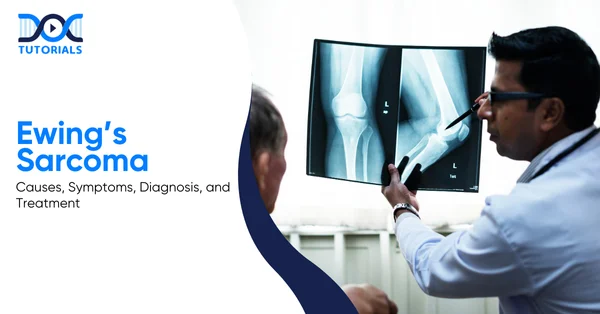
Ewing’s sarcoma is a rare but highly aggressive bone and soft-tissue tumour that mostly affects children and adolescents. It accounts for about 6–8% of all primary bone cancers and is most common in adolescents and young adults.
Since it spreads early and requires multimodal treatment, understanding its basics is crucial for both exams and clinical practice. Read below to get a detailed, high-yield understanding of Ewing’s sarcoma.
What is Ewing’s Sarcoma?
Ewing’s sarcoma is a bone or soft-tissue tumour with rapid growth, generally occurring during teenage years, and usually originating in the pelvis or long bones. It tends to be disseminated early.
Ewing’s sarcoma is an uncommon and aggressive malignancy that arises in bones or their surrounding soft tissues. It can arise in almost any bone, but most often in the pelvis and the long bones of the legs. Sometimes it appears in ribs, arms, chest wall, abdomen, or other soft tissues.
Fortunately, treatment outcomes have massively improved: many young patients now survive long-term thanks to multimodal therapy. However, since chemo and radiation are intense, survivors usually need lifelong monitoring for late treatment effects.
What are the Stages of Ewing’s Sarcoma?
The stages of Ewing’s Sarcoma are explained below:
- Localised Ewing Sarcoma: The cancer is still in the bone or soft tissue where it started. It may have grown into nearby tissue or lymph nodes, but hasn’t spread far.
- Metastatic Ewing Sarcoma: At this stage, the cancer has spread from the original site. In bone Ewing sarcoma, it typically spreads to the lungs, other bones, or the bone marrow.
- Recurrent Ewing Sarcoma: It means that the cancer has returned after treatment. The return can occur either within the same location or in another part of the body.
What are the Types of Ewing’s Sarcoma?
Ewing’s sarcoma comprises a family of closely related tumours that can start in bone, soft tissue, or the chest wall, and they all share the same genetic fingerprint. Three types of Ewing’s Sarcoma include Ewing sarcoma of the bone, extraosseous Ewing tumour, and peripheral primitive neuroectodermal tumour.
Ewing’s sarcoma is not a single tumour but actually part of a group of related small round blue cell tumours. These tumours appear similar under the microscope, share genetic abnormalities, and therefore respond to treatment in a nearly identical manner.
The main types are listed below:
1. Ewing Sarcoma of Bone
This is the most common and the “classic” form. It originates directly in the bone. Dr James Ewing first described it in 1921 and noted that it was distinct from osteosarcoma.
The cells did not resemble osteosarcoma cells under the microscope, and interestingly, they were more responsive to radiation. Since it arises in the bone, it’s the type most students picture when they think of Ewing’s sarcoma.
2. Extraosseous Ewing tumour (EOE)
Extraosseous Ewing tumours arise from the soft tissues that envelop the bones. They behave almost exactly like Ewing sarcoma of bone and also share the same histologic features.
They are sometimes called extraskeletal Ewing sarcomas because they don’t arise from the bone itself. Despite the different sites of origin, the diagnostic and therapeutic approach doesn’t change much.
3. Peripheral Primitive Neuroectodermal tumour (PPNET)
The PPNET is a rare childhood tumour that may originate in either soft tissues or bone. Clinically and pathologically, it shares many features with both Ewing’s sarcoma and EOE. The well-known subtype is the Askin tumour, arising in the chest wall. Although the name sounds different, it is actually part of the same spectrum.
Similar genetic abnormalities, particularly characteristic translocations involving the EWSR1 gene, have been identified in Ewing’s sarcoma, EOE, and PPNET. They also express similar proteins. Because of these striking similarities, it is believed that all three arise from the same type of primitive cells.
The basic differences lie in their presentation and location, but clinically they are managed the same way. That’s why you’ll often see them grouped under the Ewing Sarcoma Family of tumours (ESFT).
What Causes Ewing’s Sarcoma?
No single cause of Ewing’s sarcoma has been identified, but it usually originates from the alterations in DNA, notably the fusion of the EWSR1 gene, which triggers an uncontrollable division of cells.
The exact cause of Ewing’s sarcoma is still not fully understood. What is known is that the disease begins when certain cells undergo abnormal changes in their DNA.
Since DNA controls how cells grow, divide, and die, any disruption in these instructions can cause cells to multiply uncontrollably, eventually forming a tumour. Here are the potential causes:
1. How Normal Cells Differ from Cancerous Cells
In healthy cells, DNA guides the cell to grow at a regulated pace and to die at the end of its lifecycle. The changed DNA in Ewing’s sarcoma gives an abnormal set of instructions. These mutated cells divide much faster than normal cells and survive longer than they should.
As they continue to multiply, they form a mass that can invade the surrounding tissues, and if the cancer cells enter the bloodstream or lymphatic system, the disease can spread to distant organs.
2. Role of the EWSR1 Gene
Mutations in the EWSR1 gene cause many cases of Ewing’s sarcoma. The presence of this change is so typical of the disease that this mutation is often examined exclusively when tumour tissue of patients is tested.
3. Chromosomal Translocation and Tumour Growth
Translocations involving chromosomes 11 and 22 are among the most common genetic anomalies in Ewing’s sarcoma. During that process, a segment of chromosome 11 fuses with the EWS gene on chromosome 22.
This fusion results in the inappropriate activation of genes, leading to uncontrollable cell division. In cases where chromosome 22 might fuse with another chromosome partner, the core mechanism of the process is similar.
What are the Risk Factors of Ewing’s Sarcoma?
Unlike many cancers, Ewing’s sarcoma doesn’t have strong, clearly defined risk factors. Still, a few patterns have been observed. It mostly affects the younger generation and is far more common among individuals of European ancestry.
The common risk factors observed for Ewing’s Sarcoma are:
- Young Age: Most frequent in children and young adults.
- European ancestry: Individuals of European ancestry demonstrate an increased risk. It is far less common in individuals of African or East Asian origin.
There is no known way to prevent Ewing’s sarcoma, since the genetic changes occur randomly and aren’t inherited from the parents. Researchers have also not found any environmental or lifestyle exposures that increase the risk.
What are the Symptoms of Ewing’s Sarcoma?
Symptoms of Ewing’s sarcoma first tend to appear in and around the affected bone. Since this cancer most often involves the long bones of the legs and the pelvis, one of the common early signs is pain or swelling in these regions.
There are several symptoms to identify Ewing’s Sarcoma, and they are categorised as follows:
1. Local Symptoms
These symptoms appear directly where the tumour is growing:
- Bone pain that may worsen with activity or at night.
- Swelling or tenderness around the affected area.
- A palpable lump in the arm, leg, chest, or pelvis.
- Pathological fractures develop because the tumour weakens the bone structure.
Some patients may initially dismiss the pain, thinking it’s just a sports injury; therefore, diagnosis can sometimes be delayed.
2. Systemic Symptoms
Ewing’s sarcoma does not always remain confined to local sites. Because it is an aggressive tumour, systemic symptoms can also appear due to the body’s inflammatory response or because of metastatic spread:
- Fever, without any apparent infection.
- Unintentional weight loss
- Fatigue or general tiredness, which doesn’t improve easily.
Systemic features are not always present, but when they are, there is often a greater tumour burden or disseminated disease.
What is the Diagnosis of Ewing’s Sarcoma?
Ewing’s sarcoma remains difficult to diagnose because it shares a similar appearance with other small round blue-cell tumours. Thus, doctors use clinical evaluation, imaging, laboratory studies, and, finally, biopsy with genetic testing.
The diagnostic process for Ewing’s Sarcoma usually begins with an appropriate medical history and a physical examination. When something suspicious is found, such as persistent bone pain, swelling, or a mass, your clinician will proceed to targeted tests.
Diagnosis is essentially made by:
- Ruling out other small round blue-cell tumours
- Confirming the EWSR1-related translocation through molecular tests
- Correlating clinical findings with imaging and pathology
Key Diagnostic Tests for Ewing’s Sarcoma
Below is a structured table to break down the major tests and why they’re used:
| Test/Procedure | What it Does | Why it’s Important |
| X-ray | Uses electromagnetic waves to capture images of bones. | Often, the first step may show bone destruction or periosteal reaction. |
| Radionuclide Bone Scan | Injects radioactive dye that collects in active bone lesions. | Helps detect additional bone abnormalities or metastasis. |
| MRI (magnetic resonance imaging) | Uses magnets + radio waves to produce detailed soft-tissue images. | Best for assessing tumour extent, soft-tissue involvement, and surgical planning. |
| CT (computed tomography) Scan | Combines X-rays and computer tech to create thin “slice” images. | Useful for evaluating bone detail and detecting lung metastases. |
| PET (positron emission tomography) Scan | Uses radioactive glucose to highlight high-metabolism tissues, such as tumours. | Detects small metastases and monitors treatment response. |
| Blood Tests | Includes CBC and chemistries. | Not diagnostic, but helps assess overall health and treatment readiness. |
| Tumour Biopsy | Removes tissue (needle or surgical) for microscopic analysis. | Essential for confirming Ewing’s sarcoma and ruling out similar tumours. |
| Bone Marrow Aspiration/Biopsy | Sample marrow from the hip bone. | Checks for bone marrow involvement—important for staging. |
What are the Treatment Options for Ewing’s Sarcoma?
Multimodal therapy, including chemotherapy, surgery, and radiation, is given with the intention of shrinking the tumour, surgical removal, or controlling whatever is left behind.
Management of Ewing’s sarcoma requires a coordinated, expert team usually consisting of a pediatric oncologist, surgeons, radiation oncologists, rehabilitation specialists, psychologists, and fertility counsellors.
Treatment plans depend on the patient’s age and health, tumour site and size, and the presence of metastasis.
| Treatment | Purpose | Key Points |
| Chemotherapy | To shrink the tumour and treat micrometastasis | Standard regimen: VDC (vincristine, doxorubicin, cyclophosphamide) alternating with IE (ifosfamide, etoposide); usually first-line; given before and after local therapy; lasts 6–12 months |
| Surgery | To remove the primary tumour | Limb-sparing preferred; may require grafts or implants; amputation only when absolutely needed; adjuvant chemo/radiation may follow |
| Radiation Therapy | To control the tumour when surgery isn’t possible or to treat residual disease | External beam radiation; used for unresectable tumours, function-critical areas, residual cancer, or palliation |
| Stem Cell Transplant | To allow high-dose chemotherapy in high-risk cases | Primarily used for recurrent/aggressive disease; stem cells are collected, frozen, and then reinfused after chemo |
| Supportive & Rehabilitation Care | To manage side effects and restore function | Includes antibiotics, pain control, prosthetics (if needed), physical therapy, fertility counselling, psychosocial support |
FAQs about Ewing’s Sarcoma
- Is stage 4 Ewing sarcoma curable?
While in theory, Stage 4 Ewing’s sarcoma is curable, the outcomes are not very promising. Most Stage 4 patients did not respond well to the treatment, and the disease often recurred even after aggressive therapy.
- What are the risk factors for Ewing sarcoma?
No lifestyle-related risk factors have been identified so far. Studies have not found any links with chemicals, radiation, or environmental exposure. The main risk factors remain age, mostly among children and teens; gender, slightly more common among males; and race, with a higher incidence among Caucasians.
- Is Ewing sarcoma genetic?
It’s genetic in that it is due to a specific gene mutation, but it’s not hereditary-the mutation doesn’t pass down through generations, and we still have no clue why it arises in the first place.
- Can adults get Ewing sarcoma?
Ewing’s sarcoma predominantly affects children and adolescents. It does not completely spare adulthood either, though it is uncommon in this age group.
Conclusion
Ewing’s sarcoma is a highly aggressive small round blue-cell tumour that typically arises in the long bones and pelvis of children and adolescents. Owing to its rapid growth and early metastasis, this core feature is essential for any NEET PG aspirant to know.
To understand more such complex NEET PG concepts, DocTutorials can be your study partner. We offer crisp videos, clinical Qbank, exam-focused notes, flashcards and mindmaps to ensure aspirants gain clarity over these concepts.
Join DocTutorials today and explore our NEET PG course to excel in your medical career!


Latest Blogs
-

INI CET Exam 2026: Your Roadmap to Success – Key Topics, Strategies, and Lessons from Last Year’s Papers
The INI CET exam is more than just a test; it’s a significant milestone for many medical students aiming to…
-

INI CET Exam Success: Previous Year Question Papers & Ultimate Guide – INI CET PYQ
One can feel overwhelmed while preparing for the INI CET (Institute of National Importance Combined Entrance Test). A vast syllabus,…
-

NEET PG 2026 Preparation with Live Power Pack: Your Path to Success in 2026
Preparing for the NEET PG 2026 can be an overwhelming journey because of its vast syllabus and the pressure to…