Supraspinatus Muscle: Anatomy, Functions & Applied Importance
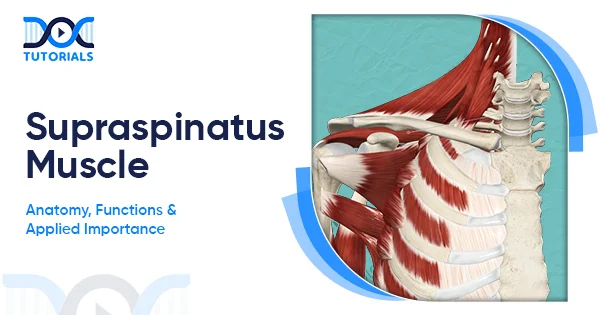
The supraspinatus muscle, being the smallest of the four rotator cuff muscles, is also the highest in anatomical position. It originates in the supraspinous fossa of the scapula, but its tendon passes inferiorly to the acromion, inserting into the superior facet of the greater tuberosity of the humerus.
The essential action of the supraspinatus is initiating shoulder abduction. Additionally, it provides dynamic stability to the glenohumeral joint. For both daily activities and clinical evaluations, the function of the supraspinatus is crucial.
Read on to learn more about it!
What is the Anatomy of the Supraspinatus Muscle?
The supraspinatus muscle is the most superior of the rotator cuff muscles, originating from the supraspinous fossa and inserting onto the superior facet of the greater tubercle of the humerus. Its anatomy, including its relations and the action of the supraspinatus muscle, must be comprehended properly for both clinical and exam purposes.
The supraspinatus is the most clinically significant and superior of the rotator cuff muscles. Originating from the medial portion of the supraspinous fossa, a shallow concavity above the scapular spine, its fibres converge into a strong tendon that passes beneath the acromion.
After crossing the subacromial space, the tendon crosses the superior aspect of the shoulder joint capsule to attach to the supraspinatus insertion on the superior facet of the greater tubercle of the humerus.
Located deep to the trapezius and superior to the infraspinatus muscle, it is anteriorly cushioned by the subacromial bursa that prevents friction of the tendon under the acromion and coracoacromial arch.
Innervated by the suprascapular nerve (C5–C6) and vascularised by the suprascapular artery with occasional contribution from the dorsal scapular artery, this muscle is structurally designed for precision over power.
Its key function is to initiate the first 0–15 degrees of arm abduction before the deltoid takes control. The action of the supraspinatus muscle is essential for initiating the upward movement of the arm. It also compresses the humeral head against the glenoid fossa, providing dynamic stability during supraspinatus muscle movements.
Due to its position within the subacromial corridor and its extensive functions, it is particularly prone to impingement, tendon degeneration, and rotator cuff tears; therefore, a clear understanding of its anatomy is fundamental for medical students and clinicians.
What are the Key Functions of the Supraspinatus Muscle?
The supraspinatus muscle is a critical component of the rotator cuff, responsible for initiating shoulder abduction and stabilising the humeral head during supraspinatus muscle movement. Innervated by the supraspinatus nerve, it works closely with the deltoid to coordinate smooth shoulder motions.
The tendons and anatomy of the supraspinatus muscle enable it to resist gravitational and translational forces at the glenohumeral joint, making it essential for dynamic stability and controlled upper-limb movements.
The following are its key functions:
- Shoulder Stabilisation
Functionally, the supraspinatus muscle acts as a crucial rotator cuff muscle, resisting the downward pull of the upper limb and keeping the humeral head pressed firmly against the glenoid fossa. Such dynamic stabilisation is important in the movement of the supraspinatus muscle to prevent any dislocations or excessive translation of the joint.
- Abduction Initiation
The supraspinatus muscle action is primarily responsible for the initiation of the first 0-15 degrees of shoulder abduction. Electromyography studies show it activates before other shoulder muscles, enabling smooth upward arm movement and setting the stage for the deltoid to continue abduction.
- Assistance to Deltoid
Beyond initial abduction, the supraspinatus assists the deltoid in lifting the arm from 15 to 90 degrees. Its tendon arrangement and anatomy enable effective force transmission while coordinating with other rotator cuff muscles to facilitate controlled upper-limb elevation.
- Structural Contribution to Force
The supraspinatus has anterior and posterior muscle bellies, each with distinct tendon structures. The anterior tendon bears greater stress and contributes more to abduction strength, while the posterior belly provides stability and alignment during the movement. It is this complex structure that underpins its efficient supraspinatus muscle action.
- Rotator Cuff Integration
Acting together with infraspinatus, teres minor, and subscapularis, the supraspinatus maintains glenohumeral joint integrity in all movements of the shoulder. It compresses the humeral head into the glenoid fossa, thereby preventing inferior displacement and ensuring smooth movement of the supraspinatus muscle.
- Role in Lateral Rotation
Although a weak muscle, the supraspinatus does provide some lateral rotation to the humerus to assist in fine-tuned positioning of the upper limb during overhead activities and shoulder functional movements.
- Clinical Relevance
Its passage under the acromion and the tendon blending with the joint capsule make the supraspinatus particularly prone to impingement, tears, and degeneration.
Understanding the function and structure of the supraspinatus muscle helps predict functional issues, thus aiding in rehabilitation or surgical planning.
FAQs about the Supraspinatus Muscle
- What is the empty can test for the supraspinatus?
The empty can test is a clinical diagnostic method used to assess the condition and possible impingement of the supraspinatus muscle and tendon. The arm is positioned in the scapular plane at 90 degrees of abduction with full internal rotation, thus imitating the action of emptying a can.
The doctor applies downward resistance while the patient attempts in order to maintain the position. Pain or weakness during this movement indicates a positive test, suggesting supraspinatus pathology.
- What are the consequences of an injury to the supraspinatus muscle?
A supraspinatus injury or tear, whether it is partial or full-thickness, almost always causes shoulder discomfort, movement limitation, and a significant loss of strength, particularly in abduction.
The patients have a tough time raising their arms, and each of their daily overhead activities causes them more pain due to the unstable position of the rotator cuff.
- What does the supraspinatus muscle mainly do?
The supraspinatus muscle is mainly responsible for the first 0–15 degrees of arm abduction and stabilises the humeral head by keeping it tightly seated in the glenoid cavity during shoulder movements.
It also plays an important role in controlled elevation and overall shoulder joint stability by preventing the humeral head from slipping downward.
- What is the blood and lymphatic supply of the supraspinatus muscle?
The supraspinatus is supplied primarily by the suprascapular artery with additional support from the dorsal scapular artery, both of which form important anastomotic networks around the scapula.
Lymphatic drainage runs to the posterior subscapular nodes, then to central and apical axillary nodes, before entering the subclavian lymphatic trunk for systemic drainage.
- How does the supraspinatus muscle grow through embryonic development?
The supraspinatus muscle comes from the dorsal pre-muscle mass of the upper limb bud at about five to six weeks of embryonic development.
With the formation of the scapular spine and acromion, the common myoblast mass that was previously joined divides into supraspinatus and infraspinatus, indicating their tight functional bond. This growth route is vital for the synchronised control of the glenohumeral joint.
Conclusion
The supraspinatus muscle is a small, however crucial, muscle among the four muscles of the rotator cuff that initiates abduction through its dynamic action, ensuring stability at the glenohumeral joint. A proper understanding of its anatomy and clinical relevance strengthens diagnostic acumen and surgical planning.
For added guidance in learning such high-yield concepts with confidence, DocTutorials provides 3D & 2D animated videos, CBME-based video lectures, and structured mentorship, ensuring aspirants have a clear understanding and can address any doubts about medical concepts.
Join DocTutorials today and explore our MBBS curriculum to excel in your medical career!

Latest Blogs
-

9 Essential MBBS Preparation Tips for Success
Achieving the dream of becoming a doctor is not easy. You need to be determined and have the right mindset…