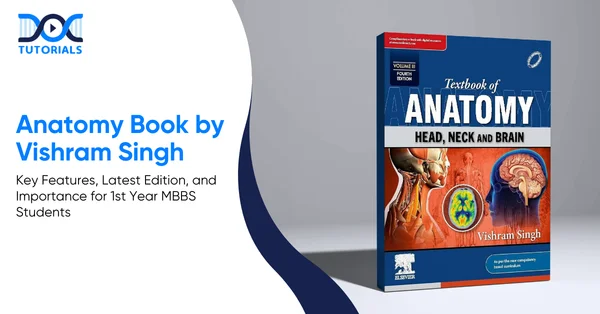
Anatomy Book by Vishram Singh: Key Features, Latest Edition, and Importance for 1st Year MBBS Students
MBBS students often face difficulties in understanding the complex concepts of anatomy. However, they need to grasp various aspects of anatomy to prepare themselves for professional exams as well as the MBBS syllabus.
In this regard, Vishram Singh Anatomy books deserve special mention. These books are specifically designed as guides for board and clinical exams for MBBS students. Anatomy handbooks by Vishram Singh, such as Selective Anatomy, General Anatomy, and Textbook of Anatomy, include clear explanations of multiple anatomy concepts in a simple and effective manner.
Here’s more on it!
A Brief Overview of Anatomy Book by Vishram Singh
MBBS, nursing, and dental students preparing for exams can consider Vishram Singh’s Anatomy Book. His books include straightforward language and illustrations for practical comprehension. They cover the upper limb/thorax according to the MCI syllabus, including the heart/lungs with clinical correlations, histology, embryology, and case studies.
Selective Anatomy Vishram Singh and his other books on anatomy play a crucial role for medical, nursing, and dental students. They include ample questionnaires and details to help MBBS 1st-year students prepare for exams. These books cover the anatomy of the upper limb and thorax as per the Anatomy syllabus recommended by the Medical Council of India.
They also cover the anatomy of the heart and lungs as per clinical correlation. Apart from basic information, these books provide knowledge regarding the histological, embryological, and anatomical basis of clinical conditions. The Clinical Correlation and Clinical Case Study features of his books help students gain knowledge regarding clinical practices.
Without any exaggerating details, these books include illustrations through diagrams and explanations through simple, understandable language, which is ideal for MBBS students.
Which is the Latest Edition of the Textbook of Anatomy by Vishram Singh?
The most recent editions of Vishram Singh’s books, Textbook of Anatomy (4th) and Selective Anatomy (3rd, 2 vols.), complement the competency-based MBBS curriculum offered by NMC. They support UG medical/dental students and exams like NEET, FMGE, USMLE, and PLAB with their current trends, lots of illustrations, straightforward language, and Clinical Correlation boxes.
The 4th edition of the Textbook of Anatomy by Vishram Singh is the latest edition of this book. Selective Anatomy comes in two volumes, and the 3rd edition is the latest version. All these books are upgraded as per the curriculum of competency-based undergraduate medical education and guidelines of NMC (National Medical Commission).
They use recent trends, extensive illustrations, and easily understandable language to help students learn anatomy concepts clearly. This book includes important developments in anatomy, using specific Clinical Correlation boxes in each chapter to apply facts practically.
It was created primarily for undergraduate medical students, but it also helps dental students and those preparing for exams like the NEET, FMGE, USMLE, and PLAB.
What are the Key Features of Anatomy Books by Vishram Singh?
Vishram Singh’s anatomy books include simple language with illustrations for easy comprehension. Clinical correlations for real-world application, chapter objectives for concentrated learning, golden facts for review, and PBL case studies effectively improve exam performance and clinical skills.
Here are some of the key features of the Anatomy Book by Vishram Singh:
- Simple and Clear Language
Anatomy books by Vishram Singh are written in easy language without exaggerating details to help students grasp the concepts quickly. These books include multiple visuals for quick understanding that help students understand anatomy concepts efficiently.
- Clinical Correlations
These books enhance practical knowledge for exams and integrate updated clinical applications throughout the text. This helps connect anatomical facts to real-world medical information, such as surgical details on the heart and lungs, helping students gain practical knowledge.
- Chapter Learning Objectives
The self-directed learning objectives at the beginning of each chapter help students concentrate on important subjects. This can monitor their progress and methodically get them ready for the NEET PG, USMLE, or FMGE exams.
- Golden Facts to Remember
End-of-chapter highlights serve as succinct revision tools to swiftly reinforce high-yield information. They also help capture essential points for viva-voce and competitive exams like PGME or PLAB.
- Clinical Case Studies
PBL-style cases at the end of chapters encourage problem-solving, foster analytical abilities, and connect theory to real-world situations for improved exam performance and patient care.
What is the Table of Contents of the Anatomy Book by Vishram Singh?
The table of contents for the latest textbook of Anatomy Upper Limb and Thorax Volume 1, 4th edition, includes 25 chapters in total. It includes MCQs (multiple choice questions) to help students revise the chapters. It includes chapters on the Bones of the Upper Limb, Axilla, Pectoral Region, Forearm, Arm, etc. Another textbook of Vishram Singh, General Anatomy, includes 17 chapters in total on Anatomical terminology, Cardiovascular System, Skeletal System, Joints, Muscular System, etc.
The table of contents for Textbook of Anatomy Upper Limb and Thorax Volume 1 includes the following:
- Preface to the Fourth Edition
- Preface to the First Edition
- Acknowledgments
- Reviewers
- Competency Map: Upper Limb and Thorax
Section 1: Upper Limb
- Chapter 1: Introduction to the Upper Limb
- Chapter 2: Bones of the Upper Limb
- Chapter 3: Pectoral Region
- Chapter 4: Axilla (Armpit)
- Chapter 5: Back of the Body and Scapular Region
- Chapter 6: Shoulder Joint Complex (Joints of Shoulder Girdle)
- Chapter 7: Cutaneous Innervation, Venous Drainage, and Lymphatic Drainage of the Upper Limb
- Chapter 8: Arm
- Chapter 9: Forearm
- Chapter 10: Elbow and Radio-ulnar Joints
- Chapter 11: Hand
- Chapter 12: Wrist Joints, Joints of the Hand, and Movements of the Hand
- Chapter 13: Major Nerves of the Upper Limb
- Chapter 14: Surface Anatomy of the Upper Limb
Section 2: Thorax
- Chapter 15: Introduction to Thorax
- Chapter 16: Bones and Joints of the Thorax
- Chapter 17: Thoracic Wall and Mechanism of Respiration
- Chapter 18: Pleural Cavities
- Chapter 19: Lungs (Pulmones)
- Chapter 20: Mediastinum
- Chapter 21: Pericardium and Heart
- Chapter 22: Superior Vena Cava, Aorta, Pulmonary Trunk, and Thymus
- Chapter 23: Trachea and Oesophagus
- Chapter 24: Thoracic Duct, Azygos and Hemiazygos Veins, and Thoracic Sympathetic Trunks
- Chapter 25: Surface Anatomy of the Thorax
- Multiple Choice Questions: Upper Limb and Thorax
- Index
The table of contents for General Anatomy—with Systemic Anatomy, Radiological Anatomy, Medical Genetics:
- Chapter 1: Introduction and History of Anatomy
- Chapter 2: Anatomical Terminology
- Chapter 3: Architecture and Design of the Human Body
- Chapter 4: Cells, Epithelium, Glands, and Connective Tissue
- Chapter 5: Skin, Superficial Fascia, and Deep Fascia
- Chapter 6: Skeleton: Bones and Cartilages
- Chapter 7: Joints
- Chapter 8: Vertebral Column
- Chapter 9: Muscular System
- Chapter 10: Cardiovascular System
- Chapter 11: Lymphatic System
- Chapter 12: Nervous System
- Chapter 13: Endocrine System
- Chapter 14: Digestive and Respiratory Systems
- Chapter 15: Urogenital System
- Chapter 16: Radiological (Imaging) Anatomy
- Chapter 17: Medical Genetics
How does the Anatomy Book by Vishram Singh help MBBS 1st Year Students?
Vishram Singh’s anatomy books are excellent for MBBS because they have vibrant diagrams that help with retention, straightforward language that facilitates rapid review, self-assessment multiple-choice questions and Golden Facts for USMLE, FMGE, and PLAB, and a free e-book with CT and MRI images that guarantees thorough clinical preparation and mobile learning.
Anatomy books by Vishram Singh include several clinical aspects, focusing on preparation for MBBS as well as other competitive exams. These books highlight all the crucial details of anatomy, ensuring comprehensive knowledge regarding anatomy. Here’s how it helps MBBS students:
- Illustration through Diagrams
The latest editions of anatomy books by Vishram Singh include line diagrams for better retention of knowledge and understanding. Students can memorise all concepts easily through the visualisation of the colourful diagrams.
- Helps in Easy Revision
The easy language of these books helps students revise all the important chapters thoroughly. Moreover, it answers all your anatomy-related questions in a simple and straightforward way. Thus, students can easily revise all the chapters.
- Self-assessment Tools
The self-assessment tools support thorough revision and confidence in the USMLE, PLAB, or FMGE. They include MCQs at the book’s end and Golden Facts for PG entrances, with N.B. sections for advanced insights.
- Digital Access
A free e-book makes it possible to study at any time with up-to-date images, such as CT/MRI, which is useful for mobile learning and topics that require a lot of visuals, like upper limb or thoracic sections.
FAQs about the General Anatomy Book by Vishram Singh
- What does the book Selective Anatomy by Vishram Singh represent?
Vishram Singh’s Selective Anatomy Prep Manual for Undergraduates provides a thorough, methodical study of anatomy by fusing sound theoretical underpinnings with meticulous analysis to enhance student learning.
- Which edition of Vishram Singh’s General Anatomy book is the most recent?
Vishram Singh’s General Anatomy with Systemic Anatomy and Radiology is presently in its fourth edition.
- What characteristics distinguish Vishram Singh’s books on anatomy?
Simple language for easy comprehension, colourful diagrams for memory retention, clinical correlations with case studies, chapter objectives, golden facts for review, multiple-choice questions for self-evaluation, and free e-books with CT/MRI are all features of Vishram Singh’s anatomy books. These are perfect for MBBS, NEET PG, and FMGE.
- What are the key topics covered in MBBS Anatomy?
Essential areas include types and derivatives of epithelium, thyroid/parathyroid glands, axillary artery, dermatomes of limbs, knee joint, sciatic nerve, saphenous vein/nerve, imperforate anus, midgut rotation, ectopic pregnancy, testicular descent, haemorrhoids, liver/uterus histology, and diaphragmatic/sciatic openings.
- Who is known as the father of human anatomy?
This title is earned by Andreas Vesalius, the son of a Belgian physician. His seminal work, De Humani Corporis Fabrica (Fabrica), was widely praised for its meticulous dissections and illustrations that transformed the study of anatomy.
- What is the difference between microscopic anatomy and gross anatomy?
A microscope is necessary to examine cells and tissues in microscopic anatomy, which is distinct from gross (macroscopic) anatomy, which is visible to the unaided eye.
- Why is human anatomy important?
It provides the basis for medical diagnosis, surgery, and comprehension of health by revealing body structures, their relationships, and the distinctive characteristics of organs.
- What distinguishes anatomy from physiology?
Anatomy studies the layouts and structures of the body, while physiology investigates how those components work together to support life.
- What are the primary categories of anatomy?
Key types encompass gross anatomy, microscopic anatomy, human anatomy, phytotomy (plant), zootomy (animal), embryology (developmental), and comparative anatomy (species differences).
- What constitutes examples in anatomy studies?
Anatomy explores organisms’ physical structures, such as muscles, heart, brain, bladder, and kidneys, detailing their form and organisation.
Conclusion
The Textbooks of Anatomy by Vishram Singh are perfect for MBBS 1st-year students. They include diagram illustrations and clear and concise texts for easy explanations. However, MBBS 1st-year students also require professional guidance or coaching to prepare effectively.
DocTutorials is a trusted name in this regard. Our online classes are conducted by expert faculty through video lectures. Additionally, we assess the student’s progress through Qbank and provide 2D and 3D animation models for better understanding and analysis.
Join our MBBS course for more information!

Latest Blogs
-
INI CET Exam Pattern 2027: A Complete Guide with Subject-Wise Weightage
INI CET Exam Pattern 2027: A Complete Guide with Subject-Wise Weightage The Institute of National Importance Combined Entrance Test (INI…
-

NEET PG Registration 2026: An Essential Guide For Exam Prep
The NEET PG registration, which is conducted online, is a crucial step in the exam process. Filling out the NEET…
-

NEET PG Exam 2025- Date, Pattern, Marking Scheme, Subject Wise Weightage, and Exam Mode
NEET PG Exam 2025 is the ultimate gateway for medical graduates aspiring to pursue postgraduate courses in medicine, including MD,…