Biochemistry By DM Vasudevan: Overview, Features, and Editions
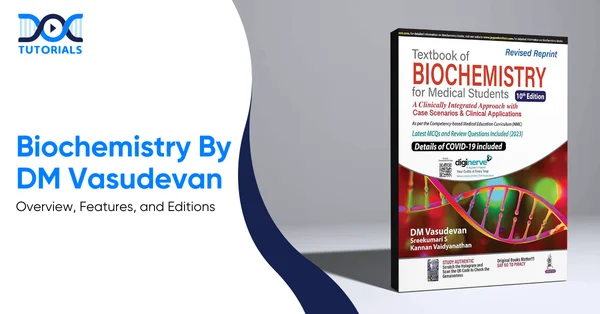
In the first year of the MBBS, Biochemistry provides a foundation for understanding other subjects, such as pathology and physiology. In order to establish this foundation, students require a clear and well-organised textbook. One of the most popular ones in India is Textbook of Biochemistry for Medical Students by Dr D.M. Vasudevan.
It is characterised by the use of simple language, systematic presentation and adherence to the MBBS syllabus. The guide covers an overview of studying first-year biochemistry with the Vasudevan Biochemistry book. Keep reading to know more.
DM Vasudevan’s Biochemistry Textbook: Overview
Textbook of Biochemistry by Vasudevan is a reliable MBBS textbook in India. It provides a detailed but easily comprehensible guide to biochemistry with well-organised chapters, illustrative images, and exercise questions.
Textbook of Biochemistry for Medical Students by Dr D.M. Vasudevan is a successful textbook on biochemistry widely accepted by MBBS students in India.
The book was first published in 1995 and has been revised several times over the years; the 10th edition was published in 2022, and a revised reprint in 2023. It is written by Dr Vasudevan, an AIIMS-trained biochemist, and is specifically oriented toward medical students.
It is known for its simple descriptions, practical illustrations, and good clinical correlations that refer to the fundamental biochemical concepts to actual medical practice to ensure that the students develop understanding and application abilities.
Key points about the Vasudevan Biochemistry book:
- The Medical Council of India (MCI) endorses it, and it is commonly used in Indian medical colleges. It is a good exam-friendly textbook commonly recommended by senior students.
- The style of writing is simple and clear. Past editions have been made concise to eliminate irrelevant information and focus on high-yield information.
- The book is full of learning tools: almost 50 chapters in 6 organised sections (Chemical Basis, Metabolism, Clinical Biochemistry, Nutrition, Molecular Biology, Advanced Biochemistry), and hundreds of figures and tables (approximately 1000 figures and 200 tables according to one analysis).
- Nearly all chapters are followed by learning exercises (essays, quick notes, MCQs, viva-style prompts) to facilitate exam preparation. Clinical case studies are used to relate theory to patient scenarios.
In general, Vasudevan’s biochemistry book is a comprehensive, exam-oriented textbook. Reviews have found it “comprehensive and student-friendly,” with a focus on explaining and highlighting its relevance to practice.
Concisely, it serves to equip MBBS students with depth and practice in biochemistry.
Table of Contents of Vasudevan’s Biochemistry Book
The 10th edition of Vasudevan Textbook of Biochemistry consists of 45 chapters organised in six parts and encompasses the whole of the first year MBBS syllabus. It goes beyond introductory biochemical principles to clinical practices, molecular biology, and advanced information, while keeping the conceptual comprehension clear in the MBBS course.
The 10th edition of Vasudevan’s textbook is divided into thematic parts that cover all the first-year MBBS topics. Each section is composed of several chapters, with 45 chapters in edition 10. The contents (as listed on the official site) are as follows:
| Section (Part) | Topics Covered |
| A. Chemical Basis of Life (Ch 1–6) | Cell structure and organelles, biomolecules (amino acids, proteins, carbohydrates, lipids), the fundamentals and kinetics of enzymes. |
| B. General Metabolism (Ch 7–20) | Energy and metabolism: Glycolysis, TCA cycle, electron transport, carbohydrate metabolism (glucose, glycogen, diabetes), lipid metabolism (fatty acids, cholesterol, ketone bodies), amino acid metabolism and urea cycle, inborn errors of metabolism. |
| C. Clinical & Applied Biochemistry (Ch 21–27) | The analysis of body fluids and laboratory tests: liver and kidney function tests; plasma proteins; acid-base balance; electrolytes and free radicals; drug detoxification (biotransformation). |
| D. Nutrition (Ch 28–32) | Vitamins (fat and water soluble); metabolism and deficiencies of minerals; energy metabolism and nutrition; environmental toxins (heavy metals). |
| E. Molecular Biology (Ch 33–38) | Nucleotides and nucleic acids; DNA structure, replication, transcription, translation, genetic control, mutations, cell cycle, recombinant DNA technology, and gene therapy, molecular diagnostics. |
| F. Advanced Biochemistry (Ch 39–45) | Special topics: Clinical laboratory methods and instrumentation; immunochemistry; biochemistry of AIDS/HIV and cancer; extracellular matrix proteins; hormones; use of isotopes in medicine. |
Key Features of Vasudevan’s Biochemistry Textbook
The Textbook of Biochemistry for Medical Students by Vasudevan is renowned for its full coverage of the syllabus, straightforward language and clinical orientation. It has been tailored to the MBBS examinations by providing summaries, MCQs, viva questions, and high-yield content to revise.
There are a number of strengths that made Vasudevan’s biochemistry textbook popular among students and teachers:
- Comprehensive Coverage: The book focuses on the entire MBBS biochemistry syllabus elaborately, so no major aspect is overlooked. It has been reviewed as covering the entire syllabus with good clinical focus.
- Student-Friendly Presentation: The concepts are described using simple language with flowcharts and tables to simplify comprehension. Its clear explanations, detailed explanations, and good clinical correlations are well appreciated.
- Exam-Oriented Structure: Each chapter has summaries, MCQs, short notes, and viva questions to be actively memorised and designed for MBBS examinations. Newer editions have greater content that is high yield by reducing redundant information.
- Visual Aids: The book is organised into pathway charts, structures, and clinical images with approximately 1000 diagrams and 200 tables that simplify complicated topics and make retention easier.
- Clinical Relevance: Disease-based discussions and clinical case studies connect biochemical pathways to clinical practice, supporting theory and exam-based case studies.
- Updated Content: The 10th edition is consistent with the latest MCI/NMC guidelines, with almost all new topics such as nutrition and environmental biochemistry, and removing obsolete information.
How is Biochemistry by DM Vasudevan Aligned with the MBBS Curriculum?
The textbook by Vasudevan is also consistent with the competency-based MBBS curriculum, as it combines biochemistry with physiology and pathology to provide a clear comprehension. It discusses high-yield and content such as glycolysis, TCA cycle, enzyme kinetics, and major clinical biochemistry topics in a systematic and exam-oriented manner.
The main advantage of the textbook by Vasudevan is that it closely follows the national MBBS curriculum. The NMC’s competency-based program is more focused on integrating physiology and pathology, and the book reflects this. As an example, such issues as diabetes are described using clear biochemical peripherals, which support parallel learning in physiology.
All the key high-yield areas of the MBBS syllabus, including glycolysis, the TCA cycle, enzyme kinetics, and the metabolic pathways, are discussed in depth. It also accommodates the core clinical biochemistry, such as liver and kidney function tests, metabolic disorders, and vitamin deficiencies, as per the updated MCI/NMC guidelines.
The book is based on an integrated approach that relates the biochemical concepts to clinical practice and molecular biology. This will make sure that learners studying through Vasudevan fully cover the prescribed curriculum in an organised and exam-relevant manner.
Vasudevan’s Biochemistry Textbook: Editions, Updates, and Pricing
Vasudevan’s biochemistry textbook is a reliable resource among all MBBS students; the most recent version corresponds to the current syllabus, with the 11th edition anticipated in 2025. It is widely available in bookstores, and older and second-hand copies are available at reduced prices.
Vasudevan’s biochemistry textbook has been used since the first edition in 1995, and new editions are published every 3-4 years. Its 10th edition was published in 2022 (reprinted in 2023), and the 11th edition is anticipated sometime before 2025.
It is usually recommended that students stick to the recent version to keep up with the updated syllabus. Retail sources price the 10th edition at about ₹1600-1700 for students requesting the price of the book.
Old versions (9th, 8th, etc.) can be found second-hand at a lower price, but take into account that they are not updated to the latest versions. The important aspects that should be noted regarding editions and availability include:
- 10th Edition (2022/2023): Most colleges use the current edition. Meets the recent syllabus requirements.
- 9th Edition: Past edition, which is useful in case you discover it. (Same as 10 th with some updates possibly missing.)
- 8th Edition (and earlier): Inapplicable to the present curriculum, yet can be used as supplementary reading.
- 11th Edition: Planned by mid-2025; it is likely to undergo additional changes.
- Practical and Dental Editions: They have separate books on Practical Biochemistry (4th edition) and Dental Biochemistry (4th edition).
Vasudevan textbooks are sold in many bookstores (both online and offline). Students usually purchase a new 10th directly, but second-hand copies at a lower price are also available.
What’s New in the 11th Edition of Vasudevan’s Biochemistry Textbook?
The 11th edition of Vasudevan Biochemistry is revised to include 40 or more new clinical cases, more images and illustrations, and a research appendix of 1000 or more MCQs and viva questions as a bonus booklet.
The 11th edition of Vasudevan’s Textbook of Biochemistry for Medical Students incorporates major updates that are based on CBME 2024 and NMC standards that reinforce learning approaches that are competency-based.
Here’s what is new:
- Addition of chapters on COVID-19, Molecular Diagnostics, Laboratory Medicine, and Immunology.
- Chapters on Clinical and Applied Biochemistry have been updated, along with clinically relevant points.
- Advances in Molecular Biology have been added.
- Learning objectives are given at the beginning of each chapter.
- Competencies are covered in the chapters.
- Case Studies given in boxes for Early Clinical Exposure.
- Clinically relevant points are highlighted in Clinical Application Boxes in every chapter.
- Each chapter ends with:
- Key Concepts
- Summary
- Clinical Case Studies
- Essay Questions, Short Answer Questions, MCQs and Viva Voce Questions and Answers
- Enriched with 1200+ figures, 200+ tables and 200+ boxes, altogether making it more student-friendly
- Complementary Online Student Resource includes Key Concepts, Clinical Case Studies, Review Questions, Viva Voce Questions, Questions with Clinical Applications, MCQs, Self-study Exercises, and Important Metabolic Cycles
Practical Manual of Vasudevan Biochemistry Book
The Practical Manual of Vasudevan Biochemistry is an additional text to the main textbook, and the topics include qualitative and quantitative laboratory experiments with explicit procedures and theory in accordance with the up-to-date MCI/NMC curriculum.
The practical Vasadevan books and the theory volumes are usually used by the MBBS students as a major resource in examination and laboratory assignments.
In addition to the main MBBS book, Dr Vasudevan has come up with a practical handbook book to include:
- Offers laboratory advice to biochemistry practical courses.
- Both qualitative and quantitative experiments are covered in accordance with the syllabus.
- Incorporates stepwise instructions and theory.
- Revised based on the existing MCI/NMC curriculum (newer manuals updated to reflect the same).
- So far, four editions have been released.
- The new version has newer laboratory methods and quality control issues.
- Intended to fill the gap between theories and clinical practice.
- Learning is aided by the use of life situations and a comprehensive illustration.
Comparison: Vasudevan and Other Textbooks
Vasudevan is recommended because it has the right mix of depth and an exam orientation of the studies, which is perfect to prepare students for MBBS and NEET PG. Harper is more researched and detailed, and Satyanarayana is easier to read about.
Preference is given to Vasudevan due to its examination-based approach and balanced comprehensiveness. Whereas Harper is the research standard and Satyanarayana is a simplistic setting, Vasudevan fills the professional medical examination gap.
Check out the table below:
| Feature | D.M. Vasudevan | Harper’s Illustrated Biochemistry | U. Satyanarayana |
| Depth | Balanced (Exam + Clinical) | Very High (Research level) | Moderate (Simplified) |
| Language | Simple, Student-friendly | Dense, Technical | Very Simple |
| Exam Utility | Very good for University and NEET PG. | With concepts, they are good, but hard in writing exams. | Good to pass University exams. |
| Flowcharts | Excellent | Complex | Good |
| Best For | Overall Best Choice | Top 1% students / Reference | Students struggling with the basics |
FAQs about Vasudevan’s Biochemistry Textbook
1. Is Vasudevan’s book good for first-year MBBS Biochemistry?
Yes. It is applied in India most frequently and is focused on MBBS students, so it can be suitable for university exams and NEET.
2. Which edition of Vasudevan should I buy?
The most recent edition should be used, since it covers the latest NMC syllabus. Older editions might not be revised.
3. Are there Vasudevan books for other courses?
Yes. Dental students have a separate edition, and there is a practical biochemistry manual specific to the course specifications.
4. How does Vasudevan compare with other biochemistry textbooks?
It is brief and exam-oriented. It is simpler and aligned with the university trends as compared to other books, such as Harper’s and Lippincott.
5. Is Vasudevan useful for NEET PG preparation?
Indeed, it assists in developing strong basics. Nevertheless, it must be used together with MCQ practice books and revision books.
6. Are metabolic pathways explained clearly?
Yes. The most important pathways are illustrated in a step-by-step format, with supporting diagrams.
7. Does the book include clinical case studies?
Yes. Recent editions introduce the use of clinical case discussions to connect the theory to its practical implementation.
8. Does Vasudevan follow the NMC competency-based curriculum (CBME)?
Yes. The latest editions are revised in accordance with NMC CBME guidelines.
9. Is the Vasudevan Practical Manual necessary?
Yes, for practical exams. It addresses the necessary qualitative and quantitative experiments.
10. Is Vasudevan suitable for self-study?
Yes. It is well organised with summaries and practice questions, which help in independent learning.
Conclusion
D.M. Vasudevan’s Textbook of Biochemistry for Medical Students remains a reliable source of information to first-year MBBS students, presenting difficult concepts in an easily understandable way.
To get additional academic assistance, DocTutorials can be your study partner. We offer in-depth resource materials, like 2D & 3D video lectures, along with structured mentorship and guidance. Join DocTutorials today and explore our MBBS curriculum to excel in your medical career!
Latest Blogs
-
INI CET Exam Pattern 2026: A Complete Guide with Subject-Wise Weightage
The Institute of National Importance Combined Entrance Test (INI CET) is your key to entering some of the most prestigious…
-
NEET PG Registration 2026: An Essential Guide For Exam Prep
The NEET PG registration, which is conducted online, is a crucial step in the exam process. Filling out the NEET…
-

NEET PG Exam 2025- Date, Pattern, Marking Scheme, Subject Wise Weightage, and Exam Mode
NEET PG Exam 2025 is the ultimate gateway for medical graduates aspiring to pursue postgraduate courses in medicine, including MD,…