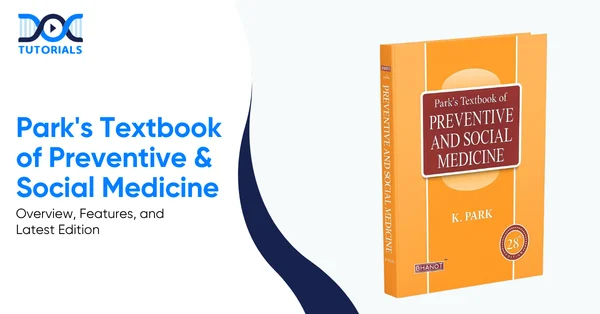
Park’s Textbook of Preventive & Social Medicine: Overview, Features, and Latest Edition
Preventive and Social Medicine, or Community Medicine, is one of the important branches in the MBBS 3rd year. Among many resources, Park’s Textbook of Preventive and Social Medicine is a simple and practical guide for students.
It provides detailed, structured content on community medicine, aligned with the study style and examination requirements. The engaging illustrations and flowcharts provide clear, easy-to-understand information for students, helping them gain deeper insight into the subject.
Keep reading to know more about the Park’s textbook and its key details.
Overview of Park Textbook, Latest Edition
The K Park PSM book is an essential textbook for 3rd-year medical students seeking to understand community medicine. It provides a deeper understanding of preventive and social medicine, helping students gain expertise in the field.
The Park PSM textbook is widely regarded as the gold standard in PSM and is recommended in almost all medical colleges for third-year students. The latest edition of the Park’s textbook of preventive and social medicine includes simplified versions, summaries, and classroom-style notes.
It helps students break down complex topics into simpler concepts and understand them effectively without undue stress. The book is designed to serve as an essential resource for 3rd-year MBBS students in preventive and social medicine. It provides a detailed understanding for students, researchers, healthcare professionals, and aspiring doctors.
The Community Medicine Park textbook is a detailed and comprehensive guide for students. Therefore, it is advisable to study the textbook slowly and effectively, rather than memorising concepts, as this can lead to confusion.
Key Features of the Park PSM Textbook New Edition
The PSM book by K Park covers the entire curriculum and is the standard reference for community medicine for 3rd-year students, thanks to its strong biostatistics section and up-to-date public health data.
The new edition of Park PSM includes several essential details of preventive and social medicine in greater depth. Here are the important characteristics of the PSM book by K. Park that make it suitable for the 3rd year MBBS candidates:
- Covers the Entire Curriculum: The K. Park textbook thoroughly addresses all essential topics in preventive and social medicine as prescribed in the 3rd-year syllabus, ensuring clear conceptual understanding and exam readiness.
- Most Reliable and Standard Reference: The Park PSM book, latest edition, is recognised as an authoritative and trusted resource by students, educators, and healthcare professionals, thanks to its accuracy and structured presentation.
- Strong Epidemiology and Biostatistics Sections: The textbook provides clear, detailed explanations of key concepts, study designs, data interpretation, and practical applications of theory, making complex topics easy to understand.
- Updated Health Programs and Public Health Data: The new edition of Park PSM includes the latest National Health programs, recent policy updates, and current public health statistics to keep the readers aligned with the current guidelines and examination trends.
Table of Contents of the PSM Park Book
The PSM by Park is a well-structured book on preventive and social medicine, providing a detailed understanding of the community health care in a phased manner to enhance the conceptual clarity of the subject.
Here is a list of chapters available in the Park PSM for a better and more detailed understanding of community medicine:
- Man and Medicine: Towards Health for All
- Concept of Health and Disease
- Principles of Epidemiology and Epidemiological Methods
- Screen for Disease
- Epidemiology of Communicable Diseases: It includes respiratory infections, intestinal infections, arthropod-borne infections, zoonoses, surface infections, emerging and re-emerging infectious diseases, and hospital-acquired infections.
- Epidemiology of Chronic Non-Communicable Diseases and Conditions: It covers cardiovascular diseases, coronary heart disease, hypertension, stroke, rheumatic heart disease, cancer, diabetes, obesity, blindness, and accidents and injuries.
- Health Programs in India
- Demography and Family Planning
- Preventive Medicine in Obstetrics, Paediatrics, and Geriatrics
- Nutrition and Health
- Medicine and Social Sciences
- Environment and Health
- Hospital Waste Management
- Disaster Management
- Occupational Health
- Genetics and Health
- Mental Health
- Health Information and Basic Medical Statistics
- Communication for Health Education
- Health Planning and Management
- Healthcare of the Community
- International Health
What are the Strengths of the Park PSM Textbook?
The preventive and social medicine by Park is useful for several specific conditions. The book is the gold standard as the primary textbook for 3rd-year MBBS students, providing conceptual clarity and support for university exams.
Here are the common arenas where the textbook is used as a primary resource:
- Primary Textbook: Preventive and Social Medicine (PSM) is a primary resource for MBBS 3rd-year students, serving as core study material throughout the course.
It is a systematic study of all essential topics according to the university syllabus, making it suitable for regular study and revision. Students can rely on the book for detailed explanations and practice questions fr better study.
- Conceptual Clarity: The textbook provides a detailed analysis of all community medicine concepts, covering core fundamentals.
The complex topics are broken down into simpler sections, helping students grasp them effectively. Therefore, it is useful for learners who want a deep understanding of the subject.
- Helps in University Exams: The textbook is specifically aligned with the university exam patterns for 3rd-year MPBS students, supporting effective exam preparation.
It includes all the key questions and reference materials that help students score well in their MBBS. Additionally, the structured presentation of the textbook makes it a reliable guide for students seeking high marks.
Tips to Study the Park’s PSM Textbook
The Park book on Community Medicine is a comprehensive guide to the field. Therefore, it requires a careful strategy and guidance to cover the book comprehensively without confusing the concepts.
Follow these simple tips to cover the Community Medicine K Park effectively:
- Park’s PSM is a detailed guide to community medicine. Students should break complex concepts into smaller parts to cover them effectively.
- Take the help of Lowcharts for National Health Programs for better memorisation.
- Practice biostatistics numerals regularly to solidify concepts.
- Revise the core concepts of epidemiology every few weeks to keep the concepts fresh in your mind.
- Analyse the concepts using real-world examples to internalise them effectively.
- Focus on preparing for practicals, as they offer easy marks.
- Use a separate notebook to practice the PSM diagrams for better understanding.
- Preventive and Social Medicine becomes convenient and easy if you study it consistently, and not all at once.
FAQs about the Park PSM Textbook
- What is the Park PSM textbook?
Preventive and Social Medicine by Park is a popular textbook in Community Medicine, informally referred to as Park PSM. It covers epidemiology, biostatistics, national health programs, environmental health, and public health concepts, making it a necessary resource for MBBS students and those pursuing a career in public health.
- Who is the author of Park PSM?
Park PSM is written by a well-known specialist in Community Medicine, K. Park. The book has been incredibly popular with the medical students in India over the decades due to its organised and exam-oriented strategy.
- Why is Park PSM popular among MBBS students?
Park PSM is widely used because it describes public health concepts in a straightforward way and covers the exam syllabi of universities. It contains revised national health programs, definitions, and data, most commonly used in exams and competitive tests.
- Is Park PSM enough for university exams?
Yes, university exams should be no problem as long as Park PSM is studied properly. Nevertheless, students tend to add it up with the class notes along with the past year’s question papers to present their answers better and score higher.
- Does Park PSM help in NEET PG preparation?
Park PSM provides a strong conceptual foundation for NEET PG. While detailed, it is primarily used by aspirants for theoretical clarity and is often combined with MCQ-based preparation books for competitive exam practice.
- How often is the Park PSM updated?
Park PSM is updated regularly to contain newer national health programs, statistics and policies in the area of public health. It is suggested that students should use the most recent version so that information and program descriptions are accurate.
- Is the Park PSM difficult to understand?
Park PSM is dense with information and statistics for some students. Nevertheless, it is easier to read regularly and pay attention to the main headings, definitions, and summaries in order to understand and memorise.
- What topics are covered in the Park PSM textbook?
The book covers epidemiology, biostatistics, communicable and non-communicable diseases, environment-related health, nutrition, health programs, and health management, thereby comprehensively addressing the Community Medicine syllabus.
- How should one study Park PSM effectively?
Students should read it topic-wise, make concise notes, highlight definitions, and revise national health programs regularly. Practising previous year questions alongside reading improves retention and answer-writing skills.
- Is Park PSM useful for postgraduate public health courses?
Yes, Park PSM is useful in the post-graduate entrance examination and the elementary course in public health. It develops conceptual understanding in epidemiology and health systems, which is vital in further education on health.
Conclusion
Park’s Textbook of Preventive and Social Medicine remains the cornerstone resource for Community Medicine in the MBBS 3rd year. When studied strategically, Park PSM builds a solid public health foundation for NEET PG and future postgraduate training.
For any MBBS student aiming to master Preventive and Social Medicine with confidence, Park remains the most reliable starting point. For added guidance, DocTutorials can be your study partner. We offer in-depth resources, including 2D & 3D video lectures and structured mentorship, helping aspirants gain clarity on complex medical concepts.
Join DocTutorials today and explore our MBBS curriculum to excel in your medical career!
Latest Blogs
-
INI CET Exam Pattern 2026: A Complete Guide with Subject-Wise Weightage
INI CET Exam Pattern 2026: A Complete Guide with Subject-Wise Weightage The Institute of National Importance Combined Entrance Test (INI…
-

NEET PG Registration 2026: An Essential Guide For Exam Prep
The NEET PG registration, which is conducted online, is a crucial step in the exam process. Filling out the NEET…
-

NEET PG Exam 2025- Date, Pattern, Marking Scheme, Subject Wise Weightage, and Exam Mode
NEET PG Exam 2025 is the ultimate gateway for medical graduates aspiring to pursue postgraduate courses in medicine, including MD,…