ini-cet Archives - Page 2 of 4 -

Cracking INI CET: The MCQ Strategy That Got Dr Sairaj Rank 8 
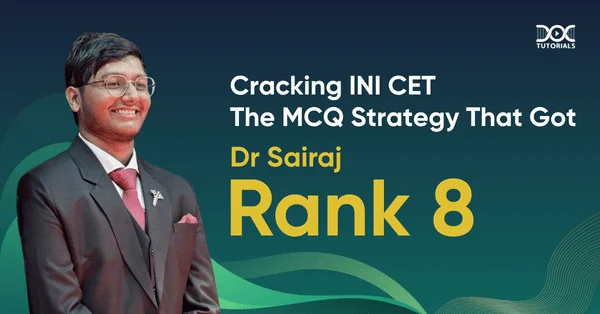
Dr Sairaj rank -8

There is a very common myth in the medical community that you need to crack your postgraduate entrance exam on your very first try to be considered a truly brilliant student. But the reality of medical exams in India is completely different. These exams test your emotional endurance and your persistence just as much as they test your clinical knowledge. 

Dr Sairaj Mane proved this reality by securing a massive All India Rank 8 in the highly competitive INI CET exam. What makes his story incredibly inspiring is that this was his third attempt after finishing his internship. His journey is the perfect example of how studying smartly, analyzing your mistakes, and staying fiercely consistent will eventually bring you to the absolute top of the list. 

Securing a single digit rank in an exam that sees thousands of the brightest minds competing for limited seats is no accident. Dr Sairaj did not rely on luck, and he certainly did not try to read textbooks all day. He used a highly calculated, practical approach to his preparation. 

If you are a medical student tired of reading endless notes and not seeing your mock test scores improve, grab a notebook. Here is the exact strategy, the mindset shift, and the daily study setup Dr Sairaj used to conquer the exam. 

Want to hear the full story from Dr. Sairaj Mane in his own words? Watch his complete interview right here:  

Why Just Reading Notes Fails 

The biggest trap medical aspirants fall into during their preparation phase is the illusion of reading. When you sit at your desk with a fresh highlighter and a massive textbook, reading feels incredibly productive. You spend ten hours flipping pages, and you go to sleep feeling like you have conquered the syllabus. 

The problem with only reading notes is that everything seems important. Your brain simply stops actively thinking. You never realize your actual weak areas until you sit for a test and all four options look exactly the same. 

Dr Sairaj realized early in his journey that just mugging up facts was not going to work for a tricky exam like the INI CET. The exam does not just test your memory anymore. It tests your ability to apply a concept to a twisted clinical scenario. He knew he needed a system that actively exposed his weak points and forced him to understand the core mechanism of a disease. 

As he said in his own words: 

“Mugging up things did not work out well for me. The real game is all about building strong concepts”   

The MCQ First Approach 

The biggest change for Dr Sairaj was stepping away from basic reading. He shifted his focus to solving multiple choice questions (MCQs) every single day. He adopted a daily routine known as the retrospective study method. 

Many students divide their day by keeping 80 percent of their time for reading notes and only 20 percent for solving questions. Dr Sairaj completely flipped this rule. He maintained a strict ratio for his daily schedule. If he read theory for three hours, he would strictly spend six solid hours solving MCQs. 

Why is this so effective? Because solving questions is a diagnostic tool. When you are reading notes, your brain assumes it knows everything. But when you are forced to choose the right answer among four very similar options, your true preparation level is exposed. 

By solving questions for six hours a day, he found out exactly which concepts he was repeatedly forgetting. Every time he made a mistake, he went backward. He opened his notes to clear that specific concept. This retrospective method meant he was only spending time reading the exact things he did not know, rather than wasting hours rereading things he had already mastered. 

Furthermore, he noted that aggressively solving MCQs automatically leads to multiple revisions without you even realizing it. Every time you solve a mixed subject test, you are forcing your brain to recall old information, keeping it completely fresh for exam day. 

How DocTutorials Helped His Journey 

To execute this heavy MCQ strategy and build his core concepts, Dr Sairaj trusted the DocTutorials platform. He used a very smart mix of recorded video lectures, daily testing tools, and specialized revision series to stay on track and save massive amounts of time. 

1. Falling in Love with Weak Subjects: Every medical student has that one subject they absolutely hate. For Dr Sairaj, Biochemistry was his weakest link. It is a notoriously dry subject filled with volatile cycles and complex enzymes that most students simply try to cram at the last minute. But after watching Dr Priyansh Jain Biochemistry video lectures on DocTutorials, his entire mindset shifted. The focus on clear, logical concepts helped him completely fall in love with the subject, and it eventually became his absolute favorite. 

He also relied heavily on the Medicine faculty to build his clinical base. He specifically pointed out Dr Rahul Rajeev and his ability to brilliantly simplify the CVS and CNS modules. When expert teachers make your core concepts clear, you stop relying on pure memory. You can logically figure out the right answer directly inside the exam hall. 

2. Building Discipline with the Daily Dose: When you are studying alone for months, maintaining discipline is the hardest part. To keep his brain constantly engaged, Dr Sairaj made the DocTutorials Daily Dose tests an absolute rule in his routine. 

The app provided him with 10 fresh questions in the morning, 10 in the afternoon, and 10 in the evening. This constant, low pressure testing provided a much-needed adrenaline rush throughout the day. Taking these small tests helped him constantly brush up on volatile topics he might have otherwise forgotten. This daily habit ensured he never lost touch with his older subjects while focusing on new ones. 

3. Smart Final Month Revision with RDx: In the last month of preparation, time is your most precious asset. You cannot afford to spend an hour reading a long text explanation for every single mock test question you get wrong. 

During the critical final weeks for the INI CET, Dr Sairaj focused entirely on the DocTutorials RDx Series. The RDx is specifically designed to push students to their maximum potential. But the biggest advantage for him was the online video solutions provided for these tests. Instead of reading detailed text explanations, he just watched the video solutions. This saved him massive amounts of time and allowed him to catch the exact thought process of the faculty, teaching him how to eliminate wrong options instantly. 

The Exact Study Plan 

Dr Sairaj used a highly systematic approach to his studies. He treated his preparation like a clinical protocol. Here is the exact blueprint you can copy for your own study plan. 

The Mindset Shift and the 20th Notebook 

A major concern for many students is how to manage their exam preparation while doing a busy internship. Dr Sairaj offered a very realistic view on this. He noted that out of the entire year, only two to three months of hospital postings are genuinely exhausting. For the remaining months, the postings usually last around four to five hours a day. 

His advice is simple. Do not wait for a perfectly free day to start studying, because that day will never come. You have to steal time. Whenever you get a free hour in the hospital, open your phone and watch a video lecture or solve a quick block of questions. Starting from day one of your internship is the key to staying ahead. 

For people who feel stuck at a certain score, his biggest advice is to strictly limit your study material. Whatever source you have chosen, stick to it with total faith and ensure you revise it at least two to three times. Changing books in the middle of your preparation is a guaranteed way to confuse your memory. 

But the most critical piece of advice Dr Sairaj shared is the absolute necessity of creating a 20th Notebook. 

Medical PG preparation usually requires making individual notebooks for all 19 subjects. But the 20th Notebook is different. This is a highly customized, personal notebook filled only with the tiny details, volatile facts, and specific concepts that you personally get wrong in your daily tests. It should not contain basic concepts that you already know. 

When the actual exam is just four to seven days away, opening huge textbooks or your main subject notes will only create a huge mess and cause extreme panic. You simply cannot read everything in a week. Your 20th Notebook should be fully ready for those final seven days. Because it contains only your specific weaknesses, revising it ensures you will not lose silly marks on the things you tend to forget the most. It becomes your ultimate exam savior. 

The Conclusion 

Securing Rank 8 in one of the toughest medical exams in the country does not happen by accident, and it certainly is not restricted to first attempt candidates. It is the direct result of shifting your entire focus from blind reading to active MCQ solving. 

Dr Sairaj Mane proved that persistence always wins. If you want to replicate his incredible success, you need to change your daily habits. Stop trying to memorize every single line in your textbook. Focus heavily on understanding the core concepts. To make this journey easier, trust DocTutorials to build your clear concepts and streamline your daily practice. Our structured video lectures and targeted tests give you the exact edge you need for a flawless final revision.  

Use the right video lectures, take your daily mock tests seriously, and stay persistent through all your attempts. Your top rank is waiting for you to claim it. All the very best. 

Want to hear the full story from Dr Sairaj Mane in his own words? Watch his complete interview right here: [Interview Link] 

NEET PG Online Live Power Pack
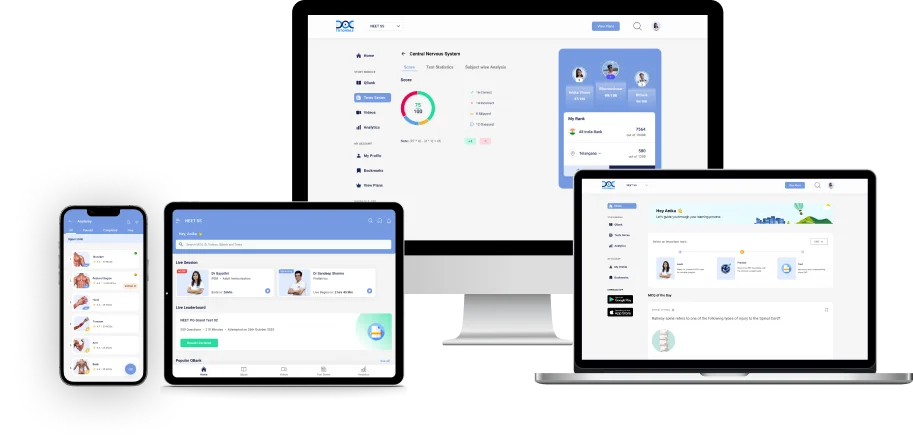
DocTutorials App Download Now

Latest Blogs

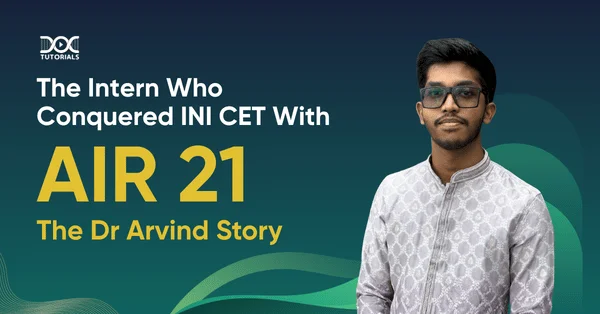
The Dropper Who Conquered INI CET With AIR 21: The Dr. Arvind Story 

Let’s be very honest right now. Taking a really tough medical entrance test, waiting nervously for the results, and then getting a rank much lower than you hoped for is deeply heartbreaking. It makes you doubt everything. You question your hard work, your study guides, your daily plans, and sometimes, even your own intelligence. That was the exact difficult situation Dr. Arvind faced after his NEET PG test. 

He had started his preparation early, balancing books alongside his tight house surgency at TDMC, Alappuzha. But when the NEET PG results came out, his rank was not what he had expected. For many aspirants, this is the breaking point. But for Dr. Arvind, it was simply a reality check. He knew his house surgency was finally over, which meant he finally had the one thing every intern desperately craves: time. 

He sat at home, built a steady plan, and quietly went to work. A year later, the results of the INI CET were released, Dr. Arvind’s name sat right at the top of the list with a massive All India Rank 21. 

In a recent interview, Dr Arvind explained how he climbed to the top after failing his first attempt. If you are a dropper right now, grab a pen and take notes from his journey. 
Want to hear the full story from Dr. Arvind in his own words? Watch his complete interview right here: 

The INI CET Secret: Cracking the “Top 6” Subjects 

Ask any senior, and they will tell you that the INI CET has a very specific pattern. While the NEET PG exam tests a broad spectrum of clinical knowledge, the INI CET loves to test how strong your absolute basics are. 

When asked to name his top subjects for this specific exam, Dr. Arvind did not point to Medicine or Surgery first. Instead, he pointed straight to the first and second-year subjects. 

His golden six for INI CET are Anatomy, Microbiology, Pharmacology, Pathology, Biochemistry, and Physiology. 

Why are these so important? Because INI CET examiners often frame questions in a tricky way. They may give you a long clinical case that looks completely like a Medicine or Surgery question. You will focus on the symptoms, investigations, and patient history. But in the end, the options will actually test your basics like the biochemical defect, the pharmacology receptor, or the exact anatomical nerve involved. 

If your base in these six fundamental subjects is weak, you will lose the mark, no matter how good your clinical diagnosis is. Dr Arvind realized this early on. He focused heavily on building an unbreakable foundation in these basic sciences, ensuring that no matter how twisted the clinical scenario was, he could always trace it back to the core concept. 

The “Active Listening” Hack 

One of the biggest struggles for any medical student taking a drop year is staying awake and focused during long video lectures. Sitting alone in your room watching a screen for six to eight hours a day can quickly burn you out. Even if your eyes are on the screen, your brain is completely switched off. 

Dr. Arvind joined the DocTutorials Online Live Batch to keep his routine strict. But the real gamechanger for him was how he took notes. 

Instead of starting with completely blank pages or relying entirely on printed handouts, he used partially filled workbooks. This is a brilliant strategy for active learning. Because the workbook already has the structure and the basic text printed, you do not have to waste time frantically copying every single word the faculty says. 

However, because the workbooks have specific blanks for high-yield points, keywords, and critical flowcharts, you are forced to actively listen to fill them in. 

As Dr. Arvind perfectly put it: “It helps us to study loads of information right there in the class. By simply actively listening and filling in the blanks, you retain so much. After the class, all you need to do is give it a quick 10-minute read, and the concept is locked.” 

Breaking Down the Subject Strategies 

Every subject requires a slightly different approach. You cannot study a massive subject like Medicine the exact same way you study a high-scoring short subject like Psychiatry. Here is how Dr. Arvind tackled the heavy subjects smartly with DocTutorials. 

1. Medicine: Keeping it Concise. Medicine is an endless ocean. You can easily spend six months reading a standard textbook and still feel like you know nothing on exam day. Dr. Arvind knew he had to draw a strict line. He relied completely on Dr. Rahul Rajeev’s online live lectures. 

The strategy here was simple: stick to exactly what is needed. Do not read extra just to feel smart. As Dr. Arvind mentioned, the lectures were incredibly concise. They had nothing more than what was required, but they perfectly contained every single high-yield fact needed for the INI CET pattern. When the syllabus is this vast, knowing what not to read is your biggest superpower. 

2. Forensic Medicine: Beating the Sleep Forensic Medicine is highly factual and heavily dependent on previous year’s questions (PYQs). But it can also be a bit dry to study on your own. Dr. Arvind attended Dr Jayaprakash (JP Sir) live classes, and he highlighted a very funny, yet highly effective reality: it is biologically impossible to sleep in Dr Jayaprakash class. 

The sudden voice modulations, the energy, and the strict focus on the subject keep you completely on your toes. But more importantly, Dr Jayaprakash does not just teach the theory; he breaks down how previous year questions were asked, and exactly how the examiner might twist those same PYQs into new, potential questions for the future. That level of comprehensive understanding meant Dr. Arvind barely had to touch multiple sources. The notes and the PYQ discussions were more than enough. 

3. Short Subjects: The Power of Embedded MCQs For subjects like Psychiatry, Dermatology (with Dr. Pallavi), and OBGY (with Dr. Gayatri), Dr. Arvind loved the structure of the workbooks. 

Short subjects are rank boosters. But reading the theory and then waiting a month to solve MCQs on that topic is a flawed strategy. You will forget the minor details. The workbooks Dr. Arvind used had up to 150 questions embedded directly at the end of every chapter or topic. 

This means the moment he finished learning a concept, he was immediately testing his brain on it. This combination of theory followed by immediate MCQ practice is scientifically proven to boost memory retention. It locks the concept into your long-term memory instantly. 

The DocTutorials Advantage: Breaking the Monotony with Daily Tests 

When you are preparing from home for an entire year, every single day starts to look exactly the same. You wake up, you read your notes, you highlight, and you sleep. By month four, boredom is enough to burn anyone out. You start losing your competitive edge because there is no daily challenge to keep your brain sharp. 

To fix this, Dr Arvind made the DocTutorials Daily Dose Test an absolute rule in his routine. 

Every single day, the DocTutorials app gave him 30 brand new, mixed bag questions. It was a short test, but it provided a much-needed adrenaline rush. It forced his brain to switch gears rapidly from Anatomy to Surgery to Pharma, mimicking the exact chaos of the real exam. This consistent practice kept him accountable and made sure he was never just reading passively. 

But taking the test was only step one. What he did after the test is what built his AIR 21 rank. 

Dr Arvind created a habit out of his mistakes. If he got a question wrong, or even if he guessed a question right but found the concept tricky, he immediately jotted it down in a separate notebook. He knew that getting a lucky guess right in a daily test did not guarantee he would remember it six months later in the real exam hall. 

He constantly revised this specific notebook. By the end of his preparation, he had a highly personalized, handwritten book of his own weak points and high yield concepts. Instead of rereading things he already knew, he used his notes to attack the exact areas where he used to lose marks. By combining the DocTutorials platform with his own notes, he turned a simple daily test into his most powerful revision tool. 

The Exam Day Mindset 

All the preparation in the world means nothing if you freeze on the final day. And the INI CET is specifically designed to make you freeze. 

With multiple correct options, assertion-reasoning questions, and long clinical stems, the exam is mentally exhausting. It requires an intense level of presence of the mind. You cannot just rely on pure memory; you have to actively think, eliminate, and apply logic for a grueling three hours. 

Dr. Arvind managed to hold his nerve. Because he had spent the last year doing active learning with his workbooks and giving daily randomized tests, his brain was heavily conditioned to handle the pressure. He didn’t just study hard; he trained his brain to perform under stress. 

The Conclusion 

Dr Arvind’s journey from a disappointing NEET PG rank to INI CET AIR 21 is proof that a setback is not the end of your medical career. It is just feedback. 

He did not pull off a miracle. He simply accepted his initial result, sat down, and fixed his process. Throughout this journey, DocTutorials became his backbone. By joining the Online Live Batch, he replaced his lonely, monotonous study routine with a structured schedule that kept him disciplined. He used DocTutorials workbooks to stay actively engaged, and he relied on the concise, high yield lectures from his faculty to cut through the massive syllabus without wasting time on fluff. 

Most importantly, he made the DocTutorials Daily Dose Test a strict part of his life. He showed up every single day to face 30 questions, turning every wrong answer into a learning lesson. 

If you are currently in your drop year, feeling exhausted or doubting if your hard work will pay off, look at Dr Arvind. The syllabus is exactly the same for everyone. The only difference is consistency, the right mentorship, and a solid daily routine with the right tools by your side. 

Keep your head down, stick to your plan, and never skip your daily tests. Your AIR is waiting. All the very best. 

NEET PG Online Live Power Pack
DocTutorials App Download Now

Latest Blogs

INI CET Toppers: Rank Holders, Scores & Success Strategies

INI CET Toppers

INI CET toppers have once again set a benchmark of excellence in braving one of the most challenging entrance exams in India to get admission to postgraduate medical courses. After the declaration of the INI-CET result for November 2025, aspirants are looking forward to gaining valuable insights from the toppers that they can implement in their preparation strategies. 

What separates the toppers is not the number of hours they put in, but rather a well-thought-out strategy for handling mock tests, revisions, and stress management. Each top rank tells a story of informed decisions, timely revisions, and perseverance during moments of exhaustion and self-doubt.

Continue reading to uncover the rank-wise toppers, their scores, and the proven strategies that can shape your own INI CET success story!

INI CET 2025 Toppers List

This section offers a comprehensive listing of the top scorers in the INI CET sessions for the Medical and MDS courses. It showcases the remarkable percentiles and ranks attained by candidates who have set new benchmarks in one of the most competitive postgraduate medical exams in India.

The announcement of the topper list for INI CET 2025 highlights the performance of candidates who achieved the highest ranks in this highly competitive exam. Here we have provided detailed information on the toppers of the INI CET 2025 sessions:

INI-CET November 2025 – Top Rankers 

RankStudent NameRoll No.Percentile
1Dr. Sairam100
2Dr. Tarun7,916,823100
3Dr. Abhinav Agarwal7,963,930100
4Dr. Ajinkya7,920,855100
5Dr. Harshit7,947,399100
6Dr. Sumeet7,968,260100
7Dr. Sai Trisha7,968,29199.9929981
8Dr. Nihit7,919,18299.9877468
9Dr. Kavya796251299.9877468
10Dr. Shreyas Agarwal793008299.9877468

2025 INI CET topper list (Jan session)

AIRRoll NumberCandidate’s nameGenderCategoryPercentileState
17600048Dr. NetreshMaleGeneral100
27605327Dr. SoumyadityaMaleGeneral99.998West Bengal
37623788Dr. RaviMaleGeneral99.996
47636631General99.995
57663318Dr. SayaniFemaleGeneral99.993West Bengal
67629831Dr. AkhilMaleGeneral99.991
77665147Dr. RohanMaleGeneral99.989
87661629Dr. DeveshMaleGeneral99.989
97657374Dr. HamzaMaleOBC99.986
107609976General99.986

INI CET 2025 topper list (MDS course- Jan session)

All India RankRoll NumberCategoryPercentile
17605011General100
27660939General99.982
37617181OBC99.963
47647970General99.945
57641120OBC99.926
67637771General99.908
77652926General99.889
87649537General99.889
97612933General99.852
107616077OBC99.834

INI-CET November 2025 Toppers’ Success Stories

Dive into the personal journeys of top rankers like Dr. Abhinav and Dr. Sumeet to understand the commitment needed to achieve top results. The experiences of these rank holders will help us understand how they have handled their internships, addressed weaknesses in their subjects, and developed the mental toughness to turn pressure into results.

Every successful rank obtained in the November 2025 INI-CET examination has its tale of struggle and hard work. The success stories of the aspirants not only include ranks and percentages but also experiences that help understand the journey to becoming INI CET toppers.

  1. Dr. Abhinav – AIR 3

Dr. Abhinav’s achievement in securing an All India Rank of 3 is a reflection of his planning and composure in his preparation strategy. Rather than beginning from scratch, he sharpened and honed his already accumulated knowledge from years of dedicated hard work by pouring it all into one final surge. Despite anticipating that the INI-CET exam would be tough, he approached it with the mindset that it was “another Grand Test,” which reduced his stress by reminding him of his reliance on the solid foundations established during his MBBS. 

Recognising Surgery as a personal weak area, he proactively made it a central focus of his early revision cycle. An important part of his preparation was his ability to resist being stuck on confusing questions; instead, he quickly shifted his attention to other questions to save his mental energy for those questions in which he was confident. 

During the final month of preparation leading to his exams, his intense activities were centred on doing previous years’ questions (PYQs), taking Grand Tests, and systematically reviewing his weaker subjects until he achieved mastery. 

  1. Dr. Sumeet – AIR 6

Dr. Sumeet’s journey to securing AIR 6 is marked by a disciplined approach to building knowledge and an unwavering focus on strengthening his core fundamentals. His earlier preparations for the USMLE had already provided him with a solid foundation in both preclinical and clinical topics. However, when he devoted himself completely to PG entrances in India, he realised that conceptual understanding would be the key to achieving a high rank. 

He adopted a methodical approach to ensure that he attained conceptual understanding through the use of video lectures to reinforce areas such as Pathology and Microbiology. He places significant credit for his success on Grand Tests, which he analysed with meticulous detail on the very same day he took them. This enabled him to unlock the logic behind each option, correct as well as incorrect. 

When he felt low on motivation or energy, the LR/LRR (Last Revision/Last Resort Revision) activity served as his lifeline. His achievement of AIR 6 is a testament to the effectiveness of a disciplined approach towards preparation.

  1. Dr. Ajay – AIR 11

Dr. Ajay’s story honestly embodies the distinct challenges of preparing for a competitive exam while navigating the unpredictable demands of a medical internship. With irregular timings and unpredictable postings, he decided to synchronise his study routine with the unpredictability of the internship. 

He made the decision to study in a way that connected what he was learning at the ward with what he was studying for the exams. For example, he focused on Paediatrics while he was in the Paediatrics ward and on Gynaecology while he was in the OB-GYN ward. 

His last six months were entirely devoted to revisions, PYQs, and Grand Tests. He further reinforced his learning by forming a study group consisting of three members, wherein they would discuss each Grand Test held on the very same day, ensuring that the error is not merely marked but understood thoroughly.

In the final stretch, he regularly employed LR/LRRs to master the memory-intensive subjects of Pathology and Microbiology until he felt he knew them entirely by heart. Dr. Ajay’s experience proves that an internship need not be a disadvantage if one has clean fundamentals and executes a sharp, focused revision strategy.

  1. Dr. Anjali – AIR 16

Dr. Anjali’s success in securing AIR 16 is a result of her excellent understanding of her strengths, weaknesses, and the specific changes needed for improvement. Despite securing a strong rank in the earlier session, she remained determined to push herself and thus made a difficult choice to re-attempt the test. 

Her preparation relied on a two-tiered approach: first, developing a conceptual foundation by viewing the primary subject video lectures, and subsequently, using the LRR sessions for a high-yield consolidation exercise. 

She included Grand Tests in her practice regimen, with a rigorous review session: first reviewing all incorrect responses, then reviewing unattempted questions, and finally reviewing all questions for a complete understanding, regardless of whether they were answered correctly. 

Her personal learning approach included a series of intense, small revision sessions instead of lengthy subject marathons, a strategy that kept her on track throughout the internship period and the intense revision phase.

  1. Dr. Bhavek – AIR 19

Very few journeys in the world of competitive examinations are as heartwarming and strong as Dr. Bhavek’s. Having achieved an elite rank in the past, he had joined the Dermatology course in the prestigious PGI, Chandigarh. However, in the midst of this, he felt the stream did not resonate with his desired and actual identity as a doctor. Showing immense courage and conviction in his decision, he made one of the toughest decisions to leave it all and begin again, which was wholeheartedly supported by his parents. 

With the same passion to achieve his goal, this time in the stream of Radiology, his strategy was extremely targeted. His preparation this time was largely focused on the question-based approach, extensively involving Grand Tests and PYQs. He mastered the art of compiling vast subjects into concise notes using Rapid Revision and LRR sessions, which he then transformed into a summary for easy and repeated review. 

During the final, high-pressure phase of his preparation, when active studying felt draining due to anxiety, he smartly switched to passive learning modes. By listening to LRR sessions, he was able to continue absorbing information effectively without experiencing burnout, showcasing adaptability in his study methods.

Toppers’ Proven Tips for INI CET Success

Success in the INI-CET needs organised habits like learning from standard resources, creating concise revision notes, and conducting thorough analyses of mistakes. The toppers have further added that dedicated study hours and taking practice tests that mimic actual test conditions are more beneficial than last-minute preparation.

Cracking INI-CET is not about doing everything, but it is about doing what is right and doing it consistently. Based on learning and understanding from top rank holders, the following tips can be followed:

  • Adhere to Standard Sources: The top performers spend time learning from limited and standard sources rather than switching between books. Repetitive revision of standard sources helps build conceptual understanding and avoid confusion at the end.
  • Make Concise Revision Notes: Short, well-structured notes become invaluable in the final month. Toppers rely on crisp formulas, algorithms, and facts that can be revised multiple times without mental fatigue.
  • Try Daily MCQs: Doing MCQs regularly enhances recall and accuracy. It will also help to identify weaknesses, which can then be corrected before the exams.
  • Simulate a Real Exam Situation: The full-length grand test, conducted in a strict time slot of three hours, trains the candidates for speed and endurance. Toppers consider the mock test as a real exam and train accordingly.
  • Track and Analyse Mistakes: Maintaining an error log is a common habit among rank holders. Revisiting mistakes prevents repetition, strengthens weak concepts, and turns errors into scoring opportunities.
  • Stay Consistent Over Long Hours: Consistency is more valued than studying for longer hours. According to most toppers, 6-8 hours of quality studying are more valuable than 12 hours of inefficient studying, especially during the final stages.

These are proven study habits that show that achieving success at the INI CET involves having clear, consistent, and deliberate decision-making, not last-minute cramming.

FAQs about INI CET Toppers

  1. Where can I check my INI CET result?

The candidates can check their INI CET result on the official examination website for AIIMS, aiimsexams.ac.in. The result will be released in the form of a PDF, containing the roll numbers, ranks, and qualifying status of the candidates. It is always a good practice to check the website for any updates regarding the result.

  1. What is the next step after the INI CET result announcement?

After the announcement of the result, the eligible candidates have to undergo the online counselling process organised by AIIMS. This consists of steps such as registration, filling choices for institutes and specialities, allocation of seats according to merit and choices, and then document verification.

  1. How do I download the topper list for the INI CET exam?

The merit list of INI CET toppers is typically published simultaneously along with the notification of the official result declaration or as a separate PDF download from the AIIMS website. Candidates can download it directly from the results section.

  1. How important are PYQs for INI-CET preparation?

PYQs are also very important for INI-CET preparation, as they help identify patterns and concepts that are repeatedly tested. Toppers also make extensive use of PYQs as a practice and revision exercise to enhance concepts and exam-oriented thinking.

  1. Can INI-CET be cracked during internships?

Yes, cracking INI-CET during internship is absolutely possible. Many toppers aligned their study subjects with clinical postings and focused primarily on revision, PYQs, and grand tests. A structured plan and efficient use of limited time are key to balancing hospital duties and exam preparation.

  1. What is a good rank in INI-CET? 

A good performance is usually indicated by a score of 160+ out of 200 in INI CET 2026. A performance at such a level is sure to enhance the prospects for securing a postgraduate course at the top medical institutions in India.

  1. How can I crack INI CET in one month?

A one-month plan needs to be sharp and focused. Build your strategy around core concepts, solve as many MCQs as you can, and regularly take timed tests using previous years’ papers. Create a structured daily schedule and make sure you leave time for revision.

  1. Is two months enough to crack INI CET?

Absolutely, two months can be quite enough if you make the best out of it! Set a schedule on how you will utilise the time, focus on key topics, and rely heavily on solving previous years’ questions.

  1. What is an INI CET topper’s strategy?

NEET toppers are not just reading the material and then moving on. They are developing an in-depth understanding by revisiting topics through active methods. That means testing themselves without notes (active recall) and mixing subjects while studying.

  1. How many hours do INI CET toppers sleep?

Despite the heavy study load, most toppers ensure they get 6 to 8 hours of sleep each night. They understand the need to sleep well, as it ensures the mind is fresh, the brain can concentrate, and memory is retained.

Conclusion

The INI-CET toppers have shown that success in one of India’s toughest postgraduate medical entrance exams is rarely accidental. Their journeys underline a powerful truth: top ranks are built on strong fundamentals, smart resource selection, relentless revision, and calm execution under pressure. Whether it was refining weak subjects, analysing every grand test, or staying consistent during internships and low-energy phases, each topper followed a personalised yet disciplined strategy.

Looking for guidance to secure a top rank in the INI-CET exam?

Trust DocTutorials. Our concise video lectures, high-yield notes, PYQs, mock tests, and expert faculty help take your preparation to the next level. Check out our INI-CET preparation courses today!

NEET PG Online Live Power Pack
DocTutorials App Download Now

Latest Blogs

/20

NEET PG Mock Test

Mini Mock. Major Results. – NEET PG Quick Challenge

1 / 20

A 19-year-old boy presented to the OPD with shoulder pain. He had been training in the gym and had hyperextended his shoulder. On examination, the avulsion of the long head of the triceps was noticed. What is the site at which avulsion of the long head of triceps occurs?

2 / 20

A 24-year-old male sustained a shaft of femur fracture after a road traffic accident, and internal fixation was done for the same. Two days later, he developed shortness of breath with confusion and a petechial rash. What is the most likely diagnosis?

3 / 20

During an abdominal surgery, the surgeon accidentally nicks a structure that passes posterior to the epiploic foramen, which results in profuse bleeding. Which of the following structures is most likely to get injured?

4 / 20

Upon the delivery of a term new born, a thorough examination of the umbilical cord reveals crucial information. What are the essential components of a healthy umbilical cord?

5 / 20

During eversion of the foot, which of the following ligaments is most likely to be injured?

6 / 20

Which of the options aids in the transportation of fatty acids through the inner mitochondria membrane?

7 / 20

Which of the following statements regarding orbital cellulitis is true?

8 / 20

In the Pritchard regimen for the management of eclampsia, what is the loading dose of magnesium sulfate?

9 / 20

Which laboratory test is commonly used to confirm the diagnosis of rotavirus-induced diarrhoea?

10 / 20

In a patient presenting with fever and a positive filarial antigen test, what should be the next appropriate step in management?

11 / 20

A patient presents with long limbs and ectopia lentis. His arm span is found to be greater than his height. Marfan syndrome is suspected. Which of the following gene defects is most likely responsible?

12 / 20

A patient with tumour lysis syndrome has elevated uric acid levels. What is the mechanism of action of pegloticase?

13 / 20

Which of the following enzyme activities can be estimated in red blood cells to diagnose vitamin B2 deficiency?

14 / 20

A 75-year-old male who is a known case of hypertension and type 2 diabetes mellitus presents with epistaxis, which does not respond to conservative measures and nasal packing. Which of the following arteries should be prioritised for ligation?

15 / 20

A patient is diagnosed with paroxysmal supraventricular tachycardia and requires prophylaxis for the same. Which of the following drugs is appropriate for this patient?

16 / 20

A 2-year-old child is brought to the emergency room with a generalised seizure following a high-grade fever. What is the first-line drug of choice for seizure control in this setting?

17 / 20

A female patient with HIV infection (CD4 count 150 cells/mm³) was newly diagnosed with rifampicin-resistant tuberculosis. What anti-tubercular treatment regimen should be initiated, and which HIV-related complication should you look out for?

18 / 20

What is the term for a single mutation in a nucleotide base pair that leads to formation of termination codon?

19 / 20

A boy presents with fever and chills. A rapid diagnostic test detects the HRP-2 antigen. Which Plasmodium species is most likely responsible for the infection?

20 / 20

What is the mechanism of renal calculi formation in a patient on Hydrochlorothiazide?

Your score is

0%

INI CET Exam Analysis – May 2025 Session

INI CET May 2025 Session Analysis

The INI CET exam for May 2025 is over, and the successful aspirants have already received their placements. However, their experience is necessary for the upcoming aspirants to ensure proper focus on the right subjects.

A detailed INI CET exam analysis from the aspirants of the May 2025 session can help you understand the exam pattern, question type, highest weightage, what worked well for them and what did not, what they have missed, and a lot more.

A comprehensive survey has been conducted to gather the views of the candidates regarding the INI CET exam of the May session. If you are an aspiring candidate for the INI CET exam, keep reading to learn about the difficulty level, question type, highest and lowest weightage, etc., of the May session.

What is the Difficulty Level of the INI CET Exam May 2025?

According to 63.8% of the candidates, the INI CET May 2025 question paper was moderately difficult. However, for 25.5% of the candidates, it was challenging, and 10.6% of the candidates found the paper on the easier side.

The majority of the INI CET May 2025 candidates found the question paper to be moderate in difficulty. 63.8% of students feel the question was a combination of easy and difficult questions. However, some students also noted that the topics were familiar, but the question pattern and provided options were tricky. So, candidates need a deeper understanding of each concept to answer such questions.

The overall difficulty level was moderate to challenging, with both simple and complex questions. Nearly 25.5% of students found the paper very difficult, though it emphasised Pharma and Anatomy. On the other hand, 10.6% of the aspirants found the questions easier.

What is the Question Type of INI CET Exam May 2025?

The question types in the INI CET exam May 2025 included a diverse range of questions that tested reasoning abilities, clinical knowledge, problem-solving skills, etc. There were a few image-based questions, one-liner questions, and, of course, some unfamiliar questions as well. 

Here is a detailed breakdown of the question types and crucial insights on each question as per the feedback of the candidates who appeared in the INI CET May 2025 exam:

Type of QuestionDetails
Buzzword-Based and Short-StemThere were multiple one-liner questions that required quick recall.
IBQs (Image-based Questions)There were a few image-based questions from radiology and histopathology.
Less Represented SubjectsThough some subjects, such as PSM, were predominantly covered in the paper, others were completely under-represented. 
Length of the ExamThere were lengthy and time-consuming clinical questions that affected the pace of the exam.
Problem-solving QuestionsThere were several problem-solving questions based on clinical formats.
Absence of PsychiatryThere were limited questions from psychiatry, which appeared notably missing.
Unfamiliar QuestionsSome of the questions were unfamiliar or unexpected.
Mislabelling IncidentThere were no significant incidents reported.
Integrated Medicine QuestionsThis is present mostly in clinical scenarios that involve multidisciplinary knowledge.

Which Subject had the Highest and Lowest Weightage in INI CET May 2025?

Candidates who appeared in the INI CET May 2025 declared that Paediatrics had the highest weightage of 22%. Surgery and Biochemistry ranked 19.5% and 14.6%, respectively. According to the students, these subjects appeared more frequently in the INI CET May 2025 question paper.

During the INI CET exam analysis of May 2025, students reported that Paediatrics, Surgery, and Biochemistry had the highest weightage. According to the candidates, these subjects appeared frequently and prominently throughout the question paper. 

They also conveyed that Dermatology, Biochemistry, Forensic Medicine, etc., had the lowest weightage. Some students also claimed that Anatomy and Ophthalmology were under-represented compared to other subjects.

The general question pattern of INI CET May 2025 was as follows:

  • Clinical questions: 12.8%
  • One-liners: 29.8%
  • Concept-based questions: 57.4%

Here are the subjects with high frequency:

  • Surgery: It has a strong presence, as most asked clinical questions were from this topic.
  • Medicine: Most students have frequently mentioned this subject as dominant or have integrated it with other subjects.
  • Microbiology and Pathology: Found as case-based or integrated questions.
  • Anatomy and Biochemistry: Students have reported an unusually higher weightage of these pre-clinical subjects.

Here are the subjects with low frequency:

  • Anaesthesia and Forensic Medicine: Most students reported that these topics were neglected in the paper.
  • Dermatology: Candidates said there were no or very few questions.
  • ENT and Ophthalmology: These were found to be under-represented in the exam.
  • Orthopaedics and Psychiatry: These topics had few questions or have been subtly integrated with other topics. 

Time Management and Strategy for INI CET May 2025

Students conveyed that the INI CET May 2025 exam had a well-balanced question structure. It consisted of concept-based and short-stemmed questions, helping students with effective time management. When considering coverage, specific topics such as Psychiatry were not included in the question, but this did not affect the exam quality.

Here’s a breakdown of the time management and strategy for the INI CET May 2025 exam:

  • Time Management: The paper included manageable and concise questions. So, the candidates could attempt the entire paper as their mental pressure decreased. 
  • Difficulty Level: As already mentioned, the exam was moderate, with a few image-based questions and some difficult problem-solving questions.
  • Type of Question: It included short-stemmed and concept-based questions, as well as case-based scenarios and clinical knowledge.
  • Topic Coverage: Specific topics, such as Psychiatry, were not included in the question paper, but this did not affect the overall quality of the exam.
  • Success Strategy: The exam appeared manageable for candidates with deeper knowledge of key concepts and core subjects, as it included repeated topics.
  • Overall Experience: For well-prepared candidates, the exam has been balanced, with only minor issues.

Were any Repeats Noticed in the INI CET Exam May 2025?

The INI-CET Nov 2025 survey of 47 students showed inconsistent responses to repeat questions: 6.4% reported 2, 5, or 20; 4.3% reported 4-5, 5-10, or 0. Repeats were scattered, minor, and often rephrased—favouring concepts over direct copies.

After surveying with the INI CET May 2025 exam, no clear consensus was reached. While 4.3% candidates reported ranges of repeat questions of 4-5, 5-10, or none at all. On the other hand, a small group, roughly 6.4%, recalled exactly 2, 5, or even 20 repeats, respectively. 

This discrepancy suggests that repeats do not dominate the 200-question paper but rather have a small, dispersed role. Due to exam stress, lengthy vignettes, or subtle rephrasing of prior-year questions (PYQs), the majority of respondents could recall only isolated instances, which were often difficult to quantify precisely.

What was the Number of Good Attempts in INI CET May 2025?

After conducting the INI CET exam analysis, the number of good attempts was approximately 130-150 out of 200 for moderate difficulty. However, for those with greater difficulty, the number of good attempts was 125-135 out of 200. Usually, the number of good attempts depends on the difficulty level of the question. 

Good attempts in the INI CET exam depend on the difficulty level of the question paper and the accuracy of the candidate’s responses. As per the survey, 130–150 out of 200 good attempts were of a moderate level, and 125–135 out of 200 were of a difficult level. 

Considering the past trends and feedback of the candidates who appeared in the exam, those who managed to attempt most of the accurate questions have higher chances of getting placed in top institutions. 

The attempts mainly focused on buzzword-based, conceptual questions and clinical areas. As the difficulty level was moderate and most questions were problem-solving and recall-based, students needed to maintain accuracy throughout the exam to make a successful attempt.

FAQs about INI CET Exam Analysis

  1. What was the INI CET May 2025 exam’s overall difficulty level?

The difficulty level of the INI CET exam was moderate, with a blend of easy one-liners as well as lengthy clinical scenarios. Though time management was challenging for many, 60-70% of the questions felt straightforward per candidate feedback.

  1. How many image-based questions were there in INI CET May 2025?

There were a few image-based questions, mainly from histopathology and radiology. Focus shifted to short-stem and clinical vignettes rather than visuals, easing some sections.

  1. Which subject had strong representation in the INI CET exam in May 2025?

Preventive and Social Medicine (PSM) dominated the question paper unexpectedly. Key areas like Biochemistry, Surgery, and Microbiology also featured heavily, unlike the reduced number of OBGYN questions.

  1. What was the percentage of good attempts in the INI CET exam in May 2025 for success?

There were nearly 130-150 accurate attempts at 80%+ precision for moderate-level difficulty. This prioritised conceptual, buzzword, and clinical accuracy for a top institute qualification.

  1. What were the notable exam features or absences in the INI CET exam in May 2025?

There were many one-liners that needed to be recalled. Psychiatry was notably absent. Integrated, problem-solving queries tested multidisciplinary knowledge amid time pressure.

     6. Was the INI CET May 2025 exam conceptual or fact-based?

The INI CET May 2025 exam analysis indicates that the paper was largely conceptual, with over half the questions testing clinical reasoning and integrated understanding. One-liners were present, but success depended more on clarity of concepts than pure memorisation.

    7. Did PYQs help in the INI CET May 2025 exam?

Yes. According to the INI CET May 2025 exam analysis, PYQs helped only when asked in a rephrased or concept-based way. There were not many direct repeats, but anyone who had practiced PYQ trends could identify the pattern and answer with full confidence.

   8. How important was PSM in INI CET May 2025? 

The INI CET May 2025 exam analysis shows that PSM had unexpectedly high weightage. Most questions were application-based, highlighting the need for strong conceptual preparation rather than rote learning of facts.

   9. Were image-based questions significant in INI CET May 2025?

As per the INI CET May 2025 exam analysis, image-based questions were fewer, and questions from radiology and histopathology were more. They did not have as strong an effect on overall performance as clinical and concept questions.

   10.  What mattered more in INI CET May 2025: attempts or accuracy?
According to the INI CET May 2025 exam analysis, accuracy was the key and not solving all questions. Candidates who got around 130-150 attempts correct were in a better position to score high.

Conclusion

Candidates who focus on learning core concepts and practising previous year questions frequently can perform better in the INI CET exam. As per the INI CET exam analysis, students must have a deeper understanding of the clinical and conceptual questions. 

Overall learning of all topics is mandatory, but more focus should be given to high-weightage topics. Thus, candidates should seek expert guidance while preparing themselves for INI CET examinations. DocTutorials can help you in this regard, as we offer candidates concise video lectures, Q-banks, mind maps, exam-focused notes, and more. All these help candidates adopt an effective preparation strategy to crack their INI CET exam.

For further guidance, join our INI CET online coaching!

NEET PG Online Live Power Pack
DocTutorials App Download Now

Latest Blogs

INI-CET Exam Analysis: Question Paper Review

INI-CET Exam Analysis

The INI CET exam ended on 9th November 2025, and candidates who appeared are now waiting for counselling. Candidates have prepared themselves for several months to crack the exam. 

Thus, in this guide, we have conducted the INI CET exam analysis after 9th November to decode the paper thoroughly. This detailed analysis will help understand the difficulty level, question pattern, marks distribution, number of attempts, etc.

Whether you have appeared in the INI CET November 2025 or are aspiring to appear in the next session, this analysis will help you understand every detail of the paper. Here’s more on it!

Quick Highlights of the INI CET Exam November 2025 Session

INI CET (Institutes of National Importance Combined Entrance Test) is an entrance exam for MBBS candidates seeking admission to INIs for MD, MS, DM, MCh, etc. courses. The exam for the January 2026 session was conducted on 9th November 2025 in computer-based mode.

Before conducting the INI CET paper analysis, we will review the exam highlights to understand the exam better. Here’s a tabular representation of the exam highlights for your reference:

ParticularsDetails
Mode of ExamCBT (Computer-Based Test Mode)
Question TypeMultiple correct choices and single correct choices
Number of SessionsSingle
Total Number of Questions200
Language English
Total Marks200
Exam Duration3 hours
ShiftsSingle

How Difficult was the INI CET Question Paper for November 2025?

According to students who appeared in the INI CET November 2025, the difficulty level of the question paper was moderate. Nearly 60% of the students found it moderate, while the rest gave mixed opinions.

After gathering the responses of several aspirants, it has been inferred that the difficulty level of the question paper was moderate. However, some students also found the paper a combination of tough, tricky, and easy questions.

In general, the question was simple and conceptual, with an overall balance of easy and difficult questions, as per recent INI CET trends. However, a few of the aspirants have found the paper extremely challenging.

The most common answer to the paper’s difficulty level was “moderate but tricky”. Here’s what the students felt:

  • Easier than their expectations: 15%
  • Tough: 25%
  • Moderately difficult: 60%

The previous papers of INI CET were usually based on direct recall, but this paper was conceptually based. You cannot just memorise the answers; instead, you need to understand every “why” behind the facts.

What was the Subject-wise Weightage of Questions?

According to the students, there were around 20-25 questions from pre-clinical subjects, focusing mainly on Physiology and Anatomy. 35-40 questions were from para-clinical subjects, focusing on Pharmacology and Pathology, and the rest were from clinical subjects.

Among the maximum candidates who appeared for the INI CET November 2025, Anatomy had the highest representation, accounting for approximately 43% of the total questions. The next in the row was Physiology, with 21% weightage, and Pathology, with 14% weightage. 

Though moderate, the weightage of Physiology and Pathology was notable among other subjects. Other subjects, such as Microbiology, Biochemistry, and FMT, accounted for approximately 7% of the questions.

Paediatrics and Surgery had the least weightage among all. The overall mark distribution was balanced, with emphasis on Pathology and Anatomy throughout the paper. Some students have explained the question distribution in this way:

  • Para-clinical Subjects: 35-40 questions (emphasising Pharmacology and Pathology)
  • Pre-clinical Subjects: 20-25 questions (emphasising Physiology and Anatomy)
  • Clinical Subjects: Rest of the questions

How Many Repeats did Candidates Encounter?

According to some students, there were only 1 to 3 repeated questions, while others claimed there were 15 to 20 repetitions. Overall, the frequency of repeated questions has been limited.

Considering the responses from different students, it has been deciphered that the repeated questions in INI CET November 2025 were limited. Most students said there were only a few repeated questions, while some gave mixed responses.

According to some students, there were only 1 to 3 repetitions, while others claimed 15 to 20 repeated questions. A few students also claimed that there were no repeat questions at all.

Note: Some students claimed that a few questions have been rephrased from PYQs. 

What was the Subject-wise Difficulty Level of the INI CET Question Paper for November 2025?

The difficulty level of the entire question was moderate, with 18 to 20 questions in Physiology, 13 to 15 questions in Biochemistry, and 15 to 17 questions in Anatomy. In the para-clinical section, there were 15 to 17 questions in Pharmacology, 20 to 22 in Pathology, 15 to 17 in Microbiology, etc.

Here is a section-wise INI CET exam analysis for the paper that was held on 9th November 2025. The review has been done as per the expert insights and student review:

PartSubject and Approximate Number of QuestionsDifficulty Level
Pre-ClinicalPhysiology -18-20Biochemistry – 13-15Anatomy – 15-17Moderate
Para-Clinical Pharmacology – 15-17Microbiology – 15-17Forensic Medicine – 20-22Pathology – 20-22Moderate
ClinicalGeneral Surgery – 5-7General Medicine – 28-30Paediatrics – 5-7Obstetrics & Gynaecology – 20-22Community Medicine – 5-7Moderate

What was the General Question Pattern?

As per the students, 35.7% questions were concept-based, 50% questions were from clinical, and 14.3% questions were one-liners.

According to the students who appeared in the INI CET exam in November 2025, the general pattern of questions was as follows:

  • Approximately 35.7% question was concept-based.
  • Nearly 50% of the questions were from clinical subjects.
  • One-liner questions contributed to 14.3% of the questions.

What was the Overall Experience of Candidates Who Appeared for INI CET?

The INI-CET paper was rated moderate in difficulty by most students, with a mix of easy, tricky, and lengthy clinical questions. It tested conceptual clarity and time management rather than rote learning, with a fair distribution—neither too tough nor too easy.

Candidates widely regarded the recent INI-CET paper as moderate in difficulty, featuring a well-balanced combination of straightforward, challenging, and lengthy questions. It exemplified the typical INI-CET style, in which time constraints and clinical-scenario-based framing posed greater hurdles than the complexity of core content.

The exam emphasised strong conceptual understanding and efficient time allocation over mere memorisation. Some aspirants regretted overlooking simpler questions amid exam pressure or rushed pacing, yet most appreciated the equitable distribution of subjects.

Overall, feedback highlighted a moderate-to-difficult profile that effectively tested clinical application and reasoning skills, striking a fair equilibrium without being excessively gruelling or misleadingly easy.

FAQs about INI CET Exam Analysis November 2025

  1. How many questions did the candidates attempt in the INI CET November 2025?

According to the analysis, 71.4% of the candidates answered 151-200 questions. 21.4% of the candidates have answered 101-150 questions, and 7.1% of the candidates have answered fewer than 50 questions.

  1. Was the allotted time enough for students to complete the exam paper?

According to the analysis, 57.1% of candidates found the allotted time sufficient to complete the exam. However, 42.9% of the candidates found it insufficient.

  1. How difficult was the question framing?

According to the analysis, 50% of the candidates found the question easy but confusing, 42.9% found it difficult in a clinical scenario, and 7.1% had never heard of one-liners.

  1. How many attempts did a student make in INI CET November 2025?

According to the analysis, 42.9% of students were appearing for the first time, while 21.4% were appearing for the second time. However, for 35.7% of students, it was more than the second attempt.

  1. What was the overall difficulty level of the INI CET exam in November 2025?

For 71.4% candidates, the difficulty level was moderate, while 7.1% candidates found the paper easy. However, for 21.4% candidates, it was difficult to answer.

6. Is the INI CET exam analysis useful for future attempts?

Yes, the INI CET exam provides candidates with insights into current examination trends, difficulty levels, and subject-wise weightage. It enables candidates to focus on high-priority areas, enhance conceptual clarity, and tailor their preparation to recent changes in INI CET question trends.

7. What type of questions dominate the INI CET exam based on analysis?

According to the INI CET exam analysis, a major part of the questions is concept-based and clinical. Clinical scenario questions form nearly half of the paper, while one-liner questions are fewer, highlighting a shift toward application-based learning rather than direct recall.

8. How reliable is student feedback in the INI CET exam analysis?

Student feedback used in the analysis of the INI CET exam is generally reliable when reviewed collectively. While individual experiences may vary, common trends related to difficulty level, subject weightage, and question framing provide valuable insights for future aspirants.

9. Does the INI CET exam analysis show a shift from recall-based questions?

Yes, the INI CET exam analysis shows a clear shift from recall-based to concept-driven questions. Recent papers mostly show clinical reasoning and integrated concepts, making understanding and application more important than memorising isolated facts.

10. How can aspirants use the INI CET exam analysis to improve scores?

Aspirants can use the INI CET exam analysis to identify important subjects, understand exam trends, and plan revisions effectively. It helps improve time management and to prioritise high-weightage topics.

Conclusion

The INI CET exam analysis for November 2025 indicates that the difficulty level was moderate. According to most of the candidates who appeared on 9th November 2025, the question was a perfect balance of conceptual and one-liner questions. Thorough practice and determined revision sessions help students crack the exam in one go.

For expert guidance, DocTutorials can be your study partner. We provide clinical Qbank, crisp videos, flashcards, exam-focused edition notes, mindmaps, and subject tests under our INI CET course.

For more information, join our INI CET online coaching today!

NEET PG Online Live Power Pack
DocTutorials App Download Now

Latest Blogs

INI-CET November 2025 Recall: A Detailed Analysis

INI-CET November 2025 Recall

The INI CET exam is a crucial entrance examination for MBBS or BDS graduates seeking postgraduate courses in MD, MS, MCh, DM, and MDS. The exam for the January 2026 session was held on 9th November 2025.

As per most candidates, the question paper was moderately challenging, with maximum emphasis on clinical subjects. The question paper included 200 MCQs, image-based questions, and one-liners. 

Keep reading to learn more about the INI CET recall by the students, focusing on different subjects. It will help you analyse the exam pattern and identify mistakes to avoid while preparing for the INI CET exam.

Detailed Exam Overview and Difficulty Assessment

According to 60% of the students, the question paper was moderately challenging with tricky question framing. Most students have attempted around 170 to 195 questions, with the maximum number of questions from the clinical concepts. Around 70% of the question paper was case-based MCQs, and the remaining questions were from other specialities. 

​​Due to the lengthy clinical stems and closely worded options, students rated the paper as moderate but challenging after attempting 170–195 questions. About 60% said it was moderately complex, 25% said it was tough, and 15% said it was easier. Time management was necessary, so avoiding unclear questions early increased accuracy.  

This exam leaned 70–75% towards case-based multiple-choice questions (MCQs) that tested the “why” behind concepts. It included questions on pathology-medicine integration or anatomy-surgery links, in contrast to previous exams that heavily relied on direct recall.

Pre-clinical (20–25 questions: Anatomy, Physiology) and para-clinical (35–40 questions: Pathology, Pharmacology) subjects are seamlessly integrated with clinical heavyweights. However, image-based questions (e.g., Radiology films) prioritised interpretation over identification.  

Repeats were low (10–15%), but high-yield areas, such as trauma protocols, recurred. According to topper feedback, the anticipated cutoffs for top ranks were between 170 and 180, with results due on November 15.

In-Depth Dermatology Recalls: High-Yield Topics and Patterns

Dermatology contributes to 10-13 questions, emphasising STDs, scabies, and the adverse effects of topical steroids. The INI CET November exam recalled the trends of the May 2025 exam, including risks of neurotoxicity in scabies, clinical red flags, etc.

As per the INI CET recall, 10-13 questions were from Dermatology with emphasis on STDs, topical steroid adverse effects, and scabies. The section on STDS included secondary syphilis via VDRL, herpes zoster differentiation, while the scabies section contained questions on permethrin (contraindicated for <2 months). 

Topical steroid adverse effects include hypertrichosis, acneiform eruptions, and skin atrophy, not blue-grey discolouration, which signals argyria. Image-based questions on lesion histology (acellular layers, keratolytic agents) and drug reactions (e.g., nickel allergy in jewellery, parthenium weeds) also contribute to the questions.

INI CET recall for the exam trends of May 2025, including gram stains, STDs, clinical red flags such as hypopigmentation, and risks of neurotoxicity in scabies treatment. Faculty-recommended mnemonic charts for allergens and procedural management indicate that 60% of attempts are simple if the fundamentals are sound. This was integrated with Pharmacology (steroid MOAs) and Microbiology (infections).​​

Furthermore, the May 2025 INI CET session emphasised post-video Q-bank practice for reinforcement, as repeats like steroid atrophy tested application over facts.​​

Comprehensive Medicine Recalls: Expert Insights

In INI-CET November 2025, more than 20 medical questions have been highlighted, beginning with stroke management in hypertensive crisis. Conceptual vignettes on MI interactions, cardiology (echo endocarditis), endocrinology (insulin titration), and neurology (thrombolysis) accounted for 40% of the total. For high scores, concentrate on emergency algorithms and cross-links such as Rheumatology-Pharma.

Beginning with acute stroke in hypertensive crisis (BP >220/120), 20+ medical questions were suggested by an expert, avoiding aggressive reduction and including mild hypertension for perfusion. 

Endocrinology (insulin titration in regimens) and neurology (stroke thrombolysis windows) came after cardiology (endocarditis vegetations on echo, valve choices). Vignettes on emergencies, such as MI drug interactions, are included in the moderate difficulty level.

According to experts, Cardiology-Endocrinology overweight accounted for 40% of the questions. Trends include conceptual rather than factual, such as pathology-integrated echo interpretations. Students observed that procedural accuracy was crucial, with fewer repetitions but high scorability through guidelines.

Expanded Coverage of Other Key Subjects 

Other key subjects of the INI CET November exam include Surgery, Pharmacology, Forensics, Biochemistry, ENT, etc. 15 to 18 questions come from Surgery; Biochemistry constitutes 8 to 10 questions; Forensics constitute 10 to 12 questions; Pharmacology constitutes 12 to 15 questions; and Ophthalmology constitutes 6 to 8 questions.

The INII CET recall of the November 2025 exam includes the following subjects as well:

  • Surgery. It contains 15 to 18 questions on ATLS trauma (primary survey, Rule of 9s for burns, Parkland fluids), hernias (types and complications), pre-op antibiotics, and post-op ileus management. Image-based questions on X-rays or fractures are integrated with Ortho or Anatomy.​​
  • Pharmacology: Includes 12-15 questions on MOAs (beta-blockers, statins), ADRs (ototoxicity), and antidotes (naloxone doses). Repeated questions were found on interactions, a high yield for quick scores.​
  • Biochemistry: There were 8-10 questions. Questions were based on NGS or BRCA diagnostics, inborn errors (G6PD variants), and the Warburg effect in cancers; conceptual, with Physiology links.​​
  • PSM/Forensic: There were 10-12 questions on PSM and Forensic. Questions were based on Epidemiology (odds ratios) and biostatistics (p-values). Forensic questions were on poisons/autopsy.​​
  • ENT/Ophthalmology: 6 to 8 questions were there from each subject. Questions were based on BPPV manoeuvres, JNA biopsy risks (carotid bleed), retinal layers, and CN palsies.​​

FAQs about INI CET Recall

  1. What dominated Dermatology in INI-CET Nov 2025?

STDs (syphilis/herpes), scabies (permethrin; contraindicated for <2 months), steroids (atrophy/acne), histology/images; 10-13 Qs, 60% easy with basics.​​

  1. What were the projected cutoffs for Nov 2025?

The cutoffs for the INI CET November 2025 exam include 170-180 for top merit as per topper analyses.​

  1. What is optimal recall utilisation for the INI CET exam?

The recall helps with faculty discussions and Q-banks. It guides aspirants to target high-yield (trauma/STDs) clinical application over rote.​​

  1. What were the overlaps of the INI CET May and Nov 2025 questions?

Some sections overlapped in the questions of May and November. The topics include scabies, STDs, steroid effects, etc.​​

  1. What is INI CET recall, and why is it important?

INI CET recall is a memory-based compilation of questions shared by candidates after the exam. It’s mostly important because the INI CET recall helps aspirants understand exam trends, high-yield topics, and clinical focus, enabling more targeted and efficient revision.

  1. How accurate is INI CET recall analysis? 

The INI CET recall analysis is mostly accurate when collected from multiple candidates. While exact questions are not repeated, INI CET recall does help understand the weightage of the topic, the difficulty level, and also how a concept can be represented in the exam.

  1. Can INI CET recall help predict cutoffs?

INI CET recall can help estimate cutoffs by indicating exam difficulty, average attempts, and question complexity. It offers a realistic cutoff range, though final scores depend on normalisation.

  1. How should the INI CET recall be used for revision?

INI CET recall can be utilised after the basic preparation for focusing on high-yielding topics. It guides candidates to revise frequently asked topics, practice similar case-based MCQs and enhance their accuracy as well as time management.

  1. Which subjects repeat most in INI CET recall?

INI CET recall shows frequent repetition of topics from Medicine, Dermatology, Surgery, and Pharmacology. These subjects often test clinical algorithms, drug interactions, and integrated scenarios, making them high-scoring areas.

  1. Is the INI CET recall useful for future exam sessions?

Yes, the INI CET recall is useful for future sessions because topics often get repeated each year. Reviewing previous INI CET recalls helps aspirants anticipate high-yield areas and adapt to evolving exam patterns.

Conclusion

INI CET recall for Nov 2025, as dissected via DocTutorials, spotlights clinical integration and high-yield repeats in Dermatology and Medicine. The questions are moderately complex, rewarding conceptual understanding and application knowledge. Aspirants can use these for targeted revision—Q-banks, mocks, updates—to secure INI seats and excel in NEET PG/DNB. 

For further guidance, you can join our INI CET online coaching today!

DocTutorials App Download Now

Latest Blogs

INI CET 2026 Exam Date: Important Dates, Guidelines, and Pattern

INI CET 2026 Exam Date

AIIMS, New Delhi, conducts the INI CET, a national-level entrance exam for candidates seeking admission to postgraduate medical courses. Candidates who crack the INI CET 2026 can get admission to MD, MDS, MS, DM, and MCh courses at top institutions such as AIIMS, NIMHANS, JIPMER, etc.

The AIIMS INI-CET July 2026 session is scheduled to be held on 16th May 2026. The admit card will be released on 9th May 2026 and will be uploaded on the official AIIMS website at aiimsexams.ac.in. Keep reading to learn more about the important dates for the INI CET exam, its highlights, exam-day guidelines, documentation, and more.

What are the Important Dates of the INI CET 2026 Exam?

The INI CET exam is conducted in two sessions. The exam date for the January 2026 session was 9th November 2025, and for the July 2026 session, the exam date is 16th May 2026. Candidates must visit the official website to stay updated on the upcoming dates for the INI CET exam 2026.

The important dates for the INI CET 2026 exam are given in the table below. Some of the dates are not released yet, so the tentative dates are provided here:

INI CET Exam EventsJanuary 2026 Session DatesJuly 2026 Session Dates
Release of Application Form30th September 2025 March 28, 2026
Last Date of Form Fill Up21st October 2025April 25, 2026
Last Date of Application Fee Submission21st October 2025April 25, 2026
Application Edit Window24th October to 26th October 2025 April 30, 2026, to May 2, 2026
Admit Card Release1st November 2025May 9, 2026
Date of INI CET Exam9th November 202516th May 2026
Result Declaration15th November 202523rd May 2026 (Saturday)
Counselling1st Week of DecemberDate yet to be announced.

What are the Main Highlights of the INI CET 2026 Exam?

The main highlights of the INI CET 2026 exam include the following:

ParticularsDetails
Name of the ExamINI CET
Conducting BoardAIIMS (All India Institute of Medical Sciences)
Duration of Exam180 minutes (3 hours)
Level of ExamNational
Total Number of Questions200
Question TypeMultiple Choice Questions (MCQs)
Marking Scheme+1 for each correct answer
Total Sections of Questions4
Number of Questions in Each Section50
EligibilityMBBS degree with compulsory internship and minimum marks as per category
Language of ExamEnglish
SyllabusPre-Clinical (Anatomy, Physiology, Biochemistry), Para-Clinical (Pathology, Microbiology, etc.), Clinical (Medicine, Surgery, etc.)

What are the Guidelines for the INI CET 2026 Exam Day?

Candidates appearing for the INI CET 2026 must follow some guidelines on the day of the exam. Upon arrival, they need to verify their ID and admission card. Moreover, they must follow the list of items that must be carried and those that are prohibited in the exam centre.

Here are some of the common guidelines that you must follow in the INI CET exam centre:

  • Each candidate must enter the examination hall at least 60 – 90 minutes prior to the scheduled time.
  • Latecomers will not be allowed to enter the examination centre as the gates will be closed after the time mentioned on the admit card.
  • Candidates must undergo biometric verification upon arrival, in accordance with the examination centre’s norms.
  • Verification and frisking of ID and admit cards will be done upon arrival.
  • Frisking & verification of identity and admit card details will be conducted. 
  • Candidates must carry the admit card, a valid photo ID, and a passport-size photograph (if required).
  • They can also carry basic stationery for the exam, if the examination centre permits.
  • Smart watches, mobile phones, electronic gadgets, log tables, calculators, any metallic or electronic items, heavy accessories, etc., are strictly prohibited.
  • Candidates may need to wear a mask, use sanitiser, and maintain social distancing, as per the centre’s protocols, in the event of any ongoing health advisories.

What are the Documents Required to Apply for INI CET 2026?

Candidates applying for the INI CET 2026 must keep all the necessary documents handy. It includes their MBBS degree certificate, a recent passport-size photo, internship certificate, valid ID proof, etc.

Candidates need to submit the following documents while applying for INI CET 2026:

  • Passport-sized photograph of the candidate (recent)
  • Scanned copy of signature
  • Certificate of internship and an MBBS or BDS degree
  • Category certificate if applicable (SC, ST, OBC, etc.)
  • Aadhaar, passport, driving license, or any other Valid ID proof

What is the Exam Pattern of INI CET 2026?

Candidates must have a thorough understanding of the INI CET exam pattern to prepare effectively. It is a computer-based test that is conducted for 3 hours. The papers are divided into 4 parts; each part contains 50 questions, and 45 minutes is allotted for each part.

The exam pattern for the INI CET 2026 exam is explained in the table below:

ParticularsDetails
Mode of ExaminationCBT (Computer-Based Test)
Total Number of Questions200
Duration180 minutes (3 hours)
Question TypeMultiple Choice Questions (MCQs) 
Paper Pattern4 sections with 50 questions in each, and the duration for each section is 45 minutes
Marking Scheme+1 mark for each correct answer and -1/3 for each wrong answer
SubjectsAnatomy, Physiology, Biochemistry, Pathology, Pharmacology, Microbiology, and Clinical Subjects

What is the INI CET 2026 Cut Off?

The INI CET 2026 cut-off refers to the minimum percentile a candidate must achieve to qualify for admission to postgraduate medical courses offered by Institutes of National Importance (INIs), such as AIIMS, JIPMER, PGIMER, NIMHANS, and others.

For candidates in the Unreserved (UR) category, including OCI, EWS, Sponsored, and Foreign Nationals, the qualifying percentile is set at 50. If you belong to OBC, SC, ST, PwBD, and Bhutanese Nationals applying particularly to PGI Chandigarh, the qualifying percentile is 45.

This cut-off percentile varies each year based on factors such as the number of applicants, seat availability, exam difficulty, and reservation policies. Meeting the qualifying percentile is necessary to be eligible for the counselling process and subsequent seat allotment in these institutes.

FAQs about INI CET 2026 Exam Date

  1. When is the INI CET exam in 2026?

The INI CET 2026 exam will be held in two sessions. For the January 2026 session, the exam date is 9th November 2025, and for the July session, the exam date is 17th May 2026.

  1. Is there a time limit for answering each section of the INI CET 2026?

Yes, the question paper is divided into 4 sections with 50 questions in each part. The maximum time limit to answer each section is 45 minutes.

  1. How many attempts are allowed in the INI CET exam?

Candidates who meet the eligibility criteria for the INI CET exam may appear for it as many times as they wish.

  1. What is the application fee to appear for the INI CET exam?

The INI CET exam app costs ₹4,000 for General and OBC candidates. For SC, ST, and EWS candidates, the fee is ₹3,200; PwBD candidates are exempt.

  1. What documents are needed to apply for the INI CET exam?

Candidates must submit their MBBS or BDS degree certificate, ID proof, photographs, scanned signature, and internship certificate to apply for the exam.

  1. What is INI-CET?
    INI-CET is a national-level entrance exam for admission to PG medical and dental courses in top institutes like AIIMS, JIPMER, PGIMER, and more.
  1. What documents should I carry for the INI-CET 2026 exam day?
    You must carry your admit card, a valid photo ID proof like Aadhaar, Passport, PAN, Voter ID.
  1. Can the application form be edited after submission in INI-CET 2026 ?

Candidates can edit their INI CET 2026 application form details before the final submission and fee payment. However, changing the category after fee payment is generally not allowed.

  1. What is the exam pattern and marking scheme of INI-CET 2026 July Session?

INI-CET 2026 is conducted in Computer Based Test (CBT) mode for a duration of 3 hours. The exam consists of 200 objective-type questions. Each correct answer carries +1 mark, while an incorrect answer attracts a negative marking of −1/3 mark.

  1. When will the INI-CET 2026 July Session admit card be released?

The INI-CET 2026 admit card is expected to be released 7–10 days before the examination date on the official AIIMS examination portal. Candidates must download it online, as no admit card will be sent by post.

Conclusion

The INI CET 2026 exam for the Jan 2026 session will be held on 9th November 2025. Candidates who have missed this date can prepare for the July session, which will be held in May 2026. You must go through the exam highlights, pattern, eligibility, and syllabus before applying to ensure effective preparation.

You can also seek guidance from expert online tutorial platforms like DocTutorials. We provide clinical Qbank, crisp videos, exam-focused edition notes, mindmaps, and much more to ensure your success in INI CET 2026.For more information, enrol in our INI CET online coaching today!

NEET PG Online Live Power Pack
DocTutorials App Download Now

Latest Blogs

INI CET November 2026 Exam: Complete Guide to Schedule, Eligibility, Pattern, and Preparation

INI CET Exam Complete Guide

Choosing the right postgraduate pathway after completing MBBS or BDS is one of the most essential academic decisions for medical graduates in India. The INI CET is the most important entrance exam for those seeking admission to the prestigious national institutes.

This comprehensive guide provides all the necessary information about the INI CET November 2026 exam, including the exam date, eligibility criteria, application stages, syllabus, exam pattern, and preparation roadmap. Keep reading for a detailed insight.

What are the Programs Offered Through INI CET?

The INI CET November 2026 is a single, highly competitive national exam by AIIMS for PG medical admissions across India’s top Institutes of National Importance. Scheduled for 1 November 2026, it replaces earlier separate entrance tests, streamlining access to MD, MS, MDS, DM, and MCh programs.

The INI CET is a national-level entrance exam administered by AIIMS that admits students to postgraduate medical programs, such as MD, MS, MDS, DM (6 years), and MCh (6 years).

The exam admits candidates to the most esteemed Institutes of National Importance, including various AIIMS campuses, PGIMER Chandigarh, JIPMER Puducherry, NIMHANS Bengaluru, and SCTIMST Trivandrum, making it a very popular choice among medical candidates.

Earlier, these institutions had separate entrance exams, such as AIIMS PG, JIPMER PG, PGIMER PG, and NIMHANS PG. All these, combined into a single examination, have made candidates focus on a single, highly competitive examination.

For those wishing to enrol in the INI CET January 2027 academic session, the INI CET November 2026 exam will be of paramount importance. The official timeline has fixed the computer-based examination for Sunday, 1 November 2026, in identified centres in India.

What are the Key Dates and Schedule for INI CET November 2026?

The INI CET November 2026 exam cycle follows a consistent timeline, helping candidates plan. Registration is expected to open in September 2026, with the exam scheduled for 1 November 2026, results likely within a week, and counselling beginning soon after.

The schedule at hand makes it easier to plan for the exam. The INI CET cycle timeline often follows a consistent pattern based on previous sessions. Although AIIMS publishes a formal announcement near the exam, the rough schedule can be inferred from previous cycles.

Below are the expected key dates for the INI CET November 2026 exam:

  • Registration Opens: Tentatively September 2026 (based on previous cycles). The online registration typically consists of two steps: Basic Registration and Final Registration.
  • Registration Closes: Usually 2–3 weeks after opening.
  • Admit Card Release: Typically, a few days before the exam (late October 2026).
  • Exam Date: 01 November 2026 (Sunday)
  • Result Declaration: Likely within a week (previous cycle had result on 07 Nov 2026)
  • Counselling & Seat Allotment: Begins after results are out.

These dates will be in accordance with the AIIMS official academic calendar. Earlier cycles also followed a similar structure, where the exam was scheduled for the January session but held in November of the previous year.

Candidates should check the AIIMS official exam portal regularly because changes are always possible.

What is the INI CET November 2026 Tentative Timeline?

To help you plan your preparation and application process efficiently, here is the tentative schedule for the INI CET November 2026 cycle:

EventExpected Date (Nov 2026 Cycle)
Registration StartSeptember 2026
Registration EndMid/End October 2026
Correction WindowLate October 2026
Admit Card DownloadLate October 2026
INI CET Exam1 November 2026 (Sunday)
Result AnnouncementEarly November 2026
Counselling ProcessTo be announced after the results

Bookmark the AIIMS exam portal and set reminders for each important date so you don’t miss deadlines, especially during registration and correction windows.

What are the Eligibility Criteria for INI CET November 2026?

Candidates for INI CET November 2026 must hold an MBBS/BDS degree with the required marks and complete a one-year internship by the deadline. Eligibility extends to Indian nationals, OCI/PIO, and foreign applicants (with NOC), with no age limit.

To appear for the INI CET November 2026 exam, candidates must fulfil the basic eligibility criteria laid out by AIIMS and other participating Institutes of National Importance:

1. Educational Qualification

  • For MD/MS/DM/MCh courses: A recognised MBBS degree from a recognised medical university or institution.
  • For MDS courses: A BDS degree in a recognised dental college or university.
  • The degree should be NMC/DCI (as applicable).

2. Minimum Academic Marks

  • General/EWS/OBC Candidates: At least 55% aggregate marks in MBBS/BDS.
  • SC/ST Candidates: Minimum 50% aggregate marks in MBBS/BDS.
  • Only the final professional exams should be used as marks as indicated in the prospectus.

3. Internship Requirement

  • One-year mandatory rotating internship completed within the stipulated deadline.
  • According to the former counselling cycle, the internship must be completed by 31 July 2025.
  • For the January 2027 admission, applicants must ideally finish their internship by October 2026 (tentative).
  • Applicants who fail to have the completion certificate for the internship before the deadline will not be allowed.

4. Nationality

  • Indian Nationals are eligible.
  • Applications by OCI/PIO candidates may be submitted in accordance with the Government of India’s existing rules.
  • Foreigners can also apply, though they must obtain an NOC (No Objection Certificate) from the Ministry of Health and Family Welfare.

5. Age Limit

  • INI CET has no age restriction as long as the internship and documentation are completed.

6. Reservation Policy

  • The benefits of reservation are based on the Government of India regulations and the institution’s policy.
  • Applicants must produce valid category certificates in the required format.

7. Institutional Specific Rules

  • The participating institutes (AIIMS, PGIMER, NIMHANS, JIPMER, SCTIMST, etc.) may have additional requirements, e.g., service bonds or special quotas (e.g., sponsored, foreign nationals, defence, pensioners, etc.).

Important Note:

  • The eligibility is tentative until the physical verification of documents during admission/counselling.
  • Before application, aspirants are expected to confirm their information to prevent disqualification.

What is the Application Process for INI CET November 2026?

The INI CET November 2026 application is online via the AIIMS portal in two steps: Basic Registration (personal details, photo/signature upload, exam city choice) and Final Registration (EUC entry, document upload, fee payment, and submission). Save the confirmation page after completion.

The overall application process is done online using the AIIMS exams portal. It consists of two major steps: Basic Registration and Final Registration. Below is a simple explanation of each step:

Step 1: Basic Registration

  • Begin by filling in the basic personal information
  • Complete details of contact, education history, and address.
  • Upload a passport-size photo and signature (as per AIIMS requirement)
  • Choose the city preferences for the examinations.
  • Basic Registration is approved on verification.

This phase will ensure that your profile is registered in the AIIMS system.

Step 2: Final Registration

After the basic registration is granted:

  • Register the Exam Unique Code (EUC).
  • Register with EUC to complete your application.
  • Upload the necessary documents that include
    • MBBS/BDS degree
    • Internship certificate
    • Category certificate
    • ID proof
  • Pay the application fee.
  • Preview and submit your form
  • Save a printout of the confirmation page.

What is the Application Fee Structure?

The INI CET November 2026 exam fee is expected to be ₹1000 for General/OBC/EWS and ₹800 for SC/ST, with PwBD likely exempt. Admit cards are usually released 7–10 days before the exam on the AIIMS portal.

INI CET usually does not change the examination fee per session, though the candidates are required to wait until the official announcement. The anticipated fee structure is as follows:

CategoryExpected Exam Fee
General / OBC / EWS₹1000
SC / ST₹800
PwBD (Persons with Benchmark Disability)Likely exempt or significantly discounted

The admit card is normally issued 7-10 days before the examination date on the official AIIMS examination portal. The applicants should use their registration details to download and print the admit card.

What is the Exam Pattern and Syllabus for INI CET November 2026?

The INI CET November 2026 exam will be a computer-based test of 200 MCQs over 3 hours, conducted in English. It follows a +1/–⅓ marking scheme, with no marks for unattempted questions, and covers the full MBBS/BDS curriculum.

The exam structure will help you plan your preparation. Since it is a very competitive exam, it is important to be familiar with the format:

ParameterDetails
Exam ModeComputer-Based Test (CBT)
Duration3 hours (180 minutes)
Total Questions200 MCQs
Question TypesSingle-best-answer & Multiple-correct-answer MCQs
Marking Scheme+1 mark for each correct response
Negative Marking–⅓ mark for each incorrect response
Unattempted QuestionsNo marks awarded
Medium of ExamEnglish
SyllabusFull MBBS/BDS curriculum

What is the Syllabus Overview for INI CET November 2026?

The INI CET evaluates the knowledge acquired throughout the MBBS/BDS program, with a focus on conceptual mastery, clinical correlation, diagnostic reasoning, and problem-solving. The questions are not purely theoretical but practical, combining case scenarios, research, and management concepts.

Here’s an overview of the syllabus for INI CET November 2026 exam:

1. Pre-Clinical Subjects

These subjects form the foundation of the medical sciences and help understand the human body’s structure and function.

SubjectFocus Areas
AnatomyGross anatomy, histology, embryology, neuroanatomy, and radiological correlations
PhysiologyHomeostasis, organ system physiology, endocrine regulation, neurophysiology, applied physiology
BiochemistryMetabolism, molecular biology, nutrition, enzymes, genetics, clinical correlations, laboratory values

2. Para-Clinical Subjects

These subjects bridge the gap between basic sciences and clinical practice by focusing on mechanisms of disease and therapeutic principles.

SubjectFocus Areas
PathologyCellular pathology, systemic pathology, neoplasia, haematology, and lab diagnostics
PharmacologyMechanisms of action, drug interactions, adverse effects, and clinical pharmacology
MicrobiologyBacteriology, virology, parasitology, immunology, sterilisation, antimicrobial resistance
Forensic MedicineMedico-legal procedures, toxicology, IPC/CrPC sections, autopsy findings
Community Medicine (SPM)Epidemiology, biostatistics, health programs, screening tests, and public health management

3. Clinical Subjects

These subjects reflect real-world medical and surgical decision-making. Expect case-based and problem-solving MCQs.

SubjectCoverage Highlights
General MedicineInternal medicine, cardiology, nephrology, pulmonology, infectious diseases
General SurgeryAbdominal surgery, trauma, burns, thyroid & breast, perioperative care
OrthopaedicsBone healing, fractures, pediatric ortho, joint diseases, prosthetics
OphthalmologyVisual pathways, refractive errors, cataract, glaucoma, emergencies
ENTEar/hearing disorders, sinus diseases, airway problems, head & neck tumours
Obstetrics & GynaecologyPregnancy care, labour, complications, gynaecological oncology
DermatologyInfectious dermatoses, immunological diseases, leprosy, STDs
RadiologyImaging modalities, basic interpretation, and radiation safety
AnaesthesiaAirway management, sedation, analgesia, perioperative monitoring
PaediatricsGrowth & development, nutrition, neonatology, infections, emergencies
PsychiatryMental health disorders, substance abuse, counselling, psychopharmacology

4. Syllabus for MDS Aspirants

Dental candidates are tested on basic medical sciences and specialised dental knowledge:

SubjectFocus Areas
Dental AnatomyTooth morphology, occlusion, and histology
Oral PathologyOral lesions, cysts, tumours, and diagnostic tests
Oral Medicine & RadiologyOral diagnosis, imaging, systemic-oral links
ProsthodonticsComplete & partial dentures, implants, occlusal analysis
Conservative DentistryRestorations, endodontics, aesthetic dentistry
PedodonticsPediatric oral health, behavioural management
PeriodontologyGingival diseases, periodontal therapy, and maintenance

What are the Participating Institutes and Seat Availability?

The INI CET is a test conducted by AIIMS New Delhi. It is a standard entrance test for admission to postgraduate medical programs at several Institutes of National Importance (INIs) in India. Qualified candidates are eligible to undergo centralised counselling on seat allocation in these premier institutions.

Here are the participating institutes listed below, along with seat availability details:

1. All India Institute of Medical Sciences (AIIMS) Campuses

Includes the main and newly developed campuses across the country:

  • AIIMS New Delhi
  • AIIMS Bhopal
  • AIIMS Bhubaneswar
  • AIIMS Jodhpur
  • AIIMS Nagpur
  • AIIMS Patna
  • AIIMS Raipur
  • AIIMS Rishikesh
  • AIIMS Bibinagar
  • AIIMS Bathinda
  • AIIMS Deoghar
  • AIIMS Mangalagiri
  • AIIMS Rae Bareli
  • AIIMS Kalyani
  • AIIMS Bilaspur
  • AIIMS Gorakhpur
  • AIIMS Guwahati
  • AIIMS Rajkot

2. Other Participating National Institutes

InstituteLocationSpecial Notes
JIPMERPuducherryOffers MD/MS
NIMHANSBengaluruSpecialises in Mental Health & Neurosciences (MD Psychiatry & DM Neurology)
PGIMERChandigarhAdvanced specialities, DM/MCh major intake
SCTIMSTThiruvananthapuramFocus on Neurology, Neurosurgery, Cardiovascular sciences (DM/MCh)

Seats & Availability

  • INI CET provides an average of about 800-900 seats per session, but the figure differs annually.
  • An institute-wise and speciality-wise seat matrix is also published alongside the official prospectus or counselling notification.

How to Prepare for INI CET November 2026?

Systematic planning, disciplined execution, and repeated revision are needed to prepare for the INI CET. Daily MCQs, weekly mock tests, crisp revision notes, staying updated via AIIMS notifications, and maintaining good health habits are key to success.

The following are some of the successful study methods and strategies employed by candidates:

  • Understand the Syllabus Thoroughly

Break down all subjects of MBBS into the Pre-Clinical, Para-Clinical, and Clinical. Identify the subjects with high-yielding points using past papers and credible notes. Keep a subject-wise checklist to track progress and avoid omitting important areas.

  • Create a Realistic Study Plan

Establish a proper schedule that balances learning, revision, and MCQ practice. Aim for daily and weekly targets and alternate heavy and light subjects to prevent burnout. An organised schedule increases productivity and decreases stress.

  • Practice MCQs Every Day

The practice of MCQs daily will reinforce concept recall and speed. Clinical, image-based, and multiple-correct MCQs Trusted INI CET question banks and concentrate. Interpret responses to identify trends and commonly used ideas.

  • Attempt Mock Tests Regularly

Mock examinations enhance endurance, accuracy, and time. Test weekly, take full-length tests, and check your mistakes. Address weak points as soon as you can to avoid frequent mistakes.

  • Maintain Crisp Revision Notes

Write brief, visual, and high-yield revision notes. Apply mnemonics, charts, mind maps, and diagrams. Also focus on high-scoring topics such as classes on pharmacology, micro-organisms, anatomy images, and clinical triads.

  • Stay Updated with Official Notifications

Check the AIIMS exams website for accurate information on dates, admit cards, and instructions. Do not rely on rumours; check official announcements regularly.

  • Take Care of Your Health

Healthy habits enhance concentration and memory. Always get enough sleep, water, food, and rest. Plan your travel, documents, and reporting time well in advance of exam day to eliminate stress.

FAQs about INI CET November 2026

  1. How should I prepare for INI CET November 2026? 

Focus on thoroughly revising the MBBS syllabus, especially the clinical subjects. Practice previous years’ papers, take mock tests, and strengthen weak areas. Time management and accuracy are crucial due to the negative marking system.

  1. Which institutes accept INI CET scores?

INI CET scores are accepted by AIIMS (New Delhi and other AIIMS), JIPMER Puducherry, PGIMER Chandigarh, and NIMHANS Bengaluru, among other Institutes of National Importance.

  1. What is the difficulty level of INI CET? 

The exam is considered highly competitive, with questions often testing clinical application and integrated concepts across subjects.

  1. How many attempts are allowed for INI CET? 

There is no restriction on the number of attempts, provided the eligibility criteria are met each time.

  1. What is the marking scheme?

Each correct answer carries +1 mark, while incorrect answers incur a -1/3 negative mark. Unanswered questions receive zero marks.

  1. Who is eligible for INI CET 2026?

INI CET 2026 eligibility criteria include holding an MBBS/BDS degree from a recognised university, with Indian nationals, OCI/PIO, and foreign nationals eligible.

  1. What is the minimum qualifying mark required for eligibility in INI CET 2026?

General/EWS/OBC candidates generally need at least 55% aggregate marks in MBBS/BDS, while SC/ST candidates need at least 50%.

  1. Is there a negative marking in the INI-CET 2026 Exam?

Yes, negative marking is applicable. Usually, +1 mark is awarded for a correct answer, and -1/3 marks are deducted for each incorrect answer.

  1. What is the exam pattern of INI-CET 2026 July Session?

INI-CET 2026 is conducted in Computer-Based Test (CBT) mode for a duration of 3 hours. The exam consists of 200 objective-type questions. 

  1. What documents are required for registration in INI CET 2026 Exam?

Candidates need to upload a recent passport-size photograph, scanned signature, MBBS degree or provisional certificate and  internship completion certificate

Conclusion

The INI CET November 2026 test is an essential gateway through which candidates who want to pursue postgraduate medical training at the best national institutions in India pass. Always use approved updates provided by AIIMS and do not believe any unproven or sure-shot fake news.

Be mindful when making your preparation and application decisions by aligning your career objectives, strengths, and desired specialities with realistic expectations. For added guidance, DocTutorials can be your study partner for the INI CET exam.

We offer clinical Qbank, crisp video lectures, flashcards, exam-focused edition notes, mind maps, and subject-wise mini tests to ensure every aspirant is well-prepared.

Join DocTutorials today and explore our INI CET course to excel in your exam!

NEET PG Online Live Power Pack
DocTutorials App Download Now

Latest Blogs

INI CET January 2026: Registration Process, Eligibility, Important Dates, and Syllabus

INI CET Registration

All India Institute of Medical Sciences (AIIMS) conducts the INI CET exam for admission to MD, MS, MCh, DM, and MDS. Candidates aspiring for any of these PG courses can opt for the INI CET Jan 2026 registration process online.

Eligible candidates can visit the official website and follow the registration steps to apply for this exam. Keep reading to learn more about the INI CET registration, eligibility criteria, examination dates, and syllabus.

What is the Registration Procedure for INI CET January 2026?

Candidates appearing for the INI CET must register themselves to apply for the examination. For that, they need to follow a few steps after logging in to the official AIIMS exam website. They must meet the eligibility criteria and provide the required details to register themselves.  

Here are the easy steps to follow for INI CET Jan 2026 registration:

  • Step 1: Visit the official website of the AIIMS exam at www.aiimsexams.ac.in. Create your account. If you already have an account, log in to it with your credentials.
  • Candidates who have already registered in the previous session do not need to re-register if their basic registration has been accepted.
  • Step 2: Before registering, you must check whether you meet the eligibility criteria or not. For that, you must hold an MBBS or BDS degree and complete the necessary internship by 31st December 2025.
  • Step 3: After creating your account, select the “INI-CET January 2026” option under “Academic Courses”.
  • Step 4: Provide your personal and academic details accurately and upload the required documents, including a photograph, signature, and category certificates. If you are applying under the SC, ST, OBC, EWS, or PwBD categories, don’t forget to submit the relevant certificates.
  • Step 5: Pay the application fee online. For general, OBC, or foreign nationals, the cost is 4,000; for SC, ST, or EWS, the price is 3,200. PwBD candidates are exempt from the application fee.
  • Step 6: Click “Submit” to complete your registration. Save a copy of the registration form for future use.

What are the Eligibility Criteria for INI CET January 2026?

Candidates appearing for the INI CET exam must meet the required eligibility criteria. An MBBS or BDS degree holder from a recognised organisation can apply for the exam. Moreover, they must complete an internship on or before 31st December 2025.

Here are the eligibility criteria to appear for the INI CET exam:

  • Candidates must have an MBBS or BDS degree from a recognised university.
  • Aspirants who are pursuing their MDS course must have a BDS degree from a recognised university.
  • Candidates appearing for the INI CET exam must complete a mandatory 12-month internship by 31st of December 2025.
  • Those belonging to SC, ST, OBC, or EWS categories should have a valid certificate issued in accordance with government norms.
  • Though INI CET has no age limit, candidates appearing for MCh and DM courses must meet specific age criteria.

What are the Important Dates for INI CET January 2026?

Knowing the important INI CET dates is essential for the aspirants so that they do not miss any crucial updates. The online application for basic registration began on 30th September 2025 and ended on 21st October. The INI CET exam was held on 9th November 2025. Qualified candidates can start their PG courses from 1st January 2026.

Here is a tabular representation of the important INI CET dates:

ProceduresDates
Online registration starting date30th September 2025
Online registration ending date21st October 2025 (until 5:00 pm)
Final status of accepted registration1st November 2025
Uploading a valid SC, ST, OBC, EWS, PwBD certificate30th September to 21st November 2025
Dates for verifying the application form’s completion status and the deadline for submitting the necessary paperwork24th October to 26th October 2025
Final online registration status and admit card upload on the AIIMS website1st November 2025
Last date for submitting a duly recommended and forwarded application form with No Objection Certificate (NOC) from the Ministry of Health and Family Welfare, for application and appearance of foreign nationals in INI CET PG courses, January 20267th November 2025
Last date for submitting sponsored certificates (scanned copies)7th November 2025
Examination date9th November 2025
Result declaration date15th November 2025
Online seat allocationYet to be announced
Commencement of courses1st January 2026
Last date of admission28th February 2026

What is the Syllabus of INI CET January 2026?

Candidates appearing for the exam must know the syllabus of INI CET to prepare effectively. It covers a wide range of topics, including Botany, Physics, Chemistry, General Knowledge, and Zoology. Topics in Chemistry are further divided into three sections: Organic Chemistry, General and Inorganic Chemistry, and Physical Chemistry.

Check out the syllabus of INI CET January 2026 in the table below:

SubjectsTopics 
PhysicsNuclear Physics, Electricity, Electronic Devices, Electromagnetic Induction, Solids, Thermodynamics (Work and Heat), Measurement, and Motion, Circular Motion, Wave Motion, Optics, the First Law of Thermodynamics
ZoologyDiversity of Animal Life, Fundamentals of Genetics and Evolution, Anatomy and Physiology, Developmental Biology, Histology, and the Reproductive System
ChemistrySection A: Periodic Properties of Elements, General and Inorganic Chemistry, Structure of Atoms, etc.Section B: Organic Chemistry, Chemistry of Elements and Compounds, etc.Section C: Physical Chemistry, Energetics, Chemical Equilibrium, States of Matter, etc.
BotanyPlant Growth and Development (Meristems), Transport of Water and Minerals, Internal Structure of Dicot and Monocot Leaves, Anatomy and Physiology of Plants, Internal Structure of Stem and Secondary Growth, Botany and Human Welfare, Absorption and Cell Water Relations, Transpiration and Respiration, Growth Regulators, Photosynthesis, Internal Structure of Dicot and Monocot Roots, Tropic and Turgor Movements, Xylem and Phloem (Cell Elements and Functions), etc.
General KnowledgeFamous Awards and Prizes, Company Slogans, Major Businesses, Science, Books and Authors, Current Affairs, History, Top Corporate Officials, World Records, and Major Corporate Events

What is the Exam Pattern of INI CET January 2026?

The INI CET January 2026 exam pattern provides information on the exam mode, language, duration, and other details. It is a computer-based exam with multiple-choice questions, conducted only in English. There are a total of 200 questions to be answered within 180 minutes.

The INI CET exam pattern is provided in the table below:

ParticularsDetails
Exam ModeCBT (Computer-Based Test)
Language of ExamEnglish
Question TypeMultiple Choice Questions (MCQs)
Exam Duration 180 minutes
Number of Questions200
Marking Scheme+1 for each correct answer, -1/3 for each incorrect answer

How to Fill Out the INI CET January 2026 Application Form?

Here are the steps to follow to apply for the INI CET Jan 2026:

  • Step 1: Log in to the official website of AIIMS INI CET: aiimsexams.ac.in.
  • Step 2: Select options for MS, MD, DM, or MCh as per your preference.
  • Step 3: Select the “Proceed” option and provide your details to complete the basic registration.
  • Step 4: Create your registration ID and password.
  • Step 5: Log in to the application form using your credentials.
  • Step 6: Fill out the INI CET 2026 application form.
  • Step 7: Pay the application fee online and submit your form.

What are the Exam Centres for INI CET January 2026?

The exam centres for INI CET January 2026 include a wide range, from New Delhi, Lucknow, and Noida to Sikkim, Shillong, Manipur, and Meghalaya. Candidates from all parts of the country can participate in this exam to get admission to PG courses.

Here is a list of the INI CET exam centres for 2026:

  • New Delhi
  • Kolkata
  • Mumbai
  • Bengaluru
  • Pune
  • Chennai
  • Salem
  • Nagpur
  • Sikkim
  • Bikaner
  • Lucknow
  • Shillong
  • Gandhinagar
  • Noida
  • Agartala
  • Bhopal
  • Dehradun
  • Jodhpur
  • Haldwani
  • Ahmedabad
  • Sikar
  • Guwahati
  • Aurangabad
  • Udaipur
  • Meghalaya
  • Ajmer
  • Panaji
  • Manipur
  • Siliguri
  • Tripura
  • Bhilai Nagar
  • Shimla
  • Amritsar
  • Ambala
  • Kurukshetra
  • Chhattisgarh
  • Jammu
  • Bhatinda
  • Hisar
  • Hamirpur
  • Chandigarh
  • Patna
  • Karnal
  • Agra
  • Greater Noida
  • Guntur
  • Allahabad
  • Tirupathi
  • Raipur
  • Vijayawada
  • Vishakhapatnam
  • Ernakulam
  • Kannur
  • Puducherry
  • Kottayam
  • Madurai
  • Coimbatore
  • Kollam
  • Tirunelveli
  • Thiruvananthapuram

FAQs about INI CET Jan 2026

  1. What is INI CET Jan 2026?

INI CET Jan 2026 is a national-level entrance examination for MBBS or BDS graduates to get admission in PG medical or dental courses in India’s top institutions like AIIMS, PGIMER, JIPMER, etc.

  1. Who can apply for INI CET Jan 2026?

Candidates with MBBS or BDS degrees from recognised institutions, and those who will complete their 12-month internships by 31st December 2025, can apply for INI CET Jan 2026.

  1. What is the purpose of the INI CET Jan 2026 exam?

The INI CET exam is conducted for candidates to get admission in approximately 872 MS, MD, MCh, DM, and MDS seats offered by 19 top institutions. The institutions include AIIMS, PGIMER Chandigarh, JIPMER Puducherry, SCTIMST Trivandrum, NIMHANS Bengaluru, etc.

  1. Where is the INI CET prospectus available?

You can visit the official website of AIIMS: aiimsexam.ac.in to download the prospectus for INI CET Jan 2026.

  1. What is the application procedure for INI CET Jan 2026?

Candidates should visit the official website of AIIMS for INI CET Jan 2026 registration. After providing all the necessary details, uploading the documents, and paying the fees, you can apply for the exam.

  1. What documents should I carry for the INI-CET 2026 exam day?

You must carry your admit card with photo & signature, a valid photo ID proof (Aadhaar, Passport, PAN, Voter ID, etc.), and one passport-size photo. 

  1. What is the reporting time and entry cut-off for INI-CET 2026?

Candidates should arrive at least 60 to 90 minutes before the scheduled time. Entry may be refused after the gate closing time specified on the admit card.

  1. What is the exam pattern of INI-CET 2026?

INI-CET 2026 is conducted in Computer-Based Test (CBT) mode for a duration of 3 hours. The exam consists of 200 objective-type questions. 

  9. Is 500 a good rank in INI CET?

Yes, a rank of around 500 in INI CET is considered good and can offer chances in several popular MD/MS branches, depending on the institute and seat availability.

  1. Is INI CET held twice a year?

Yes, the INI CET Exam is conducted twice a year, in May and in November, by AIIMS Delhi.

Conclusion

Candidates seeking admission to super-speciality courses in various medical fields must clear the INI CET exam conducted by AIIMS. If you are preparing for this exam, you must know the procedure for INI CET Jan 2026 registration, exam pattern, eligibility criteria, etc.

All these help in a smooth admission process, but preparing for the exam is equally important. For that, you can seek expert guidance from online platforms like DocTutorials. We provide comprehensive preparation guidance to candidates, ensuring they remain updated and well-prepared to crack the exam in one go.

From detailed video lectures to comprehensive study materials, we offer every assistance to ensure your success. For further information, join our INI CET online coaching today!

NEET PG Online Live Power Pack
DocTutorials App Download Now

Latest Blogs

NEET PG Online Live Power Pack
DocTutorials App Download Now