The Dropper Who Conquered INI CET With AIR 21: The Dr. Arvind Story
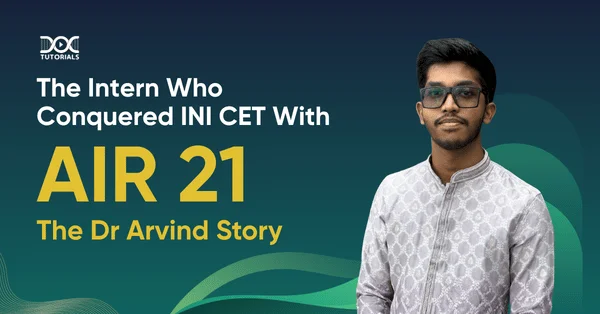
Let’s be very honest right now. Taking a really tough medical entrance test, waiting nervously for the results, and then getting a rank much lower than you hoped for is deeply heartbreaking. It makes you doubt everything. You question your hard work, your study guides, your daily plans, and sometimes, even your own intelligence. That was the exact difficult situation Dr. Arvind faced after his NEET PG test.
He had started his preparation early, balancing books alongside his tight house surgency at TDMC, Alappuzha. But when the NEET PG results came out, his rank was not what he had expected. For many aspirants, this is the breaking point. But for Dr. Arvind, it was simply a reality check. He knew his house surgency was finally over, which meant he finally had the one thing every intern desperately craves: time.
He sat at home, built a steady plan, and quietly went to work. A year later, the results of the INI CET were released, Dr. Arvind’s name sat right at the top of the list with a massive All India Rank 21.
In a recent interview, Dr Arvind explained how he climbed to the top after failing his first attempt. If you are a dropper right now, grab a pen and take notes from his journey.
Want to hear the full story from Dr. Arvind in his own words? Watch his complete interview right here:
The INI CET Secret: Cracking the “Top 6” Subjects
Ask any senior, and they will tell you that the INI CET has a very specific pattern. While the NEET PG exam tests a broad spectrum of clinical knowledge, the INI CET loves to test how strong your absolute basics are.
When asked to name his top subjects for this specific exam, Dr. Arvind did not point to Medicine or Surgery first. Instead, he pointed straight to the first and second-year subjects.
His golden six for INI CET are Anatomy, Microbiology, Pharmacology, Pathology, Biochemistry, and Physiology.
Why are these so important? Because INI CET examiners often frame questions in a tricky way. They may give you a long clinical case that looks completely like a Medicine or Surgery question. You will focus on the symptoms, investigations, and patient history. But in the end, the options will actually test your basics like the biochemical defect, the pharmacology receptor, or the exact anatomical nerve involved.
If your base in these six fundamental subjects is weak, you will lose the mark, no matter how good your clinical diagnosis is. Dr Arvind realized this early on. He focused heavily on building an unbreakable foundation in these basic sciences, ensuring that no matter how twisted the clinical scenario was, he could always trace it back to the core concept.
The “Active Listening” Hack
One of the biggest struggles for any medical student taking a drop year is staying awake and focused during long video lectures. Sitting alone in your room watching a screen for six to eight hours a day can quickly burn you out. Even if your eyes are on the screen, your brain is completely switched off.
Dr. Arvind joined the DocTutorials Online Live Batch to keep his routine strict. But the real gamechanger for him was how he took notes.
Instead of starting with completely blank pages or relying entirely on printed handouts, he used partially filled workbooks. This is a brilliant strategy for active learning. Because the workbook already has the structure and the basic text printed, you do not have to waste time frantically copying every single word the faculty says.
However, because the workbooks have specific blanks for high-yield points, keywords, and critical flowcharts, you are forced to actively listen to fill them in.
As Dr. Arvind perfectly put it: “It helps us to study loads of information right there in the class. By simply actively listening and filling in the blanks, you retain so much. After the class, all you need to do is give it a quick 10-minute read, and the concept is locked.”
Breaking Down the Subject Strategies
Every subject requires a slightly different approach. You cannot study a massive subject like Medicine the exact same way you study a high-scoring short subject like Psychiatry. Here is how Dr. Arvind tackled the heavy subjects smartly with DocTutorials.
1. Medicine: Keeping it Concise. Medicine is an endless ocean. You can easily spend six months reading a standard textbook and still feel like you know nothing on exam day. Dr. Arvind knew he had to draw a strict line. He relied completely on Dr. Rahul Rajeev’s online live lectures.
The strategy here was simple: stick to exactly what is needed. Do not read extra just to feel smart. As Dr. Arvind mentioned, the lectures were incredibly concise. They had nothing more than what was required, but they perfectly contained every single high-yield fact needed for the INI CET pattern. When the syllabus is this vast, knowing what not to read is your biggest superpower.
2. Forensic Medicine: Beating the Sleep Forensic Medicine is highly factual and heavily dependent on previous year’s questions (PYQs). But it can also be a bit dry to study on your own. Dr. Arvind attended Dr Jayaprakash (JP Sir) live classes, and he highlighted a very funny, yet highly effective reality: it is biologically impossible to sleep in Dr Jayaprakash class.
The sudden voice modulations, the energy, and the strict focus on the subject keep you completely on your toes. But more importantly, Dr Jayaprakash does not just teach the theory; he breaks down how previous year questions were asked, and exactly how the examiner might twist those same PYQs into new, potential questions for the future. That level of comprehensive understanding meant Dr. Arvind barely had to touch multiple sources. The notes and the PYQ discussions were more than enough.
3. Short Subjects: The Power of Embedded MCQs For subjects like Psychiatry, Dermatology (with Dr. Pallavi), and OBGY (with Dr. Gayatri), Dr. Arvind loved the structure of the workbooks.
Short subjects are rank boosters. But reading the theory and then waiting a month to solve MCQs on that topic is a flawed strategy. You will forget the minor details. The workbooks Dr. Arvind used had up to 150 questions embedded directly at the end of every chapter or topic.
This means the moment he finished learning a concept, he was immediately testing his brain on it. This combination of theory followed by immediate MCQ practice is scientifically proven to boost memory retention. It locks the concept into your long-term memory instantly.
The DocTutorials Advantage: Breaking the Monotony with Daily Tests
When you are preparing from home for an entire year, every single day starts to look exactly the same. You wake up, you read your notes, you highlight, and you sleep. By month four, boredom is enough to burn anyone out. You start losing your competitive edge because there is no daily challenge to keep your brain sharp.
To fix this, Dr Arvind made the DocTutorials Daily Dose Test an absolute rule in his routine.
Every single day, the DocTutorials app gave him 30 brand new, mixed bag questions. It was a short test, but it provided a much-needed adrenaline rush. It forced his brain to switch gears rapidly from Anatomy to Surgery to Pharma, mimicking the exact chaos of the real exam. This consistent practice kept him accountable and made sure he was never just reading passively.
But taking the test was only step one. What he did after the test is what built his AIR 21 rank.
Dr Arvind created a habit out of his mistakes. If he got a question wrong, or even if he guessed a question right but found the concept tricky, he immediately jotted it down in a separate notebook. He knew that getting a lucky guess right in a daily test did not guarantee he would remember it six months later in the real exam hall.
He constantly revised this specific notebook. By the end of his preparation, he had a highly personalized, handwritten book of his own weak points and high yield concepts. Instead of rereading things he already knew, he used his notes to attack the exact areas where he used to lose marks. By combining the DocTutorials platform with his own notes, he turned a simple daily test into his most powerful revision tool.
The Exam Day Mindset
All the preparation in the world means nothing if you freeze on the final day. And the INI CET is specifically designed to make you freeze.
With multiple correct options, assertion-reasoning questions, and long clinical stems, the exam is mentally exhausting. It requires an intense level of presence of the mind. You cannot just rely on pure memory; you have to actively think, eliminate, and apply logic for a grueling three hours.
Dr. Arvind managed to hold his nerve. Because he had spent the last year doing active learning with his workbooks and giving daily randomized tests, his brain was heavily conditioned to handle the pressure. He didn’t just study hard; he trained his brain to perform under stress.
The Conclusion
Dr Arvind’s journey from a disappointing NEET PG rank to INI CET AIR 21 is proof that a setback is not the end of your medical career. It is just feedback.
He did not pull off a miracle. He simply accepted his initial result, sat down, and fixed his process. Throughout this journey, DocTutorials became his backbone. By joining the Online Live Batch, he replaced his lonely, monotonous study routine with a structured schedule that kept him disciplined. He used DocTutorials workbooks to stay actively engaged, and he relied on the concise, high yield lectures from his faculty to cut through the massive syllabus without wasting time on fluff.
Most importantly, he made the DocTutorials Daily Dose Test a strict part of his life. He showed up every single day to face 30 questions, turning every wrong answer into a learning lesson.
If you are currently in your drop year, feeling exhausted or doubting if your hard work will pay off, look at Dr Arvind. The syllabus is exactly the same for everyone. The only difference is consistency, the right mentorship, and a solid daily routine with the right tools by your side.
Keep your head down, stick to your plan, and never skip your daily tests. Your AIR is waiting. All the very best.

Latest Blogs
-
INI CET Exam Pattern 2027: A Complete Guide with Subject-Wise Weightage
INI CET Exam Pattern 2027: A Complete Guide with Subject-Wise Weightage The Institute of National Importance Combined Entrance Test (INI…
-

NEET PG Registration 2027: An Essential Guide For Exam Prep
The NEET PG registration, which is conducted online, is a crucial step in the exam process. Filling out the NEET…
-

NEET PG Exam 2025- Date, Pattern, Marking Scheme, Subject Wise Weightage, and Exam Mode
NEET PG Exam 2025 is the ultimate gateway for medical graduates aspiring to pursue postgraduate courses in medicine, including MD,…