Sterilisation: Procedures, Benefits, and Risks
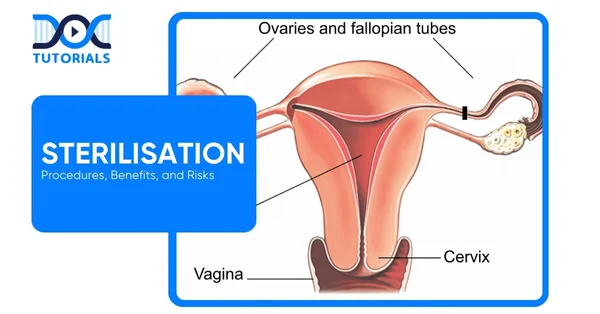
Sterilisation is one of the most reliable and permanent methods of contraception practiced in the world. It plays a crucial role in family planning and population control. Permanent surgical contraception, also called voluntary sterilisation, is a surgical method whereby the reproductive function of an individual male or female is purposefully and permanently destroyed.
Medical students preparing for the NEET PG examination need a solid understanding of sterilising procedures and techniques, as well as their associated clinical implications, not only to perform well in their academics but also in subsequent clinical work.
Keep reading for a detailed insight into sterilisation.
What is Sterilisation?
Sterilisation is a permanent surgical birth control method. It comprises female sterilisation ( tubal ligation, commonly tubectomy) and male sterilisation (vasectomy). Both serve to prevent future pregnancy by disrupting the reproductive tube, that is, the fallopian tube in women and the vas deferens in men.
Vasectomy and tubectomy are the two most common sterilisation methods. Sterilisation is meant to last a lifetime; therefore, only an informed patient who knows fully the permanence of the action should opt to undergo the surgery. A couple must be counselled adequately before any permanent procedure is undertaken.
The individual procedure must be discussed in terms of its benefits, risks, side effects, failure rate, and reversibility. Notably, sterilisation is not subject to protection against sexually transmitted diseases, so condoms should be used to prevent STIs (sexually transmitted infections).
What are the Procedures of Sterilisation?
Sterilisation may be provided during or following childbirth or at a later time as an interval procedure. Common procedures include:
- Female Sterilisation
The fallopian tubes are cut, tied, or occluded in a manner that eggs cannot enter the uterus. This is typically performed through a laparoscopy or a small incision of 2-3 cm. The surgeons can excise a portion of the tube, clip it, or band it.
A. Interval Sterilisation
- The operation is done beyond 3 months following delivery or abortion.
- Commonly done laparoscopically or via mini-laparotomy.
- The ideal time of operation is following the menstrual period in the proliferative phase.
B. Puerperal Sterilisation
- If the patient is otherwise healthy, the operation can be done 24–48 hours following delivery.
- Its chief advantage is technical simplicity.
- Uses the accessibility of the fallopian tubes during the post-delivery period for ease of procedure.
- A hospital stay and rest at home following delivery are sufficient to help the patient recover simultaneously from both events, i.e., delivery and operation.
C. Surgical Techniques
- Pomeroy Technique: One loop of the fallopian tube is ligated and cut. Minimalistic and commonly used.
- Modified Pomeroy Method: A variation with double ligature for added security.
- Uchida Technique: This technique involves the removal of a portion of the tube, burying the ends into the myometrium, which reduces failure rates.
- Vasectomy (Male Sterilization)
A simple outpatient procedure whereby the two vas deferens are cut and sealed. Vasectomy is most often performed with local anesthesia, and patients are discharged on the same day.
- Conventional Vasectomy: A small scrotal incision to reach and tie the vas deferens.
- No-Scalpel Vasectomy (NSV): It has a low-impact puncture technique that causes less tissue trauma and faster recovery.
Other methods to block the Vas are:
A. Electrocoagulation may be used to encourage scar tissue formation.
B. Fascial interposition following ligation, excision and cautery. This is done to prevent recanalisation.
What are the Benefits of Sterilisation?
Sterilisation is a consistent, convenient form of contraception, but again, every process has its costs. Here are its respective benefits:
- Female Sterilisation
- Permanent Contraception: One does not have to go back to birth control.
- Highly Effective: The failure rate is approximately 0.5%.
- No Hormones Involved: Dodges the side effects associated with hormonal contraceptives
- Can Be Done Postpartum: Commonly done following childbirth or in a C-section
- Minimal Long-term Side Effects: Does not influence sexual health and hormone levels.
- Male Sterilisation
- Simpler Procedure: Less invasive than female sterilisation; usually done under local anesthesia.
- Quick Recovery: Most men resume normal activities within a few days.
- Highly Effective: Over 99% success rate after semen evaluation at 3 months.
- No Effect on Sexual Performance: Libido, erection, and ejaculation remain unchanged.
- Lower Complication Rate: Fewer risks compared to female sterilisation.
What are the Risks of Sterilisation?
The risks of both types of sterilisation are as follows:
- Female Sterilisation
- Surgical Procedure: Needs general or local anesthesia; consisting of cutting or obstructing the fallopian tubes.
- Recovery Time: Typically recovers within 2 to 5 days, with some discomfort.
- Not Easily Reversible: Reversal is very complicated, costly, and ineffective.
- Ectopic Pregnancy Risk: When they fail, there is an increased risk of a pregnancy outside the uterus.
- Complications: Uncommon risks include internal bleeding, infection, or damage to nearby organs during laparoscopy.
- Male Sterilisation
- Delayed Effectiveness: Sperm can stay in semen up to 3 months; reserve contraception is required until cleared.
- Not Easily Reversible: There can be a reversal, but at a price that is not always certain.
- Minor Complications: May include bruising, swelling or infection at the operation site.
- Psychological Impact: Certain men may experience emotional discomfort or remorse.
- No STI Protection: Does not block sexually transmitted diseases; condom usage is still recommended in the event of the presence of the risk of acquiring a sexually transmitted disease.
FAQs about Sterilisation
- How effective is sterilisation?
Sterilisation is highly efficient. The success rates of both tubal ligation and vasectomy are greater than 99%; less than 1 in 100 patients conceive annually following a properly performed procedure.
- Can sterilisation be reversed?
Sterilisation is intended as permanent. Reversal is a major surgical process and not always guaranteed to be successful.
- Does sterilisation protect against STDs?
No. Sterilisation does not defend against sexually transmitted infections. STDs still require barrier methods (such as condoms) or other precautions.
- Which is simpler, vasectomy or tubal ligation?
Vasectomy is usually less complicated and less invasive. It is performed in an outpatient manner and under local anesthesia. Tubal ligation involves surgery to the abdomen and, in many cases, general anesthesia, thus undergoing a more complex procedure.
- What is the Pomeroy method of tubal ligation?
The Pomeroy method is one of the popular tubal ligation methods. It consists of lifting a loop of each fallopian tube, followed by tying and cutting off this loop. This ties and removes a segment of the tube to block it.
Conclusion
Sterilisation is a practical family planning method. When conducted on an informed patient, it provides long-term contraception with reliability. Both vasectomy and tubal ligation have low complication rates and are very safe, and recovery is quick.
However, every aspirant should remember that sterilisation is intended as permanent birth control. Patients should be aware that reversal is a challenging and not always successful process. All alternatives should be discussed with counsel before proceeding.
Stay ahead in your clinical knowledge with DocTutorials, where we help you elevate your NEET PG studies and deliver evidence-based care to your patients throughout your career.
Join DocTutorials today and check out our NEET PG course to excel in your medical exam.


Latest Blogs
-

FMGE DT-SAT: Your Chance to Win ₹1 Crore+ Scholarship
Preparing for the Foreign Medical Graduate Examination (FMGE) can be stressful, but what if you could get the best coaching…
-

FMGE Exam Dates: Important Updates, Eligibility, Registration & More
Preparing to practice medicine in India after completing an MBBS abroad requires more than just academic dedication; it demands clearing…
-

FMGE Exam Date 2026 – Everything You Need to Know About the FMGE
The Foreign Medical Graduate Examination is the most important exam for Indian students pursuing their medical courses abroad. Upon completion…