Ananthanarayan & Paniker’s Textbook: A Guide to MBBS 2nd Year Microbiology
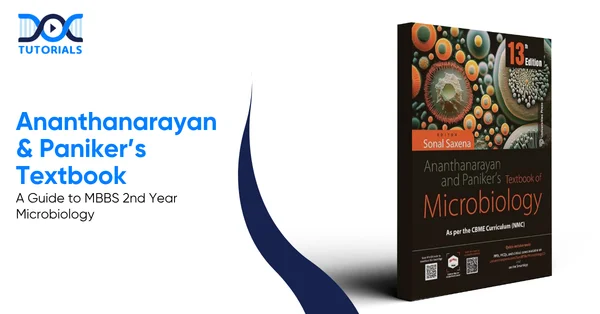
Ananthanarayan and Paniker’s Textbook of Microbiology is among the most popular microbiology reference books used by second-year MBBS students in India. The book, written by R. Ananthanarayan and C. K. Jayaram Paniker, is a fundamental work for undergraduate medical training for MBBS students.
This guide highlights the authorship of the Paniker microbiology textbook, the recent edition’s CBME compliance, its content, and how the textbook facilitates integrated learning in the MBBS course. Keep reading to know more.
Overview of the Ananthanarayan & Paniker’s Textbook of Microbiology
Ananthanarayan & Paniker’s Textbook of Microbiology, by R. Ananthanarayan and C. K. Jayaram Paniker, is a popular textbook among MBBS students in their second year. It was initially published in the 1970s under the name Paniker Microbiology and aims to bridge basic microbiology and clinical practice.
Dr R. Ananthanarayan and Dr C. K. Jayaram Paniker were the first Indian microbiologists whose Textbook of Microbiology (first published in the 1970s) became an important reference to MBBS students. The so-called “Paniker microbiology” or “Ananthanarayan microbiology” has been part of the MBBS 2nd-year syllabus and has been widely used as a textbook in that subject.
Later editions were revised to indicate developments in microbiology and medical training. Earlier editions were published by Orient Longman (now Orient BlackSwan), and the most recent (2023) by Universities Press, with a focus on bacteriology, virology, immunology, parasitology, and laboratory methods.
Key Features of Ananthanarayan and Paniker’s Textbook of Microbiology
The 13th edition (2023) of Ananthanarayan & Paniker’s Textbook of Microbiology is edited by Dr Sonal Saxena. It is aligned with the CBME curriculum (NMC) and features a special focus on integrative and clinically oriented learning.
The most recent 13th edition (2023) of Ananthanarayan & Paniker’s Textbook of Microbiology is revised according to the CBME guidelines of the National Medical Commission. It is, therefore, relevant to the existing MBBS curriculum. It features:
- Expanded and Structured Bacteriology Section: Bacteriology is divided into Basic Concepts and Systematic Bacteriology to improve conceptual clarity and systematic learning.
- Modern Diagnostic and Laboratory Techniques: The latest version features some of the newest techniques, such as the VITEK automated identification systems, PCR-based diagnostics, BioFilm Array technology, and newer sterilisation techniques, including plasma sterilisation and CSSD care bundles.
- Updated Clinical and Public Health Content: Clinical sections are updated with new HIV treatments, national health programs such as the National Hepatitis Control Programme and new information on antibiotics, resistance, and novel infections.
- Syndromic and Integrated Approach: The discussion of infections is based on a syndromic framework that encompasses epidemiology, laboratory investigation, and prevention. Topics in parasitology and virology are addressed within the corresponding clinical syndromes for a more holistic understanding.
- AETCOM Integration: A dedicated chapter explores the relationship between AETCOM (Attitude, Ethics, and Communication) ideas and the practice of microbiology.
- Student-Friendly Learning Aids: Chapters are simplified in tabular format, with flowcharts, illustrations, and images of microbes. Quick revision is aided by summaries, key points, and review questions, whereas online resources with QR codes offer additional study content.
- Focus on Clinical Competencies: The editors focus on clinical relevance and problem-solving, ensuring that the core competencies needed for exams and clinical practice are prioritised.
- Continuous Updates Across Editions: Medical advances are reflected in previous iterations, which added national TB and HIV programs, new vaccines, molecular diagnostics, and new viruses such as SARS and Zika.
- Established Reference for MBBS Students: The book has undergone numerous editions (10th, 12th, and 13th) over the years and remains a reliable microbiology textbook among medical students in India.
Evolution of Ananthanarayan & Paniker’s Microbiology Across Editions
The most radical structural changes have taken place in the latest edition to attain total adherence to the new competency-based curriculum. These current versions completely break down the old academic silos and integrate basic knowledge with clinical applications within a highly ordered syndrome-based approach.
Ananthanarayan & Paniker’s Textbook of Microbiology, 12th edition, has made significant changes to conform to the CBME curriculum by the NMC, adopting a system-based, syndromic model, which integrates microbiology with clinical diseases.
The materials were simplified to fit the reduced MBBS program, and pathogens, pathogenesis, clinical manifestation, and laboratory diagnostics are organised clearly. This approach is further enhanced in the 13th edition, which was edited by Dr Sonal Saxena.
It incorporates parasitology into clinical syndromes, updates on sterilisation and infection control, and includes modern diagnostics, VITEK systems, the BioFilm array, automated antimicrobial susceptibility testing, and a new chapter on AETCOM.
The table below indicates the changes in the textbook structure and focus over the significant editions:
| Feature / Element | 8th, 9th & 10th Editions | 12th Edition | 13th Edition (Latest) |
| Primary Structural Approach | Traditional organism-based, with late clinical additions. | Early adoption of system-based clinical integration. | Fully Syndromic Approach strictly aligned with NMC CBME. |
| Parasitology Integration | Taught as an entirely independent volume or separate section. | Taught with clinical association, but quite distinct. | Completely merged with all infectious clinical syndromes. |
| Diagnostic Technologies Focus | Basic staining, conventional culture and early molecular methods. | Recent molecular diagnostic methods and quality management. | Improved emphasis on VITEK, BioFilm Array and automated AST. |
| Curriculum Alignment | Based on the classical historical medical program. | Aligned with early integrated teaching recommendations and a must-know approach. | Total compliance with the most recent NMC core competencies. |
| AETCOM Elements | Not explicitly featured as a specific learning module. | Minor references to ethical public health reporting. | A full chapter devoted to Attitude, Ethics, and Communication. |
Table of Contents of Ananthanarayan and Paniker’s Textbook of Microbiology, 13th Edition
The table of contents of Ananthanarayan and Paniker’s Textbook of Microbiology, latest edition, is broadly divided into three major sections, with several chapters under each. This is the chapter-by-chapter list commonly offered in the book.
The table of contents for Ananthanarayan and Paniker’s Textbook of Microbiology, 13th Edition, is as follows:
Part I: General Microbiology
- History and Scope of Microbiology
- Basic Concepts of Bacteriology
- Systematic Bacteriology
- Basic Concepts of Virology
- Basic Concepts of Mycology
- Basic Concepts of Medical Parasitology
- Microbial Genetics
- Epidemiology of Infectious Diseases
- Sterilisation and Disinfection
- Antimicrobial Agents
- Infection Control in Healthcare Settings
Part II: Immunology
- Immunological Mechanisms in Health
- Antigens, Antibodies and the Complement System
- Mechanisms of Immune Response
- Laboratory Methods Used in the Detection of Immunological Response (Antigen–Antibody Reactions)
- Hypersensitivity
- Autoimmune Disorders and Immunodeficiency States
- Immunological Mechanisms of Transplantation, Immunohematology and Tumour Immunity
- Immunoprophylaxis
Part III: Microbiology as Applied to Infectious Diseases
- Cardiovascular and Bloodstream Infections
- Acquired Immunodeficiency Syndrome (AIDS)
- Infections of the Respiratory System
- Central Nervous System Infections
- Gastrointestinal Infections
- Hepatobiliary Infections
- Genitourinary and Sexually Transmitted Infections
- Urinary Tract Infections
- Skin, Soft Tissue and Musculoskeletal Infections
- Infections of the Eyes and Ears and Congenital Infections
- Zoonotic and Vector-Borne Infections
- Opportunistic Infections
- Emerging Infections
- Oncogenic Viruses
- National Health Programmes, Disease Detection and Reporting
How to Use the Ananthnarayan Textbook for MBBS 2nd Year Study?
Ananthanarayan & Paniker’s Textbook of Microbiology is an elaborate resource; therefore, MBBS students must approach the book with a plan. Begin with chapter outlines, simplify ideas with a table and mnemonic, and align ideas and topics with CBME objectives, with short revision notes during training on clinical scenarios and questions.
The Ananthanarayan textbook is broad and, therefore, should be used wisely by the students. Here are some tips:
- Read Chapter Summaries First: Many chapters include descriptions of the outlines and objectives (e.g., competency links). These reviews will give a summary of major topics before getting into details.
- Use Mnemonics and Tables: Mnemonics may be provided in the book itself (some older sections list them). Otherwise, develop your own tables (e.g. compare Staphylococcus vs Streptococcus). This complements the book’s text flow and aids retention.
- Focus on CBME Competencies: Since the book is CBME-aligned, align the official learning objectives with each chapter. A good example is to tie Chapter 12 (Antimicrobials) to antimicrobial stewardship competency.
- Supplement with Clinical Scenarios: The book provides pathogen lists for diseases. To reinforce learning, learners are recommended to review clinical cases. Such an active method transforms a passive reading into effective knowledge.
- Review Updated Guidelines: Be extra keen on sections marked “updated guidelines” (e.g., HIV, TB, hepatitis). These are usually presented as boxed notes or highlighted text. These reflect real-world practices.
- Combine with Short Notes: Once you read a chapter of the book, summarise its chapters in bullet notes. This is to assist in the last-minute revision and some high-yield facts.
- Solve Questions: Test yourself with the summary points of the textbook and self-assessment questions (or textbook-created questions) at the end of the semester. The book’s content can be supplemented with practice questions by Apurba Sastry or lecture notes.
Students can leverage the book’s comprehensiveness by systematically aligning its chapters with course lectures and practicals. Ananthanarayan & Paniker’s Textbook of Microbiology is designed to serve as both a learning resource and a reference.
Comparison: Ananthanarayan Microbiology with Other Standard Microbiology Textbooks
Ananthanarayan and Paniker’s Textbook of Microbiology is a popular Indian textbook used to teach microbiology to MBBS students due to its clarity of explanations and sound conceptual basis. Textbook of Microbiology by Apurba S. Sastry is clinically oriented and CBME-friendly.
The following is a comparison table of the Ananthanarayan and Paniker Textbook of Microbiology with other popular microbiology textbooks used by MBBS students:
| Feature | Ananthanarayan and Paniker’s Textbook of Microbiology | Textbook of Microbiology by Apurba S. Sastry | Jawetz, Melnick & Adelberg’s Medical Microbiology | Levinson Review of Medical Microbiology and Immunology |
| Primary Audience | MBBS, BDS students, and allied health students. | MBBS students (CBME curriculum). | International medical students. | Medical students preparing for the USMLE and other exams. |
| Approach to Topics | Classification based on organisms (bacteriology, virology, mycology and so on). | Clinically oriented and system-wise approach. | Classical microbiology approach. | Review-based conceptual approach. |
| Content Coverage | Extensive descriptions of medical microbiology and immunology. | Comprehensive clinical associations and diagnostics. | Extensive microbiology with a strong theoretical foundation. | Focus on high-yield concepts and immunology. |
| Clinical Orientation | Moderate; it combines clinical microbiology and infectious diseases. | Clinical correlation and case-based learning are at an exceptionally high level. | Moderate clinical focus. | Strong conceptual explanation with clinical relevance. |
| Illustrations & Diagrams | Sufficient number of diagrams and tables. | New diagrams, flowcharts and summary boxes. | Detailed diagrams but more text-heavy. | Simplified figures and tables for revision. |
| Exam Orientation | Helpful in college exams, contains exam-type questions. | Highly exam-oriented with quick revision tables. | Less exam-oriented for Indian university exams. | Designed for review and competitive exams. |
| Latest Updates | Revised to cover CBME curriculum, molecular diagnostics, and infection control. | With frequent updates on modern diagnostics and clinical microbiology. | Global updates in microbiology and infectious diseases. | Updated with molecular microbiology and immunology concepts. |
| Strengths | In a traditional Indian textbook, the explanations are very clear, and the basic knowledge is good. | Concise, organised, easy to revise. | Highly authoritative international reference. | Excellent for concept revision and board exams. |
| Limitations | A little conventional structure and long text. | Some sections may be condensed for beginners. | Large and dense for undergraduate exams. | Not a completely detailed textbook. |
FAQs about Ananthanarayan & Paniker’s Textbook
- What is the latest edition of Ananthanarayan & Paniker’s Microbiology?
The latest edition (2023) is the 13th edition of 2026. It has been edited by Dr Sonal Saxena and is published by the University Press.
- What topics does the Ananthanarayan & Paniker’s Microbiology textbook cover?
Ananthanarayan & Paniker’s Microbiology book includes general microbiology (microscopy, sterilisation, immunity) and clinical microbiology (bacteriology, virology, mycology, and parasitology), as well as laboratory diagnosis and disease-based discussions.
- Is Ananthanarayan & Paniker’s Microbiology enough for 2nd-year MBBS exams?
Along with Ananthanarayan & Paniker’s Microbiology, many students also use short review books or lecture notes as a simplified way to revise.
- Are the Ananthanarayan & Paniker’s Microbiology e-book or PDF versions available?
Certain editions of Ananthanarayan & Paniker’s Microbiology include official e-book versions. Authorised copies should be obtained by students from publishers, libraries, and official platforms.
- How does Ananthanarayan & Paniker’s Microbiology book compare with other microbiology books?
Ananthanarayan & Paniker’s Microbiology is regarded as a standard guide to MBBS microbiology in India and is popular for its extensive, examination-related material.
- What is the difference between the Ananthanarayan & Paniker’s Microbiology 10th and 13th editions?
The Ananthanarayan & Paniker’s Microbiology, 10th edition, was written in a classic organism-based format, whereas the 13th edition is written in a syndromic approach, with CBME-friendly diagnostics and new divisions such as AETCOM.
- Who were the original authors of Ananthanarayan & Paniker’s Microbiology book?
The Ananthanarayan & Paniker’s Microbiology textbook was first published in 1978 by Dr R. Ananthanarayan and Dr C. K. Jayaram Paniker, making it a classic textbook in medical studies.
- Is the Paniker microbiology book sufficient to pass university exams?
Yes. When studied systematically, Ananthanarayan & Paniker’s Microbiology offers an overall theory and clinical scenario required for both the written examination and the practical viva.
- How should students make notes from Ananthanarayan & Paniker’s Microbiology book?
Organise notes under key headings, such as causative agent, pathogenesis, transmission, clinical features, laboratory diagnosis, and prevention/treatment, for each disease.
- Why is Ananthanarayan & Paniker’s Microbiology, the latest edition, recommended over older editions?
The current version of Ananthanarayan & Paniker’s Microbiology is based on the NMC competency-based curriculum and a clinical syndromic approach, and is therefore much more relevant to contemporary MBBS exams.
Conclusion
Microbiology is a second-year course in MBBS which requires strong concepts and clinical knowledge. Ananthanarayan & Paniker’s Textbook of Microbiology can be used to establish this framework through a CBME-based approach. Reviewing textbooks combined with notes, case discussion and practice questions, enhances concepts and prepares for the exam.
For structured academic support, DocTutorials can be your study partner. We offer 3D & 2D animated videos, CBME-based video lectures, and structured mentorship and guidance by experts. This ensures aspirants gain complete clarity over complex medical concepts.
Join DocTutorials today and explore our MBBS curriculum to excel in your medical career!
Latest Blogs
-

9 Essential MBBS Preparation Tips for Success
Achieving the dream of becoming a doctor is not easy. You need to be determined and have the right mindset…