MBBS Question Bank for All Years: A Complete Guide for Exam Preparation
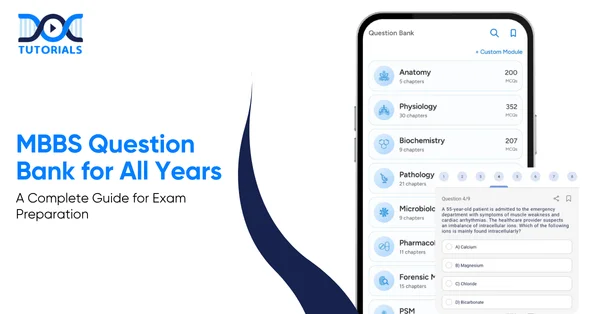
Students studying for an MBBS are held to high academic standards, as they have to learn a vast syllabus that covers the theory of medicine as well as how to apply it in clinical practice.
In such scenarios, an MBBS question bank helps identify commonly asked questions and tests a student’s understanding of fundamental concepts. Each year of the MBBS program has its own question bank that can be reviewed frequently to develop strategies for preparing for and excelling in the examinations.
Keep reading to know more!
MBBS Question Bank: Course Structure and Subjects
The MBBS course follows a structured progression, with students moving from foundational medical sciences in the first year to more advanced clinical subjects in later years. Learning the subjects and regularly practising with an MBBS question bank helps students revise key topics and become familiar with exam-oriented questions.
The MBBS course is divided into multiple phases across several years, each focusing on different aspects of medical education. Students begin with fundamental subjects in the first year and gradually progress toward clinical and diagnostic disciplines in later years.
Practising with an MBBS question bank will help students revise important topics and understand the questions.
1st Year MBBS Question Bank Subjects
The first year of the MBBS course is built on the basic medical sciences, which underpin the entire course. The main subjects included in the MBBS first-year question bank are as follows:
1. Anatomy
Anatomy is the study of the structure and organisation of the body of a human being. A normal 1st year MBBS anatomy question bank PDF will include questions on the following topics:
- Gross anatomy
- Histology
- Embryology
- Neuroanatomy
Practising with the best question bank for the MBBS 1st-year exam will help students understand the exam questions.
2. Physiology
Physiology explains how the human body functions and how different organ systems interact to maintain normal health. The question bank for the MBBS 1st year for physiology usually covers:
- Cardiovascular physiology
- Respiratory physiology
- Renal physiology
- Nervous system physiology
- Endocrine physiology
Practising questions improves analytical thinking and conceptual clarity.
3. Biochemistry
Biochemistry focuses on the chemical processes that occur within the human body at the molecular level. Topics commonly covered in the question bank for 1st year MBBS include:
- Biomolecules
- Enzyme function
- Metabolism pathways
- Molecular biology
- Clinical biochemistry
Regular practice with an MBBS 1st year question bank with answers helps students prepare both theory and viva questions.
2nd Year MBBS Question Bank Subjects
The second year of MBBS introduces students to subjects that explain disease mechanisms and drug therapy. A comprehensive MBBS 2nd year question bank typically includes:
1. Pathology
Pathology focuses on the study of diseases, their causes, mechanisms, and effects on the body. A 2nd year MBBS pathology question bank usually covers:
- General pathology
- Cellular injury and inflammation
- Neoplasia
- Systemic pathology
Using an MBBS pathology question bank helps students understand how diseases develop and how they affect organs.
2. Microbiology
Microbiology studies germs that cause infection and disease. A microbiology question bank contains topics that cover the following:
- Bacteriology
- Virology
- Mycology
- Immunology
- Parasitology
Practising from a microbiology question bank will improve the student’s comprehension of the ways that infections occur, as well as how to diagnose an infection by using laboratory tests.
3. Pharmacology
Pharmacology refers to how medications work with our bodies and how they are used to treat various diseases. A pharmacology question bank usually consists of the following:
- Classifications of drugs
- Mechanisms of drug action
- Interactions between drugs
- Reactions to drugs
Practising from the 2nd-year pharmacology question bank will help the student improve their understanding of how to use medications therapeutically.
3rd Year MBBS Question Bank Subjects
Clinical exposure and practical medical training start in the third year. Thus, students use a question bank for the MBBS third year to study relevant clinical concepts using the appropriate exam format.
Common subjects found in the MBBS 3rd year question bank include:
1. Community Medicine
Community medicine deals with public health, disease prevention, and the health delivery systems. The question bank for the MBBS includes public health-related questions encompassing epidemiology, vaccination programs, and health policy.
2. Forensic Medicine
Forensic medicine has to do with the legal aspects of health, as they pertain to the medical definition of being injured, as well as understanding how to deal with the following:
- Medico-legal autopsy
- Toxicology
- Identification of injuries
- Legal responsibilities of doctors
Using a question bank in the MBBS 2nd and 3rd years will assist you with both theory test and viva preparation.
Benefits of Using an MBBS Question Bank for Exam Preparation
An MBBS question bank helps students prepare strategically by familiarising them with exam patterns, improving conceptual understanding, and highlighting frequently asked topics. Regular practice also enhances time management and answer-writing skills, allowing students to perform more confidently in university exams.
The MBBS question bank has a number of benefits that assist students to improve their performance and understanding of concepts in exams:
1. Understand the Exam Pattern
This is one of the most significant advantages of using the MBBS question bank since it will make them acquainted with the pattern of the exam.
Students are able to find out the most frequently asked issues, question formats and marking patterns. This enables students to be more confident when taking exams.
2. Enhance Cognitive Competence
Repeatedly revising questions in a question bank, such as the MBBS 1st year or MBBS second year question bank, is a method to reinforce theoretical knowledge and enhance the retention of concepts.
Students also learn to apply concepts in clinical situations as opposed to merely memorising facts.
3. Find High-Yield Topics
There are a lot of questions that have a pattern in university exams. The MBBS question bank and answers assist students in figuring out topics that are likely to come up in the exams.
4. Practice on Timed Questions
This practice involves having questions that the students solve in a time-bound situation so that they can improve their time management. Doing the papers on a regular basis enables the students to finish their examinations on time.
5. Enhance Answer Writing Competencies
Medical examinations usually demand formal responses to diagrams and explanations. MBBS using question banks enhances the presentation of clear and well-organised answers by students.
How to Use a Question Bank for MBBS Effectively?
Using an MBBS question bank strategically can significantly improve exam preparation and academic performance. By following a structured study plan, practising topic-wise questions, revising regularly, and attempting mock tests, students can strengthen their concepts and develop better exam strategies.
Strategic preparation of exams and academic results can be greatly enhanced using the MBBS question bank. Here’s how:
1. Develop a Study Plan
Break your syllabus into achievable parts and draw realistic objectives to be achieved per day. Once you have studied a topic, practise questions in the MBBS question bank to cement what you have learned.
2. Study Topic-Wise
Begin by doing questions subject-wise:
- MBBS 1st year question bank
- MBBS 2nd year question bank
- MBBS 3rd year question bank
Topic-wise practice strengthens subject knowledge.
3. Practice Regularly
Consistency is essential for mastering the MBBS syllabus. Students should practise questions daily from:
- Question bank MBBS 1st year
- Question bank MBBS 2nd year
- Question bank MBBS 3rd year
Regular practice improves both speed and accuracy.
4. Revise Frequently
Revision is essential for long-term retention of medical concepts. Students should revisit important questions from their MBBS question bank regularly before exams.
5. Attempt Mock Tests
Simulating real exam conditions helps students evaluate their preparation level. Full-length mock tests also help in improving time management.
Common Mistakes MBBS Students Should Avoid
Avoiding common mistakes is essential for effective MBBS exam preparation. Many students struggle due to irregular study habits, over-reliance on memorisation, or insufficient practice. Consistently using an MBBS question bank can help students strengthen their concepts, practise exam questions, and prepare more confidently.
Preparation for MBBS needs discipline and constant practice. Nonetheless, many students make mistakes that affect their academic performance on exams. Here are some of them:
Mistake 1: Studying Only Before Exams
A lot of students put their preparation off until they are near exams. MBBS courses involve a substantial amount of knowledge; therefore, studying is vital.
Mistake 2: Ignoring Conceptual Learning
Concentrating on memorisation rather than the conceptual comprehension of information can complicate the provision of answers to application-based questions.
The MBBS question bank should be used to enhance conceptual knowledge in the learners.
Mistake 3: Using Too Many Study Resources
It is confusing to consult more than one source. An ambient MBBS question bank and reliable textbooks should be followed by the students.
Mistake 4: Not Practising Enough Questions
There is a great number of students who learn the theory without practising questions. An MBBS question bank can assist students in using their knowledge to solve questions.
FAQs about the MBBS Question Bank
1. What is an MBBS question bank?
An MBBS question bank is a compilation of exam-oriented questions to assist medical students in preparing for university exams and to assist them in mastering important aspects of their coursework.
2. Which is the best question bank for the MBBS 1st year?
The best MBBS question bank for the first year is one that has questions on a specific topic, contains detailed explanations for each question, and has many of the same questions from prior MBBS exams for anatomy, physiology, and biochemistry courses.
3. Are question banks enough for MBBS exam preparation?
While MBBS question banks are a valuable study resource, they should be used in conjunction with other resources, including textbooks, lecture notes, and notes from an additional source.
4. How many years of previous questions should MBBS students practise?
Medical students should ideally practise 5 to 10 years’ worth of previous exam questions to gain an understanding of the exam pattern and frequently tested areas.
5. How often should I practise questions from an MBBS question bank?
Students should regularly complete question banks throughout the year, increasing the number of question bank questions completed as the exam date approaches.
6. How will a question bank for MBBS help me with my practical exams?
In addition to providing you with viva questions, diagrams, and case-based scenarios, an MBBS question bank will assist you in your preparations for your practical examinations and viva examinations.
7. Is it beneficial to have a PDF format MBBS question bank when preparing for examinations?
Yes, a first-year MBBS question bank PDF provides you the flexibility to practice questions at any time and easily review key topics before an examination.
8. When should I begin using a question bank for MBBS?
It is recommended that you begin using a question bank for MBBS after you complete a topic so that you can practice exam-oriented questions and reinforce what you have learned.
9. Do MBBS question banks give the answers and provide explanations for each answer?
Most MBBS question banks contain answers and provide explanations that provide you with an understanding of the concepts being tested and aid in understanding how to arrive at the correct answer.
10. Can I use an MBBS question bank for my second year to prepare for PG entrance examinations?
Yes, you can use a second year MBBS question bank to develop a strong foundation in the areas of pathology, microbiology, and pharmacology, and it will assist with your preparation for the PG entrance examination.
Conclusion
The MBBS exams may be challenging, and therefore, an aspirant needs to dedicate themselves to studying and focus on the subject, along with having some clear concepts and a planned method of studying.
Regular practice is beneficial for enhancing students’ confidence and exam performance, regardless of whether it is the MBBS 1st-year, 2nd-year, or 3rd-year question bank. Through learning, revision, and question-bank practice, students can develop a solid academic base, and they can succeed in their medical education.
For structured academic support, DocTutorials can be your study partner. We offer 3D & 2D animated videos, CBME-based video lectures, and structured mentorship and guidance by experts. This ensures aspirants gain complete clarity over complex medical concepts.Join DocTutorials today and explore our MBBS curriculum to excel in your medical career!

Latest Blogs
-
INI CET Exam Pattern 2027: A Complete Guide with Subject-Wise Weightage
INI CET Exam Pattern 2027: A Complete Guide with Subject-Wise Weightage The Institute of National Importance Combined Entrance Test (INI…
-
NEET PG Registration 2027: An Essential Guide For Exam Prep
The NEET PG registration, which is conducted online, is a crucial step in the exam process. Filling out the NEET…
-

NEET PG Exam 2025- Date, Pattern, Marking Scheme, Subject Wise Weightage, and Exam Mode
NEET PG Exam 2025 is the ultimate gateway for medical graduates aspiring to pursue postgraduate courses in medicine, including MD,…