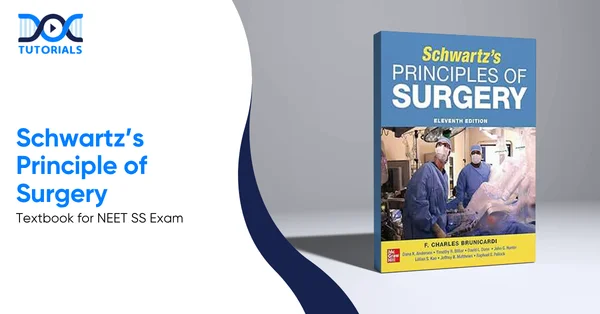
Role of Schwartz’s Principle of Surgery Textbook for NEET SS Exam
In India, securing a super-speciality medical seat is based on performance in NEET-SS, the national entrance examination for DM, MCh, and DrNB programs administered by NBEMS. As the only qualifying exam for most super-speciality seats, NEET-SS is quite competitive and requires concentrated, intensive preparation.
It evaluates postgraduate and super-speciality knowledge through clinically based and practice-oriented questions. Among surgical aspirants, traditional textbooks play a very important role, and Schwartz’s Principles of Surgery is considered a fundamental source of information for its extensive, clinically significant content.
Learn more about Schwartz’s Principles of Surgery, 11th edition, its contents, high-yield units, and other crucial details!
About Schwartz’s Principle of Surgery
The physiological detail in Basic Considerations by Schwartz gives the physiological depth required in NEET SS Part A, beating basic texts in core areas such as shock and electrolytes. It clearly explains the molecular biology and cytokine responses behind surgical procedures,s thereby equipping aspirants with the necessary why-based questions that often determine exam ranks.
In NEET SS, the part of the test dealing with General Surgery (Part A) depends extensively on fundamental principles of surgery. This is where Schwartz’s Principles of Surgery outshines the competition. The first section of the book, often titled Basic Considerations, is referred to as gold for the exam.
Topics such as Systemic Response to Injury, Fluid and Electrolytes, Shock and Surgical Infections are discussed with a physiological level of thoroughness that cannot be found in the simpler textbooks. In NEET SS, they tend to examine the why of a protocol, the molecular biology behind it, or the precise cytokine response, and these are the answers that Schwartz provides in a clear manner.
Why Schwartz Surgery is the Gold Standard for NEET SS
In NEET-SS, Schwartz’s Principles of Surgery are popular due to their emphasis on the pathophysiology and evidence-based care. It addresses high-yield areas such as systemic response to surgery, fluids, electrolytes, and shock in a clear manner with MCQ-friendly Key Points and helpful algorithms, which makes it more exam-oriented than both Bailey and Love or Sabiston.
When it comes to the Big Three of Bailey, Sabiston, and Schwartz, it may be confusing to pick a primary reference. For NEET-SS, however, many toppers point to Schwartz as the most impactful. Its strength lies in its strong focus on the biological foundations of modern surgery.
The book provides detailed explanations of the systemic response to surgery, electrolyte and fluid balance, and shock, which are often examined in exams. Moreover, the boxes with the Key Points in the new version also come in handy as they frequently become compatible with MCQ concepts.
| Feature | Schwartz’s Principles | Bailey & Love | Sabiston |
| Focus | Pathophysiology & Evidence-Based Care | Clinical Signs & Basics | Detailed Operative Technique |
| Best For | NEET SS & Residency | NEET PG & Final Year | Reference & In-depth Reading |
| Diagrams | High-quality Algorithms | Clinical Photos | Anatomical Plates |
Schwartz’s Principles of Surgery, 11th Edition Contents
Schwartz’s Principles of Surgery is a two-volume powerhouse, where Volume 1 covers the surgical “Basic Sciences” (Shock, Trauma, Fluids) and Thoracic systems, whereas Volume 2 covers Abdominal, HPB, and high-yield Endocrine surgery. The new edition also combines a modern ERAS protocol and Robotics.
Based on the latest widely available edition of Schwartz’s Principles of Surgery, 11th Edition, the contents of the textbook are:
Volume 1
Part I: Basic Considerations
- Leadership in Surgery
- Systemic Response to Injury and Metabolic Support
- Fluid and Electrolyte Management of the Surgical Patient
- Haemostasis, Surgical Bleeding, and Transfusion
- Shock
- Surgical Infections
- Trauma
- Burns
- Wound Healing
- Oncology
- Transplantation
- Quality, Patient Safety, Assessments of Care, and Complications
- Physiologic Monitoring of the Surgical Patient
- Minimally Invasive Surgery, Robotics, Natural Orifice Transluminal Endoscopic Surgery, and Single-Incision Laparoscopic Surgery
- Molecular Biology, The Atomic Theory of Disease, and Precision Surgery
Part II: Specific Considerations
- The Skin and Subcutaneous Tissue
- The Breast
- Disorders of the Head and Neck
- Chest Wall, Lung, Mediastinum, and Pleura
- Congenital Heart Disease
- Acquired Heart Disease
- Thoracic Aneurysms and Aortic Dissection
- Arterial Disease
- Venous and Lymphatic Disease
- Oesophagus and Diaphragmatic Hernia
- Stomach
Volume 2
- The Surgical Management of Obesity
- Small Intestine
- Colon, Rectum, and Anus
- The Appendix
- Liver
- Gallbladder and the Extrahepatic Biliary System
- Pancreas
- The Spleen
- Abdominal Wall, Omentum, Mesentery, and Retroperitoneum
- Soft Tissue Sarcomas
- Inguinal Hernias
- Thyroid, Parathyroid, and Adrenal
- Paediatric Surgery
- Urology
- Gynaecology
- Neurosurgery
- Orthopaedic Surgery
- Surgery of the Hand and Wrist
- Plastic and Reconstructive Surgery
- Anaesthesia for Surgical Patients
- Surgical Considerations in Older Adults
- Ethics, Palliative Care, and Care at the End of Life
- Global Surgery (New in this edition)
- Optimising Perioperative Care: Enhanced Recovery (New in this edition)
- Understanding, Evaluating, and Using Evidence for Surgical Practice (New in this edition)
- Ambulatory Surgery (New in this edition)
- Skills and Simulation (New in this edition)
- Web-Based Education and Implications of Social Media (New in this edition)
Decoding the Schwartz Principles of Surgery, 11th Edition
Schwartz Principles of Surgery, 11th edition, remains a trustworthy staple that introduces new guidelines and a more modern emphasis on decision-making, minimally invasive, and robotic surgery. Aspirants are also advised to align important subjects with the new NCCN and official guidelines to keep up to date with the exams.
It is essential to keep up with Schwartz’s principles of surgery, the latest edition, since the exam setters are fond of updates. The transition to the Schwartz Principles of Surgery, 11th Edition, brings new emphasis on:
- Global Surgery and Ambulatory Surgery.
- Updated AJCC Cancer Staging guidelines.
- Newer protocols in Enhanced Recovery After Surgery (ERAS).
While studying from the Schwartz Surgery 11th edition, focus on the tables and algorithms. The exam often lifts content directly from these “boxed” summaries. When a new version comes with a new system of classification, new questions can be expected on it.
Additionally, always cross-check the National Comprehensive Cancer Network (NCCN) current guidelines with the Schwartz’s Principles of Surgery chapter bibliographies. This is because NEET SS frequently includes questions about the newest protocols, which may appear in the Schwartz physiology of surgical care sections before they appear in other textbooks.
High-Yield Units in Schwartz’s for NEET SS
Not every chapter carries equal weight. Some chapters in Schwartz’s Principles of Surgery are high-yield and consistently appear in exams. Focusing on trauma and critical care, endocrine surgery, surgical oncology, gastrointestinal surgery, and basics like wound healing and haemostasis helps strengthen core concepts, improve clinical reasoning, and boost NEET-SS performance.
To get the most out of the latest edition of Schwartz’s Principles of Surgery, focus on these high-yield clusters where Schwartz clearly outperforms other reference texts:
- Trauma & Critical Care: Chapters on Metabolic Response to Injury and Shock are necessary. Schwartz offers a detailed description of cytokine activities and neuroendocrine reactions that go beyond other surgery textbooks, which renders it invaluable to NEET-SS candidates.
- Endocrine Surgery: One of the major areas would be the Thyroid, Parathyroid, and Adrenal surgery. The management algorithms for incidentalomas are especially high-yield and can be found in examination situations.
- Surgical Oncology: The 11th edition of Schwartz is very effective in blending AJCC staging and practical surgical planning, which is essential to questions on oncology in NEET-SS.
- Gastrointestinal Surgery: Pay close attention to the lectures regarding the Pancreas and Hepatobiliary system. Schwartz describes the principles of operation, as well as complication management, in a clinically relevant and exam-oriented manner.
- Breast: Molecular subtypes of breast cancer, genetic testing (BRCA), and the peculiarities of sentinel node biopsy are covered in an excellent way.
The first part of the book should not be ignored. Students tend to avoid topics such as Wound Healing and Haemostasis, but they are often rank-deciders due to their high-yield nature in questions.
FAQs about the Role of Schwartz’s Principle of Surgery Textbook for NEET SS Exam
- What books should I study for NEET-SS preparation?
In the case of NEET-SS, it is advisable to use standard postgraduate books and super-speciality resources. S. Schwartz’s Principles of Surgery is fundamental in surgery; on a more detailed level, so are Bailey & Love and Sabiston. Other major writings are those by Harrison or Davidson on medicine, Nelson on Paediatrics, and Miller on Anaesthesia.
- Is Schwartz’s Principles of Surgery really necessary for NEET-SS?
Yes. Schwartz is generally considered the classic textbook on the principles of general surgery. It provides a clear explanation of surgical physiology, metabolic response to injury, fluid therapy, coagulation, and core operations, making it highly relevant to NEET-SS surgery questions.
- Is Schwartz alone enough for NEET-SS Surgery?
Schwartz is excellent for general surgery concepts and foundational principles. But in the case of super-specialities, such as urology, neurosurgery, or paediatric surgery, subject-specific textbooks as well as guidelines should be added to your preparation.
- Should I buy the Schwartz Principles of Surgery, 11th edition?
Yes. The 11th edition has the updated TNM staging and guidelines, as well as newer concepts. It has a dedicated ABSITE & Board Review version with 800+ practice questions and detailed rationales, making it useful for residents and those preparing for certification exams
- How should I revise Schwartz in the last month before NEET-SS?
Avoid detailed reading. Concentrate on tables, flowcharts, algorithms, summary boxes, and highlighted texts. These parts are more useful in terms of quick revision and MCQ questions and are high-yield.
- Can I skip Sabiston if I read Schwartz?
No. For NEET SS preparation, Gastrointestinal (GI) surgery and oncology are better covered in Sabiston, whereas endocrine surgery and basic surgical principles, such as fluids, electrolytes, and shock, are more comprehensively explained in Schwartz’s.
- Are the “Schwartz Operation” descriptions important for the MCQ format?
Yes, but not the entire procedure. Pay attention to anatomical points, safety perspectives (such as the Critical View of Safety in cholecystectomy), and certain complications that are described in the text. These form the basis of “next best step” questions.
- How many questions in NEET SS are typically from Schwartz?
While it varies, around 15-20% of Part A (General Surgery) and advanced physiology and endocrine questions are directly sourced from the Schwartz Book of Surgery.
- Does the 11th edition of Schwartz cover recent advances?
Yes. There are chapters on Global Surgery, Robotics, and Enhanced Recovery After Surgery (ERAS) in the Schwartz Surgery 11th edition, which are commonly examined in NEET SS.
- How important are the “Key Points” boxes in Schwartz’s Principles of Surgery?
Extremely important. The “Key Points” boxes summarise complex concepts into clear, exam-oriented facts and are frequently used as the basis for MCQs in NEET-SS, making them essential for focused revision.
Conclusion
For success in NEET-SS, standard high-yield resources are essential, particularly in surgery. This is where the Schwartz Principles of Surgery, latest edition, can be used to clarify several important issues, such as injury response, fluid and electrolyte balance, and haemostasis.
However, the best preparation is achieved through the integration of core textbooks, brief revision notes, practice of multiple-choice questions, past year questions, and mock tests.
To help you be more systematic, DocTutorials provides a well-organised study experience with clear and concise video lectures, a clinically oriented QBank, examination-oriented notes, flashcards, and mind maps to simplify your work.
Check out our NEET SS courses today!
Latest Blogs
-

NEET SS Exam 2024: Analysis, Key Dates, Counselling
The NEET SS 2024 exam kicked off on March 29, 2025. Over two days and two slots, candidates across 13…
-
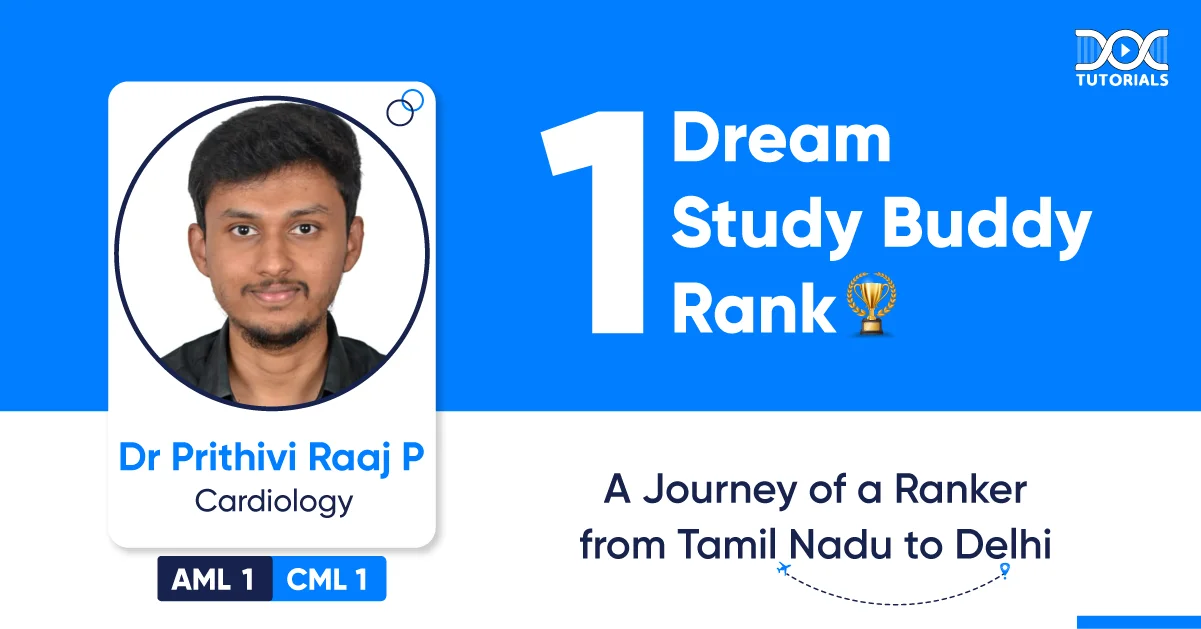
INI SS Topper: 1 Dream, 1 Study Buddy, 1 Rank – The Journey of Dr. Prithivi Raaj, CML 1 & (AIIMS) AML 1 in DM Cardiology
Achieving the top rank in a competitive exam like the INI SS DM Cardiology requires tireless dedication, a structured approach,…
-
INI SS Results: Merit List, Exam Insights, and What Comes Next
The INI SS results for October 2024 are just around the corner. This is a life-changing moment for thousands of…