Volkmann’s Ischemia: Causes, Symptoms, Diagnosis, and Treatment
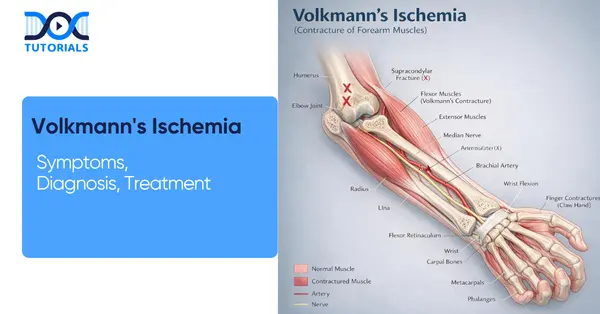
Volkmann’s ischemia is a severe and time-sensitive condition seen in orthopaedic and emergency care. What may start as a simple limb injury can quickly worsen within hours, leading to permanent muscle damage and loss of hand function. However, the condition is preventable if it is recognised early and treated promptly.
For NEET PG aspirants and practising clinicians, Volkmann’s ischemia is a high-yield topic in orthopaedics that demands clarity of its pathophysiology, clinical presentation, and management at each stage of progression. Keep reading to know more.
What is Volkmann’s Ischemia?
Volkmann’s ischemia is a condition where reduced blood flow to the forearm muscles causes swelling and elevated pressure, threatening muscle survival. If treated early, the damage can be reversed, but delay can lead to muscle shortening and a claw-like deformity of the hand.
Volkmann contracture, also known as Volkmann ischaemic contracture, is a claw-like deformity of the hand named after the 19th-century German doctor Richard von Volkmann. Ischaemic refers to the possible aetiology, and contracture indicates shortening.
This condition is a permanent flexion deformity at the wrist and fingers that results in a claw-like presentation of the hand, due to the permanent shortening of the flexor group of muscles in the forearm. Volkmann’s ischemia refers to the acute phase, the period of compromised blood flow to the forearm muscles, during which the condition is still reversible.
If this ischaemia is not relieved, it progresses to Volkmann’s ischaemic contracture (VIC), the established, irreversible stage characterised by muscle necrosis, fibrosis, and fixed deformity. Volkmann’s ischemia occurs when blood flow to the forearm is interrupted.
This results in swelling and increased pressure around the area, leading to a condition called compartment syndrome. If not treated on time, all the muscles can undergo necrosis, fibrosis, and contracture. The underlying pathological mechanism is straightforward.
Raised pressure within the closed fascial compartment of the forearm compresses the blood vessels supplying the muscles. Ischaemia leads to muscle necrosis, which leads to fibrosis. Fibrosis leads to contracture. Each step compounds the last, and only the first raised compartment pressure is fully reversible.
What is the Classification of Volkmann’s Ischaemic Contracture?
Volkmann ischaemic contracture is classified as mild, moderate, or severe based on the extent of muscle and nerve damage. It can range from limited finger involvement to widespread muscle loss with significant deformity and loss of function.
Seddon introduced a classification in 1964, later modified by Tsuge in 1975. The contractures are divided into 3 types: mild, moderate, and severe. Here they are:
- Mild (Localised): Only a small group of muscles, typically the deep flexors of the middle and ring fingers, are affected. There is minimal sensory disturbance and no nerve involvement.
- Moderate (Classic): The necrosis is confined to the flexor digitorum profundus, while in larger retractions, the contracture affects the flexor digitorum profundus, flexor digitorum longus, and sometimes flexor digitorum superficialis.
On examination, a flexion deformity is noted in all fingers, the thumb, and the wrist, with sensory loss to the median and ulnar nerves.
- Severe: Severe contractures are characterised by necrosis of all flexor muscles and, sometimes, the extensor muscles. Neurological involvement is significant, and the functional loss is extensive.
What are the Causes of Volkmann’s Ischemia?
Volkmann’s ischemia is mainly caused by increased pressure in the forearm, most often due to fractures, tight casts, or severe swelling after injury. Anything that reduces blood flow or compresses the muscles can trigger this condition if not addressed in time.
Volkmann’s ischemia is the result of acute compartment syndrome of the forearm. Anything that causes a dangerous rise in intracompartmental pressure, or significantly reduces the arterial blood supply to the forearm, can trigger the ischaemic cascade.
The most common and important causes include:
- Supracondylar Fracture of the Humerus: This is the single most common cause, particularly in children. The fracture can directly injure the brachial artery or create a surrounding haematoma and swelling that compresses the vessels, leading to compartment syndrome.
- Tight External Bandages or Plaster Casts: Volkmann described a condition involving muscle ischaemia and necrosis, attributing the contracture to an interruption of the arterial blood supply caused by the application of tight compression bandages to the injured limb.
Casts that are applied too tightly or become constrictive following post-injury swelling remain a significant preventable cause.
- Forearm and Elbow Fractures: Fractures of the radius, ulna, or both bones of the forearm can cause significant local haematoma and swelling sufficient to raise compartment pressure to dangerous levels.
- Vascular Injuries: Direct injury to the brachial or radial artery, or arterial thrombosis following trauma or catheterisation, reduces distal blood flow and precipitates ischaemia.
- Crush Injuries and Burns: Extensive soft tissue damage causes massive local oedema within the fascial compartment.
- Prolonged External Compression: Unconscious patients lying with the arm compressed under body weight can develop compartment syndrome without any fracture.
- Excessive Intravenous Fluid Extravasation: Particularly in children, inadvertent extravasation of IV fluids into the forearm soft tissues can raise compartment pressure.
What are the Risk Factors of Volkmann’s Ischemia?
Volkmann’s ischemia is more likely in children, especially after elbow injuries, and when treatment is delayed. Factors like tight casts, poor blood flow, or inadequate monitoring after injury or surgery can increase the risk by allowing pressure to build up in the forearm.
Several factors increase a patient’s susceptibility to developing Volkmann’s ischemia following injury:
- Age: Children are disproportionately affected, primarily because supracondylar fractures of the humerus are far more common in the paediatric age group. The anatomy of the growing elbow also makes vascular injury more likely with this fracture pattern.
- Delay in Seeking Medical Attention: The longer compartment syndrome goes untreated, the greater the extent of muscle necrosis and the more severe the resulting contracture.
- Circumferential Immobilisation: Plaster casts applied over a freshly injured, swelling limb that are not split or bivalved carry a significant risk of producing extrinsic compartment syndrome.
- Coagulopathy or Vascular Disease: Conditions that impair arterial flow or promote thrombosis increase the vulnerability of the forearm musculature to ischaemic injury.
- Inadequate Post-operative Monitoring: Patients managed surgically for elbow or forearm fractures who are not observed closely in the postoperative period are at risk of missed compartment syndrome.
What are the Symptoms of Volkmann’s Ischemia?
Volkmann’s ischemia usually starts with severe pain, swelling, and tightness in the forearm, often with tingling or difficulty moving the fingers. If not treated early, it can lead to a fixed claw-like deformity of the hand with muscle wasting and loss of movement.
The symptoms of Volkmann’s ischemia reflect the underlying compartment syndrome and vary in severity depending on the stage at which the patient presents.
In adults, the classic clinical warning signs are described as the 6 Ps:
- Pain: Severe, disproportionate pain that is not adequately controlled by standard analgesics and worsens with passive stretching of the fingers.
- Pressure: The forearm feels tense, firm, and woody on palpation.
- Paraesthesia: Tingling or numbness in the hand and fingers, indicating nerve involvement.
- Paralysis: Weakness or inability to move the fingers actively.
- Pallor: The hand or fingers appear pale or mottled due to compromised circulation.
- Pulselessness: Absent or diminished radial pulse in severe cases, indicating significant arterial compromise.
In children, the primary symptoms are rather summarised as the 3 As: anxiety, agitation, and increased analgesic requirements due to pain out of proportion, along with pain on passive stretching.
Pain on passive extension of the fingers is considered the most reliable and sensitive early clinical sign of forearm compartment syndrome. It should never be dismissed or attributed solely to the primary injury.
Once Volkmann’s ischaemic contracture has become established, meaning the ischaemia has progressed to irreversible muscle necrosis and fibrosis, the clinical picture changes. The patient presents with:
- Fixed flexion deformity of the wrist and fingers producing the characteristic claw-like appearance.
- The deformity partially corrects with wrist flexion, confirming its muscular rather than bony origin.
- Sensory loss in the distribution of the median and ulnar nerves.
- Muscle wasting and thinning of the forearm.
- Restricted range of motion at the wrist, fingers, and sometimes the elbow.
What is the Diagnosis of Volkmann’s Ischemia?
Volkmann’s ischemia is mainly diagnosed by checking symptoms, especially pain when the fingers are moved. Other tests may help, but early clinical signs are the most important for timely treatment.
The diagnosis of the acute phase of Volkmann’s ischemia is predominantly based on clinical evaluation. The diagnostic method consists of:
- Clinical Examination: Evaluation of the 6 Ps in adults or the 3 As in children. The main sign remains pain when the finger is passively extended.
- Intracompartmental Pressure Monitoring: This is an invasive but objective method for measuring pressure in the forearm compartment using a Stryker tonometer or a similar device. This is especially useful for patients who won’t cooperate or are unconscious.
- Imaging: Imaging studies such as X-rays, MRI (magnetic resonance imaging) scans, and CT (computed tomography) scans may prove supportive in the diagnosis of Volkmann ischaemic contracture, but are not considered first-line investigations.
X-rays identify the underlying fracture. MRI can delineate the extent of muscle involvement in established contracture.
- Vascular Assessment: Doppler ultrasound or angiography may be used when arterial injury is suspected.
- Near-infrared Spectroscopy (NIRS): NIRS can also aid the assessment and management of acute compartment syndrome, though its wide use is limited due to cost and limited availability of sensors, despite proving to be a reliable non-invasive investigation.
What are the Treatment Options for Volkmann’s Ischemia?
Treatment of Volkmann’s ischemia depends on how early it is detected. Early treatment aims to relieve pressure and prevent damage, while later stages may need physiotherapy to improve function. Recovery also depends on regular rehabilitation to regain movement and strength.
The treatment of Volkmann’s ischemia is staged according to whether the patient presents in the acute phase or with established contracture. The guiding principle is that early intervention saves function; late intervention restores it only partially.
Here’s how the treatment process goes:
1. Acute Phase Treatment: Preventing Contracture
The most important step in the acute phase is prompt recognition and relief of compartment syndrome, before irreversible muscle death occurs.
Immediate non-surgical measures involve:
- Remove all circumferential dressings, bandages, and constrictive plasters immediately. It is shown that casts may restrict compartment expansion by up to 40% and should always be removed, a step that reduces pressure elevation by about 40 to 60%.
- Correct anaemia and allow relative hypertension to maintain limb perfusion.
- Position the limb at heart level, not elevated beyond this, as elevation reduces arterial inflow.
Emergency Fasciotomy
The primary emergency treatment for acute compartment syndrome leading to Volkmann contracture is emergency fasciotomy. In this procedure, the surgeon opens the fascial envelope surrounding the forearm compartments to relieve the elevated pressure and restore perfusion to the ischaemic muscles.
Prompt fasciotomy, within 4 hours, leads to minimal sequelae. Delays of 6-8 hours or more significantly increase the likelihood of irreversible muscle damage and subsequent contracture.
2. Treatment of Established Volkmann’s Ischaemic Contracture
Once contracture has set in, treatment depends on the severity as classified by the Tsuge classification. Here’s how it goes:
Mild Contracture
Conservative management with physiotherapy, passive stretching, and dynamic splinting may be sufficient. The aim is to prevent further tightening and maximise the residual range of motion. Surgery in mild cases is rarely necessary.
Moderate Contracture
In moderate Volkmann’s contracture, tendon slide and neurolysis surgery should be performed (median and ulnar) along with extensor transfer procedures.
The muscle slide operation, also known as the Page-Scaglietti procedure, detaches the origin of the forearm flexor muscles from the medial epicondyle. This allows them to slide distally, thereby lengthening them and reducing the deformity. This procedure produces reliable functional improvement in moderate cases.
Severe Contracture
In severe cases, debridement of injured muscle may be performed, along with scar tissue release and salvage procedures. Where the bulk of the flexor muscle mass is necrotic and fibrotic, free functional muscle transfer using a healthy muscle from another site, such as the gracilis, can restore active finger flexion.
Functional free muscle transfer can restore grasp in moderate and severe contractures. In the most advanced cases, where salvage is not achievable, wrist arthrodesis may be performed to stabilise the joint in a functional position, and in rare cases of digital necrosis, amputation may be necessary.
Postoperative Rehabilitation
Regardless of the surgical procedure performed, physiotherapy is an integral part of recovery. Range-of-motion exercises to enhance soft-tissue elasticity and to activate and strengthen the weak agonist muscles.
This is to ensure that the equilibrium between agonist and antagonist pulls during joint movement is an essential component of the therapy programme.
FAQs about Volkmann’s Ischemia
- What is the most common cause of Volkmann’s ischemia?
The most common cause is a supracondylar fracture of the humerus, particularly in children. This fracture can directly injure the brachial artery or cause surrounding haematoma and swelling, which raises forearm compartment pressure to dangerous levels. This triggers the ischaemic cascade, leading to muscle necrosis and contracture.
- What is the critical window for treating Volkmann’s ischemia?
Prompt fasciotomy, within four hours, leads to minimal sequelae. Beyond 6-8 hours of untreated compartment syndrome, the risk of irreversible muscle necrosis rises sharply. This makes Volkmann’s ischemia a genuine orthopaedic emergency in which hours, not days, determine the functional outcome.
- What pressure level requires immediate fasciotomy?
A compartmental pressure of greater than 30 to 40 mmHg is considered abnormal and warrants immediate fasciotomy, as delays of even a few hours might prove detrimental to the prognosis. Pressure monitoring is particularly useful in unconscious, sedated, or uncooperative patients where clinical assessment is unreliable.
- Can Volkmann’s ischaemic contracture be fully reversed?
Once contracture has developed, full reversal is not possible. Once the condition sets in, the prognosis always remains guarded, even after long and intensive physiotherapy and various restorative surgical techniques.
Treatment at this stage aims to maximise residual function rather than restore normality. Prevention through early recognition and timely fasciotomy remains the most effective strategy.
- How is Volkmann’s contracture classified?
Seddon introduced a classification in 1964, later modified by Tsuge in 1975. The contractures are divided into 3 types: mild, moderate, and severe. Mild cases involve only a small group of deep flexor muscles with no nerve involvement.
Moderate cases affect a larger muscle group with median and ulnar nerve sensory damage. Severe cases involve necrosis of all flexor muscles and sometimes the extensors, with a significant neurological deficit.
- Who is most commonly affected by Volkmann’s ischemia?
Children are disproportionately affected, primarily because supracondylar fractures of the humerus are far more common in the paediatric age group.
Nearly all patients with a childhood contracture end up with a relatively short limb due to the effects of fibrosis and contracture on the growing bones of the forearm.
- What is the role of physiotherapy in managing Volkmann’s contracture?
Physiotherapy plays a central role both before and after surgical intervention. In mild cases, it may be the primary treatment.
Following surgery, a range of motion exercises to enhance soft-tissue elasticity and activation and strengthening of weak agonist muscles. This is to ensure equilibrium in agonist and antagonist pull during joint movement.
Conclusion
Volkmann’s ischemia is a preventable condition that becomes progressively less treatable with every hour of delay. The clinical message is unambiguous: recognise compartment syndrome early, act without delay, and perform fasciotomy within the critical window.
Once contracture is established, the focus shifts to restoration of function through a carefully graded surgical approach, supported by sustained physiotherapy. For NEET PG aspirants, Volkmann’s ischemia is a recurring high-yield topic in orthopaedics.
For additional guidance, DocTutorials can be your study companion. We offer crisp videos, clinical Qbank, exam-focused notes, flashcards, and mind maps. This helps ensure aspirants gain complete clarity over complex medical topics.
Join DocTutorials today and explore our NEET PG course to excel in your medical career!


Latest Blogs
-

INI CET Exam 2026: Your Roadmap to Success – Key Topics, Strategies, and Lessons from Last Year’s Papers
The INI CET exam is more than just a test; it’s a significant milestone for many medical students aiming to…
-

INI CET Exam Success: Previous Year Question Papers & Ultimate Guide – INI CET PYQ
One can feel overwhelmed while preparing for the INI CET (Institute of National Importance Combined Entrance Test). A vast syllabus,…
-

NEET PG 2026 Preparation with Live Power Pack: Your Path to Success in 2026
Preparing for the NEET PG 2026 can be an overwhelming journey because of its vast syllabus and the pressure to…