How to Balance University Exams and NEET PG Preparation

It is the ultimate juggling act for any medical student. On one side, you have your heavy MBBS university exams demanding long essays and practical knowledge. On the other, the mammoth NEET PG syllabus staring right back at you, waiting to test your clinical speed. It is stressful. Really stressful. But guess what? It is totally manageable if you play your cards right.
Let’s face the truth. Most medical students feel like they are running on a treadmill that never stops. You finish your ward postings, sit down to study for your 3rd Prof, and suddenly the panic of PG entrance exams creeps in.
Here is the secret: you don’t actually have to choose between the two.
Get free, handwritten-style notes covering the most high-yield NEET PG topics!
The Myth of “Studying Separately”
For the longest time, students believed that MBBS academics and NEET PG strategy were two completely different paths. That is a myth.
Think about it. The pathology you cram for your profs? It is the exact same pathology testing your limits in PG exams. The only difference is the approach. Your university asks you to write descriptive answers. The entrance exam tests your clinical decision-making through MCQs.
According to the latest CBME and NMC guidelines, the focus has drastically shifted toward clinical application. This means your university exam-focused learning is already laying the groundwork for your entrance exams. You just need to align them properly.
Smart Strategies to Master Both Worlds
So, how do we practically balance university exams and NEET PG preparation without burning out? Let’s break it down.
1. Integrate Your Timetable
Never make separate schedules for your profs and PG prep. If you are reading Surgery for your 4th Prof clinics, solve Surgery MCQs the very same evening. Concept-to-clinical learning is the key here. When you read a topic from standard textbooks to build your academic foundation, cap it off by seeing how that exact topic is framed in a multiple-choice format.
2. Prioritize Previous Year Questions (PYQs)
This applies to both arenas. For your MBBS academics, your university-specific PYQs are your holy grail to pass with flying colors. For your entrance prep, NEET PG & INI-CET PYQs show you the examiner’s mindset. Identify the high-yield topics that overlap in both sets of papers. That intersection is where you should spend 80% of your time.
3. Rely on Visual and Active Learning
Reading paragraphs of text for hours is passive. It puts you to sleep. Switch it up. Use 3D & 2D animated learning tools to visualize complex anatomy or physiological pathways. Science shows that active recall through flashcards and solving IBQs (Image-Based Questions) boosts memory retention significantly compared to just reading notes.
Should I completely pause my NEET PG preparation a month before my university exams?
Answer: Not entirely! While your primary focus must absolutely shift to your university exams, pausing your PG prep completely breaks your momentum. Instead, scale it down. Dedicate just 30 to 45 minutes a day to solving a few MCQs or reviewing your Quick Revision Program notes related to the exact subject you are studying for your prof. It keeps the engine running without adding extra stress.
Understanding the Shift in Approach
To balance both effectively, you need to understand how to switch gears mentally. Here is a quick breakdown of how your approach should differ, yet complement each other.
| Feature | University Exam Preparation | NEET PG Preparation |
| Primary Goal | Passing the profs and building core concepts. | Securing a top rank for your dream specialty. |
| Question Format | Long essays, short notes, and practical vivas. | Objective MCQs, IBQs, and VBQs (Video-Based). |
| Study Material | Standard textbooks, University-specific PYQs. | High-yield notes, QBank, Grand Tests. |
| Testing Strategy | Detailed theoretical explanations and diagrams. | Time management, accuracy, and elimination skills. |
| Focus Area | Step-by-step academic knowledge. | Integrated system-based clinical application. |
Why Starting Early is Your Biggest Advantage
Waiting until your internship to start serious PG prep is a risky game. The syllabus is just too vast.
This is why starting your NEET PG journey from your 3rd Prof is widely considered the smartest move. By starting early, your MBBS academics and PG prep go hand in hand. You build strong fundamentals and connect them with clinical applications seamlessly.
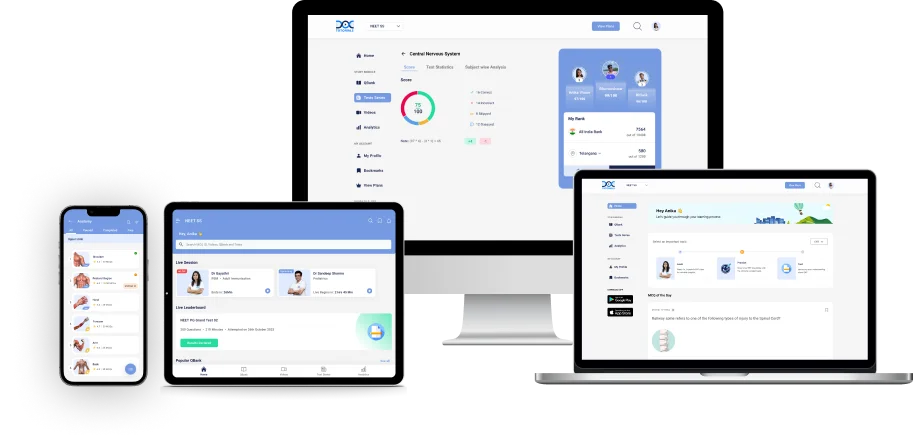
If you are wondering how to practically execute this without getting overwhelmed by different platforms, the DocTutorials NEET PG Foundation Plan is built exactly for this. It is a brilliant, integrated learning plan that takes you all the way from your 3rd Prof academics to your Dream Rank.
Instead of juggling multiple resources, this plan acts as a complete medical learning journey.
A Complete Ecosystem for Success
Think of it as having a mentor guiding you through both hurdles at once. With the foundation plan, you get complete academic preparation for your 3rd Prof + 4th Prof. This includes Theory and Practical videos, plus a dedicated Academic QBank tailored for university exam-focused learning. It is completely aligned with the CBME & NMC curriculum.
But here is the best part. Along with your academics, it unlocks a massive 36 Months of NEET PG Power Pack. You get long-term access to a complete entrance exam ecosystem featuring:
- 19 Subjects covered in 1500+ Syllabus Videos.
- Over 20,000+ MCQs, IBQs & VBQs with detailed explanations to practice consistently.
- 500+ QRP (Quick Revision Program) Videos for high-yield rapid revision.
- 60+ Grand Tests & 200+ Mini Tests to track performance analytics.
- Smart revision tools like mindmaps, flashcards, and consolidated Edition 6 Notes.
It nudges you in the right direction. You study for your university exams using their academic modules, and then immediately test your PG readiness with their system-based learning tools. It is one unified system to revise smarter and practice better.
Wrapping It Up
Balancing university exams and NEET PG preparation does not require you to study for 18 hours a day. It requires you to study smart. It requires combining your academic preparation with a long-term entrance exam ecosystem. Align your syllabus, practice questions daily, and never lose sight of your clinical concepts.
Take a deep breath. Start early. Stay consistent. You have absolutely got this!
Frequently Asked Questions (FAQs)
1. When should I start preparing for NEET PG?
Best time to start: 3rd Prof. Starting early will help you get good MBBS concepts and will allow you to combine your university exam preparations with PG level MCQ practice without rushing.
2. Is it possible to crack NEET PG with just the university textbooks?
Standard textbooks are important for your baseline concepts, but NEET PG involves solving objective MCQs, knowing the exam pattern and time management. You need a separate QBank and grand tests along with the textbooks.
3. How many hours should I study everyday to strike a balance between both?
Consistency is less than long hours. A good long-term strategy is to have 4 to 6 focused hours a day, split between university academics and solving related MCQs.
4. Is university exam marks important for NEET PG?
The university marks, by themselves, do not count toward your NEET PG score, but the conceptual clarity you need to get good marks in your profs will help you to get through tough clinical scenarios in the PG entrance.
5. To do more pre-clinical subjects or clinical subjects?
Both are highly integrated in the current NMC aligned pattern. You need to know pre-clinical fundamentals (like Anatomy and Pathology) to answer complex clinical questions (Medicine and Surgery).
6. Is solving only University specific PYQs enough to pass?
PYQs of university specific are good for understanding recurring themes but examiners often throw in new CBME aligned clinical questions. It’s no longer completely safe to rely on past papers alone.
7. With such a huge syllabus how to revise efficiently?
Use clever revision tools. Flashcards, consolidated notes, mind maps and Quick Revision Program (QRP) videos help you remember massive amounts of information fast before exams.
8. What is the INI-CET exam pattern as compared to NEET PG exam patterns?
Both tests evaluate clinical knowledge, but INI-CET usually has more detailed conceptual questions, multiple-correct options and more dependence on recent clinical updates and integration of basic sciences.
9. How Grand Tests help in MBBS academics?
Going for Grand Tests (even if you haven’t finished syllabus) builds exam stamina. It teaches you the art of elimination and time management and your weakest subjects at the earliest.
10. How to avoid burnout studying for two major exams?
Take breaks Follow a good sleeping schedule and make use of integrated plans like the NEET PG Foundation Plan so that you do not end up doing double the work. Study the same subjects for both exams at the same time to save time.

Latest Blogs
-

INI CET Exam 2026: Your Roadmap to Success – Key Topics, Strategies, and Lessons from Last Year’s Papers
The INI CET exam is more than just a test; it’s a significant milestone for many medical students aiming to…
-

INI CET Exam Success: Previous Year Question Papers & Ultimate Guide – INI CET PYQ
One can feel overwhelmed while preparing for the INI CET (Institute of National Importance Combined Entrance Test). A vast syllabus,…
-

NEET PG 2026 Preparation with Live Power Pack: Your Path to Success in 2026
Preparing for the NEET PG 2026 can be an overwhelming journey because of its vast syllabus and the pressure to…