Fellowship in Reproductive Medicine: Overview, Features, Syllabus, and Career Options
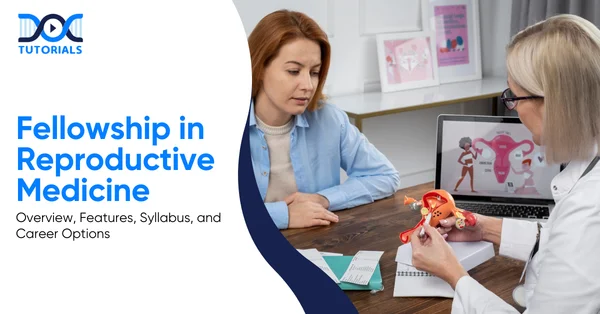
Reproductive medicine addresses the critical challenges of assisted reproductive technologies (ART), reproductive endocrinology, infertility, etc. Medical professionals seeking specialisation in this field can join the Fellowship in Reproductive Medicine programme to gain hands-on expertise and advanced knowledge.
With this specialised training programme, medical students can learn cutting-edge technologies in intracytoplasmic sperm injection (ICSI), in-vitro fertilisation (IVF), intrauterine insemination (IUI), etc.
By working closely with renowned super speciality hospitals in India, DocTutorials delivers industry-aligned medical fellowship programs that strengthen clinical expertise, enhance practical skills, and open new career opportunities for healthcare professionals.
Keep reading to learn more about fellowship in reproductive medicine, its features, curriculum, eligibility, and career opportunities!
What is Fellowship in Reproductive Medicine?
A Fellowship in Reproductive Medicine helps medical professionals like gynaecologists, endocrinologists, obstetricians, etc., enhance their skills and expertise in fertility management and reproductive health. Fellows can gain advanced knowledge in IVF, ICSI, and other procedures and handle patients with care.
Fellowship in Reproductive Medicine refers to specialised training for medical postgraduates or professionals to enhance their expertise in reproductive health and fertility management. Gynaecologists, obstetricians, and endocrinologists enrol themselves in these fellowship programmes to gain practical as well as theoretical experience.
From fertility evaluations to reproductive endocrinology disorders and advanced diagnostic techniques, fellows can significantly expand their clinical knowledge base through this programme. Moreover, they receive hands-on training in procedures such as ICSI and IVF from experienced mentors.
This fellowship programme not only focuses on clinical skills but also teaches the fellows to address the ethical and emotional challenges of the patients during fertility treatments.
What are the Features of Fellowship in Reproductive Medicine?
The Fellowship in Reproductive Medicine programme includes a comprehensive curriculum, covering all aspects of the subjects from ART to fertility preservation and reproductive surgery. Fellows can learn from the experts in this field and gain hands-on experience through clinical practices.
Here are some of the notable features of a Fellowship in Reproductive Medicine programme:
- Comprehensive Syllabus
This fellowship programme covers all the essential aspects of reproductive medicine. It includes fertility preservation, ART (assisted reproductive technologies), reproductive surgery, reproductive endocrinology, etc. It is focused on evidence-based practices to ensure that the fellows gain in-depth knowledge of the latest diagnostic tools, research, and treatment modalities.
- Advanced Techniques and Facilities
Reproductive Medicine Fellowship programmes offer an immersive learning environment to the candidates so that they can get hands-on training in a real-world clinical setup. These programmes equip fellows with advanced infrastructure and technologies to enhance their skills in reproductive medicine and handle the challenges in this field.
- Learn from Experts
These fellowship programmes are often conducted by experienced specialists in reproductive medicine. Therefore, fellows get the opportunity to learn from the experts in this field who are committed to academic excellence and have notable clinical experiences.
- Clinical Practices
Fellows are integrated into clinical exposure modules to turn their theoretical knowledge into practical skills. They are engaged in rotations at reputed medical institutions or clinics so that they can handle real-world scenarios, using their knowledge. Collaborative projects, discussions, and case studies further help them enhance their understanding of the subject and stay well-prepared for future challenges.
- Hands-On Training
To further strengthen their practical experience, fellows are allowed to perform various procedures related to reproductive medicine, like ultrasound-guided follicle aspirations, embryo transfers, etc. It helps them master the technical procedures related to reproductive medicine.
What are the Program Details for Fellowship in Reproductive Medicine?
The Reproductive Medicine Fellowship programme helps the fellows master therapeutic and diagnostic techniques in infertility. They can learn IUI, ICSI, IVF, and other advanced ART procedures. This programme also teaches the fellows to develop strategies for patient-centric management in case of infertility and other reproductive issues.
The Fellowship in Reproductive Medicine programme usually lasts for 3 months to 1 year, enabling candidates to master infertility-related diagnostic and therapeutic techniques, gain expertise in ART procedures, and receive hands-on training in clinical settings and state-of-the-art IVF laboratories.
Fellows also get to acquire clinical research skills and gain the ability to develop patient-centric management strategies for infertility cases. Now, the curriculum syllabus will tend to vary across institutions.
Here’s what is usually covered:
- Fertilisation and Embryogenesis
- Anatomy/Embryology and applied anatomy
- Oogenesis / follicular genesis and evaluation of female infertility
- Reproductive endocrinology
- Endometrium and Implantation
- Spermatogenesis and evaluation of male infertility
- Endocrine disorders and infertility
- Anovulation
- Amenorrhea
- Uterine factors in infertility
- Tubal factors in infertility
- Ovulation induction drugs
- Ovulation induction protocols
- IUI (Intrauterine Insemination)
- IVF-ICSI embryologist perspective
- IVF Lab Clinicians’ Perspective and embryologist perspective
- Triggers and adjuvants in IVF
- Endometrial transfer
- Endoscopy in infertility
- IVF stimulation protocols
- OPU (Ovum Pick-Up)
- Oocyte and embryo grading
- Semen preparation
- Infection in infertility
- PCOS ( Polycystic ovarian syndrome)
- Assessment of ovarian reserve
- Endometriosis
- Ultrasound in infertility
- Luteal phase defects and Luteal phase support
- POR (Poor Ovarian Responders)
- Unexplained infertility
- Recurrent implantation failure
- Recurrent pregnancy loss
- Azoospermia and male infertility
- Genetics in infertility, including PGD
- Immunology in infertility
- Third-party reproduction
- ART and law
- Counselling in ART
- Troubleshooting and optimising results in ART
- Fertility
The course also involves simulation training, which may include:
- Basic Laparoscopic training on a simulator
- Egg pick-up
- Embryo Transfer
- IUI
- Basic Hysteroscopy training on a simulator
What is the Eligibility Criteria for a Fellowship in Reproductive Medicine?
Candidates holding a degree in DNB, DGO, MD, or MS in Gynaecology and Obstetrics can apply for a Fellowship in Reproductive Medicine. Medical professionals in the same field are also eligible for the fellowship programme.
Here are the eligibility criteria for the Fellowship in Reproductive Medicine programme:
- Postgraduate DNB, DGO, MD, or MS in Gynaecology or OBG
- Candidates must have completed their degree from an institution recognised by the NMC (National Medical Commission) of India
- Practising medical professionals in a similar field can also apply for the programme
How to Apply for a Fellowship in Reproductive Medicine?
Candidates applying for the Fellowship in Reproductive Medicine programme need to submit the enquiry form after filling in their details. Next, they need to upload the educational documents for screening. If shortlisted, the candidate will be called for an interview. Upon selection, you can follow the instructed procedure to enrol.
Here are the steps to follow while applying for the Fellowship in Reproductive Medicine programme:
Step 1: Submit the enquiry form after filling in all your details.
Step 2: Upload all your educational documents for the screening requirements.
Step 3: Shortlisted candidates will be called in for an interview.
Step 4: If selected, you will receive confirmation and proceed further with the enrolment process.
What are the Career Opportunities after a Fellowship in Reproductive Medicine?
Reproductive medicine specialists are in high demand due to the worldwide infertility crisis. It highlights the importance of Fellowship in Reproductive Medicine programmes. Such courses help develop expertise and credibility while outlining important career paths, such as clinical research and professional advancement in clinics, private practice, or academia.
As per the WHO, 1 in every 6 people face infertility issues across the globe. Thus, there is a rising demand for professionals with specialisation in reproductive medicine to handle the increasing caseload.
Here are some of the career opportunities if you are pursuing a Fellowship in the Reproductive Medicine programme:
- Opportunities in Research
Participation in clinical research allows you to bring innovative approaches to fertility treatments. Candidates pursuing Reproductive Medicine Fellowship programmes can work as researchers to contribute to the advancement of the field.
- Advancement in Career
After completing the fellowship programme, candidates can start their careers in fertility clinics or begin private practice. They can also start a career in academic institutions by training others. These fellowship programmes enhance the credibility of candidates, shaping their future as reproductive health experts.
FAQs about Fellowship in Reproductive Medicine
- Who can apply for a Fellowship in Reproductive Medicine?
Candidates holding a PG degree in MD, MS, DGO, or DNB in Gynaecology or OBG are eligible for Reproductive Medicine Fellowship programmes. Practising medical professionals in a similar field can also apply for this fellowship.
- What are the career options after pursuing a Reproductive Medicine Fellowship?
Candidates completing their Fellowship Programme in Reproductive Medicine can work as specialists in a fertility clinic or start a private practice. Besides, they can also take up academic job roles to strengthen the skills of fellows in Reproductive Medicine.
- What is the course duration for the Reproductive Medicine Fellowship programme?
Candidates can enrol in Fellowship in Reproductive Medicine programmes for a duration of 3, 6, or 12 months. The course duration may vary depending on the institution you choose.
- What are the benefits of pursuing a Fellowship Programme in Reproductive Medicine?
A Fellowship in Reproductive Medicine improves research profiles, strengthens case analysis confidence for accurate decisions, and sharpens IVF/ART clinical and lab skills through practical expert training. It also prepares you for senior fertility roles that prioritise ethical care.
- For which professionals is a Fellowship Programme in Reproductive Medicine suitable?
This fellowship programme is ideal for gynaecologists, obstetricians, and andrologists who are enthusiastic about fertility care. Clinicians looking for structured ART training and those hoping to gain practical IVF, IUI, and ICSI skills for expanded roles in reproductive treatments are all good candidates for this fellowship.
- What is covered under the Reproductive Medicine Fellowship Programme?
Reproductive anatomy and embryology, male and female infertility assessment (PCOS, azoospermia), ovarian testing, ART (IUI/IVF/ICSI), lab/clinical IVF training, third-party reproduction, and legal/ethical counselling are all covered in Reproductive Medicine fellowships.
- What IVF skills do fellows learn in the Reproductive Medicine Fellowship Programme?
Through expert-supervised hands-on training, fellows gain expertise in IVF cycle planning and monitoring, stimulation protocol selection, egg retrieval, embryo transfer, quality assessment, and evidence-based decision-making.
- In what ways does a Reproductive Medicine Fellowship prepare you for fertility preservation and egg freezing?
Candidate evaluation, stimulation cycle design, egg retrieval techniques, lab coordination for cryopreservation, and patient counselling regarding success rates, timing, and storage options are all covered.
- Does the Reproductive Medicine Fellowship Programme provide hands-on training to the candidates?
Yes, candidates joining this fellowship programme receive hands-on training from experts in this field. They can learn various procedures related to reproductive medicine, such as embryo transfers, IVF, ultrasound, etc.
- How to apply for a Fellowship Programme in Reproductive Medicine?
Candidates need to submit the enquiry form and provide their educational certificates. Shortlisted candidates will have to attend an interview, and then, after the final selection, they can go through the enrolment process.
Conclusion
The Fellowship in Reproductive Medicine is a special training programme for postgraduate medical candidates who aim to specialise in infertility issues and reproductive health. Apart from improving their clinical acumen, these programmes open up potential career paths and promote research and development opportunities in the field.
However, to reap the full benefit of such programmes, one must consider pursuing them from reputed organisations like DocTutorials. We provide specialised, hands-on training in clinical practices by expert faculty across 10+ partner hospitals in India.
Additionally, candidates get a globally recognised certification after successful course completion, enabling them to take their careers to the next level. Check out our fellowship programme for more information!