Human Anatomy by BD Chaurasia: Key Features, Latest Edition, and Importance for 1st year MBBS
In medical studies, Anatomy plays a crucial role in understanding the foundation of the human body. It helps with accurate diagnosis of anatomical issues, effective surgical procedures, and clinical decision-making.
For MBBS 1st-year students, it is essential to gain a deeper understanding of Anatomy in line with their syllabus requirements. In this regard, the BD Chaurasia Human Anatomy book deserves special mention. The book includes clear, simple explanations of essential anatomical topics, making it easily accessible to students.
Keep reading to learn more about the features, overview, and table of contents of this book!
BD Chaurasia Human Anatomy Book: A Brief Overview
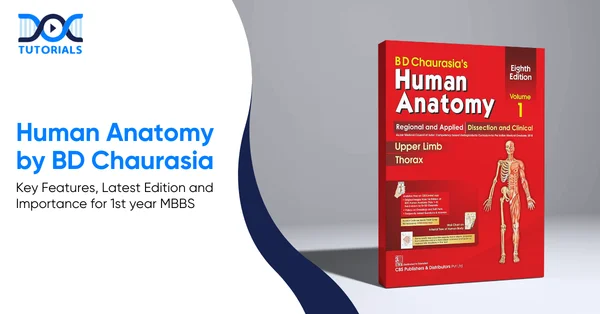
BD Chaurasia Human Anatomy is one of the top textbooks in anatomy since its first publication in 1979. Published in 4 volumes, this book is known for its simple language, detailed illustrations, comprehensive coverage, etc.
The Human Anatomy book by BD Chaurasia was first published in 1979 in 4 volumes. It has been a popular textbook among medical students for several years due to its easier explanations, wide coverage of all aspects of anatomical concepts, etc.
Besides, it includes high-quality diagrams to help the readers visualise and understand the concept better. The language of this textbook is simple and clear to help the readers understand complex structures easily.
All these make the book an ideal choice for both novice and expert learners preparing for dentistry, occupational therapy, and physiotherapy. This book has been translated into multiple languages for students in India and abroad. It prepares professionals from a variety of healthcare disciplines for clinical success by laying a solid anatomical foundation.
Which is the Latest Edition of BD Chaurasia Human Anatomy?
BD Chaurasia’s Handbook of General Anatomy, 10th Edition, equips medical, dental, and allied health students with clear CBME-aligned content, new chapters, 364+ 3D models, 1689 diagrams, 351 flowcharts, quotes, key points, and MCQs. Its user-friendly format simplifies anatomy mastery for aspiring physicians.
BD Chaurasia’s Anatomy, the latest edition, was published in 2024. Edited by Krishna Garg, PS Mittal, and Mrudula Chandrupatla, the 10th edition of this book adheres to the updated CBME guidelines. Each chapter of this book features insightful quotations, concise takeaways, and multiple-choice questions (MCQs) for self-assessment.
BD Chaurasia, 10th edition, stands out as one of the best resources for students of dental, medical, allied health sciences, and AYUSH. The updated edition of this book covers chapters on essential topics of human anatomy.
Students can access more than 364 3D anatomical models, 351 flowcharts, 1689 line diagrams, etc., in this updated edition to enhance their learning experiences. This textbook acts as an indispensable tool that helps master the complexities of human anatomy in an easy format.
The clear explanations, detailed coverage, and advanced features of this book provide complete guidance for aspiring medical professionals on their journey to becoming skilled physicians. Moreover, it includes several engaging features to enhance students’ learning experiences.
What are the Features of the BD Chaurasia Anatomy Book, Latest Edition?
BD Chaurasia Human Anatomy aligns with NMC/CBME guidelines, featuring 364+ 3D illustrations, 1689 line diagrams, 351 flowcharts, 203 tables, and fact boxes. Interactive QR codes, eBook access, clear style, revision points, MCQs, and 100+ animated models via app enhance visual, summarised, and digital learning for medical students.
Here are some of the notable features of the BD Chaurasia Anatomy Book:
- Alignment with NMC Guidelines
The anatomy textbook by BD Chaurasia has been updated to align with the recent NMC (National Medical Commission) guidelines to fit in modern medical training frameworks.
It is specifically designed to adhere to the CBME (Competency-Based Medical Education) curriculum. This book emphasises the practical skills and competencies to help students so that they can prepare for real-world applications in clinical practice.
- Helps in Visual Learning
This book holds more than 364 full-colour 3D illustrations that help explain anatomical structures in a simpler way. These images explain the complex topics in a more intuitive and memorable way.
To complement these images, there are 1689 precise line diagrams in the book that are easier to replicate. Besides, there are 351 flowcharts in this handbook to make complex procedures easily understandable through rapid review and deeper understanding.
- To-the-Point Information
There are 203 concise tables in this book that cover essential data in easy and simple formats. Such structures help in memorising the details easily and quickly. It highlights crucial information related to topics like ossification timelines and dissection techniques to draw readers’ attention towards high-yield topics.
- Interactive Learning Tools
This book includes QR codes to link the readers to eSmartQuiz to promote self-testing and instant recall for necessary topics. You can also access an eBook that offers digital video and notes for an engaging learning experience.
What is the Table of Contents of the BD Chaurasia Anatomy Book?
The table of contents for BD Chaurasia book volume 1 includes 18 sections. Each section includes chapters on different topics, along with MCQs and points to remember sections. The topics covered in this book are subdivisions of anatomy, history of anatomy, anatomical nomenclature, anatomical terminology, etc.
Here is the table of contents for the Human Anatomy Book by BD Chaurasia:
Section 1: Introduction
- Subdivisions of Anatomy: History of Anatomy
- Anatomical nomenclature
- Anatomical terminology
- Terms related to body movements
- Clinical anatomy
- Arrangement of structures in the body from within outwards
- Points to remember
- Multiple choice questions
Section 2: Skeleton
- Bones
- Classification of bones
- Gross structure of an adult long bone
- Parts of a young, growing bone
- Blood supply of bones
- Nerve supply of bones
- Development and ossification of bones
- Growth of a long bone
- Medicolegal and anthropological aspects
- Cartilage
- Clinical Anatomy of the Skeleton
- Points to remember
- Multiple choice questions
Section 3: Joints
- Classification of joints
- Fibrous joints
- Cartilaginous joints
- Synovial joints
- Clinical anatomy of the joint
- Points to remember
- Multiple choice questions
Section 4: Muscles
- Derivation of name
- Skeletal muscles
- Parts of a muscle
- Structure of striated muscle
- Naming the muscles
- Nerve supply of skeletal muscle
- Action of muscles
- Clinical anatomy of muscles
- Points remember
- Multiple choice questions
Section 5: Circulatory System
- Components
- Arteries
- Veins
- Capillaries
- Sinusoids
- Angiosome
- Nerve supply
- Anastomoses
- Arteries
- Clinical Anatomy of the Circulatory System
- Points to remember
- Multiple choice question
Section 6: Lymphatic System
- Components
- Lymph nodes
- Clinical Anatomy of the Lymphatic System
- Points to remember
- Multiple choice questions
Section 7: Nervous System
- Parts of the Nervous System
- Cell types of the nervous system
- Blood-brain barrier
- Reflex arc
- Peripheral nerves
- Spinal nerves
- Nerve fibres
- Autonomic nervous system
- Sympathetic nervous system
- Parasympathetic nervous system
- Clinical Anatomy of the Nervous System
- Points remember
- Multiple choice questions
Section 8: Skin and Fasciae
- Surface area
- Pigmentation of skin
- Structure of skin
- Surface irregularities of skin
- Appendages of skin
- Clinical anatomy of skin
- Superficial fascia
- Deep fascia
- Modifications of the deep fascia
- Clinical anatomy of skin
- Points to remember
- Multiple choice questions
Section 9: Connective Tissue Ligaments and Raphe
- Introduction
- Constituent elements
- Types of connective tissue
- Definition
- Clinical anatomy of connective tissue
- Points remember
- Multiple choice questions
Section 10: Respiratory System
- Organs of respiration
- Clinical Anatomy of the Respiratory System
- Points to remember
- Multiple choice questions
Section 11: Digestive system
- Layers of the alimentary canal
- Digestive tract or alimentary canal
- Liver
- Extrahepatic biliary apparatus
- Pancreas
- Spleen
- Clinical Anatomy of the Digestive System
- Points to remember
- Multiple choice questions
Section 12: Sensory Organs
- Tongue
- Nose
- Ear
- Eye
- Clinical anatomy of sensory organs
- Points to remember
- Multiple choice questions
Section 13: Endocrine System
- Hypothalamus and pituitary gland
- Thyroid gland
- Parathyroid gland
- Suprarenal or adrenal glands
- Pancreas-islets of Langerhans
- Pineal gland
- Ovaries, testes
- Juxtaglomerular apparatus in the kidney
- Clinical anatomy of endocrine
- Points to remember
- Multiple choice questions
Section 14: Urinary System
- Components of the urinary system
- Gross structure of the kidney
- Blood Supply of the Kidney
- Nephron
- Clinical Anatomy of the Urinary System
- Points to remember
- Multiple choice questions
Section 15: Reproductive System
- Female reproductive system
- Breast or mammary gland
- Male reproductive system
- Clinical Anatomy of the Reproductive System
- Points to remember
- Multiple choice questions
Section 16: Principles of Radiography
- History of X-rays
- Properties of X-rays
- Radiographic procedures
- Special procedures
- Magnetic resonance imaging
- Positron emission tomography
- Interventional radiology
- Points to remember
- Multiple choice questions
Section 17: Genetics
- The genes
- Some important terms
- The chromosomes
- Mitochondrial DNA
- Chromosomal aberrations
- Prenatal diagnosis
- Methods of diagnosis
- Foetal therapy
- Molecular regulation of development
- Points to remember
- Multiple choice questions
Section 18: Cadaver as Our First Teacher
- Cadaver as a first teacher
- How to obtain a cadaver
- Preservation of the cadavers
- Embalming and ethics
- Dissection instruments
- Points to remember
- Multiple choice questions
How is the BD Chaurasia Anatomy Book Important for 1st Year MBBS Students?
The 10th edition of BD Chaurasia’s Human Anatomy revolutionises MBBS 1st-year learning with simple text, interrelated concepts, 3D colour plates, reproducible diagrams, flowcharts, tables, fact boxes, and QR-linked eSmartQuizzes. These features enhance comprehension, visualisation, quick revision, and self-assessment.
For first-year MBBS students learning gross anatomy, BD Chaurasia’s Human Anatomy is crucial. Its four regional volumes: head/neck/brain, lower limb, abdomen/pelvis, and upper limb/thorax, perfectly align with Indian exam patterns and dissection schedules.
Unlike dense texts, simple, concise language makes complex topics easier for beginners to understand. During practicals and vivas, visualisation is aided by clear, labelled diagrams, radiographs, and clinical correlations.
FAQs about BD Chaurasia Anatomy Book
- When was BD Chaurasia’s anatomy book first published?
BD Chaurasia’s Human Anatomy was first published in 1979. Written by Dr B.D. Chaurasia, a renowned anatomist from Gwalior Medical College, quickly became a staple for Indian MBBS students due to its practical regional approach and dissection focus.
- Which is the latest edition of the BD Chaurasia anatomy book?
The latest edition is the tenth Edition, released around 2025 by CBS Publishers. Updated by editors like Krishna Garg, it includes modern additions like more radiographs, CT/MRI images, and CBME-aligned content for current medical curricula.
- What are the unique features of the BD Chaurasia anatomy book?
Features include concise regional dissection text, labelled colour diagrams, clinical correlations, muscle tables, radiological anatomy, and surface markings.
Its student-friendly language, affordability, and alignment with Indian exams make it superior for first-year practical and theory.
- How many volumes are there in the BD Chaurasia anatomy book?
BD Chaurasia’s Human Anatomy comprises four volumes: Volume 1 (Upper Limb & Thorax), Volume 2 (Lower Limb, Abdomen & Pelvis), Volume 3 (Head, Neck & Brain), and Volume 4 (Neuroanatomy).
- Which topics are the most important in anatomy?
Topics such as nerve supply, venous drainage of any region, adrenal gland, thorax, embryology, joints, osteology, orbital bone, etc.
- What are the main types of anatomy?
Anatomy can be divided into two main categories. The study of anatomical features that are visible to the unaided eye, such as the internal and external organs, is known as gross (macroscopic) anatomy.
The study of microscopic anatomy focuses on small anatomical components, including tissues and cells.
- Which four branches of anatomy are there?
Macroscopic or gross anatomy and microscopic anatomy are the two main categories of anatomy, as can be seen above. While microscopic anatomy is further subdivided into cytology and histology, macroscopic anatomy is further subdivided into surface, regional, and systemic anatomy. The branches of anatomy are these five divisions.
- How many organ systems exist in human anatomy?
Human anatomy features 11 major organ systems that work together to sustain life and maintain bodily functions.
They include the integumentary (skin), skeletal (bones), muscular (muscles), nervous (brain/nerves), cardiovascular (heart/blood vessels), lymphatic (immunity), respiratory (lungs), digestive (stomach/intestines), urinary (kidneys), endocrine (glands/hormones), and reproductive systems.
- What is gross anatomy?
The macroscopic, or large-scale, study of organs and structures in their whole is known as gross anatomy. The study of organs and structures that are readily visible to the unaided eye is another way to characterise it.
- What is microscopic anatomy?
Microscopic anatomy or histology is the study of the microscopic structure of cells, tissues, and organs. The study of organs, tissues, and cells under a microscope is another way to put it.
Conclusion
BD Chaurasia Anatomy book is a great choice for 1st year MBBS students to grasp the basic yet detailed knowledge of anatomy. This book includes simple, concise texts for easy understanding. Moreover, the 3D images, flow charts, and line diagrams also help comprehend complex topics in an easy manner.
However, despite all these materials, 1st-year MBBS students require professional guidance to master the subject thoroughly and skilfully. Here comes the need for reliable online platforms like DocTutorials.We provide coaching for MBBS through CBME-based video lectures conducted by expert faculty, QBank for formative assessment, 3D and 2D animations, etc. Get in touch to know more about our MBBS course!

Latest Blogs
-
INI CET Exam Pattern 2027: A Complete Guide with Subject-Wise Weightage
INI CET Exam Pattern 2027: A Complete Guide with Subject-Wise Weightage The Institute of National Importance Combined Entrance Test (INI…
-

NEET PG Registration 2026: An Essential Guide For Exam Prep
The NEET PG registration, which is conducted online, is a crucial step in the exam process. Filling out the NEET…
-

NEET PG Exam 2025- Date, Pattern, Marking Scheme, Subject Wise Weightage, and Exam Mode
NEET PG Exam 2025 is the ultimate gateway for medical graduates aspiring to pursue postgraduate courses in medicine, including MD,…