MBBS Courses List: Complete Overview, Duration, and Eligibility
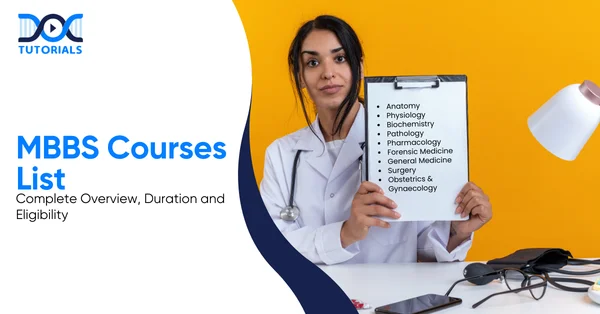
The MBBS programme (Bachelor of Medicine, Bachelor of Surgery) is the oldest undergraduate programme for aspiring medical professionals in India. This is a rigorous academic and clinical training programme that combines academic studies with clinical experiences.
The primary channel for admission to MBBS courses in India is the NEET (National Eligibility Cum Entrance Test), a national-level entrance examination conducted by the National Testing Agency.
Read on to explore the MBBS course details, including subjects, duration, and eligibility criteria in depth.
MBBS Course Overview Table
The Bachelor of Medicine and Bachelor of Surgery (MBBS) is a foundational undergraduate degree that certifies students as licensed medical professionals and physicians.
An MBBS degree is widely recognised internationally as a basic requirement for becoming a medical doctor or physician. The programme comprises 19 subjects of MBBS, and other core topics under each of them.
Here’s an overview table regarding the crucial MBBS course details:
| Parameter | Details |
| Course Name | MBBS (Bachelor of Medicine and Bachelor of Surgery) |
| Course Duration | 5.5 Years (4.5 years academic + 1 year compulsory internship) |
| Level | Undergraduate |
| Eligibility Criteria | 10+2 with Physics, Chemistry, Biology; Minimum 50% marks (40% for SC/ST/OBC) |
| Minimum Age | 17 years at the time of admission |
| Entrance Exam | NEET-UG (National Eligibility cum Entrance Test) |
| Admission Process | Based on NEET rank, followed by counselling |
| Course Structure | Pre-clinical, Para-clinical, Clinical subjects + internship |
| Regulatory Body | National Medical Commission (NMC), India |
| Career Options | General Physician, Surgeon, Medical Officer, Postgraduate Studies (MD/MS) |
| Average Course Fee | ₹5 – ₹25 lakhs (varies by government/private/deemed institutions) |
The MBBS Courses List: A Complete Guide
The MBBS courses list comprises an exhaustive list of all possible paths in medical education, from basic B.Sc. courses through advanced specialisations (MD/MS) and post-doctoral fellowships.
Below is the comprehensive list of medical undergraduate and postgraduate programs by speciality and duration. This guide is a roadmap for medical practitioners who want to progress from core medical training to highly specialised medical expertise.
Refer to the MBBS courses list tables below:
1. DM/M.Ch. (03 Years) Courses
| S.No. | Course | Subject | Department | Duration |
| 1 | DM | Cardiac Anaesthesiology | Anaesthesiology | 3 Years |
| 2 | DM | Critical Care Medicine | Anaesthesiology | 3 Years |
| 3 | DM | Neuroanaesthesia and Critical Care | Anaesthesiology | 3 Years |
| 4 | DM | Onco-Anaesthesia | Anaesthesiology | 3 Years |
| 5 | DM | Pain Medicine | Anaesthesiology | 3 Years |
| 6 | DM | Paediatric Anaesthesiology | Anaesthesiology | 3 Years |
| 7 | M.Ch. | Plastic, Burns & Reconstructive Surgery | Burns & Plastic Surgery | 3 Years |
| 8 | DM | Metabolic Medicine | Biochemistry | 3 Years |
| 9 | DM | Cardiology | Cardiology | 3 Years |
| 10 | M.Ch. | Cardiovascular and Thoracic Surgery | Cardiothoracic and Vascular Surgery | 3 Years |
| 11 | DM | Endocrinology | Endocrinology | 3 Years |
| 12 | DM | Forensic Radiology & Virtual Autopsy | Forensic Medicine & Toxicology | 3 Years |
| 13 | DM | Gastroenterology | Gastroenterology & Hepatology | 3 Years |
| 14 | DM | Clinical Immunology & Rheumatology | General Medicine | 3 Years |
| 15 | DM | Hospital Medicine & Critical Care | General Medicine | 3 Years |
| 16 | DM | Infectious Disease | General Medicine | 3 Years |
| 17 | M.Ch. | Minimal Access Surgery & General Surgery | General Surgery | 3 Years |
| 18 | M.Ch. | Breast Surgery | General Surgery | 3 Years |
| 19 | DM | Clinical Haematology | Medical Oncology Haematology | 3 Years |
| 20 | DM | Medical Oncology | Medical Oncology Haematology | 3 Years |
| 21 | DM | Neonatology | Neonatology | 3 Years |
| 22 | DM | Nephrology | Nephrology | 3 Years |
| 23 | DM | Neurology | Neurology | 3 Years |
| 24 | M.Ch. | Neurosurgery | Neurosurgery | 3 Years |
| 25 | M.Ch. | Gynaecological Oncology | Obst. & Gynaecology | 3 Years |
| 26 | M.Ch. | Joint Replacement & Reconstruction | Orthopaedics | 3 Years |
| 27 | M.Ch. | Paediatric Orthopaedic | Orthopaedics | 3 Years |
| 28 | M.Ch. | Spine Surgery | Orthopaedics | 3 Years |
| 29 | M.Ch. | Paediatric Surgery | Paediatric Surgery | 3 Years |
| 30 | DM | Paediatric Gastroenterology | Paediatrics | 3 Years |
| 31 | DM | Paediatric Neurology | Paediatrics | 3 Years |
| 32 | DM | Paediatric Pulmonology & Intensive Care | Paediatrics | 3 Years |
| 33 | DM | Haemato-Pathology | Pathology | 3 Years |
| 34 | DM | Clinical Pharmacology | Pharmacology | 3 Years |
| 35 | DM | High Altitude Medicine | Physiology | 3 Years |
| 36 | DM | Pulmonary Medicine, Critical Care & Sleep Medicine | Pulmonary Medicine | 3 Years |
| 37 | DM | Interventional Radiology | Diagnostic & Interventional Radiology | 3 Years |
| 38 | M.Ch. | Surgical Gastroenterology | Surgical Gastroenterology | 3 Years |
| 39 | M.Ch. | Head Neck Surgery & Oncology | Otorhinolaryngology | 3 Years |
| 40 | M.Ch. | Surgical Oncology | Surgical Oncology | 3 Years |
| 41 | M.Ch. | Sports Injury | Trauma Surgery & Critical Care | 3 Years |
| 42 | M.Ch. | Trauma Surgery & Critical Care | Trauma Surgery & Critical Care | 3 Years |
| 43 | M.Ch. | Urology | Urology | 3 Years |
| 44 | DM | Virology | Microbiology | 3 Years |
| 45 | M.Ch. | Cosmetic Gynaecology | Obst. & Gynaecology | – |
2. PG Courses (MD/MS/MDS)
| S. No. | Course Type | Course Name | Department | Duration |
| 1 | MD | MD Anaesthesiology | Anaesthesiology | 3 Years |
| 2 | MD | MD Anatomy | Anatomy | 3 Years |
| 3 | MD | MD Biochemistry | Biochemistry | 3 Years |
| 4 | MD | MD Community Medicine | Community & Family Medicine | 3 Years |
| 5 | MD | MD Family Medicine | Community & Family Medicine | 3 Years |
| 6 | MD | MD Dermatology, Venereology and Leprosy | Dermatology | 3 Years |
| 7 | MD | MD Diagnostic & Interventional Radiology | Radiology | 3 Years |
| 8 | MD | MD Emergency Medicine | Emergency Medicine | 3 Years |
| 9 | MS | MS ENT | ENT | 3 Years |
| 10 | MD | MD Forensic Medicine and Toxicology | Forensic Medicine & Toxicology | 3 Years |
| 11 | MD | MD General Medicine | General Medicine | 3 Years |
| 12 | MS | MS General Surgery | General Surgery | 3 Years |
| 13 | MD | MD Geriatric Medicine | Geriatric Medicine | 3 Years |
| 14 | MD | MD Microbiology | Microbiology | 3 Years |
| 15 | MD | MD Nuclear Medicine | Nuclear Medicine | 3 Years |
| 16 | MD/MS | MD/MS Obst. & Gynaecology | Obst. & Gynaecology | 3 Years |
| 17 | MD | MD Ophthalmology | Ophthalmology | 3 Years |
| 18 | MS | MS Orthopaedics | Orthopaedics | 3 Years |
| 19 | MD | MD Paediatrics | Paediatrics | 3 Years |
| 20 | MD | MD Pathology | Pathology | 3 Years |
| 21 | MD | MD Pharmacology | Pharmacology | 3 Years |
| 22 | MD | MD Physical Medicine & Rehabilitation | PM&R | 3 Years |
| 23 | MD | MD Physiology | Physiology | 3 Years |
| 24 | MD | MD Psychiatry | Psychiatry | 3 Years |
| 25 | MD | MD Respiratory Medicine | Pulmonary Medicine | 3 Years |
| 26 | MD | MD Radiation Oncology | Radiation Oncology | 3 Years |
| 27 | MD | MD Transfusion Medicine | Transfusion Medicine | 3 Years |
| 28 | MDS | MDS Oral and Maxillofacial Surgery | Dentistry | 3 Years |
| 29 | MDS | MDS Periodontology | Dentistry | 3 Years |
| 30 | MDS | MDS Periodontics | Dentistry | 3 Years |
3. M.Ch. (06 Years) Integrated Courses
| S. No. | Course Name | Department | Duration |
| 1 | M.Ch. Plastic, Reconstructive & Burns Surgery | Burns & Plastic Surgery | 6 Years |
| 2 | M.Ch. Cardiovascular & Thoracic Surgery | CTVS | 6 Years |
| 3 | M.Ch. Neuro Surgery | Neurosurgery | 6 Years |
| 4 | M.Ch. Paediatric Surgery | Paediatric Surgery | 6 Years |
| 5 | M.Ch. Trauma Surgery & Critical Care | Trauma Surgery | 6 Years |
| 6 | M.Ch. Urology | Urology | 6 Years |
4. Post-Doctoral Fellowship (PDF) Courses
| S. No. | Subject | Department | Duration |
| 1 | Gastro Biochemistry | Biochemistry | 1 Year |
| 2 | Breast Imaging | Radiology | 1 Year |
| 3 | Cross-sectional Body Imaging | Radiology | 1 Year |
| 4 | Gastro-Radiology | Radiology | 1 Year |
| 5 | Paediatric Radiology | Radiology | 1 Year |
| 6 | Musculoskeletal Radiology | Radiology | 1 Year |
| 7 | Emergency Critical Care | Emergency Medicine | 1 Year |
| 8 | Emergency Toxicology | Emergency Medicine | 1 Year |
| 9 | Paediatric Endocrinology | Endocrinology | 1 Year |
| 10 | Diabetology | General Medicine | 1 Year |
| 11 | Lifestyle Disease Management | Geriatric Medicine | 1 Year |
| 12 | Infectious Diseases | Microbiology | 1 Year |
| 13 | Cornea | Ophthalmology | 1 Year |
| 14 | Squint & Orthoptics | Ophthalmology | 1 Year |
| 15 | Musculoskeletal & Tumour Bone Banking | Orthopaedics | 1 Year |
| 16 | Foot & Ankle Surgery | Orthopaedics | 1 Year |
| 17 | Maternal & Foetal Medicine | Obst. & Gynaecology | 1 Year |
| 18 | Molecular Diagnostics | Pathology | 1 Year |
| 19 | Cytopathology | Pathology | 1 Year |
| 20 | Radiation Oncology (Head, Neck & Neuro) | Radiation Oncology | 1 Year |
| 21 | Radiation Oncology (Urogenital & Gyn) | Radiation Oncology | 1 Year |
| 22 | Apheresis Technology & Blood Component Therapy | Transfusion Medicine | 1 Year |
| 23 | Spine Trauma | Trauma Surgery | 1 Year |
| 24 | Sleep Medicine | Psychiatry | 2 Years |
5. Allied Health Sciences and Other Courses
| S.No. | Course / Subject | Department | Duration |
| 1 | Anaesthesia Technology | Anaesthesiology | 3+1 Year |
| 2 | Dental Hygiene | Dentistry | 3+1 Year |
| 3 | Dental Operating Room Assistant | Dentistry | 3+1 Year |
| 4 | Medical Laboratory Technology (BMLT) | Microbiology | 3+1 Year |
| 5 | Medical Radiology & Imaging Technology (BMRIT) | Radiology | 3+1 Year |
| 6 | Neuro Monitoring Technology | Orthopaedics | 3+1 Year |
| 7 | Nuclear Medicine Technology | Nuclear Medicine | 3+1 Year |
| 8 | B. Optometry | Ophthalmology | 3+1 Year |
| 9 | Orthopaedics Technology | Orthopaedics | 3+1 Year |
| 10 | Perfusion Technology | CTVS | 3+1 Year |
| 11 | Radiotherapy Technology (BRTT) | Radiation Oncology | 3+1 Year |
| 12 | Respiratory Therapy | Pulmonary Medicine | 3+1 Year |
| 13 | Sleep Laboratory Technology | Psychiatry | 3+1 Year |
| 14 | Urology Technology | Urology | 3+1 Year |
| 15 | Medical Biochemistry | Biochemistry | 3 Year |
| 16 | Medical Pharmacology | Pharmacology | 3 Year |
| 17 | Medical Physiology | Physiology | 3 Year |
| 18 | Perfusion Technology (M.Sc.) | CTVS | 2 Year |
| 19 | MPH Course | Community & Family Medicine | 2 Year |
| 20 | Ph.D. | Ph.D. Cell | – |
6. College of Nursing Courses
| S. No. | Course / Subject | Department | Duration |
| 1 | B.Sc. Hons Nursing | College of Nursing | 3.5 + 0.5 Years |
| 2 | M.Sc. Medical Surgical Nursing | College of Nursing | 2 Years |
| 2.1 | Cardiothoracic and Vascular Nursing | College of Nursing | 2 Years |
| 2.2 | Neurological Nursing | College of Nursing | 2 Years |
| 2.3 | Orthopaedics Nursing | College of Nursing | 2 Years |
| 2.4 | Oncology Nursing | College of Nursing | 2 Years |
| 2.5 | Critical Care Nursing | College of Nursing | 2 Years |
| 3 | M.Sc. Community Health Nursing | College of Nursing | 2 Years |
| 4 | M.Sc. Psychiatric Nursing | College of Nursing | 2 Years |
| 5 | M.Sc. Paediatric Nursing | College of Nursing | 2 Years |
| 6 | M.Sc. Obstetrics and Gynecological Nursing | College of Nursing | 2 Years |
What is the MBBS Course Duration?
The MBBS programme spans 5.5 years, divided into 4.5 years of rigorous academic and practical study followed by a mandatory one-year clinical internship.
The duration of the MBBS course in India has 2 components:
- Academic Study: This is the main academic study period for the students. The period usually lasts for 5 years. The students will study a range of medical science topics, gaining a solid foundation for their clinical practice.
- Compulsory Internship: After the completion of the academic curriculum, all MBBS graduates are required to complete a mandatory internship program. This internship usually lasts for 1 year.
- Academic Study: 4.5 years (typical)
- Internship: 1 year (mandatory)
- Total Duration: 5.5 years (approximate)
What is the MBBS Eligibility Criteria?
Applicants must be at least 17 years old and hold a 10+2 qualification with Physics, Chemistry, and Biology, with a minimum of 50% marks (40% in the case of reserved categories).
Applying for the MBBS course in India requires meeting the eligibility criteria set by the National Medical Commission (NMC). The criteria help ensure that applicants have the necessary qualifications to pursue the course:
- Academic Qualifications
The candidates must have passed a 10+2 or equivalent exam from a recognised board. The candidates must have had physics, chemistry, biology, biotechnology, and English as their core subjects.
The general candidates must obtain a minimum of 50% aggregate marks in PCB. The candidates belonging to SC, ST, or OBC communities must obtain a minimum of 40% marks, while the candidates belonging to the PwD category must obtain a minimum of 45% marks in PCB subjects.
- Age Requirement
The applicants should be at least 17 years old as of 31st December of the year of admission. As per the latest guidelines from the NMC, there is no upper age limit for the NEET-UG, but this may change.
- Entrance Examination Qualification
The qualifying NEET-UG is mandatory for admission to MBBS courses in all universities in India – government, private, and deemed. The final admission is based on the ranking in NEET and the participation in the counselling process conducted by MCC or the concerned authorities.
- Nationality Criteria
Indian nationals, NRIs, OCIs, PIs, and Foreign Nationals can apply for MBBS courses. This is as per the rules and regulations of the respective universities.
How to Select the Right Medical Specialisation from the MBBS Courses List?
Deciding the right MBBS specialisation depends on your interests, career goals, job demand, and work-life balance. Exploring different fields and seeking guidance from seniors can help you make the right choice.
Choosing the right specialisation from the MBBS courses list is a crucial step in shaping a successful medical career. Here are some top factors to consider:
- Personal Assessment: The first thing that you should do is think about the fields in the medical profession that excite you the most. The key to finding your perfect match is to know your strengths, your values, and your interests.
- Explore Specialities and Subspecialties: Investigate the various medical specialities. Learn about the scope of practice, the type of patients, and the work environment for the different specialities.
Network with people in the field and utilise your clinical rotations to have direct experience with different specialities.
- Market Demand: Assess the market demand for your specialities. The demand could be in your region and internationally. There are certain specialties that are always in high demand. These include Emergency Medicine, Radiology, and Obstetrics & Gynaecology.
- Mentorship and Guidance: Seek guidance from mentors or senior physicians who can share insights regarding their choice of specialisation. This will provide a reality check regarding what one can expect in a certain field of specialisation.
- Long-term Goals: You should also consider your career goals. Each field has different career paths based on your specialisation, and it is important that your goals match your field of interest.
- Work-Life Balance: Certain fields, such as Surgery or Emergency Medicine, could be highly unpredictable and challenging, while others, including Dermatology or Radiology, are relatively more balanced. You must think about how your specialisation would affect your personal and professional life.
FAQs about the MBBS Courses List
- How much time does the MBBS course last in total in India?
The total course lasts for 5.5 years. This is followed by 4.5 years of academic education (consisting of 9 semesters) and 1 year of compulsory rotatory internship in a recognised hospital.
- Is the NEET-UG exam compulsory for admission to all medical colleges?
Yes. Whether you apply for Government, Private, or Deemed University (including AIIMS and JIPMER), the only requirement for you to have an MBBS seat in India is that you have to qualify for the NEET-UG Examination.
- Is there any maximum age limit for taking the NEET exam?
According to the 2026 guidelines, there is no age restriction for NEET-UG. However, the candidate should be at least 17 years old as of December 31st of the year of admission.
- Can NRI or Foreign National students apply for MBBS in India?
Yes. Candidates belonging to the categories of Non-Resident Indian, Overseas Citizen of India, and Foreign Nationals can be given admission, mainly through the 15% quota in private and deemed universities. They also need to be eligible for the NEET-UG exam.
- What is the “Compulsory Rotating Medical Internship”?
This is the 12-month internship training session after completing 4.5 years of academics. Students intern in departments such as Medicine, Surgery, Paediatrics, and Community Health to gain practical experience before they are licensed to practice.
- Which medical speciality after MBBS requires the shortest training path?
The Family Medicine profession has been considered the easiest in terms of training requirements, as it only takes a three-year training program after graduating from a medical school. It is also considered a relatively short training process compared to others.
- What is the most challenging course offered in the MBBS program?
Among the core medical sciences, Anatomy is often considered the most challenging, particularly in the first year of MBBS courses. This is due to the large number of terms involved in the subject and the significant number of hours spent in the dissection room.
- What subject is the most critical foundation in the MBBS course?
It is important to have a great command of basic knowledge in Anatomy, Physiology, Pathology, and Microbiology to have an insight into how different diseases develop and present in patients. This knowledge would help future doctors to diagnose and treat different medical conditions effectively.
- Which year in MBBS is generally the most challenging?
The final year of the MBBS course is considered the most challenging period in the medical course of a student. A student has to cope with the academic burden and the difficulty of managing their time effectively while on clinical rotations. This period can be the most challenging for a student, often requiring a test of their endurance and concentration abilities.
- Which countries have the most competitive admission processes into medical school?
The United States and Canada are arguably the most difficult places to gain admission into a medical school program. Both countries generally require applicants to complete an undergraduate degree before applying, adding years of preparatory study and making the admissions process highly competitive.
Conclusion
MBBS is an extensive career option that equips you with the knowledge and skills to become a qualified doctor. With proper planning and commitment, you can easily meet the eligibility criteria and navigate the admission process.
By carefully evaluating colleges and MBBS courses details, candidates can make informed decisions that align with their long-term professional goals. For more guidance, DocTutorials can be your study partner. We offer 3D & 2D animated videos and structured mentorship by experts, ensuring aspirants gain complete clarity on the subjects.
Join DocTutorials today and explore our MBBS curriculum to excel in your medical career!

Latest Blogs
-
INI CET Exam Pattern 2027: A Complete Guide with Subject-Wise Weightage
INI CET Exam Pattern 2027: A Complete Guide with Subject-Wise Weightage The Institute of National Importance Combined Entrance Test (INI…
-

NEET PG Registration 2027: An Essential Guide For Exam Prep
The NEET PG registration, which is conducted online, is a crucial step in the exam process. Filling out the NEET…
-

NEET PG Exam 2025- Date, Pattern, Marking Scheme, Subject Wise Weightage, and Exam Mode
NEET PG Exam 2025 is the ultimate gateway for medical graduates aspiring to pursue postgraduate courses in medicine, including MD,…