Rotator Cuff: Anatomy, Pathophysiology & High-Yield Concepts for MBBS
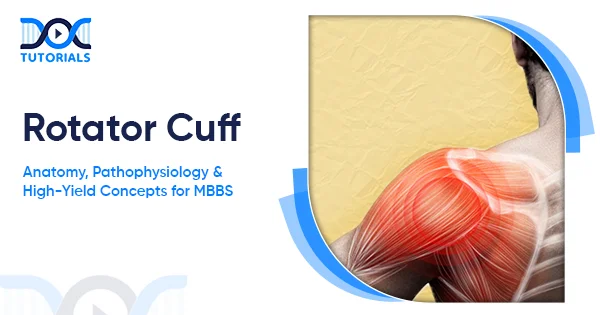
The rotator cuff is an important group of four muscles: the Supraspinatus, Infraspinatus, Teres Minor, and Subscapularis, collectively referred to as SITS. These four muscles are essential in providing both dynamic and static stabilisation of the shoulder/glenohumeral joint while allowing mobility.
Understanding these critical concepts will be vital for all aspiring medical students, especially those who are preparing for the MBBS exam. Let’s know the rotator cuff in detail, highlighting key concepts, pathophysiology, and evidence-based methods for strengthening it.
Keep reading for a detailed insight.
What is the Anatomy of the Rotator Cuff?
The rotator cuff is a functional unit composed of four muscles: supraspinatus, infraspinatus, teres minor, and subscapularis. They originate from the scapula and insert into the humerus. These muscles stabilise the glenohumeral joint and provide essential movements, including abduction, internal rotation, and external rotation.
The rotator cuff originates from different regions of the scapula; all these muscles insert onto specific facets of the humerus to form a supportive cuff around the glenohumeral joint. The supraspinatus originates from the supraspinous fossa, inserting on the superior aspect of the greater tubercle, and initiates the first 15 degrees of arm abduction.
The Infraspinatus, arising from the infraspinous fossa and attaching to the middle facet of the greater tubercle, is a principal external rotator. The Teres Minor, arising from the lateral border of the scapula and inserting on the inferior facet of the greater tubercle, works alongside it to produce external rotation and assists in adduction.
The Subscapularis, arising from the subscapular fossa and inserting on the lesser tubercle of the humerus, represents the only internal rotator of this group. This group of muscles also has a unified function, which includes stabilising the humeral head within the glenoid cavity during arm movements.
A protective subacromial bursa is placed above the rotator cuff, which reduces friction while tendons glide beneath the acromion. Since these muscles manage frequently used shoulder movements, an injury or a shoulder muscle tear—most often involving the supraspinatus—can quickly weaken abduction, rotation, and joint stability.
Understanding the origins, insertions, and actions of the rotator cuff muscles is essential for diagnosing shoulder injuries and for applying appropriate clinical management.
What are the Key Functions of the Rotator Cuff?
The rotator cuff muscles provide stability to the shoulder and control precise movements of the upper arm, including flexion, abduction, internal rotation, and external rotation. Dysfunction or a torn shoulder muscle, particularly the supraspinatus, would impede mobility and reduce functional capacity.
The rotator cuff stabilises the glenohumeral joint and ensures smooth, controlled shoulder movements. Balanced strength and flexibility in all four muscles help prevent injuries and enhance upper-limb performance.
Understanding each muscle’s specific function forms the basis for clinical assessment and rehabilitation, and for exam preparation:
- Supraspinatus: This is the muscle responsible for the initial 15 degrees of arm abduction, as well as assisting the deltoid in lifting the arm overhead. Dysfunction or a torn shoulder muscle here significantly reduces the range of abduction.
- Infraspinatus: While this is a powerful external rotator, the infraspinatus also assists in abduction and adduction to stabilise the humeral head during rotational movements of the shoulder.
- Teres Minor: While the primary action of the teres minor is external rotation, this muscle also acts as an adductor and assists in stabilising the joint during complicated movements of the upper limb.
- Subscapularis: The primary internal rotator of the arm, it also assists in abduction and adduction, maintaining humeral head alignment and overall shoulder stability.
- Neuromuscular Control: The muscles of the rotator cuff collectively act to finely tune movements of the shoulder, stabilise, and precisely control activities that are repetitive or highly active. Any kind of dysfunction here can lead to pain, weakness, and a reduced quality of life.
What is the Clinical Importance of the Rotator Cuff?
The rotator cuff provides both stability and mobility to the shoulder, the most flexible joint in the human body. Yet, it is subject to a variety of pathologies, best categorised as degenerative or traumatic.
- Degenerative conditions include subacromial impingement syndrome, which involves compression of the supraspinatus tendon beneath the acromion due to thickening of the tendon or inflammation of the overlying bursa, thereby narrowing the subacromial space and leading to pain during overhead movements.
Impingement may be exacerbated by a bony subacromial spur, which further reduces the space and compresses surrounding structures, usually presenting with a positive Neer sign when the shoulder is elevated above 120 degrees.
- Traumatic lesions are partial or complete tears of one or more rotator cuff tendons, often following degenerative changes.
A torn shoulder muscle can produce substantial pain, weakness, and limitation of motion, and its treatment may be conservative or surgical, including transosseous fixation, depending on the degree of rupture and other patient factors, such as age and activity level.
Although comprising just four muscles, the rotator cuff plays an important role in neuromuscular control, stabilising the humeral head within the glenoid cavity and enabling smooth performance of shoulder movements.
Knowledge of the clinical significance of rotator cuff pathologies is essential for diagnosis, management, and rehabilitation.
FAQs about Rotator Cuff
- What are the risk factors for rotator cuff injuries?
Some key risk factors that can lead to rotator cuff injuries include increasing age, trauma, repetitive overhead shoulder movements (e.g., in athletes), smoking, obesity, and diabetes. These factors increase the likelihood of tears or degeneration.
- Why is a rotator cuff important?
The rotator cuff consists of four muscles and tendons that form a complete ring around the shoulder joint, stabilising the head of the upper arm bone within the shoulder socket and allowing voluntary movement of the arm in multiple directions.
- Is it possible for a rotator cuff to heal by itself?
Yes, a rotator cuff can heal on its own. Small rotator cuff injuries can heal themselves if the shoulder is rested and not subjected to any stress. However, if you have certain symptoms like pain, weakness, or decreased range of motion, consider consulting a doctor because ignoring such issues can lead to severe problems in the future.
- What are common rotator cuff injuries?
Rotator cuff injuries include overuse syndrome, shoulder impingement (tendinitis), rotator cuff tears, shoulder sprains, and swimmer’s shoulder. They can develop suddenly or gradually due to repetitive activities or sports.
- What are common treatments for rotator cuff injuries?
Rotator cuff injuries can be treated based on the type of injury and the severity of the injury, so treatment may include rest, application of ice, NSAIDS, physical therapy, cortisone injections, and surgical repair if the injury is severe. The primary goal of all treatments is to relieve pain, restore function, and strengthen the shoulder muscles.
Conclusion
The rotator cuff plays a vital role in shoulder stability and precise upper-limb movement, and its injury can greatly limit daily function. An injury to it can be immensely debilitating for daily function.
Thus, MBBS students need to clearly understand rotator cuff anatomy, pathology, and management for both exams and clinical competence. Early diagnosis, focused rehabilitation, and targeted rotator cuff strengthening approaches can ensure better outcomes.
To make complex concepts easier to understand and boost exam readiness, DocTutorials offers 3D & 2D animated videos and expert mentorship and guidance. Start your MBBS journey with DocTutorials and explore our MBBS curriculum to achieve your dream of becoming a doctor!

Latest Blogs
-

9 Essential MBBS Preparation Tips for Success
Achieving the dream of becoming a doctor is not easy. You need to be determined and have the right mindset…