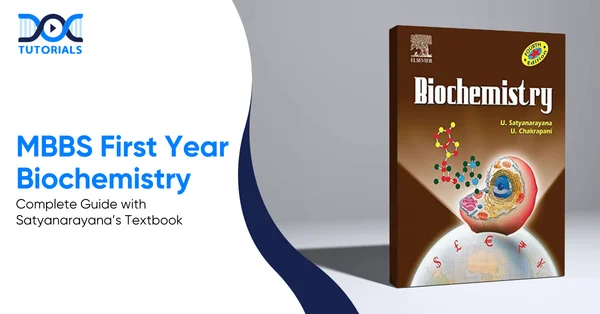
MBBS First Year Biochemistry: Complete Guide with Satyanarayana’s Textbook
The first-year MBBS course includes biochemistry as one of its core subjects, which offers the molecular and chemical basis of medicine. It links basic science and clinical practice by describing the roles of cells, enzymes, and metabolic pathways in health and disease.
The textbook of Biochemistry by Satyanarayana, written by U. Satyanarayana and U. Chakrapani, is a thorough, revised textbook in Biochemistry that adheres to the NMC registrants’ 2024 Curriculum of MBBS.
This guide covers a detailed overview of Biochemistry by Satyanarayana, its different editions, contents, and more!
Overview of Satyanarayana’s Biochemistry Textbook
Textbook of Biochemistry by Satyanarayana is a popular introductory MBBS textbook in India, which is in line with the current NMC CBME curriculum. It has well-defined concepts and exam-focused coverage of fundamentals, metabolism, molecular biology, and clinical biochemistry. Its relevance to clinical application is reinforced by case studies and diagnostic methods that bridge theory and practice.
Textbook of Biochemistry, by U. Satyanarayana and U. Chakrapani, is popular as a first-year MBBS textbook in India. It is well aligned with the newest NMC competency-based medical education (CBME) curriculum, making it very topical in modern medical education.
Dr U. Satyanarayana, along with co-authors, developed this resource for Indian medical students. Although Western texts are good for research, they are often overloaded with information and may confuse a first-year student striving to clear university exams and to form basic clinical concepts. The U Satyanarayana book finds the right balance between wide research and examination-based presentation.
The book illustrates biochemical concepts concisely, straightforwardly, and exam-focused. It uses a systematic description of fundamental principles, then proceeds to metabolism, molecular biology, clinical biochemistry, and more recent developments to ensure that students develop a solid conceptual base.
One of the strengths of the textbook is its high clinical integration. Students can relate the biochemical theory to the principles of medical practice through clinical correlations, case studies, early clinical exposure sections, and updated diagnostic techniques.
Exploring the Biochemistry Satyanarayana 5th, 6th, and 7th Edition
Satyanarayana Book of Biochemistry has developed around the Indian medical curriculum. The 5th edition was more clinical but less illustrative. The 6th edition included early clinical exposure and revised molecular biology, with the 7th edition compatible with CBME guidelines, including extended case studies, combining anatomy and physiology, and lab values that are up-to-date, with the most relevant to examination choices.
Medical curriculum in India has evolved over the years, especially with the implementation of Competency-Based Medical Education guidelines by the National Medical Commission. Publishers have therefore always kept on updating their resources in order to match these new standards. Let us look at the evolution of these editions:
- Biochemistry Satyanarayana, 5th Edition: This edition was published in 2017 by Elsevier India and was widely used before the major curriculum overhaul. It provided the foundation of simple, colourful drawings, but without any comprehensive clinical case-based scenarios like modern exams.
- Biochemistry Satyanarayana 6th Edition: In 2021, published again by Elsevier India, was a major upgrade. It took into consideration the ideas of early clinical exposure and refreshed its molecular biology sections. The 6th edition is still in use by many students today because the basic metabolic pathways are the same.
- Biochemistry Satyanarayana, 7th Edition: Biochemistry Satyanarayana, new edition was published by CBS Publishers and Distributors, 2024. It is in full line with the current competency-based medical education guidelines. It contains extended clinical cases, incorporating anatomy, physiology and revised reference values of clinical laboratory tests.
Contents of the 7th Edition Satyanarayana’s Textbook of Biochemistry
Satyanarayana Biochemistry (7th edition) is divided into 6 parts, which are fundamentals, physiology, metabolism, clinical biochemistry, molecular biology and biotechnology. It also introduces current topics such as gene therapy, diabetes, cancer, AIDS, and COVID-19. It is a complete exam-oriented resource with the lab methods and clinical values, as well as the modern tools of AI and newborn screening, provided in the appendices.
The table of contents of the Biochemistry Book of Satyanarayana, 7th Silver Jubilee Edition, is as follows. This version is divided into distinct parts, which build from the fundamentals to clinical implementation:
Section I. Chemical Constituents of Life
- Biomolecules and the Cell
- Chemistry of Carbohydrates
- Chemistry of Lipids
- Chemistry of Proteins and Amino Acids
- Chemistry of Nucleic Acids and Nucleotides
- Enzymes and Body Fluids
- Vitamins
Section II. Physiological Biochemistry
- Digestion and Absorption
- Plasma Proteins
- Haemoglobin and Porphyrins
- Biological Oxidation
Section III. Metabolisms
- Introduction to Metabolism
- Metabolism of Carbohydrates
- Metabolism of Lipids
- Metabolism of Amino Acids
- Integration of Metabolism
- Metabolism of Nucleotides (Detoxification)
- Mineral Metabolism
Section IV. Clinical Biochemistry and Nutrition
- Hormones
- Organ Function Tests
- Water, Electrolyte and Acid-Base Balance
- Extracellular Matrix, Contractile Proteins
- Nutrition
V. Molecular Biology and Biotechnology
- DNA Replication, DNA Damage and Repair
- Transcription and Translation
- Regulation of Gene Expression
- Recombinant DNA and Biotechnology
VI. Current Topics
- AETCOM (Attitude, Ethics, and Communication)
- Human Genome Project
- Gene Therapy
- Metabolism of Xenobiotics
- Prostaglandins and Related Compounds (Eicosanoids)
- Biological Membranes and Transport
- Free Radicals and Antioxidants
- Environmental Biochemistry
- Glucose Homeostasis and Diabetes Mellitus
- Cancer
- AIDS and COVID-19
- Immunology
- Clinical Biochemistry Laboratory, Artificial Intelligence, Newborn Screening, etc.
- Laboratory Techniques in Biochemistry
What’s New in Satyanarayana’s Textbook of Biochemistry, 7th Edition?
The 7th edition of Biochemistry by U. Satyanarayana has been completely updated to the requirements of the NMC-CBME curriculum, with the inclusion of more recent topics such as AI, CRISPR, and newborn screening. It has 1300+ MCQ questions, extended case studies, mind maps, and advanced visuals for exam preparation. It is an excellent connection between theory, clinical practice, and competency codes.
Here’s what’s new in the 7th edition of Satyanarayana’s Textbook of Biochemistry, based on the brochure and publisher information:
- Revised for Latest NMC–CBME Curriculum (2024)
It has been rewritten and restructured to comply with the latest National Medical Commission (NMC) Competency-Based Medical Education (CBME) requirements for medical students.
- New Topics & Chapters Added
Several important contemporary topics have been introduced, including:
- AETCOM: Attitude, Ethics & Communication skills relevant to clinical biochemistry.
- Artificial Intelligence (AI) in Clinical Biochemistry: Discussing machine learning use in diagnostic and lab automation.
- Newborn & Prenatal Screening Techniques: Modern genetic and metabolic screening guidelines.
- Dietary Guidance & Nutrition Updates: Practical dietary recommendations associated with clinical disorders and biochemical metabolism.
- Microarray & FISH Technologies: Diagnostic and gene expression molecular biology tools.
- CRISPR & Gene Editing Concepts: Introductory explanation of gene modification methods and uses.
- Protein Sorting & Trafficking: Expanded insights into the cellular protein targeting and regulation.
- Alcohol Metabolism: Biochemical mechanisms and clinical features of ethanol metabolism.
- Laboratory Techniques in Biochemistry: Practical, procedural sections covering modern assays and diagnostic tools.
- Massive Self-Assessment Material
This edition features expanded practice questions and case studies to support learning and exam preparation:
- 1300+ MCQs
- 100+ Clinical Case Studies
- 800+ Viva Voce / Short-Answer Questions
- Enhanced Visual & Clinical Learning Aids
The content now includes:
- Expanded illustrations and pictures in the chapters.
- Early Clinical Exposure (ECE) situations.
- Curiosity Corners for quick insights
- Practical Biochemistry courses to bridge theory and lab work.
- Mind Maps in Biochemistry
This edition has a new addition of Mind Maps, which assists the students to learn, remember, and recite important concepts in biochemistry.
- CBME Competency Codes Highlighted
These competency codes have been added to chapters and sub-sections so that the learning outcomes can be traced by the students according to the 2024 curriculum.
Satyanarayana’s Biochemistry Textbook Price
The Satyanarayana Biochemistry book price depends on the edition and seller. The 1st (1999) first edition cost about ₹405, the 5th 6th edition cost 1000-1500, and the 7th edition (2024) costs 1350 (MRP 1750). There are regular discounts, though the recent edition is recommended for the updated CBME content.
The price of Satyanarayana Biochemistry varies depending on the edition and seller.
| Edition | Approximate Price Range |
| 1st Edition (1999) | ₹405 |
| 5th–6th Editions | ₹1000–1500 |
| 7th Edition (2024) | ₹1350 (MRP ₹1750 approx.) |
Note: Prices may differ.
Comparison of Satyanarayan’s Biochemistry with Other Standard Textbooks
Biochemistry by Satyanarayana is clear, CBME-oriented, exam-oriented with MCQs, case study, and is therefore perfect for MBBS students. Vasudevan is simple yet less organised, Harper’s is detailed and research-oriented, whereas Lippincott is brief and has visual illustrations. They each have their specific purposes, from basic learning to detailed reference and quick revision.
Below is a clear comparison of how Biochemistry by Satyanarayana is compared to the popular books: Vasudevan’s Textbook of Biochemistry, Harper’s Illustrated Biochemistry, and Lippincott’s Illustrated Reviews:
| Feature / Aspect | Satyanarayana’s Biochemistry (7th Ed.) | Vasudevan’s Textbook of Biochemistry | Harper’s Illustrated Biochemistry | Lippincott’s Illustrated Reviews: Biochemistry |
| Language / Style | Clear and student-friendly; easier for beginners and non-English medium learners. | Simple but sometimes less logically structured. | Detailed, academic, thorough; dense reading. | Concise, straightforward, focused on visuals & key concepts. |
| Content Depth | Balanced — covers basics + clinical applications. | Moderate — more descriptive but can be superficial for deep concepts. | High — extensive coverage including advanced mechanisms and clinical links. | Good overview, but shorter and lighter than Harper. |
| Clinical Correlation | Extensive with CBME alignment, case studies, and clinical notes. | Present but less emphasised. | Strong, integrated disease-related examples and clinical relevance. | Moderate, includes clinical correlations but is less in-depth than Harper. |
| Visual Aids (Diagrams/Flowcharts) | Colourful diagrams, mind maps, and illustrations aimed at retention. | Present but often less polished. | Excellent diagrams, tables, and mechanistic figures. | Strong visual emphasis; excellent flowcharts and tables. |
| Exam Preparation Features | Extensive MCQs, case studies, and viva questions tailored to Indian exams. | Traditional questions; less structured self-assessment. | Review questions, but more focused on deep understanding than rote preparation. | Summaries and quick review aids are good for revision. |
| Level of Detail | Moderate to high, focusing on medical relevance and CBME outcomes. | Medium, sometimes verbose; may mix topics across chapters. | Very high; suitable for reference & advanced learning. | Medium; clear but less exhaustive than Harper. |
FAQs about MBBS Biochemistry and Satyanarayana’s Textbook
- Who is Dr U. Satyanarayana, and why is his biochemistry book popular?
Dr U. Satyanarayana, PhD, is a veteran professor with 48+ years of teaching experience in the Biochemistry field. His book Biochemistry (with Dr U. Chakrapani) is renowned for having successfully integrated simple and clinical elements in a clear manner. Satyanarayana, too, has earned teaching awards and been honoured internationally, which adds to the credibility of the book.
- What is the latest edition of Biochemistry by Satyanarayana, and what are its features?
The most recent edition is the 7th Edition, which was published in 2024. It has been revised to meet the present NMC/CBME curriculum. It has added features such as free mind maps for each chapter, comprehensive clinical correlations, and current content on newer topics.
- What is the Satyanarayana Biochemistry book’s price?
Prices vary by edition. The initial edition (1999) was sold at ₹405. The latest 7th edition sells at approximately ₹1350 (priced online). Earlier models (5th/6th) would sell at about ₹1,000 to ₹1500 in the Indian market.
- Does Biochemistry by Satyanarayana cover the first-year MBBS syllabus?
Yes. The textbook of Biochemistry by U. Satyanarayana is aimed at undergraduate students of medicine and allied sciences. This includes the complete first year syllabus, including cell biology, enzymes, proteins, and nucleic acids (Paper I), and the metabolism of carbohydrates and lipids, hormones, vitamins, and clinical biochemistry (Paper II).
- What is “Essentials of Biochemistry” by Satyanarayana? How is it different?
The textbook, Essentials of Biochemistry, by the same two authors, is a related text (3rd edition, 2021). It is targeted at a wider group of students (dental, pharmacy, biotechnology, etc.). It is more concise in length and is divided into parts, which comprise the tools of Biochemistry (laboratory procedures) and the basics of immunology.
- How should I study MBBS biochemistry effectively?
Focus on understanding concepts and visualising pathways. Compare flowcharts and tables by Satyanarayana to act fast and test MCQs and short answers that the author recommends doing anyway. Take brief notes on high-yield topics, update them, discuss in groups, and answer previous exam papers to strengthen learning.
- Does the Biochemistry by Satyanarayana textbook include clinical case studies?
Yes. The medical case studies are incorporated into each chapter to demonstrate the application of biochemical concepts to real-life medical situations (e.g., metabolic disease, enzyme deficiency, nutritional disease). This assists in bridging theory and practice.
- Are there supplementary resources available with Biochemistry by Satyanarayana?
The latest edition provides free access to online resources like chapter-wise mind maps and self-assessment tools. These are particularly useful for digital learners who prefer interactive study aids.
- How does Satyanarayana’s textbook help with clinical practice?
The book demonstrates the application of biochemical principles in real-world situations like diabetes, anaemia, and metabolic pathologies by incorporating clinical case studies and diagnostic examples. This aids the students in relating theory to patient care.
- How does Satyanarayana’s Biochemistry compare with review books?
Satyanarayana is a textbook that is intended for conceptual learning. The review books are somewhat exam-oriented, focusing on condensed notes and multiple-choice questions (MCQs) to help students prepare for tests. Many students use Biochemistry by Satyanarayana to study and review books at the last minute.
Conclusion
The Textbook of Biochemistry by U. Satyanarayana is a student-friendly MBBS textbook in accordance with the new NMC-CBME curriculum. The 7th Edition balances the intellectual foundations of biochemical theory with strong practical clinical applicability, guiding the learner to connect theory to actual clinical practice.
The book combines simple explanations, flowcharts, and clinical case studies with modern updates such as mind maps, AETCOM modules, AI in diagnostics, and advanced lab methods. The edition integrates core biochemistry with clinical practice, making it exam-oriented and applicable to current medical education.
However, studying only this book may not be enough to ace your MBBS exams. You need a structured study plan, expert guidance, high-yield notes, Qbanks, and mock tests to take your preparation to the next level. Rely on DocTutorials’ MBBS curriculum to excel in your medical career!
Latest Blogs
-
INI CET Exam Pattern 2027: A Complete Guide with Subject-Wise Weightage
INI CET Exam Pattern 2027: A Complete Guide with Subject-Wise Weightage The Institute of National Importance Combined Entrance Test (INI…
-
NEET PG Registration 2027: An Essential Guide For Exam Prep
The NEET PG registration, which is conducted online, is a crucial step in the exam process. Filling out the NEET…
-

NEET PG Exam 2025- Date, Pattern, Marking Scheme, Subject Wise Weightage, and Exam Mode
NEET PG Exam 2025 is the ultimate gateway for medical graduates aspiring to pursue postgraduate courses in medicine, including MD,…