Ganong Physiology for NEET PG & NEET SS: Overview and Latest Editions
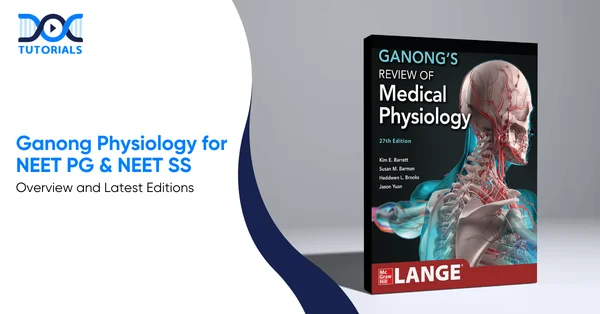
Ganong’s Review of Medical Physiology has been one of the most reliable and authoritative books in mastering physiology when it comes to competitive medical exams. For aspirants who are preparing for NEET PG and NEET SS, Ganong’s Physiology provides a good conceptual base beyond rote learning and also aids in the learning of the why behind mechanisms.
Continue reading to know which edition you should choose, how you read it for exam-oriented preparation, and what makes the latest editions different from the previous ones.
Ganong’s Review of Medical Physiology: An Overview
Ganong’s Review of Medical Physiology is a reliable, exam-oriented textbook that is characterised by clear and concise explanations and good clinical correlation. It has updated content, diagrams, summaries, and review questions, making it the best resource for studying efficiently and preparing for competitive exams.
Ganong Review of Medical Physiology is a well-regarded medical physiology textbook, initially authored by Dr William F. Ganong, but now revised by a group of editors under the leadership of Kim E. Barrett.
It is said to be the leading textbook on human physiology for more than four decades. Key aspects of Ganong’s book:
- Author and Style: Published under the editorship of Kim Barrett et al. in recent editions, the writing of Ganong is characterised as concise and clear. The text is concise and addresses all the key points without being shallow or hard to read, i.e., it is not too short but provides details extensively.
- Content: It runs through simple cellular physiology to complicated organ systems (cardiovascular, neuro, renal, endocrine, etc.). Different chapters combine illustrations and diagrams to explain processes.
- Pedagogy: Ganong chapters are well structured with objectives, concept checkpoints, summary tables and case examples. The chapters are followed by review questions (traditional and board-style) to assess the level of understanding.
- Audience: It is used worldwide by medical students and residents. The revised copies of Ganong clearly state that they are useful in other board exams, which is also similar to their utility in NEET.
The Ganong Physiology latest edition is frequently updated to reflect new research, ensuring you aren’t studying outdated concepts.
| Feature | Ganong Physiology | Traditional Textbooks |
|---|---|---|
| Focus | Review & Clinical Correlation | Detailed Mechanism Description |
| Length | Concise (High density) | Voluminous |
| Best For | Exam Prep & Revision | First-time Learning (1st Year) |
| Diagrams | Flowcharts & Schematics | Illustrative & Artistic |
What are the Latest Ganong Editions and Their Updates?
Ganong’s Review of Medical Physiology is currently in its 27th edition (2025), released in June 2025 with updated research and exam-oriented content. No official confirmation of the 28th edition dates back yet, and so, the 27th edition is the most recent and therefore, the most up-to-date edition to use to prepare.
Ganong’s Review has been updated many times. The most recent version is the 27th (2025), released in June 2025. It is an expansion of the 26th edition of 2019 and the 25th of about 20142015 (also by William Ganong himself).
The latest edition highlights the latest research and trends in exams and, on average, includes new practice questions and clarifications.
- Ganong 27th Edition (2025): The latest edition, edited by Barrett, Brooks, Barman, and Yuan and published on June 20, 2025, has significant changes in such areas as chronic pain, reproductive physiology, and acid-base balance.
It introduces new questions in USMLE format, clinical cases, flowcharts, video instruction, and high-yield FAQs, which makes it especially helpful for the preparation of NEET-PG concisely and exam-focused.
- Ganong 26th Edition (2019): This version is also edited by Kim Barrett and has been expanded with online learning tools, while maintaining its exam-friendly format, with more than 600 full-colour illustrations and board-style questions.
As of 2025, the 27th edition is the most recent release. While some students look for a “Ganong Physiology 28th edition,” there has been no official confirmation of a newer edition yet. Future editions are expected to be priced at a similar or slightly higher range.
Table of Contents of Ganong’s Review of Medical Physiology (27th Edition)
Ganong’s Review of Medical Physiology (27th Edition) is organised into seven sections covering cellular, neural, endocrine, cardiovascular, respiratory, gastrointestinal, and renal physiology. It moves from basic mechanisms to integrated system-based concepts, ensuring strong conceptual clarity.
Here’s a table of contents outline for Ganong’s Review of Medical Physiology, 27th Edition, based on the structure of the latest edition as listed on McGraw-Hill’s official preview and past edition formats:
Section I: Cellular & Molecular Basis for Medical Physiology
- General Principles & Energy Production in Medical Physiology
- Overview of Cellular Physiology
- Immunity, Infection, & Inflammation
- Excitable Tissue: Nerve
- Excitable Tissue: Muscle
- Synaptic & Junctional Transmission
- Neurotransmitters & Neuromodulators
Section II: Central & Peripheral Neurophysiology
- Somatosensory Neurotransmission: Touch, Pain, & Temperature
- Smell & Taste
- Vision
- Hearing & Equilibrium
- Reflex & Voluntary Control of Posture & Movement
- Autonomic Nervous System
- Electrical Activity of the Brain, Sleep–Wake States, & Circadian Rhythms
- Learning, Memory, Language, & Speech
Section III: Endocrine & Reproductive Physiology
- Basic Concepts of Endocrine Regulation
- Hypothalamic Regulation of Hormonal Functions
- The Pituitary Gland
- The Adrenal Medulla & Adrenal Cortex
- The Thyroid Gland
- Hormonal Control of Calcium & Phosphate Metabolism & the Physiology of Bone
- Reproductive Development & Function of the Female Reproductive System
- Function of the Male Reproductive System
- Endocrine Functions of the Pancreas & Regulation of Carbohydrate Metabolism
Section IV: Gastrointestinal Physiology
- Overview of Gastrointestinal Function & Regulation
- Digestion & Absorption of Nutrients
- Gastrointestinal Motility
- Transport & Metabolic Functions of the Liver
Section V: Cardiovascular Physiology
- Origin of the Heartbeat & the Electrical Activity of the Heart
- The Heart as a Pump
- Blood as a Circulatory Fluid & the Dynamics of Blood & Lymph Flow
- Cardiovascular Regulatory Mechanisms
- Circulation Through Special Regions
Section VI: Respiratory Physiology
- Introduction to Pulmonary Structure & Mechanics
- Gas Transport & pH
- Regulation of Respiration
Section VII: Renal Physiology
- Renal Function & Micturition
- Regulation of Extracellular Fluid Composition & Volume
- Acidification of the Urine & Bicarbonate Excretion
How to Use Ganong’s Physiology Textbook for NEET Preparation?
Ganong’s is the one that fills the gap between basic science and clinical medicine. In contrast to textbooks that focus exclusively on mechanisms, Ganong incorporates pathophysiology, making it an ideal companion for entrance examination preparation.
Ganong’s Review of Medical Physiology is unlike other textbooks because it is written as a review. This implies that it eliminates fluff and puts emphasis on high-yield facts, flowcharts, and diagrams that are immediately relevant to exams.
Key strategies for using Ganong effectively:
- Conceptual Understanding: Read Ganong to strengthen complex issues. Its explanations are more based on mechanisms and are more logically motivated (good in MCQ thinking).
For example, in case you studied the cardiac cycle somewhere, the description and illustrations provided by Ganong will reinforce your knowledge.
- Review Questions: The end-of-chapter and in-text questions of Ganong are similar to examination thinking. Test these questions to examine the understanding and areas of improvement. As Ganong has board-style questions, you would be accustomed to NEET-like questions.
- Visual Learning: Make use of the illustrations and flowcharts of Ganong. Redrawing the diagrams of Ganong’s may help in memorising. This is improved by the new 27th edition with boxed cases and more flowcharts.
- Integrated clinical links: Pay attention to Ganong’s clinical examples and FAQs. These facilitate the relation of physiology to real life. For example, Ganong could describe the physiology of shock; this knowledge can be used directly to respond to clinical questions in NEET-PG.
- Revision and Quick Facts: Summaries and concept checks of Ganong are helpful in reviewing later in the study cycles. You can re-read a chapter summary or the “frequently asked questions” section for a quick refresher.
- Concise & High-Yield: It provides more on a single page than any other physiology text and is therefore a perfect fit for those updating to the 27th edition of Ganong Physiology.
- Clinical Boxes: The Ganong book is well known because of its Clinical Boxes, which directly relate physiological principles to disease states, a pattern frequently repeated in clinical vignette-based NEET PG items.
Therefore, Ganong is useful as a thorough revision tool. It helps you go beyond rote facts and master the logic behind physiology, which is crucial for answering conceptual NEET questions.
Ganong vs Other Physiology Textbooks
Guyton & Hall and Ganong play different roles in NEET preparation, with Guyton building concepts in greater detail and Ganong doing so in a concise exam-oriented revision. Ganong is a high-yield primary source to many aspirants, with Guyton as a reference when necessary.
Guyton and Ganong are both classic texts of physiology, but they have different uses. Guyton is elaborative and concept-intensive, which is best suited to in-depth learning, and Ganong is brief and review-centred.
Most NEET aspirants study using Guyton to construct a concept and Ganong to revise on a high-yield, and Ganong is mostly preferred to study fast and to prepare towards the examination.
- Content Style: Ganong explains concepts succinctly, often directly targeting what exams ask, while Guyton provides a fuller background.
- Volume: Ganong’s book is thinner than Guyton’s large textbook, making it easier to cover in review sessions.
- Use in NEET Prep: Students frequently start with Ganong for its clear summaries and MCQs, then refer to Guyton if they need more detail.
Other books, such as the books of A.K. Jain and Sembulingam, are simpler texts and conform to the Indian exam style; they are good for beginners or as quick notes. Another high-yield review textbook is BRS Physiology (Costanzo). Nevertheless, Ganong is the only one to strike a balance between being more detailed than BRS and yet shorter than Guyton.
Ultimately, in the case of NEET-PG, a significant number of students use Ganong as a single or combined source. Some learners might rely on Ganong as their main text of physiology, together with classnotes, and others as a supplement.
In both scenarios, Ganong’s physiology can be used as an exam-oriented learning reference.
Ganong Physiology 26th vs 27th Editions (Comparison)
The table highlights that the latest edition (27th, 2025) is current, with modern updates for students. The 26th (2019) was well-received, but the 27th adds more practice tools.
Below is a tabular presentation discussing the comparison between Ganong Physiology’s 26th and 27th editions:
| Edition | Year | Editors/Authors | Key Updates |
| 26th Edition | 2019 | Barrett, Barman, et al. (Eds.) | Video tutorials by the author, revised clinical material, more than 600 illustrations, end-of-chapter and board-type questions. |
| 27th Edition | 2025 | Barrett, Brooks, Barman, Yuan (Eds.) | Comprehensively revised subjects (e.g. chronic pain, reproduction); new USMLE-style multiple choice questions and more clinical cases; video tutorials and better FAQs. |
FAQs About Ganong Physiology for NEET PG and NEET SS
- Which edition of Ganong is best for NEET PG preparation?
The latest edition is recommended. The 27th edition (published in June 2025) is the most recent edition as of 2026 and has updates, new practice questions, and tutorials. The 26th edition is still in use, but the 27th is better.
- Is Ganong alone enough for NEET PG physiology?
Ganong is an excellent core book, which cannot be applied on its own. It is most effective when it is used in combination with MCQ practice, revision notes, and other review materials such as BRS Physiology.
- Has the Ganong 28th edition been released?
No, there has been no official announcement of a 28th edition yet. The 27th edition remains the latest available, and any newer edition is likely several years away.
- Is Ganong helpful for NEET-SS aspirants?
Yes, Ganong is useful for strengthening core physiology concepts, which support super-speciality learning. However, NEET SS preparation must also include speciality-specific textbooks and clinical resources.
- Should I wait for the Ganong 28th edition before studying?
No. If you are currently preparing for an exam, use the 27th edition. Waiting for a future edition can delay preparation and is not recommended.
- How should I approach Ganong for NEET PG preparation?
Focus on high-yield chapters like cardiovascular physiology, renal physiology, neurophysiology, and endocrine physiology. Summarise key concepts into notes and practice MCQs alongside reading.
- How does Ganong differ from Guyton in exam preparation?
Ganong is concise and clinically oriented, ideal for quick revision and exam-focused study. Guyton is more detailed and explanatory, better for conceptual clarity and deeper understanding.
- Does Ganong cover clinical physiology relevant for NEET SS?
Yes, Ganong integrates clinical correlations (like autonomic nervous system disorders, endocrine pathophysiology), which are highly relevant for NEET SS-level questions.
- How should I use Ganong for neurophysiology revision?
Focus on synaptic transmission, neurotransmitters, reflexes, and higher brain functions. Clinical correlations like Parkinson’s disease, sleep physiology, and autonomic dysfunction are exam favourites.
- Can Ganong be used for quick last-minute revisions?
Yes, its concise format and summary tables make it ideal for rapid revisions. Focus on high-yield chapters and clinical notes in the margins during the final 2–3 weeks before exams.
Conclusion
In NEET PG and NEET SS, success depends on good fundamentals, especially in physiology, which is very important in NEET PG. A high-yield resource like Ganong’s Review of Medical Physiology simplifies complex concepts and improves clinical reasoning.
For structured guidance, DocTutorials can support your preparation with concise video lectures, a clinical QBank, exam-oriented notes, flashcards, and mind maps. Join DocTutorials and explore our NEET PG course to build confidence and move one step closer to achieving your postgraduate medical goals!


Latest Blogs
-

INI CET Exam 2026: Your Roadmap to Success – Key Topics, Strategies, and Lessons from Last Year’s Papers
The INI CET exam is more than just a test; it’s a significant milestone for many medical students aiming to…
-

INI CET Exam Success: Previous Year Question Papers & Ultimate Guide – INI CET PYQ
One can feel overwhelmed while preparing for the INI CET (Institute of National Importance Combined Entrance Test). A vast syllabus,…
-

NEET PG 2026 Preparation with Live Power Pack: Your Path to Success in 2026
Preparing for the NEET PG 2026 can be an overwhelming journey because of its vast syllabus and the pressure to…