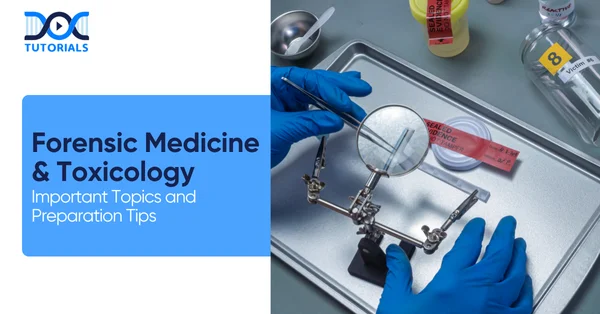
Forensic Medicine & Toxicology: Important Topics and Preparation Tips
Forensic Medicine and Toxicology (FMT) is one of the distinctive NEET PG preparation subjects, fact-based, accurate, and high-scoring. As one of the short subjects of the MBBS course, it is much sought after in exams as well as in clinical practice.
FMT provides a linking bridge between medicine and law, formulating a physician’s perception of medico-legal obligations, ethical practice, and rationale-based thinking in criminal as well as civil investigations. For NEET PG 2026, mastering this subject means memorising facts while grasping their clinical applications.
A strong command of FMT helps you tackle direct, high-yield questions confidently while enhancing your ability to think critically about real-world medico-legal scenarios, a vital skill for every future clinician.
In this article, we shall discuss the most critical Forensic Medicine and Toxicology topics and offer intelligent study tips to assist you in achieving high marks in NEET PG 2026. Keep reading for a detailed insight.
MBBS Prof Exam Pattern
According to the CBME curriculum, the MBBS professional exam in Forensic Medicine and Toxicology (FMT) has a theory paper of 100 marks and a practical/clinical exam (with viva voce) of 100 marks.
The theory paper is normally a mix of question types like structured essays (Long Answer Questions – LAQs), Short Answer Questions (SAQs), and objective-type questions like MCQs and Image-Based Questions (IBQs).
This model enables students to master both applied skills and conceptual knowledge in medico-legal knowledge.
High-Yield Topics for Forensic Medicine & Toxicology
There are usually 8–10 questions in the NEET PG exam from Forensic Medicine and Toxicology, a short but high-scoring subject. Most questions are straightforward and factual, allowing students to secure marks easily with focused preparation.
Go through the important and frequently asked topics listed below to identify your priority areas and strengthen your overall FMT preparation for NEET PG 2026:
Mechanical Injuries
- Abrasion
- Contusion
- Laceration
- Incised wound
- Chop wound
Regional Injuries
- Skull fractures
- Intracranial hemorrhages
Thermal Injuries
- Cold injuries – frostbite
- Heat injuries – heat stroke
- Burns
- Scalds
Firearm Injuries
- Would ballistics
Indian Legal System
- Inquest system
- Types of evidence & witnesses
- Recording of evidence in the court of law
Medical Law & Ethics
- Professional misconduct
- Professional negligence – types
- Doctrines related to medical negligence
- Doctrines related to consent
Legal Sections
- Homicide
- Criminal abortion
- Hurt – types
- Sexual offences
Violent Asphyxiation Death
- Hanging
- Strangulation
- Types
- Drowning – Pathophysiology
Thanatology
- Early changes
- Eye changes
- Mortis
- Late changes
- Putrefaction changes
Human Identification
- Race determination
- Age estimation
- Skull
- Ossification- wrist, sternum, sacrum, skull
- Dentition
- Sexual dimorphism – skull & pelvis
- Definite methods of identification
Sexual Offences
- Medical examination of the accused and the victim
- Seminal stains test
- Sexual perversions
- Tests for live-born
- Signs of maceration
Sexual Jurisprudence
- Satyriasis & Nymphomania
- Impotence & Frigidity
- Suppositious child, Posthumous child
- Atavism
- Twin pregnancies
- Phantom pregnancies
Toxicology
- Poisons & smell
- Poisons & hypostasis
- Gastric lavage
- Legal duties in a case of poisoning
- Classification
- Antidotes list
- Plant irritants
- Snakebite envenomation
- Metallic irritants
- Delirients
- Spinal poisons
- Somniferous poisons
- Identification of cardiac poisons
- OPC management
The list above provides a comprehensive overview of the key topics in Forensic Medicine & Toxicology, forming the foundation around which you should structure your preparation.
FMT Important Topics For NEET PG 2026
Here are a few of the essential topics that are important for the NEET PG 2026:
Postmortem Techniques
- History
- Autopsy Types
- Postmortem Techniques
- Types of Incisions
- Body Cavity to be Opened First
- Organs to be Dissected
- Exhumation
- Definitions
Court of Law
- Types of witnesses
- Important facts of the IEA
- Courts
- Other courts
- Commutation of the death sentence
- Judicial versus executive magistrate
- Inquest in India
- Court procedure
- Dying deceleration versus dying deposition
New Indian Laws
- Important BNS
- Important BNSS
Torture
- Types of Torture
Traces of Evidence
- Blood Stains
- Semen Analysis
- Hair Analysis
- Other Important Information
Sexual Offences
- Natural
- Unnatural
- Sexual Perversions
Impotence and Sterility
- Impotence
- Frigidity (Female + Rigid)
- Sterility
- Hindu Marriage Act
- Fecundation ab Extra
- Posthumous Child
- Supposititious/Fictitious/Substituted Child
- Twin Pregnancy
- Pseudocyesis/False (Spurious)
- ART (Assisted Reproduction Technique)
Virginity, Abortion and MTP
- Differences Between the Sign of Virginity and Defloration
- Hymen
- Pregnancy sign
- Lochia (Discharge from the vagina after delivery)
- Abortion
- MTP Act (Medical Termination of Pregnancy)
Medical Jurisprudence
- Medical Etiquette
- Medical Ethics
- Serious Professional Misconduct/Infamous Conduct
- Euthanasia or Mercy Killing (Painless Death)
- Living Will
- Professional Secrecy
- Consent
- Full Disclosure vs Therapeutic Privilege
- Exceptions to Informed Consent
- Consent Laws
- Medical Negligence/Malpractice
- Civil vs Criminal
- Medical negligence IPC
- Contribute Negligence
- Defences against Negligence
- Declarations
Infanticide
- Fetal/Newborn/Infant Autopsy
- Infanticide
- Dead Born
- Live Birth
- Signs
- Registration of Birth and Death Act 1969
- Criminal Abortion
- SIDS
- Munchausen Syndrome of Proxy
- Battered Baby Syndrome
Asphyxial Death
- Asphyxia
- Signs of Asphyxia
- Types of Asphyxial Deaths
- Lab Test
Road Traffic Accident Injuries
- Motorcyclist Injuries
- Pedestrian Injuries
- Car Occupant Injuries
Thermal Injury
- Hypothermia
- Heat Injury
- Local heat injury
- Corrosive or chemical burn
- Classification of born
- Wilson Classification
- Necklacing
- PM Finding – in burn cases
- Electrocution (electric shock)
- Cause of Death
- Postmortem Finding
- Lightning Injuries
Regional Injury
- Head Injury
- Skull fracture
- Coup vs. Contrecoup injury
- Intracranial hemorrhages
- Epidural Hemorrhage
- Subdural Hematoma
- Subarachnoid (SAH)
- Intracerebral hemorrhage
Mechanical Injuries
- Classification of Mechanical Injuries
- A. Due to Blunt Force (Stone, Hammer, or Heavy Objects)
- B. Due to Sharp Force (Knife, Blade, Sword, Axe)
- Defense Wounds
- Fabricated Wounds
Forensic Ballistics
- Firearm (Ballistics)
- Classification of Ballistics
- Classification of Firearms
- Advantages of Rifling in Rifled Firearms
- Definition of Bore/Gauge
- How to increase the range of a shotgun
- Cartridge
- Gun Powder
- Gunshot Residue Test (GSR)
- The Sequence in Firing
- Bullets
- Types of Bullets
- Kennedy Phenomenon
- Rayalaseema Phenomenon
Discharge From Gun Effects
- Effects
- Burning vs Tattooing
- Grease Collar vs Abrasion Collar
- Range of Rifle and Shotgun
- Contact Shot – Rifled Weapon
- Rifled Firearm
- Entry vs Exit Wound
- Metal Fouling
- Bullet Fingerprint
- Beveling of Skull
- Shot-Gun
- Billiard Ball Effect vs Balling/Welding
- Blast Injuries
- Bomb
Identification
- Corpus Delicti
- Identification
- Race
- Sexual Differentiation
- Age of Fetus
- Dentition
- Stature
- Multiplication Factor
- Length of Bone
- Medicolegal Importance of Different Ages
- Identification Method
- Fingerprint
- Poroscopy
- Palatoscopy
- Cheiloscopy
- Tattoo Mark
- Podogram
- Superimposition technique
- Anthropometry
- Scar
- Frontal Sinus Pattern
- Concealed Sex
General Toxicology
- Ideal Homicidal Poison
- Ideal Suicidal Poison
- Duty of a doctor during poisoning
- Information to the Police
- NDPS Act
- Drug and Cosmetic Rule
- Toxicological Analysis
- Special Preservation
- Special Smell
- Colour of Postmortem Staining
- Poisons causing PCT Necrosis
- Gastric Lavage (Stomach Wash)
- Universal Antidote in Gastric Lavage
- Coma Cocktail
- Emetics
- Antagonism
- Antidotes for different poisonings
- Chelating Agents
- Contraindication for Hemodialysis
- Alkaline Diuresis
- Acidic diuresis
- Stomach Mucosa
- Insecticide (Agricultural Poison)
- Organophosphorus Poisoning
- Carbamates
- Organochlorine
- Pyrethroids
- Inorganic Irritant-Nonmetallic Poison
- Inorganic Irritant- Metallic Poison
- Thallium Poisoning (ideal homicidal poison)
- Starvation
- Asphyxiant
- Carbon monoxide (CO)
- Cyanide
- Hydrogen sulphide
- Miscellaneous laws
- Protection of Children from sexual Offences (POCSO) Act 2012
- Human Organ Transplantation Act (HOTA- 1994)
- Medical certification of cause of death (MCCD)
- RBD ACT-10(3)
Animal Irritant Poison
- Blister Beetle (BB)
- Scorpion Buthidae (Venomous Arachnids)
- Spider (Venomous Arachnids)
- Snakes
Corrosives Poisoning
- Corrosive Poisoning Laws
- Classification of Corrosives
- Corrosive Poisoning: Management of Sulphuric Acid Poisoning
- Sulphuric Acid Poisoning
- Nitric Acid Poisoning
- Oxalic Acid Poisoning
- Carbolic Acid
- Boric Acid Poisoning
- Hydrofluoric Acid Poisoning
Spinal Cardiac Poison
- Spinal Poisons
- Cardiac Poisons
Somniferous Poison
- Opium
- Morphine
- Heroin: Semi-Synthetic
Organic Plant Irritant Poisons
- Deliriant Poison
Metal Poisons, Miscellaneous Poisons and CNS Depressants
- Arsenic Poisoning
- Lead Poisoning
- Miscellaneous Poisons
- CNS Depressant – Ethanol
Thanatology
- Types of Death
- Post-mortem changes
- Eye changes
- Algor mortis
- Rigor Mortis or Cadaveric stiffening or Cadaveric rigidity
- Causes of muscle stiffening after death
- Decomposition
- Casper Dictum
- Modification of Putrefaction
- Embalming or Thanatopraxia
- Ante-mortem blister vs Post-mortem blister
Forensic Psychiatry
- Civil Responsibility of the Insane
- Lucid Interval
- Perception Disorder
- Thought Disorder
- Delusion of Double
- Phobia
- Impulse
- Mental Health Care (MHC) Act 2017
- True Insanity vs Feigned Insanity
- Criminal Responsibility in Some Cases
Strategies for NEET PG Forensic Medicine & Toxicology (FMT)
To clear NEET PG Forensic Medicine and Toxicology (FMT), you require more than memorisation alone; a strategy, proper time management, and revision at all times are essential. The strategy below will help you organise your preparation, solidify your concepts, and draw out the best score from this high-scoring topic.
- Set Clear Goals
Start your preparation with a clear set of goals. Write them down and paste them somewhere you’ll see them constantly, like on your study table or notice board. Refreshing your goals daily keeps you motivated and on track. Having a vision in mind keeps you structured and reminds you why you embarked on this endeavour in the first place.
- Adhere to a Systematic Timetable
Create a realistic and well-organised study schedule that divides your time across different topics strategically. A timetable helps remove the confusion of what to study each day and ensures balanced coverage of all subjects.
- You don’t need to study for endless hours; 5–6 hours of quality, focused learning each day is sufficient.
- After finishing a topic, take a subject-wise test to reinforce your understanding.
- Leave a month exclusively for revision before the exam.
- Visit your weak areas frequently to reinforce them in the long term.
- Always focus on conceptual clarity rather than rote memorisation.
- Master Time Management
Effective time management is the key to success in NEET PG. Don’t waste precious hours studying and make the most of every opportunity. Plan your day such that each subject is given the attention it deserves.
- Track your study hours to understand how productively you’re using your time.
- Give priority to high-yield topics that are frequently tested in exams.
- Take short, refreshing breaks to maintain focus and prevent burnout.
- Spend time on understanding concepts deeply, not just memorising facts.
- Balance your time between theory, MCQ practice, and revision.
- Solve plenty of MCQs and clinical questions to build exam confidence.
- Prepare Personalised Notes
Prepare short and readable self-notes while first studying. Such self-prepared notes are your best friend during revision. They remind you of concepts instantly and are quicker than going through textbooks again. Systematic notes also make last-minute revision before the exam more effective and stress-free.
- Revision
Revision is the last and most essential step prior to the NEET PG examination. Revision enhances your memory and recall speed when answering under test conditions. Practice mock tests and computer-based tests in order to get used to the actual format.
Do not consult new books or study materials now; refer only to your notes and standard books. One complete round of revision will consolidate your concepts so you feel more confident and ready for the test.
Book Review for NEET PG Forensic Medicine & Toxicology (FMT)
Listed below are the required books for NEET PG FMT and their highlights:
| Book | Author | Highlights |
| Review of Forensic Medicine | Sumit Seth | – Revised answers by subject experts.- Complete coverage in an easy tabulated format.- Includes only high-yield and relevant facts.- Key points and frequently asked questions are highlighted.- Detailed explanations from the latest editions of standard textbooks.- Clear line diagrams and mnemonics for easy recall.- Special attention to controversial and image-based questions. |
| Smart Study Series: Forensic Medicine and Toxicology | Dr. Gaurav Aggarwal | – Concise and comprehensive notes in simple language.- Designed as a complete NEET PG guide.- Includes recent NEET-style questions for practice.- Emphasises conceptual understanding along with question-solving. |
Things to Keep in Mind for NEET PG Forensic Medicine & Toxicology (FMT)
Here are a few of the essential things to consider when studying topics for FMT:
- Forensic Medicine is a short, high-yield subject and ideal for quick revision.
- It is largely fact-based and straightforward, making it easier to score.
- Frequent practice of key areas results in knowledge retention well.
- Expect about 8–10 FMT questions in the NEET PG exam every year.
- Maintain clarity of ideas, regular practice, and revising mnemonics for recall.
Following a methodical process and emphasising judicious revision, you can simply make FMT your top-scoring subject in NEET PG 2026.
FAQs about Forensic Medicine & Toxicology Topics
- What are the most crucial Forensic Medicine and Toxicology (FMT) topics for MBBS students?
Amongst the most important subjects in FMT are Legal Procedures, Identification, Thanatology, Asphyxia, Injuries, Sexual Offences (for example, Rape), General and Special Toxicology (for example, OPC poisoning, snakebite, and drug poisoning), Autopsy methods, Fingerprint Identification, Burns, and Skull Fractures.
These subjects constitute the majority of both the MBBS exams and the NEET PG study.
- What are the best books for preparing for Forensic Medicine for MBBS students?
Highly recommended books for FMT include Review of Forensic Medicine and Toxicology and Recent Advances in Forensic Medicine and Toxicology (Vol. 1 & 2) by Gautam Biswas, The Essentials of Forensic Medicine and Toxicology by K.S. Narayan Reddy and O.P. Murty, and Forensic Medicine by J. Magendran.
These texts provide concise explanations, updated facts, and practical applications ideal for both theory and MCQ-based learning.
- Why is Medical Jurisprudence a must for NEET PG 2026 preparation?
Medical Jurisprudence introduces the student to legal principles of consent, negligence, patients’ rights, and ethical expectations in the practice environment. It is tested routinely in NEET PG in the form of case-based and conceptual questions and is thus a necessity in order to score and provide value addition to medico-legal principles.
- Why is Forensic Medicine a necessity for NEET PG exams?
Forensic Medicine happens to be one of the most compact and score-intensive topics in NEET PG. Since some questions are direct and fact-based, knowing key things such as postmortem findings, classification of injuries, and toxicological characteristics can improve your overall score and contribute to your medico-legal expertise.
- How can I effectively manage time while preparing for the FMT section in NEET PG 2026?
Time management is important for preparing for NEET PG. Schedule intense study sessions daily and take frequent short revision sessions. Prioritise high-yield topics, take brief notes, and practice multiple-choice and image-based questions every day to boost speed, accuracy, and recall before the exam.
- What is the topic of forensic toxicology?
Forensic toxicology involves tests carried out on a human or animal substance to detect toxins. It involves a report that provides valuable insights into what toxins are in a person’s system. It also provides valuable insights into whether or not toxins are within a safe or normal range.
- What are the six golden rules in forensic science?
The six golden rules of forensic science concentrate on accurate and meticulous work. The rules include working slowly, being meticulous, keeping accurate notes, asking for advice when necessary, using one’s imagination to interpret evidence, and avoiding complicated ideas that may confuse or mislead.
- What are five essential qualities a forensic scientist should have?
The essential skills that a forensic scientist should have are:
- Technical skills used in forensic science: Adequate knowledge regarding tools, techniques, and procedures.
- Analytical and critical thinking skills: Capabilities in logical assessment of evidence towards sound conclusions.
- Attention to detail: Small details can change the outcome of a case.
- Communication and interpersonal skills: Effective reporting and explanation of the findings to legal teams/courts.
- Continuous learning and adaptability: Keeping abreast of fresh ideas and scientific developments.
- What is the most essential tool in Forensic Science?
DNA profiling is the most important technique employed by forensic scientists presently. While DNA evidence alone may not always guarantee a conviction, it has become the gold standard in investigations since its first use over 30 years ago. It plays a major role in identifying individuals and linking evidence to crime scenes.
- What are the skills required in forensics?
Some of the essential skill requirements in forensic science include:
- Analytical skills: The ability to analyse evidence to understand what it implies about a crime.
- Communication skills: Being able to write reports clearly and present findings with confidence in court.
- Attention to Detail: The ability to observe details of the evidence, documenting them precisely.
- Mathematical skills: Helpful for measurements and calculations.
- Problem-solving skills: Using scientific thinking in order to reconstruct what happened and answer important questions.
Conclusion
Forensic Medicine and Toxicology appears concise, but its contribution to your NEET PG score and clinical knowledge is vast. This is a topic that challenges your understanding of medico-legal principles, ethics, and the real-world application of forensic knowledge in life, abilities that make up the strength of ethical practice of medicine.
If you prioritise studying high-yield topics, note quickly, and study accordingly, you could easily make FMT a scoring topic. Keep in mind that success in NEET PG does not depend on how long you study but on how intelligently you study.
For those aspirants who require organised direction and expert guidance, DocTutorials offers live classes with hardcopy workbooks, exam-focused test series, and high-yielding Qbank, and detailed analysis of PYQs in our NEET PG course. We ensure your preparation is focused, effective, and result-driven, helping you stay ahead and maximise your score in NEET PG.
Join DocTutorials and explore our NEET PG course to excel in your medical exam!


Latest Blogs
-
INI CET Exam Pattern 2026: A Complete Guide with Subject-Wise Weightage
INI CET Exam Pattern 2026: A Complete Guide with Subject-Wise Weightage The Institute of National Importance Combined Entrance Test (INI…
-

NEET PG Registration 2026: An Essential Guide For Exam Prep
The NEET PG registration, which is conducted online, is a crucial step in the exam process. Filling out the NEET…
-

NEET PG Exam 2025- Date, Pattern, Marking Scheme, Subject Wise Weightage, and Exam Mode
NEET PG Exam 2025 is the ultimate gateway for medical graduates aspiring to pursue postgraduate courses in medicine, including MD,…