Malaria Life Cycle: Stage-Wise Explanation
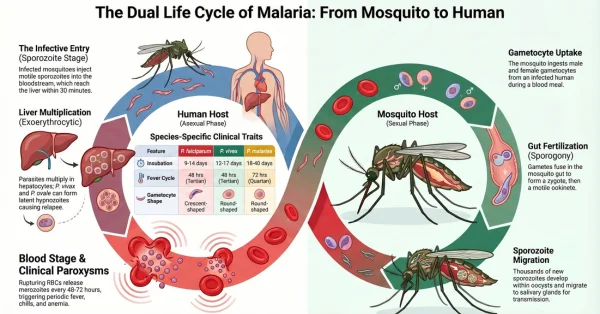
Malaria is still considered the most pathogenic infectious disease globally. In medical exam aspirants, the life cycle diagram of malaria is a high-yield concept that is the backbone of numerous microbiology and parasitology questions in entrance examinations such as NEET PG, INI-CET, and FMGE entrance tests.
It not only builds conceptual understanding but also helps in remembering important diagnostic and clinical facts by knowing the life cycle of the Plasmodium parasite through its human host as well as the mosquito vector.
In this blog, we’ll break down the life cycle of the malaria parasite step by step, covering both asexual and sexual phases, clinical correlations, and the critical details often asked in competitive exams. By the end, you’ll have a crystal-clear picture of what happens at each stage of the cycle. Keep reading for a detailed insight.
Introduction to Malaria and Plasmodium
Malaria is a protozoan disease transmitted by the vectors of the Plasmodium parasite. The most common infecting species in humans are:
- Plasmodium falciparum (most pathogenic)
- Plasmodium vivax (most common)
- Plasmodium malariae
- Plasmodium ovale
- Plasmodium knowlesi (zoonotic, forthcoming to be reported in Asia)
Transmission happens primarily through the bite of an infected female Anopheles mosquito. Then, inside the human body, the parasite undergoes a series of complex changes, which are best described by reference to the life cycle of the malaria parasite diagram.
This diagram typically illustrates the parasite’s cycle between the human (intermediate host) and the mosquito (definitive host).
Memorisation of this cycle isn’t just an abstract theory; it’s important for diagnosis, treatment, and public health control measures.
Overview of the Malaria Life Cycle
The diagram of the malaria cycle can be generally divided into two phases:
Asexual Stage (Human Host)
- Starts when sporozoites infect the human blood upon a mosquito bite.
- Encompasses the liver and red blood cell stages.
- Cause clinical symptoms.
Sexual Stage (Mosquito Host)
- Starts when gametocytes are taken up by a mosquito during a blood meal.
- Encompasses gamete union, zygote formation, and sporozoite development.
- Generate transmission to a new human host.
The Plasmodium life cycle diagram illustrates how the infection cycle repeats and that two hosts are needed to perpetuate the disease.
Infective Stage – Entry of Sporozoites
The infective phase for humans is the sporozoite. It starts when a human gets bitten by an infected female Anopheles mosquito, which injects sporozoites into the bloodstream through saliva. This is a moment of drastic action because even a couple of sporozoites is enough to induce infection.
These narrow and motile sporozoites travel to the liver in approximately 30 minutes. They penetrate the hepatocytes with the help of specific surface receptors. This rapid motion allows the parasite to evade early immunity and establish its infection quietly.
Important Points to Remember:
- Infective stage: Sporozoite
- Route: Mosquito bite → blood → liver
- No symptoms at this stage.
Exoerythrocytic (Liver) Schizogony
After they enter the hepatocytes, the sporozoites transform into trophozoites, which then develop in numbers through asexual multiplication (schizogony). This results in the formation of thousands of merozoites per infected liver cell.
This whole process is referred to as exoerythrocytic schizogony since it takes place outside the red blood cells. The liver stage is asymptomatic, i.e., the patient does not show any clinical presentation during this stage.
- Duration: Typically 5 – 15 days (species specific)
- P. vivax and P. ovale are capable of developing into hypnozoites, latent forms in the liver that become active weeks or months later to produce relapse.
- The hepatocytes burst after maturation and release merozoites into the blood.
This phase is a target for chemoprophylaxis. Drugs such as primaquine are effective against hypnozoites to avoid relapse.
Erythrocytic (Blood) Schizogony
Following liver schizogony, merozoites infect RBCs, marking the onset of the erythrocytic cycle. Merozoites develop to trophozoites within RBCs, which further mature to schizonts. Schizonts harbour a humongous number of merozoites that are eventually released upon rupture of the infected RBC.
This cycle of periodic invasion, reproduction, and disruption happens about every 48 hours in P. vivax and P. falciparum (72 hours in P. malariae), to create paroxysmal fever, thus defining symptoms of malaria.
Key events at this stage:
- Merozoite invasion of RBCs
- Trophozoite → Schizont → Merozoite
- RBC rupture → fever, chills, anaemia
Formation of Gametocytes
While most merozoites complete asexual cycles, some mature into sexual forms, known as gametocytes:
- Macrogametocytes – Female
- Microgametocytes – Male
The gametocytes do not cause symptoms but are essential in transmitting the disease. They are disseminated in the blood and ingested by another mosquito while feeding on blood.
- Gametocytes in P. falciparum are crescent-shaped.
- Other species’ gametocytes are oval or spherical.
- Development time is dependent upon the species (e.g., longer in P. falciparum).
Although the symptoms may improve, gametocytes remain present in the blood, rendering patients reservoirs for transmission.
Sexual Cycle in the Mosquito – Sporogony
Upon arrival in the mosquito gut, the gametocytes enter a sophisticated process of sexual reproduction, which allows the parasite to resume its life cycle and infect other hosts:
- Gametogenesis: The gametocytes ingested by the mosquito develop into mature male and female gametes.
- Fertilisation: Then the gametes fuse to produce one zygote that signifies the beginning of the development of the parasite within the mosquito.
- Ookinete Formation: The elongating zygote forms a motile ookinete that invades the gut wall of the mosquito cleverly.
- Formation of Oocyst: Once they have traversed the gut wall successfully, the ookinete develops into an oocyst on the outside surface.
- Sporogony: Within the protected oocyst, several divisional cycles lead to the formation of thousands of sporozoites.
- Migration: After maturing, the sporozoites migrate to the salivary glands of the mosquito, ready to be transmitted.
With this subsequent mosquito bite, the infective sporozoites are being transmitted to a new human host, finishing the Plasmodium life cycle diagram and starting another infection cycle.
Salient Features of the Malaria Life Cycle
To make the simplified malaria life cycle graphic easier to memorise and remember for exams or clinical practice, it is helpful to emphasise key major biological checkpoints and critical stages:
- The parasite’s definitive host is the female Anopheles mosquito, which reproduces sexually.
- Humans serve as intermediate hosts for asexual proliferation.
- Sporozoite is injected into the circulation through an insect bite.
- Trophozoites and schizonts are detected on a peripheral blood smear.
- The pre-erythrocytic phase is characterised by asymptomatic liver function.
- The erythrocytic phase, which is the phase of RBC breakdown that causes fever and chills.
- Sporogony occurs in the mosquito’s intestines after consumption of gametocytes.
Clinical Manifestations Linked to the Life Cycle
Clinical presentation of malaria is closely associated with all phases of the life cycle of the parasite, both because of direct parasitic injury and host immunity:
- Incubation Period: Dependent upon species; usually 10-15 days following entry of sporozoites. Occasionally longer in P. vivax and P. ovale because of latent liver stages.
- Prodromal Phase: Non-specific symptoms such as malaise, headache, myalgia, and lethargy may precede the development of fever.
- Paroxysms of Fever: Happens as a result of synchronised RBC destruction and massive cytokine release, frequently in the form of recurring chills and rigours.
- Anaemia and Splenomegaly: Usually due to the consequences of hemolysis, immune destruction, and enhanced spleen activity.
- Complications: More frequent with P. falciparum due to extreme parasitemia, which can result in cerebral malaria, renal failure, ARDS, or shock.
This progression of symptoms follows parasite multiplication, and so knowledge of the life cycle is required to make an early diagnosis and initiate treatment.
Species-Specific Variations in the Life Cycle
Here are the species-specific variations in the life cycle:
| Feature | P. falciparum | P. vivax | P. malariae | P. ovale |
| Incubation Period | 9-14 days | 12-17 days | 18-40 days | 16-18 days |
| Hypnozoite Formation | No | Yes | No | Yes |
| Fever Pattern (Periodicity) | Tertian (irregular early) | Tertian (48-hour cycle) | Quartan (72-hour cycle) | Tertian (48-hour cycle) |
| Gametocyte Shape | Crescent (banana) | Round | Round | Oval |
| Severity | High (malignant tertian, complications common) | Moderate (benign tertian) | Mild (quartan malaria) | Mild (ovale tertian) |
How to Memorise the Malaria Life Cycle Effectively?
For the to-be-medics, memorising the simple malaria life cycle diagram is easier by breaking it down lineally, step by step, with the emphasis on maximising long-term memory and recall:
- Divide the Cycle into Halves: Human host (asexual stage) and mosquito host (sexual stage).
- Mark the Entry and Exit Points: Sporozoite entry in human and gametocyte exit to mosquito.
- Practice Active Recall: Draw, label, and verbalise or think the cycle repeatedly.
- Reinforce with Symptoms and Drugs: This combines theoretical understanding with clinical presentation and treatment.
- Use Spaced Repetition: Spacing repetition of study at regular, increasing time intervals for enhanced retention.
Summary Table of Malaria Life Cycle Stages
The table below represents the summary of malaria life cycle stages:
| Stage | Host | Site | Process | Outcome |
| Sporozoite Entry | Human | Skin → Blood → Liver | Infection initiation | Sporozoite infects hepatocytes |
| Liver Schizogony | Human | Liver | Asexual multiplication | Merozoites are released into the blood |
| Erythrocytic Schizogony | Human | RBC | Merozoite invasion, trophozoite → schizont | Fever, anaemia, parasitemia |
| Gametocyte Formation | Human | RBC | Differentiation | Infective stage for mosquitoes |
| Gametogenesis & Fertilisation | Mosquito | Midgut | Sexual reproduction | Zygote and ookinete formation |
| Sporogony | Mosquito | Gut wall, salivary glands | Sporozoite development | Ready for transmission to another human |
FAQs about Malaria Life Cycle
- During which stage of malaria is the human infected?
The infectious stage is the sporozoite, spread by the bite of an infected female Anopheles mosquito.
- When do the clinical symptoms occur during the stage of malaria?
Stage of erythrocytic schizogony (blood stage) results in fever, anaemia, and all other symptoms because of rupture of RBCs.
- Which species of Plasmodium result in relapse?
P. vivax and P. ovale have hypnozoite stages in the liver that may recur after months.
- Why is the mosquito the definitive host of malaria?
Because sexual reproduction (sporogony) takes place in the gut of a mosquito, the mosquito is the definitive host.
- How do students memorise the life cycle of malaria efficiently?
Break it down into two cycles, employ mnemonics, active recall, and spaced repetition.
Conclusion
The life cycle diagram of malaria presents one of the most important parasitological concepts to medical students. Learning each step, from entry of sporozoite to gametocyte development and transmission to the mosquito, not only prepares for exam questions but also forms a basis for clinical and public health principles.
A firm understanding of this cycle allows future physicians to comprehend trends in disease, relate symptoms to phases, and use specific interventions efficiently. For added support, DocTutorials offers high-yielding Qbank, interactive live sessions with hardcopy workbooks, and PYQ recall videos, ensuring medical students unlock their true academic potential.
Join DocTutorials and explore our NEET PG course to excel in your medical journey today!


Latest Blogs
-
INI CET Exam Pattern 2026: A Complete Guide with Subject-Wise Weightage
INI CET Exam Pattern 2026: A Complete Guide with Subject-Wise Weightage The Institute of National Importance Combined Entrance Test (INI…
-

NEET PG Registration 2026: An Essential Guide For Exam Prep
The NEET PG registration, which is conducted online, is a crucial step in the exam process. Filling out the NEET…
-

NEET PG Exam 2025- Date, Pattern, Marking Scheme, Subject Wise Weightage, and Exam Mode
NEET PG Exam 2025 is the ultimate gateway for medical graduates aspiring to pursue postgraduate courses in medicine, including MD,…