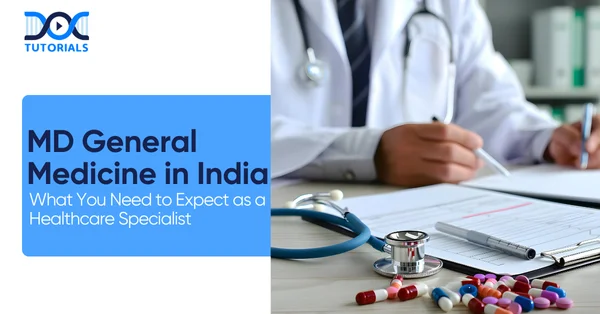
MD General Medicine in India: What You Need to Expect as a Healthcare Specialist?
The MD General Medicine course offered by different Indian institutions is both a desirable and challenging career path in the medical field. This postgraduate course equips medical graduates with the knowledge and clinical skills necessary to diagnose, treat, and manage a wide range of diseases.
The objective of this specialised course is to develop medical know-how and management skills for complex medical conditions among specialists across a variety of healthcare settings.
Continue reading to discover more about the MD in general medicine, its significance, course details, and additional information.
MD in General Medicine: Overview
The MD in General Medicine course aims to develop doctors specialised to diagnose, treat, and prevent diseases in adults. Being a professional postgraduate medical course, it builds competent doctors to perform a range of roles, from clinical practice to research, healthcare, senior professionals, and teaching.
The MD General Medicine is a specialised postgraduate medical course that focuses on comprehensive training in internal medicine. This programme encompasses major fields of medicine, cardiology, pulmonology, gastroenterology, nephrology, and endocrinology.
Through clinical rotations, case discussions, seminars, and research, learners gain a profound understanding and practical experience in diagnosing and treating various illnesses.
People who hold this degree are professional general practitioners, and their career options are hospitals, universities, research institutions, or DM in Cardiology or Gastroenterology as a super-speciality area for further studies.
What is the Duration of the MD in General Medicine Programme in India?
In India, the MD in General Medicine programme is a three-year course to pursue after finishing the MBBS degree, which lasts for five and a half years, including a one-year internship. The Medical Council of India and medical universities regulating and offering the programme determine the length of the MD programme.
To get accurate details about the duration and course structure, check the specific requirements and curriculum of the institution where you plan to pursue the MD General Medicine course.
Key Prerequisites for Pursuing an MD in General Medicine
MD (Doctor of Medicine) in General Medicine is a postgraduate medical qualification that has prerequisites like completion of MBBS from a recognised university, completion of the 12-month rotating internship, registration with the medical council, and clearing NEET-PG.
MD (Doctor of Medicine) in General Medicine offers medical professionals the skills necessary to diagnose, treat, and manage a variety of medical conditions. The general prerequisites for pursuing an MD (Doctor of Medicine) in General Medicine in India include the following:
- Educational Qualifications
Candidates are required to possess an MBBS (Bachelor of Medicine, Bachelor of Surgery) degree from a medical college or university recognised by the Medical Council of India (MCI) or the University Grants Commission (UGC).
- Internship Completion
Candidates must have successfully completed a 12-month rotating internship after obtaining their MBBS degree.
- Medical Council Registration
Candidates are required to be registered with the Medical Council of India (MCI) or the State Medical Council (SMC).
- Entrance Exam
To gain admission to MD programmes, applicants must undertake a national or state-level entrance examination. The National Eligibility and Entrance Test for Postgraduate Studies, commonly referred to as NEET-PG, is the most widely recognised national entrance examination.
An applicant who is in the middle of the internship period can also participate in the NEET-PG exam, but the internship must be completed before the beginning of the academic year or 31st March.
Admission Steps to Participate in MD General Medicine
MD in General Medicine admission steps include eligibility validation, NEET-PG registration and examination, counselling and seat allotment, and final admission.
Mentioned below is the simple step-by-step process to opt for the MD in General Medicine course:
Step 1: Eligibility Validation
The candidates should possess a degree in MBBS from a recognised medical university with a one-year compulsory internship. Registration with the MCI/SMC is a must to apply for the course. They need to fulfil the eligibility criteria before being considered for the MD programme.
Step 2: NEET-PG Registration and Examination
The candidates have to get themselves registered and appear for NEET-PG, conducted every year by the National Board of Examinations, usually in the month of January. The required qualifying percentile is the 50th percentile for the General Category and the 40th percentile for SC, ST, and OBC categories.
As it is one of the most preferred courses, the cut-off is usually high, and aspirants need to score high.
Step 3: Counselling and Seat Allotment
Eligible candidates must register for NEET-PG counselling, which may be held at either the national or state level. Seats are granted for MD General Medicine in multiple quotas like All India Quota, Management Quota, Institutional Quota, and NRI Quota.
During the counselling process, candidates can select colleges and quotas of their choice, taking into account their rank and preferences obtained in NEET-PG.
Step 4: Final Admission
After seat allotment, candidates must complete the admission formalities, including document verification, fee payment, and reporting to the allotted medical college within the stipulated time.
Admission to the MD General Medicine programme is confirmed upon successful completion of the aforementioned steps.
MD General Medicine: Course Details
Checking the MD General Medicine course syllabus and curriculum is essential, as it provides detailed information about the subject, clinical skills, and research areas to be covered in the postgraduate course. It serves to prepare learners for their future responsibilities as capable physicians, educators, and researchers.
The MD, or Doctor of Medicine in General Medicine, encompasses theoretical knowledge, practical training, research, and skill development in the curriculum to create healthcare specialists who can deliver quality healthcare, both inpatient and outpatient.
The syllabus details of the MD in General Medicine are discussed below:
- Physiology
- Community Medicine
- Yoga and Meditation
- Microbiology
- Anatomy
- Pathology
- ENT
- Ophthalmology
- Biochemistry
- Pharmacology
- Obstetrics & Gynaecology
- Forensic Medicine & Toxicology
- General Surgery & Orthopaedics
- Paediatrics
Furthermore, the MD General Medicine program at GIMSR adheres to the CBME-based framework established by the National Medical Council, encompassing essential subjects such as:
- Pharmacology
- Clinical Medicine
- Critical Care and Emergency Medicine
- Internal Medicine
- Diagnosis and Management of Common Medical Conditions
- Research Methodologies and Evidence-Based Practice
List of Super Speciality Options After MD General Medicine
Super-speciality options available after pursuing MD General Medicine help physicians choose focused career pathways, both clinically as well as aligned to their long-term goals. The list includes Cardiovascular Sciences, Neurological Sciences, Gastroenterology and Hepatology, Nephrology and Urology, Oncology, Endocrinology, Respiratory and Pulmonary Medicine, and Infectious Diseases and Critical Care.
Understanding the different super-speciality pathways available ensures informed choices and structured professional growth. Here are the major super-speciality options available for the doctors who have cleared the MD General Medicine course successfully:
- Cardiovascular Sciences
DM Cardiology is one of the most sought-after specialities that deals with heart diseases, coronary interventions, and electrophysiology. Interventional cardiology fellowships and advanced heart failure management are available to further extend procedural expertise and transplant care experience.
- Neurological Sciences
DM Neurology trains doctors to handle the most complex neurological disorders, such as stroke, epilepsy, and neurodegenerative diseases. Additional fellowships in stroke medicine and cognitive neurology provide focused clinical exposure to emerging fields of Neuroscience.
- Gastroenterology and Hepatology
DM Gastroenterology integrates skills in endoscopy with the management of liver and gastrointestinal diseases. Fellowships in advanced endoscopy, hepatology, and pancreatic care further develop diagnostic and therapeutic skills.
- Nephrology and Urology
DM Nephrology prepares physicians for the management of kidney disorders, dialysis, and transplant care. Fellowships in transplant nephrology and techniques of dialysis further enhance clinical and procedural skills pertaining to renal medicine and related urological systems.
- Oncology
DM Medical Oncology deals with the management of malignancies and blood cancers using chemotherapy, immunotherapy, and targeted therapy. In addition, you can pursue further specialisation in cancer medicine through fellowships in haemato-oncology and oncoimmunology.
- Endocrinology
DM Endocrinology encompasses metabolic and hormonal disorders, including diabetes and thyroid diseases. Specialised fellowships in diabetology as well as metabolic bone disorders provide in-depth clinical training in managing endocrine conditions.
- Respiratory and Pulmonary Medicine
Pulmonology fellowships deal with the management of respiratory illnesses like asthma, ILD, and sleep apnoea, among others. Newer fields include interventional pulmonology and sleep medicine, which offer procedural and diagnostic expertise in lung health.
- Infectious Diseases and Critical Care
Fellowships in Infectious Diseases and Critical Care Medicine teach physicians the management of severe infections, ICU care, and multi-organ failure. Courses like IDCCM and EDIC provide organised international certification pathways.
FAQs about MD General Medicine
- What documents are required to pursue an MD in General Medicine?
To apply for MD General Medicine, candidates have to furnish their degree certificate and report cards from the last qualifying university, migration certificate, proof of date of birth, identity proof, and domicile certificate. These documents are essential for verification and admission formalities.
- Which are some of the top institutes in India offering an MD in General Medicine?
Among the top institutes offering MD General Medicine in India are the All India Institute of Medical Sciences (AIIMS) in New Delhi, Christian Medical College in Vellore, Armed Forces Medical College in Pune, Kasturba Medical College in Mangalore, and Maulana Azad Medical College in New Delhi. These institutes are highly acclaimed for their academic excellence, experienced teaching faculty, and state-of-the-art clinical training.
- What steps should I take to pursue a subspeciality following my MD in General Medicine?
After you have completed your MD in General Medicine, you may apply for a fellowship in your chosen area of interest. In general, fellowships span 2-4 years and offer advanced training in a specific field.
- Is pursuing a career in research a feasible option after obtaining an MD in General Medicine?
Indeed, research represents a highly feasible and fulfilling career trajectory following an MD in General Medicine. You can make significant contributions to medical progress by engaging in clinical trials, epidemiological research, or pharmaceutical studies.
- What is the fee structure for MD General Medicine in India?
The fees for MD General Medicine vary widely depending on the type of college. Government colleges charge between ₹50,000 and ₹1.5 lakh per year, private colleges range from ₹18 lakhs to ₹70 lakhs per year, and deemed universities typically charge ₹18 lakhs to ₹45 lakhs per year.
- What career opportunities are available after an MD in General Medicine?
The MD General Medicine course offers plenty of professional opportunities, including clinical practice, hospital management, research, teaching, public health, and private practice, thus ensuring a fruitful and seamless journey in your healthcare career.
- How to pursue a subspecialty after an MD in General Medicine?
An MD in General Medicine can pursue a subspecialty or a fellowship in specialised areas that interest the candidate. The duration of a subspecialty is 2 to 4 years, depending on the topic chosen, which provided an advanced training in the field.
- Can I go abroad after completing MD General Medicine?
The MD in General Medicine degree is recognised internationally, so graduates can practice abroad after completing the course. However, they will need to pass local licensing exams, such as PLAB and USMLE, to practice in the respective countries. They may also move to abroad to pursue higher studies.
- What are the eligibility criteria for the general category for MD General Medicine?
Before pursuing an MD in General Medicine, the aspirant needs to fulfil the following eligibility criteria:
- Have a NMC recognised MBBS degree
- Complete one year of rotatory mandatory internship
- Have a provisional registration from the national or state medical council
Apart from this, you need to score more than 50% in the entrance exam, NEET-PG.
- Can I get direct admission to an MD in General Medicine without NEET-PG?
No, you cannot gain direct admission to an MD General Medicine program without appearing for NEET-PG. Once you take the exam, you need to get through with a minimum qualifying mark to sit for the counselling process and secure a seat in MD General Medicine.
Conclusion
A career in MD General Medicine in India is not just a postgraduate degree but rather a transformative journey towards professional excellence. It builds the doctors into astute clinicians, researchers, and educators who can meet diverse healthcare needs.
With growing opportunities across clinical practice, research, and administration, this specialisation promises lifelong careers marked by continuous learning, service, and innovation.
However, to get admission into the MD General Medicine course, aspirants must clear the NEET PG exam. If you are currently preparing, taking assistance from a specialised platform makes sense.
To help you out, we at DocTutorials offer interactive video lectures, CBME-oriented study materials, hard-copy notes, and PYQs to assist students in unleashing their full academic potential.
Join DocTutorials today!

Latest Blogs
-

NEET SS Exam 2024: Analysis, Key Dates, Counselling
The NEET SS 2024 exam kicked off on March 29, 2025. Over two days and two slots, candidates across 13…
-
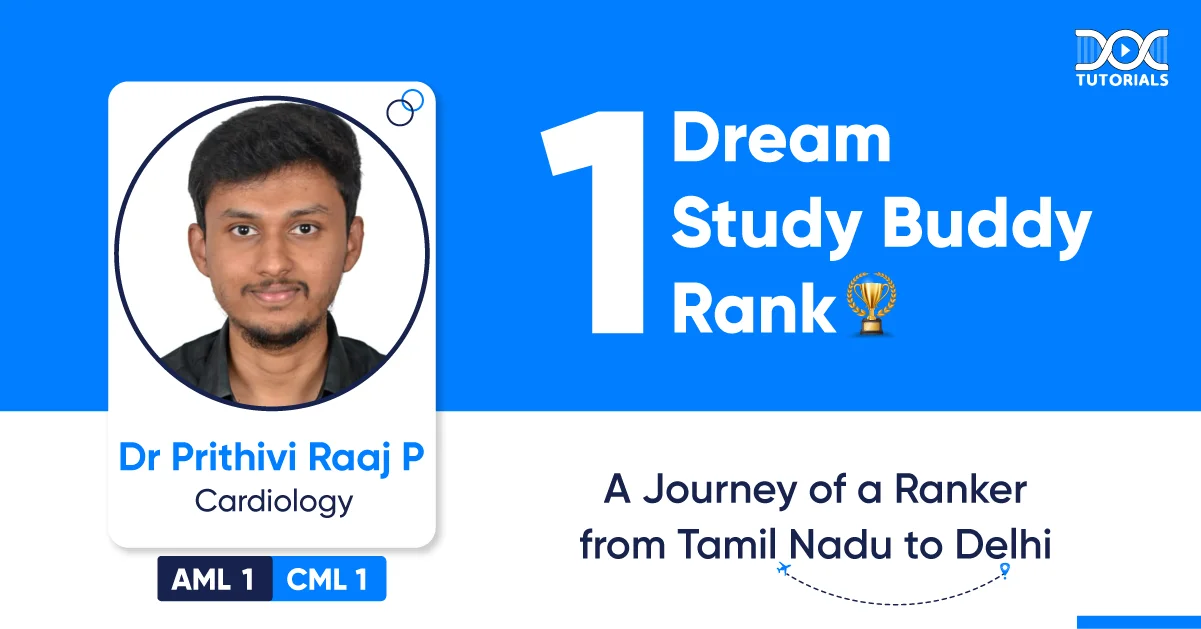
INI SS Topper: 1 Dream, 1 Study Buddy, 1 Rank – The Journey of Dr. Prithivi Raaj, CML 1 & (AIIMS) AML 1 in DM Cardiology
Achieving the top rank in a competitive exam like the INI SS DM Cardiology requires tireless dedication, a structured approach,…
-
INI SS Results: Merit List, Exam Insights, and What Comes Next
The INI SS results for October 2024 are just around the corner. This is a life-changing moment for thousands of…