How Many Revisions Are Needed for NEET PG? The Ultimate Science-Backed Strategy

You spend an entire month reading an endless stack of notes, only to realise you barely remember the first chapter. It is completely normal. The NEET PG syllabus is incredibly vast, encompassing 19 demanding subjects. Naturally, reading everything just once is never going to be enough. So, the most common question that pops up in every medical graduate’s mind is: exactly how many revisions are needed for NEET PG to secure a top rank?
Get free, handwritten-style notes covering the most high-yield NEET PG topics!
Let us break this down scientifically and practically. Consistent, active revision is the golden key to unlocking your dream medical seat.
The Science of Spaced Repetition
We lose about 60% of what we learn within days if we don’t practice active recall. And this is where the magic of spaced repetition happens.
Science says don’t cram the night before, space out your study sessions. When you review a topic just before you’re about to forget it, you fix that information in your long term memory. This method has been proven to provide you with retention rates of 85-90 percent, which is just the right thing for an exam of this magnitude.
So how many revisions are required for NEET PG?
According to toppers and education experts, you need to revise each subject a proper 3 to 5 times to really master the subject.
But not all subjects are created equal. Some are very conceptual, and others require you to learn lists and classifications. This is an excellent, subject-wise breakdown to help you plan your NEET PG revision strategy:
| Subject Category | Examples | Recommended Revisions | Best Revision Strategy |
| Fact-Heavy (Volatile) | Pharmacology, Microbiology, Pathology | 5 to 6 Revisions | Use flashcards, mnemonics, drug tables, and organism charts. Revise every 5-7 days initially. |
| Clinical & Concept-Based | Medicine, Surgery, Pediatrics, OBG | 4 to 5 Revisions | Focus on clinical presentation algorithms, diagnosis protocols, and varied case scenarios. |
| Basic & Foundational | Anatomy, Physiology, Biochemistry | 3 to 4 Revisions | Rely on visual diagrams, flowcharts, and high-yield summary sheets. |
A Quick Question for Your Prep Strategy
Question: Should I revise all 19 subjects the exact same way during my rapid revision sessions?
Answer: Absolutely not! Think of every subject as a completely different patient requiring a unique treatment plan. The pharmacology is a volatile detail, so it requires frequent, smaller doses of revision. But if your principles in Anatomy or Physiology are essentially solid, then it’s safe to review them a little less often but to concentrate more on the specific exceptions and values you tend to forget.
The 5-Revision Model That Actually Works
To make your NEET PG revision strategy fool proof, try adopting the much recommended 5-Revision Framework. It’s designed to match the way your brain naturally learns.
- Revision 1: 24-Hour Anchor: Finish this within one day of your first reading. Spend 20-30 minutes per topic going through your own notes/diagrams.
- Revision 2: The 7-Day Consolidation: Review the high-yield areas after a week, to cement your memory.
- Revision 3: The 21-Day Integration – Connecting the dots. Try to answer clinical questions applied based on what you read three weeks ago.
- Revision 4: The 45-Day Rapid Fire: This is where you put your speed to the test. Go through summaries, tables, and bookmarked MCQs.
- Revision 5: The Pre-Exam Strike: The last 15-20 days should be spent only on highly volatile facts, your mistake notebook and Previous Year Questions (PYQs).
Executing Your Strategy with the Right Ecosystem
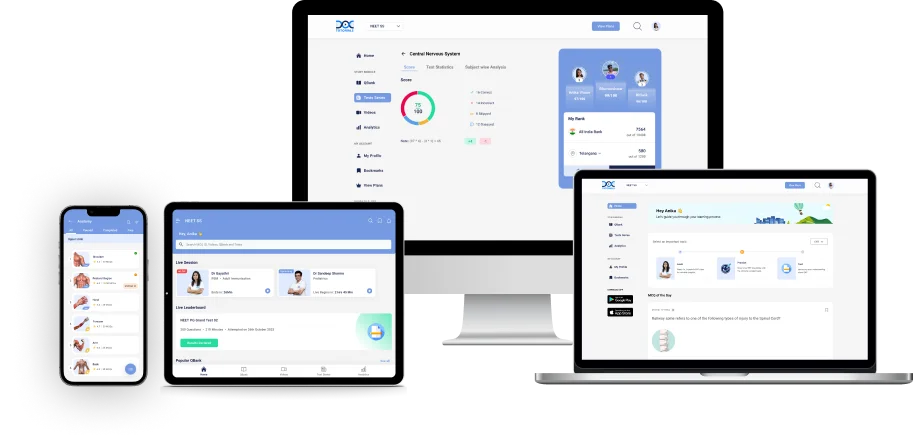
Executing 3 to 5 solid revisions requires a highly organised, all-in-one preparation ecosystem. Jumping between ten different resources often causes confusion. This is exactly where the DocTutorials NEET PG Power Pack acts as a game-changer for medical graduates aiming to ace NEET PG and INI-CET.
It is not just a course, but a complete preparation ecosystem designed beautifully for conceptual mastery, active recall and efficient last mile revision. This is how it fits in perfectly with your fast revision aims:
- V6 Videos: 1500+ New, Crisp & Concise Syllabus Videos with Detailed Conceptual Coverage. They are well tailored to suit the latest examination patterns. Plus, you get detailed PYQ Recall Videos covering recurring topics & examiner trends.
- System-Based Videos: Overcome the limits of isolated learning subjects. These videos link concepts across multiple disciplines to enhance your clinical reasoning and integrated learning.
- QRP V6 (Quick Revision Program)– Best for your 4th and 5th revision! 500+ high yield revision videos (available in Hinglish) for time efficient, rapid recall just before the exam.
- V6 QBank (India’s Most Trusted): Featuring 20,000+ MCQs, IBQs, and VBQs developed by top faculty. It includes clinical-case-based questions, custom modules for personalised tests, bookmark options for weak areas, and detailed explanations with highlight/annotate features.
- Test Series for Real Exam Experience: Improve your time management with 60+ Grand Tests and 200+ Topic-Wise Mini Tests and a Performance Analytics Dashboard.
- Flashcards & Mindmaps: Smart, visual tools for on-the-go recall of drugs, triads and formulas The subject wise conceptual mindmaps are great for that last minute pre-exam strike.
- Special INI-CET Focus: Dedicated modules, specific mock tests (AIIMS/JIPMER/NIMHANS type) and strong emphasis on image-based learning and reasoning questions.
- Edition 6 Notes Consolidated Hard Copy Notes: These are available for an additional fee. The notes are clear and concise with quality images and flowcharts.
Having a system like this in place, well structured, gives you the precision, confidence and edge you need to hit those top ranks by leveraging tools like timestamped video comments, goals and streaks.
Closing Thoughts to Increase Your Confidence
Stay positive and keep your game plan tight. Finally, the number of revisions for NEET PG depends on your consistency. Every time you revisit a topic, it takes significantly less time. What takes 20 days for the first time will only take 1 to 2 days by your final revision. Stay positive, trust your preparation ecosystem, and remember that consistent effort always brings exceptional results.
Frequently Asked Questions (FAQs) About NEET PG Revision
1. Average number of revisions required in NEET PG?
3-5 active revisions per subject is highly recommended for maximum retention and confidence on exam day.
2. Should heavy content subjects be updated more frequently?
Yes! Pharmacology and Microbiology require 5 to 6 revisions as they are full of volatile details like names of drugs, classification of organisms etc.
3. When do I start my first revision?
The first revision should be done within 24 hours of studying a new topic to catch the information before the forgetting curve kicks in.
4. How long does the last quick revision take?
A well-planned rapid review usually takes about 6 to 8 weeks and focuses on high-yield facts, tables, and brief notes.
5. What is the most important thing to be revised in last 10 days?
Your mistake notebook, volatile facts, image-based questions, formulas and previous year questions (PYQs) only.
6. Do later revisions take as long as the first read?
Not a drop. Each revision after that takes much less time. A topic that used to take 20 days can be revised in 1 or 2 days by the fourth round.
7. Why are grand tests important in the revision phase?
Sure. Mock exams help you to monitor your progress, practice time management, and highlight areas of weakness that need to be revised.
8. Do I read new books in my last revision?
It is highly recommended to stick strictly to your trusted resources, personal notes, and verified QBanks. New materials added late in the process can cause unnecessary confusion.
9. INI-CET and NEET PG: How to prepare efficiently?
Add a specific INI-CET preparation layer to your routine. Focus on conceptual integration, reasoning questions, AIIMS pattern mock tests.
10. How do flashcards and mindmaps help you revise quickly?
They are immensely powerful for active recall. Flashcards help you instantly remember triads and signs. Mindmaps visually connect big topics for integrated learning.


Latest Blogs
-

INI CET Exam 2026: Your Roadmap to Success – Key Topics, Strategies, and Lessons from Last Year’s Papers
The INI CET exam is more than just a test; it’s a significant milestone for many medical students aiming to…
-

INI CET Exam Success: Previous Year Question Papers & Ultimate Guide – INI CET PYQ
One can feel overwhelmed while preparing for the INI CET (Institute of National Importance Combined Entrance Test). A vast syllabus,…
-

NEET PG 2026 Preparation with Live Power Pack: Your Path to Success in 2026
Preparing for the NEET PG 2026 can be an overwhelming journey because of its vast syllabus and the pressure to…