NEET PG Preparation: Tips, Exam Pattern, and Subject-Weightage
The NEET PG (National Eligibility cum Entrance Test – Postgraduate) is an online entrance examination administered by the National Board of Examinations. Students aspiring to secure limited postgraduate seats all share the goal of clearing the examination on their first attempt.
However, to perform well in the exam, you not only require your textbooks but a systematic preparation strategy and study plan. Let’s explore some of the NEET PG exam preparation tips you can adopt in order to achieve success in your exams.
Boost Your NEET PG Prep – Download the Brochure
Download the NEET PG Preparatory Grand Test brochure to understand the full test format, subject-wise distribution, exam pattern details, performance analytics, and how this grand test can strategically strengthen your NEET PG preparation and improve your overall exam performance effectively.
Boost Your NEET PG Prep with Grand Test – Download the Brochure Now
Keep reading for a detailed insight.
Effective Preparation Tips to Achieve Success in the NEET PG Exam
Preparation for NEET PG demands a mix of discipline, smart strategies, and good resources. With lakhs of candidates and limited seats, your preparation should be properly planned, focused, and consistent.
The following are 10 must-know tips to increase your chances of success in the exam:
- Study Smart, Not Just Hard
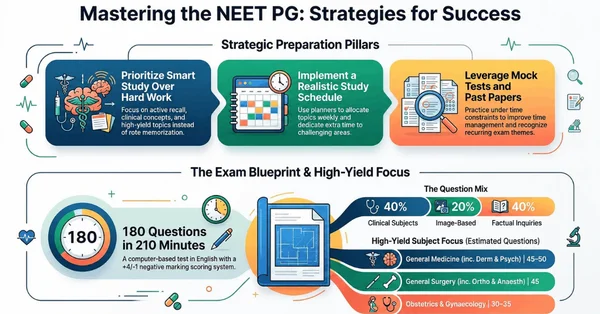
With a massive number of candidates sitting every year and only about 55% clearing, it’s evident that mere hard work won’t do. Top rankers suggest emphasising high-yield topics, clinical concepts, and active recall practice rather than mere cramming.
- Make a Realistic Study Plan
A tight-scheduled routine is the key to balancing every subject associated with the NEET PG exam and revising efficiently. Utilise Excel sheets or planners to allocate topics per week and spend more time on tricky areas. Revise and update your schedule regularly as and when required.
- Take Part in Mock Tests
Mock tests help you assess your preparation, improve time management, and identify weak areas. Participate in various mock tests in order to practice previous years’ papers, section-wise questions, and track your performance analytically. This can also help boost your mindset for the exams.
- Avoid Exhaustive Studying and Burnout
Reading 9–10 focused hours a day is better than reading for hours without end. Break every 2 hours to relax, avoid social media, and look after your mental health to see progress consistently.
- Manage Distractions and Stay Focused
Locking yourself in a room alone won’t cut it unless your mind is focused. Avoid internal disturbances by defining specific goals for every session and monitoring your actual learning hours to make sure you’re studying effectively.
- Utilise the Best Books and Study Materials
Avoid studying too many books and choose only the top-rated and recent books specific to NEET PG. Check approved sites for suggestions and always use the newest editions with current exam patterns.
- Practice Using Previous Year Papers
Solving last year’s question papers under time constraints enables you to comprehend the pattern of questions and gain confidence. It also assists in the recognition of recurring themes and areas that are commonly tested.
- Employ Reminders and Visual Aids
Use memory aids such as acronyms, charts, diagrams, and colour-coded notes in order to enhance retention. These techniques help grasp challenging subjects in a hassle-free way and reduce hectic last-minute revisions.
- Take Notes and Revise Periodically
Extensive, well-organised notes facilitate active learning and save time on final revision. Organise notes under subjects, highlight, and review them from time to time.
Now that you are aware of the best preparation tips for the NEET PG examination, let’s check out the exam pattern of the upcoming NEET PG as well as its subject-wise weightage based on the syllabus.
NEET PG Exam: Exam Pattern
The important details about the upcoming NEET PG exam format are listed below:
- Exam Date: August 30, 2026
- Duration of Exam: 3 hours 30 minutes
- Total Marks: The NEET PG 2026 will have multiple-choice questions.
- Exam Mode: The NEET PG is a computer-based test that is only in English. It consists of multiple-choice questions.
- Sections: The question paper will be divided into three sections.
- Syllabus: The exam syllabus will cover all 19 subjects from the MBBS curriculum.
- Total Number of Questions and Marks: Based on the latest NEET PG exam format, the test has five sections, each with 40 questions, making a total of 180 questions. Each question is of 4 marks, and there is a negative marking of -1 mark for every wrong answer.
NEET PG Exam: Subject-Wise Weightage
According to the latest examination trends, the following is the estimated subject-wise distribution for NEET PG:
- Anatomy (15–17 questions): Moderate significance; frequently assessed through applied and image-based inquiries.
- Biochemistry (12–15 questions): Moderate; metabolic pathways, enzymes, and molecular biology are considered high-yield topics.
- Pharmacology (20 questions): High significance; antimicrobials, mechanisms of action, and side effects.
- Physiology (15–17 questions): Moderate significance; cardiac and respiratory physiology are particularly favoured.
- Preventive & Social Medicine (25 questions): High significance; epidemiology, biostatistics, and national programs are essential topics.
- Pathology (25 questions): High significance; both conceptual and image-based inquiries are common.
- Microbiology (20 questions): High significance; bacteriology, virology, and immunology are consistently evaluated.
- Forensic Medicine (10 questions): Lower weightage but can yield easy scores with thorough revision.
- General Surgery (including Orthopaedics & Anaesthesia) (45 questions): Very high significance; trauma, gastrointestinal surgery, basic orthopaedics, and perioperative care are regularly featured.
- General Medicine (including Dermatology & Psychiatry) (45–50 questions): Very high significance; cardiology, neurology, infectious diseases, and systemic medicine are all extensively tested.
- Obstetrics & Gynaecology (30–35 questions): High significance; labour, obstetric emergencies, and gynaecological malignancies are frequently examined.
- Paediatrics (15 questions): Moderate; vaccines, growth and development, and neonatology are vital areas.
- ENT (10 questions): Low weightage; quick revision can lead to easy marks.
- Ophthalmology (10 questions): Low weightage, but image-based questions are prevalent.
- Radiology (12–15 questions): Moderate; identification of X-rays, CT scans, and MRI images is common.
- Orthopaedics (10 questions): Low weightage; fractures and bone tumours are popular topics in examinations.
- Dermatology (8–10 questions): Moderate; image-based questions concerning common skin disorders are included.
- Psychiatry (8– 10 questions): Moderate; diagnostic criteria and common treatment methods are tested.
- Anaesthesia (8–10 questions): Moderate; fundamentals of anaesthesia, CPR, and perioperative care are the main focus areas.
FAQs about NEET PG Exam Preparation
- Is NEET PG preparation more challenging than NEET UG?
NEET-UG is designed for entry into MBBS programmes, while NEET PG is intended for admission to MD/MS courses. Each examination comes with its own set of challenges. However, NEET PG is generally more competitive than NEET UG.
- How should I begin my preparation for NEET PG starting from the first year?
Initially, it is essential to examine the exam structure and gather comprehensive information regarding the NEET PG examination.
Once you are acquainted with the key aspects of NEET PG and the curriculum of the first-year subjects, engage in solving their MCQs, assessment questions, IBQs, and case studies as part of your preparation.
- Is there any negative marking in the NEET PG exam?
Yes, there is negative marking in the NEET PG examination. For each wrong answer, candidates will lose one mark. Hence, each student needs to read and attempt each question carefully.
- When will the upcoming NEET PG exam be held?
Even though no final dates have been announced, the NEET PG 2026 examination is expected to be held in August 2026.
- What is the structure of the NEET PG examination?
The NEET PG examination comprises 180 questions, which include 40% pertaining to clinical subjects, 20% based on images, and 40% consisting of one-liner factual inquiries.
- Which subjects are covered in the NEET-PG exam 2026?
The NEET-PG exam generally covers several subjects, including one-line factual questions, clinical topics, and image-based questions. Moreover, high-yeid subjects such as Obstetrics, Medicine, Gynaecology, Pharmacology, PSM, and Pathology also form a significant portion of the examination.
- How can I prepare myself for the NEET-PG exam day?
- The students will need to bring a printed copy of their registration card, a copy of their barcoded admit card, and a photo ID.
- The students must reach the examination centre at the reporting time mentioned on the admit card.
- The students must also read all the instructions carefully, while keeping in mind to take only the allowed items to the exam centre.
- What is the effective way to prepare for my NEET-PG exam?
The students must always prefer to study from their notes, including tables, mnemonics, and flowcharts, for the NEET-PG preparation. They can also enroll in available online courses to get the updated notes on all the essential topics, along with the concise tables, flowcharts, and mnemonics to memorise well.
- How can I crack NEET-PG on the first attempt?
The students who dream about pursuing a career in the medical sector should be well mentally prepared to crack the exam. Hard work, focus, diligence, and passion are mandatory to crack the exam at the first attempt.
In addition, studying smart and avoiding ineffective studying techniques, complete dedication, discipline, and determination will greatly help to ace the exam.
- Do I have to study 24/7 to crack the NEET-PG exam?
No, studying 9-10 hours every day is enough for the NEET-PG preparation plan if the students stay focused while studying. Productive learning generally comes from thoroughly reading books while escaping internet addiction.
Additionally, studying for long hours at a stretch is also not recommended. It is required to take a 10-15 minute break every 2 hours to give the mind and body a rest.
Conclusion
With the right approach, discipline, and mindset, cracking NEET PG in the first attempt is absolutely possible. Prioritise smart study methods, regular revisions, self-assessments, and self-care. Stay focused, stay consistent—and trust your journey.
For extra guidance, DocTutorials can be your study partner. Our curriculum offers crisp videos, clinical Qbank, exam-focused notes, flashcards, and mind maps to help students stay well-prepared ahead of time.
Join DocTutorials today and explore our NEET PG course to excel in your medical career.

Latest Blogs
-

INI CET Exam 2026: Your Roadmap to Success – Key Topics, Strategies, and Lessons from Last Year’s Papers
The INI CET exam is more than just a test; it’s a significant milestone for many medical students aiming to…
-
INI CET Exam Success: Previous Year Question Papers & Ultimate Guide – INI CET PYQ
One can feel overwhelmed while preparing for the INI CET (Institute of National Importance Combined Entrance Test). A vast syllabus,…
-

NEET PG 2026 Preparation with Live Power Pack: Your Path to Success in 2026
Preparing for the NEET PG 2026 can be an overwhelming journey because of its vast syllabus and the pressure to…