How to Prepare for NEET PG During Internship: The Ultimate Guide
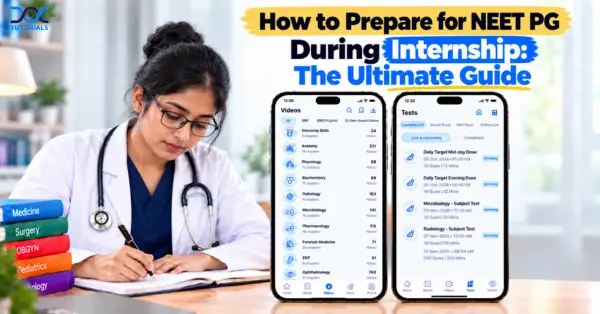
Let’s be real for a second. Being a medical intern is exhausting. Between 36-hour duties, collecting blood samples, running to the lab, and filling out endless discharge summaries, you barely get time to breathe. So, when people ask you about your study plans, it almost feels like a joke.
But here is the truth. Thousands of fresh graduates crack the exam and secure top clinical seats during their CRMI (Compulsory Rotating Medical Internship) every single year. They do not magically get a 30-hour day. They just study smarter. If you are constantly stressing over how to prepare for NEET PG during internship, take a deep breath. You just need a practical approach, a lot of consistency, and the right mindset.
Get free, handwritten-style notes covering the most high-yield NEET PG topics!
Understand the Latest NBEMS Exam Pattern
Before you even touch a book, you need to know what you are up against. The National Board of Examinations in Medical Sciences (NBEMS) has changed the game. The days of simple one-liners are long gone.
Now, the exam has 180 multiple-choice questions, down from the older 200-question format. It is divided into 5 time-bound sections. You get exactly 42 minutes to solve 36 questions in each section. Once the time for a section is up, it locks automatically. You simply cannot go back. This means your speed and clinical reasoning have to be razor-sharp. Because the time per question has slightly increased to 70 seconds, expect longer, more complex clinical vignettes. Your hospital ward is actually the best place to prepare for these real-life scenarios.
The Smart NEET PG Study Timetable for Interns
A rigid 10-hour study timetable will fail on your very first admission day. As an intern, your NEET PG preparation during internship needs to be highly flexible. You have to adapt to your clinical postings.
Match Your Reading with Your Postings
When you are doing your rounds, you are looking at live clinical cases. Use this to your advantage. Visual memory is incredibly powerful. Here is a meaningful table to help you align your subjects with your hospital duties:
| Internship Posting | Primary Subjects to Target | Secondary Integration |
| General Medicine | Medicine, Pharmacology | Pathology, Biochemistry |
| General Surgery | Surgery, Anatomy | Radiology, Anesthesia |
| OBGY | Obstetrics & Gynaecology | Pediatrics, Preventive Medicine |
| Pediatrics | Pediatrics, Genetics | Microbiology |
| PSM (Community Med) | PSM, Biostatistics | Infectious Diseases |
| Minor Postings (ENT/Ophthal) | ENT, Ophthalmology | Dermatology, Psychiatry |
When you see a patient with acute pancreatitis in the casualty, don’t just do the paperwork. Go back and quickly review the Ranson criteria on your phone. That topic is now locked in your brain forever.
Steal the “Dead Time”
Internship is full of hidden pockets of free time. Waiting for the consultant? Sitting in the OPD while the crowd is thin? Do not scroll through Instagram. Pull out your phone and solve 10 MCQs. Those 10 MCQs add up. If you solve 50 questions a day just during your duty hours, that is 1500 questions a month!
Is it really possible to rely only on MCQs and completely skip standard textbooks during my internship?
Answer: Yes, absolutely! Reading standard textbooks like Harrison or Bailey cover-to-cover during your internship is practically impossible. Your focus should be entirely on solving MCQs, reviewing Previous Year Questions (PYQs), and reading concise notes or flashcards. Active recall builds memory much faster than passive reading.
The Lifesaver: The NEET PG Power Pack
When you are short on time, you cannot afford to waste hours searching for the right materials. You need everything in one place. That is exactly where a complete ecosystem comes to the rescue.
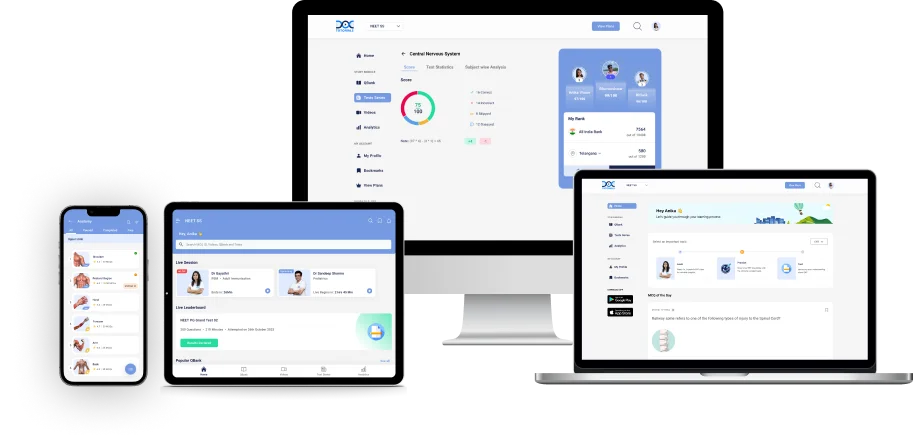
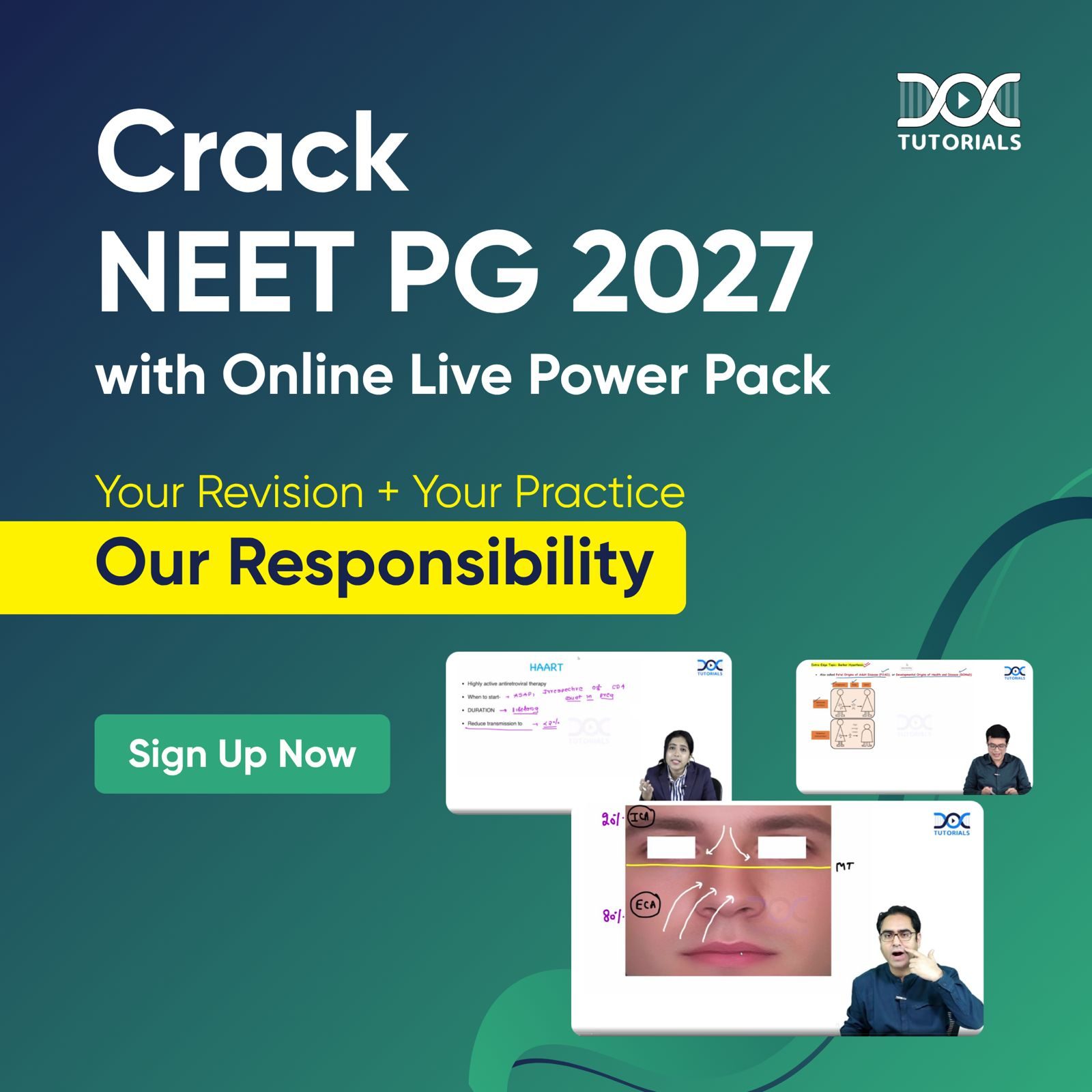
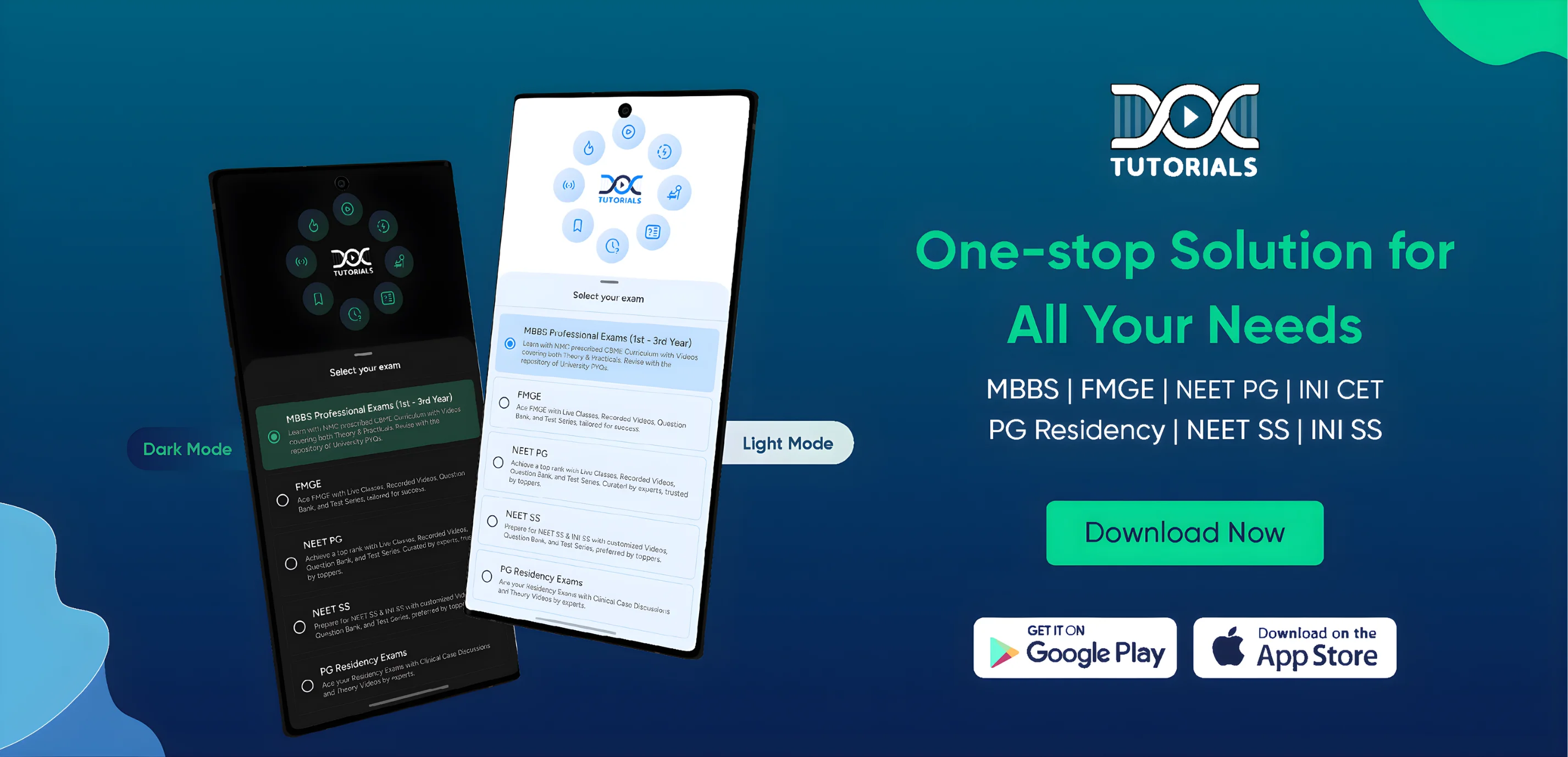
If you are looking for a highly efficient, all-in-one preparation tool, you should definitely check out the NEET PG Power Pack by DocTutorials. It is designed specifically for medical graduates aiming to ace NEET PG and INI-CET without the overwhelm. It’s not just a course; it’s a smart preparation ecosystem.
Here is why it fits an intern’s lifestyle perfectly:
- V6 Videos: You get all-new, crisp, and concisely structured videos across all 19 subjects. They mirror the latest exam pattern perfectly. Plus, the integrated, system-based videos help you connect concepts across multiple disciplines—which is exactly how clinical questions are asked now.
- Massive QBank: With over 20,000+ MCQs, IBQs, and VBQs (including PYQs), you can create custom modules. You can highlight and annotate MCQ explanations directly in the app.
- QRP V6 (Quick Revision Program): Over 500+ high-yield revision videos available in Hinglish. Perfect for rapid recall when your exam is just around the corner.
- Real Exam Experience: The 60+ Grand Tests and 200+ Topic-Wise Mini Tests give you the exact feel of the new NBEMS time-bound interface.
- Smart Flashcards & Mindmaps: Excellent for on-the-go recall of drugs, signs, and triads while you are in the hospital canteen.
- Special INI-CET Focus: A dedicated layer of specific videos, QBank modules, and mock tests designed for AIIMS/JIPMER styles.
With features like video timestamped comments and goal streaks, it keeps you motivated on a positive path. You get crisp, informative hard copy notes (Edition 6) too, if you prefer physical books. It simply gives you the precision and confidence you need to crack the exam.
Active Recall and Grand Tests (GTs)
A lot of interns make the mistake of just reading notes. Don’t do that. How to prepare for NEET PG during internship relies heavily on active recall. You must test yourself constantly.
Make Peace with Your Mistakes
Start giving Grand Tests early. Do not wait to “finish the syllabus” because, frankly, the syllabus is never truly finished. The real learning happens when you review the test. Spend 3 hours giving the GT, and at least 4 to 5 hours reviewing the explanations. Mark your weak areas. Bookmark the questions you got wrong and reattempt them a week later.
Consistent NEET PG preparation during internship is all about showing up. Even on a post-duty day, if you can only manage 2 hours of study, that is a massive win. Stay positive, trust your clinical exposure, and keep moving forward!
Frequently Asked Questions (FAQs) on NEET PG Preparation During Internship
1. How many hours an intern should study for NEET PG?
3-4 hours of solid studying on regular duty days, 8-10 hours on off days or lighter postings.
2. Can I clear NEET PG in the first attempt with internship?
Yes. Many top rankers are fresh interns every year. The trick is to revise every day and use your clinical ward experience to solve case-based MCQs.
3. When should I start giving Grand Tests (GTs)?
Start giving GTs from the beginning of your preparation. Start with 1 or 2 GTs per month and as the exam approaches, increase the frequency.
4. Are previous year questions (PYQs) important for the new exam pattern?
Absolutely. While the pattern of questioning has changed to longer clinical stems, the core, high-yield topics repeated by NBEMS remain exactly the same.
5. How do I balance duty fatigue with a NEET PG study timetable for interns?
Don’t force yourself to study heavy subjects after an exhausting 24-hour shift. Use that time to learn passively such as watching QRP videos or reviewing flashcards.
6. What is the newest NBEMS sectional timing rule?
Exam has 5 sections, 36 questions each section, total 180 questions. Each section has exactly 42 minutes and you cannot go back to a section once you have finished it.
7. While on internship reading standard textbooks?
No. Standard textbooks are for your UG days. During internship, only use short notes, QBank explanations and high yield videos.
8. Is the preparation of INI-CET different than NEET PG?
Yes, INI-CET is largely based on deep clinical reasoning, experimental questions and image-based questions. But a strong foundation covers 80% of the syllabus of both.
9. Is a custom QBank module useful?
Very helpful. It helps you generate tests relevant to the subject you are posted in, thus reinforcing your real time clinical learning.
10. How can I help myself to concentrate better during short study sessions in the hospital?
Use active recall techniques. Open a set of smart flashcards or solve 15 bookmarked MCQs on your phone. It keeps your brain engaged without requiring a quiet library.
Latest Blogs
-
INI CET Exam 2026: Your Roadmap to Success – Key Topics, Strategies, and Lessons from Last Year’s Papers
The INI CET exam is more than just a test; it’s a significant milestone for many medical students aiming to…
-
INI CET Exam Success: Previous Year Question Papers & Ultimate Guide – INI CET PYQ
One can feel overwhelmed while preparing for the INI CET (Institute of National Importance Combined Entrance Test). A vast syllabus,…
-

NEET PG 2026 Preparation with Live Power Pack: Your Path to Success in 2026
Preparing for the NEET PG 2026 can be an overwhelming journey because of its vast syllabus and the pressure to…