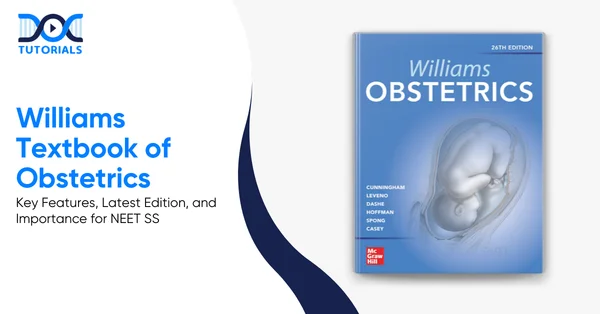
Williams Textbook of Obstetrics: Key Features, Latest Edition, and Importance for NEET SS
Candidates appearing for the NEET SS examination should have detailed insights into gynaecology and obstetrics. It is one of the crucial parts of the NEET SS syllabus. Thus, candidates need a reliable book to prepare themselves for the NEET SS exam.
Williams Obstetrics and Gynaecology is a reliable name in this regard that covers all the necessary chapters in the NEET syllabus in detail. Keep reading to learn more about the features, content, and latest edition of Williams OBG.
What is the History of Williams Obstetrics?
Williams Obstetrics is a popular book on Obstetrics, first published in 1903. Every edition of this book is carefully revised. Dr Williams was the editor of the sixth edition, which was published in the 1930s. The last revision of this book was done by Dr H. J. Stander, who was a former student of Dr Williams.
The first edition of Williams’ textbook of obstetrics was published in 1903, and it gained much appreciation among other reference books of Obstetrics. The books were published in repeated editions with careful revision each year. Dr Williams completed the sixth edition in 1930. It had every potential to rank top in the category of Obstetrics reference books.
The current revision was completed by Dr H. J. Stander, a friend and former student of Dr Williams. While adding necessary new content and occasionally altering the existing material, Dr Stander has mostly preserved the book’s structure and organisation.
Which is the Latest Edition of Williams Obstetrics?
Experts from UT Southwestern and Parkland have combined century-old knowledge with the most recent findings on preterm labour, infections, hypertension, and other topics in Williams Obstetrics, 26th Edition. It is a vital bedside guide for obstetricians, with over 1,000 colour illustrations and a focus on maternal-foetal medicine.
For many years, the field of obstetrics and gynaecology has been influenced by the seminal work Williams Obstetrics. The 26th edition of this book was created by top specialists from Parkland Hospital and the University of Texas Southwestern Medical Centre. This makes the book a reliable, evidence-based resource.
It ensures relevance for both training and day-to-day practice through the introduction of the most recent developments with classic clinical wisdom that has been accumulated over a century.
Apart from this, the 26th edition also excels in preterm labour, pregnancy-induced hypertension, infections, and severe haemorrhage. Additionally, it provides a solid foundation in fundamental subjects like physiology, anatomy, and prenatal care.
It has been updated for contemporary requirements and includes more than 1,000 vivid full-colour illustrations that visually explain difficult ideas. One of the notable aspects of this book is increased emphasis on maternal-foetal medicine, the quickly developing subspeciality that deals with high-risk pregnancies and foetal health.
This guide emphasises practical applicability and is perfect for obstetricians, residents, and clinicians at the bedside. It enables professionals to provide the best care possible in changing maternal health demands by fusing research with tried-and-true methods.
Williams Obstetrics is the most accessible and scientifically sound text available in this field. With its analysis of the most recent developments and procedures, this indispensable clinical partner makes positive results attainable.
What are the Key Features of Williams Textbook of Obstetrics?
The latest edition of Williams Textbook of Obstetrics has more than 1,000 illustrations, including updated sonograms, MRIs, and graphs, etc. With an increased emphasis on imaging, genetics, diagnosis, and treatment, it addresses pregnancy complications. The book includes easy-to-read tables with content that complies with current guidelines.
Here are some of the notable features of Williams Obstetrics, 26th edition:
- It includes over 1000 photos and illustrations for better understanding and explanation.
- This book focuses on different surgical and medical disorders which can lead to pregnancy complications.
- It provides detailed insight into the complications related to in-utero.
- The book focuses on maternal-foetal medicine and covers haemorrhage and hypertension.
- The expanded fetal section of this book is designed with advanced fetal imaging techniques, prenatal diagnosis, genetics, fetal therapy and disorders.
- Topics like preterm labour, physiology of labour, basic science, etc., are updated in the latest edition of Williams Obstetrics.
- The latest edition of this book includes eye-catching illustrations, updated sonograms, graphs, photomicrographs, MRIs, and photographs.
- The material incorporates current academic and professional guidelines, which are presented in tables that are easy to understand.
What is the Table of Contents of Williams Obstetrics, New Edition?
The Williams Obstetrics includes 12 sections and 68 chapters with detailed explanations of maternal anatomy and physiology, abnormalities and the development of the placenta, prenatal care, genetics, and more. The chapters also include obstetrical imaging for a better explanation of different types of labour, delivery, and surgical complications.
The table of contents for Williams Obstetrics is as follows:
Section 1: Overview
- Overview of Obstetrics
Section 2: Maternal Anatomy and Physiology
- Maternal Anatomy
- Congenital Genitourinary Abnormalities
- Maternal Physiology
Section 3: Placentation, Embryogenesis, and Foetal Development
- Implantation and Placental Development
- Placental Abnormalities
- Embryogenesis and Foetal Development
Section 4: Preconceptional and Prenatal Care
- Teratology, Teratogens, and Fetotoxic Agents
- Preconceptional Counselling
- Prenatal Care
Section 5: First- and Second-Trimester Pregnancy Loss
- First- and Second-Trimester Pregnancy Loss
- Ectopic Pregnancy
- Gestational Trophoblastic Disease
Section 6: The Foetal Patient
- Obstetrical Imaging
- Normal and Abnormal Foetal Anatomy
- Genetics
- Prenatal Diagnosis
- Foetal Disorders
- Foetal Therapy
- Antepartum Foetal Assessment
Section 7: Labour
- Physiology of Labour
- Normal Labor
- Abnormal Labor
- Intrapartum Assessment
- Obstetrical Analgesia and Anaesthesia
- Induction and Augmentation of Labour
Section 8: Delivery
- Vaginal Delivery
- Singleton Breech Delivery
- Operative Vaginal Delivery
- Caesarean Delivery and Peripartum Hysterectomy
- Prior Caesarean Delivery
Section 9: The Newborn
- The Newborn
- Complications of the Term Newborn
- The Preterm Newborn
- Stillbirth
Section 10: The Puerperium
- The Puerperium
- Puerperal Infection
- Contraception
- Sterilisation
Section 11: Obstetrical Complications
- Preeclampsia Syndrome
- Clinical Management of the Preeclampsia Syndrome
- Causes of Obstetrical Haemorrhage
- Haemorrhagic Placental Disorders
- Management of Obstetrical Haemorrhage
- Preterm Birth
- Postterm Pregnancy
- Foetal-Growth Disorders
- Multifetal Pregnancy
Section 12: Medical And Surgical Complications
- General Considerations and Maternal Evaluation
- Critical Care and Trauma
- Obesity
- Cardiovascular Disorders
- Chronic Hypertension
- Pulmonary Disorders
- Thromboembolic Disorders
- Renal and Urinary Tract Disorders
- Gastrointestinal Disorders
- Hepatic, Biliary, and Pancreatic Disorders
- Haematological Disorders
- Diabetes Mellitus
- Endocrine Disorders
- Connective Tissue Disorders
- Neurological Disorders
- Psychiatric Disorders
- Dermatological Disorders
- Neoplastic Disorders
- Infectious Diseases
- Sexually Transmitted Infections
How Does Williams Book of Obstetrics Help in NEET PG Preparation?
Candidates who are preparing for NEET SS (Super Speciality), especially those pursuing high-risk obstetrics and maternal-foetal medicine (MFM), Williams Obstetrics, 26th Edition, is a priceless resource.
Here’s why:
- Covers Essential NEET SS Subjects
Modern coverage of fetal imaging, genetics, prenatal diagnosis, disorders, and therapy is an essential subject in NEET SS exams. They help assess sophisticated fetal interventions and anomaly management. Williams Obstetrics focuses on MFM, offering a detailed guide on these subjects.
- Updated As Per Latest Advancements
Based on the current research, this book has updated chapters on labour physiology, basic science, and preterm labour to offer candidates deeper insights.
One can learn complicated issues like haemorrhage, hypertension, and in-utero issues better through this book. This ensures compliance with current standards, which is essential for scenario-based enquiries.
- Illustrations for Easy Understanding
With more than 1,000 visually striking illustrations, including improved obstetrical sonograms, MRIs, graphs, and photomicrographs, it streamlines complex images that are frequently included in NEET SS image-based questions.
It improves diagnostic skills and therapeutic decision-making by incorporating evidence-based updates and real-world insights, which raises test scores for super-speciality seats.
FAQs about Williams Book of Obstetrics
- Who is the author of Williams Obstetrics?
Originally authored by J. Whitridge Williams, the 26th edition is edited by experts like F. Gary Cunningham, Kenneth J. Leveno, Jodi S. Dashe, Barbara L. Hoffman, Catherine Y. Spong, and Brian M. Casey from UT Southwestern.
- When was Williams Obstetrics first published?
The book was first published in 1903 by J. Whitridge Williams, establishing it as a foundational obstetrics text that has evolved through 26 editions over a century.
- What does Williams Obstetrics cover?
It covers obstetrical complications like preterm labour, hypertension, haemorrhage, and infections, foundational reproductive anatomy, physiology, and prenatal care.
Moreover, it includes expanded Maternal-Foetal Medicine with foetal imaging and genetics.
- What makes Williams Obstetrics essential for NEET SS?
Williams Obstetrics 26th Edition covers high-yield obstetrics topics like maternal-foetal medicine, hypertension, and preterm labour, aligning perfectly with NEET SS syllabus for super-speciality preparation in OBGYN.
- Is the content updated for recent guidelines?
Yes, basic science, labour physiology, and preterm labour are refreshed with contemporary literature and professional guidelines in easy-to-read tables for quick NEET SS revision.
Conclusion
Books like the Williams OBGYN textbook help NEET SS aspirants prepare for their exam effectively. However, candidates also need professional coaching to better prepare. In this regard, DocTutorials can be your ultimate guide.
We provide online tutoring for NEET SS candidates through high-quality videos, quick revision programmes, Qbank, etc. Our expert faculty ensures that each candidate is guided professionally to top grades.
Join our NEET SS course for further information!
Latest Blogs
-

NEET SS Exam 2024: Analysis, Key Dates, Counselling
The NEET SS 2024 exam kicked off on March 29, 2025. Over two days and two slots, candidates across 13…
-

INI SS Topper: 1 Dream, 1 Study Buddy, 1 Rank – The Journey of Dr. Prithivi Raaj, CML 1 & (AIIMS) AML 1 in DM Cardiology
Achieving the top rank in a competitive exam like the INI SS DM Cardiology requires tireless dedication, a structured approach,…
-
INI SS Results: Merit List, Exam Insights, and What Comes Next
The INI SS results for October 2024 are just around the corner. This is a life-changing moment for thousands of…