General Surgery Residency in India: Complete Guide to Life as a Resident
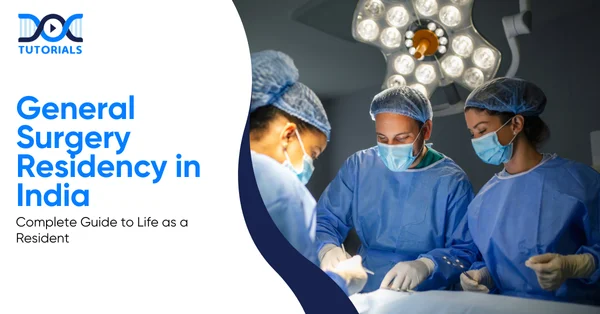
If you are aspiring to become a surgeon in India, you might be looking for details about general surgery residency. A career in general surgery is one of the most challenging and respected career paths.
General surgery residents are given extensive hands-on experience and trained to perform life-saving procedures and manage complex medical cases. Read this article to understand what residency in general surgery is all about!
What is General Surgery Residency?
A general surgery residency is a part of the three-year full-time postgraduate training program (MS/DNB). MBBS graduates can get hands-on surgical experience through this program. Residents are taught how to perform surgeries, handle pre- and post-operative care, and develop clinical judgement as surgeons under expert supervision.
A General surgery residency in India, whether through the MS (Master of Surgery) or DNB (Diplomate of National Board) pathway, is when an MBBS graduate truly learns to be a surgeon. It’s full-time, difficult, and hands-on training. The days of the resident are spent in operating rooms, wards, and emergency departments.
In India, there are two routes that are recognised for training in general surgery. There are the MS degrees and the DNB degrees. Both are considered excellent qualifications for postgraduate study. The difference between them lies in how they are assessed and accredited, and in the place of training (residency).
Both courses have the same goal — to produce competent and confident surgeons. So, a general surgery residency is where your transformation from a medical graduate to a surgeon begins.
What is the Duration of the General Surgery Residency in India?
Your general surgery residency will begin after your MBBS degree and the mandatory one-year internship. The standard duration for MS in general surgery is three years of full-time training.
You can get access to the three-year structure by viewing the National Medical Council (NMC) postgraduate curricula and also the syllabi of most institutions offering the course. DNB programs also follow a three-year structure for general surgery. In addition, the training length can be reduced if candidates hold a postgraduate diploma in a related surgical field.
The three-year surgery residency program includes rigorous practical training:
- Residents go through rotations across surgical units, emergency rooms, ICU (intensive care unit), and also other speciality postings like orthopaedics, ENT (ear, nose, and throat), urology, etc.
- They also get hands-on experience for surgeries.
- Residents have to attend seminars, conduct research, and attend conferences.
- Skill development in laparoscopic and open surgery.
What is the Admission Process for a General Surgery Residency?
Admission into a general surgery residency, such as MS General Surgery or DNB General Surgery, in India involves specific steps, eligibility criteria, and counselling systems. The candidates must meet the following eligibility criteria:
- Candidates must have an MBBS degree, which is recognised by the NMC.
- Completion of the mandatory one-year internship after the MBBS degree.
- Candidates must pass the NEET-PG/INI-CET entrance exam with the required cut-offs.
- Permanent or provisional registration with MCI/NMC/State Medical Council
- Foreign medical graduates must have cleared the FMGE (Foreign Medical Graduate Examination) before applying.
The step-by-step admission process is given below:
- Step 1: Prepare for the NEET-PG or equivalent (such as INI-CET) entrance exam
- Step 2: Appear for the exam and obtain the required score/rank as per the cut-off.
- Step 3: Check eligibility and register for counselling.
- Step 4: Fill in your choices/college preference at the counselling portal.
- Step 5: Check your seat allotment based on the list released.
- Step 6: Report to the institute for admission formalities and document verification. Secure your seat.
What Does the MS/DNB General Surgery Syllabus Include?
The MS and DNB General Surgery syllabi in India cover a wide range of surgical sciences, clinical training, and research components. Both programs include applied basic sciences, general surgical principles, oncology, and laparoscopic surgery. Students also undergo rotations across varied specialisations and get training in clinical research.
The syllabus for general surgery programs in both MS and DNB is given in the tables below:
What is the Syllabus for the MS in General Surgery?
The MS in General Surgery syllabus varies slightly from one medical institution to another, but most universities in India follow a similar framework as outlined by the National Medical Commission (NMC).
Minor differences may appear in the depth of certain modules, elective rotations, or assessment formats. Check out the table below:
| Year | Core Subjects |
| 1st Year | Pre-operative Management I & II Orthopaedics and Traumatology Intensive Care Respiratory System Neoplasia: Techniques and Outcomes of Surgery |
| 2nd Year | Vascular Surgery Head, Neck, Endocrine & Paediatric Surgery Abdominal Surgery Plastic Surgery Small Bowel and Colorectal Disorders Locomotor System |
| 3rd Year | Upper GI Tract Surgery Hepatopancreatobiliary Surgery Neurosurgery Laparoscopic Surgery ICU, Emergency, and Ward Procedures |
Note: To access the exact syllabus, students are encouraged to visit the official website of their respective universities or affiliated teaching hospitals.
What is the Syllabus for the DNB in General Surgery?
The syllabus for DNB in general surgery is given below:
| Section | Key Topics Covered |
| Applied Basic Sciences | Applied anatomy, physiology, biochemistry, microbiology, pharmacology, and pathology Molecular and cell biology, inflammation, regenerative medicine Wound healing, shock, fluid & electrolyte balance, acid-base management Principles of asepsis, sterilisation, antibiotics, and anaesthesia |
| General Surgical Principles | History of surgery, surgical infections, nutrition, and burns Principles of laparoscopy, endoscopy, and robotic surgery Oncology basics and management Trauma and emergency surgical care Blood transfusion, hemostasis, and universal precautions (HIV, hepatitis) |
| Pre- & Post-Operative Care | Pre-operative assessment and anaesthesia preparation Infection control, aseptic techniques, and antibiotic prophylaxis Post-operative complications and their management Pain control, ventilatory support, and nutritional care |
| Trauma and Critical Care | Assessment and resuscitation (ATLS, BLS) Management of chest, abdominal, and pelvic trauma Head and spinal injuries, burns, gunshot wounds ICU management |
| Oncology and Palliative Care | Cancer biology, staging, and principles of surgery, chemotherapy, and radiotherapy Screening, pain management, and palliative care Ethics, medico-legal aspects, and communication in cancer care |
| System-Based Surgery | Locomotor System Vascular Surgery Head, Neck, and Endocrine Paediatric Surgery Abdomen and Gastrointestinal Tract Hepato-Pancreato-Biliary Genito-Urinary Neurosurgery Cardiothoracic Surgery Plastic and Reconstructive Surgery Transplantation |
| Laparoscopic & Minimal Access Surgery | Laparoscopic anatomy, ports, and instruments Pneumoperitoneum, electrocautery, and laser safety Diagnostic & therapeutic laparoscopy Complications, equipment handling, robotic assistance |
| Research, Ethics, and Biostatistics | Research methodology, clinical trials, surgical audit, and data interpretation Health policy issues and medico-legal responsibilities Biomedical waste management and ethical surgical practice |
| Clinical Postings | Mandatory: Accident & Trauma (1 month), ICU (1 month) Rotational (6 weeks each): Cardiothoracic, Neurosurgery, Surgical Gastroenterology, Oncology, Paediatric, Plastic, and Urology |
Note: To access the exact syllabus, students are encouraged to visit the official website of their respective universities or affiliated teaching hospitals.
What Career Options are Available after Completing a General Surgery Residency?
After completing a General Surgery Residency, you can work as a consultant surgeon, start a private practice, or pursue super-specialisation (MCh/fellowships). Other options include becoming an academic surgeon, moving into hospital administration, training abroad, or starting a health-tech or surgical venture.
The following table summarises the career path available after you complete your General Surgery Residency:
| Career Path | Description |
| Consultant/Surgeon in Hospital | Working in a hospital setting (public/private), performing surgeries |
| Private Practice/Clinic | Establishing one’s own surgical practice or joining a private hospital |
| Super-Specialist/Fellowship | Pursuing MCh/fellowship in a niche surgical area |
| Academic/Teaching Surgeon | Faculty role in medical college + clinical work + research |
| Hospital Leadership/Administration | Transitioning into an administrative/managerial role in healthcare |
| Global Practice/International Fellowship | Training/practice abroad, then returning (or staying) |
| Entrepreneurial/Specialised Service | Starting a niche service unit, tele-surgery, and health-tech venture |
What are the Common Myths around General Surgery for Residents?
People often hold misguided opinions about surgery. Contrary to the general belief, surgery is not often the last resort; it is, in many cases, seen as the most effective treatment. Modern techniques and minimally invasive procedures make recovery time from surgeries faster. There may be certain misconceptions about general surgery that are essential to clarify. It is important to separate facts from myths, especially if you are someone who is going to enter a general surgery residency soon.
The following sections provide certain myths about general surgery and aim to clear them up:
- Surgery is Always the Last Resort
Surgery is often seen as a proactive solution. While many people think that surgery is only provided when all other lines of care have failed, this is not the case. It is often the case that in many conditions, surgery is the best and sometimes the only solution.
- All Surgeries Have an Extreme Risk
With advanced technology and modern surgical techniques, the risk of surgeries has reduced significantly. There are advanced seen in laparoscopic robotic and image-guided surgery, which residents are trained in.
General surgery residents are also trained in risk assessment, infection control, and operative protocols that make sure that patients are safe and don’t suffer from any complications.
- It Takes Time to Recover from Surgeries
The time it takes to recover from surgery depends on the type of surgery. Patients who undergo minimally invasive procedures also also surgeries as cholecystectomy and laparoscopic appendectomy, get discharged within 24 to 48 hours.
The general surgery program’s emphasis on residents getting training in these advanced procedures ensures faster recovery for patients.
- Surgeons Don’t Interact Much with Patients
Patient care is one of the important duties of a surgeon. Surgeons spend a significant amount of time counselling patients, explaining risks, and guiding postoperative recovery. During residency, trainees are encouraged to develop empathy, communication skills, and patient-education strategies.
FAQs about General Surgery Residency in India
- ow long is a general surgery residency in India?
Most general surgery programs in India are of a total of three years of duration.
- What are the eligibility criteria that I need to meet so that I can apply for general surgery programs?
To become a general surgery resident, you must hold an MBBS degree from a recognised institute and must have completed your mandatory one-year internship. You also have registration or a provisional registration with the State/National Medical Council.
Candidates also need to appear for the NEET-PG or other equivalent examinations and obtain the required cut-off score.
- Is it difficult to pursue a general surgery residency?
Being a general surgery resident can be difficult, as even before admission, you have to compete for seats. The workload is also intense, and the course is rigorous. Residents have to work to meet academic requirements and also fulfil their clinical duties.
- Do I have to appear for an entrance exam to become a general surgery resident?
Yes. Admission to MS/DNB General Surgery is based on an entrance examination. In India, the primary exam is NEET-PG (for most institutes) or other institute-specific exams for certain institutes of national importance.
- What is the scope for a general surgery resident in India?
The scope for general surgery residents in India is vast. You can get opportunities in government and private hospitals, trauma centres, and academic or research roles. If you want to refine your skills further, you can also pursue various subspecialties through MCh or fellowship programs.
- What is the shortest general surgery residency in India?
The shortest general surgery residency in India is 3 years, resulting in either a Master of Surgery (MS) or a Diplomate of the National Board (DNB) qualification. However, before applying for a general surgery residency, one must complete their MBBS and one year of rotatory internship.
- What is the highest-paid general surgery speciality in India?
In India, the highest-paid surgical specialities include neurosurgery and cardiothoracic surgery, where senior consultants earn somewhere between ₹1 crore and ₹3 crore annually. Other high-paying specialities include orthopaedic surgery and oncology surgery. However, the payout varies with experience.
- What can I do after a general surgery residency in India?
After completing a general surgery residency in India, you can work as a consultant in private hospitals or join a government medical college as a senior resident to practice further. Apart from this, you can also go for super-specialisation. Other options include completing fellow trainings in laparoscopy or trauma.
- How to get a general surgery residency in India?
To get a general surgery residency in India, there are some prerequisites before appearing in the entrance exams, and they are:
- Hold a valid NMC-recognised MBBS degree
- Complete one year of rotatory internship
- Obtain national or state medical registration
- What is the salary of a general surgery resident doctor in India?
General surgery residents in India, or Junior Residents, receive salaries ranging from ₹55,000 to ₹1,10,000 in government institutions, while private institutions pay between ₹35,000 and ₹70,000, which may vary by state. General surgery residents earn higher pay in top-tier cities
Conclusion
Completion of a General Surgery PG Residency marks the beginning of a fulfilling medical career. Whether you plan to practise independently, pursue super-specialisation, or engage in research, a residency equips you with essential surgical skills and clinical expertise.
For students undertaking PG Residency in MS General Surgery, DocTutorials provides hard copy notes and expert guidance to help you confidently navigate your residency journey and build a strong foundation for your future in surgery.
Join DocTutorials today and explore our PG Residency course!

Latest Blogs
-

NEET SS Exam 2024: Analysis, Key Dates, Counselling
The NEET SS 2024 exam kicked off on March 29, 2025. Over two days and two slots, candidates across 13…
-

INI SS Topper: 1 Dream, 1 Study Buddy, 1 Rank – The Journey of Dr. Prithivi Raaj, CML 1 & (AIIMS) AML 1 in DM Cardiology
Achieving the top rank in a competitive exam like the INI SS DM Cardiology requires tireless dedication, a structured approach,…
-
INI SS Results: Merit List, Exam Insights, and What Comes Next
The INI SS results for October 2024 are just around the corner. This is a life-changing moment for thousands of…