A Comprehensive Clinical Guide to ADHD: Epidemiology, DSM 5 Criteria, and Management
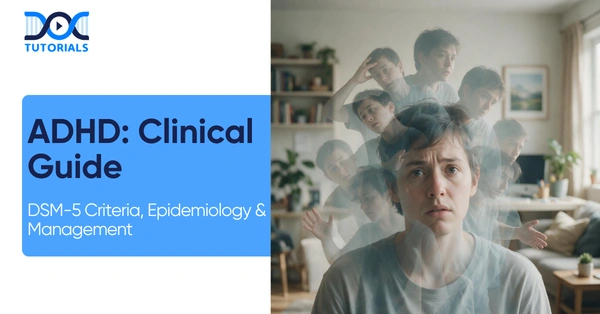
Attention-Deficit/Hyperactivity Disorder (ADHD) is a complex, pervasive neurodevelopmental disorder that primarily manifests in childhood and typically causes significant, lifelong impairment in cognitive, behavioral, academic, and emotional functioning. For Postgraduate (PG) psychiatric and pediatric residents, deeply understanding the DSM 5 (Diagnostic and Statistical Manual of Mental Disorders, Fifth Edition) criteria is an absolute necessity for executing an accurate clinical assessment and formulating a viable treatment plan.
This blog details the structural brain findings, diverse etiological factors, core DSM 5 diagnostic guidelines, and evidence-based management strategies required to achieve clinical mastery in pediatric and adolescent care.
Get High Quality, High Yield Psychiatry PG Residency Notes for Free!
Epidemiology, Structural Findings, and Core Pathogenesis
ADHD shares several underlying epidemiological similarities with Autism Spectrum Disorder (ASD), yet its distinct structural findings set it apart. While global brain volume changes are generally not clinically significant in ADHD (unlike the notable volume changes seen in ASD), there is an observable and measurable reduction in cortical thickness, particularly localized within the frontal lobe. Functional neuroimaging typically reveals a markedly decreased activation in both the basal ganglia and the frontal lobe regions during cognitive tasks.
The core pathology of the disorder stems from severe neurotransmitter dysregulation, explicitly involving Dopamine and Norepinephrine systems. In patients presenting with ADHD, there is an excess reuptake of these vital neurotransmitters into presynaptic terminals, which drastically reduces their availability at postsynaptic receptors and disrupts neural signaling.
- Dopamine Deficit: Dopamine is fundamentally responsible for regulating learning and motor functions. A deficit in this neurotransmitter leads directly to severe learning difficulties and pronounced motor initiation issues.
- Norepinephrine Deficit: Norepinephrine regulates baseline arousal, sustained attention, and mood stability. A measurable deficit here translates directly into the classic clinical symptoms of inattention, hyperactivity, and persistent sleep dysregulation.
The Multifactorial Etiology of ADHD
The etiology of ADHD operates on a complex multifactorial inheritance model that involves intricate interactions between a patient’s genetic susceptibility and environmental triggers. The DSM 5 framework implicitly acknowledges these diverse developmental trajectories when guiding clinicians on how symptoms may present and evolve over time.
Key Risk Factors for ADHD Development
| Risk Category | Specific Identified Factors |
| Genetic & Biological | Complex inheritance patterns involving polymorphisms that affect neurotransmitter transport and neuronal growth, specifically including DAT gene mutations and BDNF gene (Val66Met/rs6265) alterations. |
| Prenatal & Perinatal | Prematurity, complications during pregnancy, parental asphyxia, maternal drug or alcohol exposure in utero, and notably high maternal sucrose intake. |
| Postnatal & Environmental | Epigenetic alterations and exposure to heavy metals such as Lead, Mercury, and Manganese. Routine lead screening is considered a standard clinical practice. |
The DSM 5 Diagnostic Criteria for ADHD
The DSM 5 diagnostic criteria serve as the international gold standard for identifying and classifying ADHD in clinical practice. The DSM 5 establishes strict, objective guidelines to prevent clinical overdiagnosis and ensure diagnostic accuracy across different patient demographics.
According to the DSM 5, the core clinical triad of ADHD consists of Hyperactivity, Impulsivity, and Inattention. To successfully meet the DSM 5 diagnostic threshold, a patient must exhibit a specific symptom count. For pediatric patients under the age of 17, the DSM 5 strongly mandates that 6 or more specific symptoms must be documented.
- Inattention: The clinical traits include making careless mistakes, being easily distracted by external stimuli, not listening directly when spoken to, frequently submitting incomplete homework, and exhibiting an active dislike for tasks requiring sustained mental effort, such as mathematics.
- Hyperactivity: The DSM 5 identifies 6 key traits in this domain, including frequently fidgeting or tapping hands, leaving one’s seat when remaining seated is expected, running or climbing at inappropriate times, being completely unable to play quietly, continuously acting as if “driven by a motor,” and talking excessively.
- Impulsivity: The DSM 5 outlines 3 distinct impulsive traits that further impair social and academic functioning.
Furthermore, the DSM 5 classifies the disorder into three primary presentations: Predominantly Inattentive, Predominantly Hyperactive/Impulsive, and the Combined Type. To diagnose the Combined Type, the DSM 5 explicitly requires the patient to simultaneously meet at least 6 criteria in both the inattention domain and the hyperactivity/impulsivity domain.
How does the DSM 5 differentiate situational inattention from clinical ADHD?
The DSM 5 explicitly dictates that symptoms must be pervasive and present in more than one setting (for example, displaying symptoms at both home and school). This strict DSM 5 multi-setting requirement effectively rules out purely environmental triggers, ensuring that the patient’s impairment is a persistent neurodevelopmental trait rather than a localized, transient behavioral response to a specific chaotic environment.
Timeline, Impact, and Clinical Exclusions According to the DSM 5
The DSM 5 is exceptionally specific regarding symptom timelines to ensure developmental appropriateness. Symptoms must have a documented onset before 12 years of age and must demonstrate continuous persistence for more than 6 months; under the DSM 5, symptoms cannot be transient or episodic.
Additionally, the DSM 5 dictates that these behaviors must cause significant, observable interference with academic, social, or occupational activities. Finally, the DSM 5 includes an exclusion criterion stating that the symptoms must be excessive for the patient’s developmental level and cannot be better explained by another overarching mental disorder.
Comprehensive Management and Treatment Algorithm
Adhering to a highly structured management algorithm is just as critical as correctly applying the DSM 5 diagnostic criteria. Clinical management heavily relies on the patient’s chronological age and the overall severity of the symptoms.
ADHD Evidence-Based Management Hierarchy
| Patient Age Group | Primary Interventions (First-Line) | Secondary / Refractory Interventions |
| Children < 6 Years | Behavioral Therapy, Parent Training, and comprehensive Environmental Modification. | Early medication is strictly indicated only for severe issues like school expulsion, aggression, self-injury, or a strong family history. |
| Children > 6 Years | Immediate Pharmacotherapy alongside targeted Psychotherapy. | Transition to alternative drug classes depending on existing comorbidities (e.g., using Atomoxetine for heart disease, or Alpha-2 Agonists for tic disorders). |
Non-Pharmacological Interventions
For all pediatric age groups, non-pharmacological approaches form the robust foundation of treatment, comprising up to 90% of early clinical management. Caregiver interventions involve using heavily structured daily schedules, utilizing charts and checklists, and minimizing environmental distractions by maintaining a calm room with minimal extraneous objects.
Clinicians should coach parents on employing specific, clear communication and utilizing “calm discipline” techniques, such as time-outs, instead of yelling. Furthermore, establishing realistic and measurable goals (like consistently completing assignments) and encouraging hobbies or sports where success is highly possible are vital behavioral strategies.
Pharmacological Interventions
When the DSM 5 diagnostic threshold confirms a severe case requiring immediate pharmacological intervention in children over 6, the hierarchy of treatments is structured strictly by clinical efficacy and safety profiles.
- Stimulants: Methylphenidate is widely considered the superior and safer first-line option, requiring a trial of 4-6 weeks. It effectively blocks DAT/NET transporters, which subsequently increases synaptic Dopamine and Norepinephrine availability. Dosing strategies typically start at 0.5mg/kg/day, targeting an eventual maintenance dose of 1-2 mg/kg/day. The drug features a peak efficacy at 1-2 hours and a half-life of 4-5 hours.
- Non-Stimulants: Atomoxetine, alongside the newly approved Viloxazine (an extended-release non-stimulant approved for ages 6-17), serve as reliable second-line treatments. Atomoxetine operates as a Selective Norepinephrine Reuptake Inhibitor (SNRI) that specifically targets the prefrontal cortex. Because it does not increase dopamine levels in the Nucleus Accumbens, it possesses no major abuse potential. However, PG residents must remain vigilant regarding side effects, which include decreased appetite, mild gastrointestinal issues (vomiting/loose motions), increased blood pressure, insomnia, sleep disturbances (such as talking in sleep), weight loss, and headache. Critically, clinicians must continuously monitor for suicidal tendencies, which present in 1-2% of patients taking Atomoxetine or Viloxazine.
- Alpha-2 Agonists: Medications like Clonidine and Guanfacine represent the third line of pharmacological treatment, and they are often the preferred route if the patient has a comorbid tic disorder.
Frequently Asked Questions (FAQs)
1. What is the core triad of ADHD under the DSM 5?
The DSM 5 strictly defines the disorder’s core triad as Hyperactivity, Impulsivity, and Inattention.
2. At what age must ADHD symptoms appear according to the DSM 5?
The DSM 5 guidelines state that initial symptom onset must clearly occur before 12 years of age.
3. How long must symptoms persist for a valid DSM 5 diagnosis?
The DSM 5 explicitly requires that clinical symptoms persist continuously for more than 6 months.
4. What is the minimum symptom count for children under 17 in the DSM 5?
The DSM 5 mandates the presence of 6 or more symptoms from either the inattention or hyperactivity/impulsivity categories.
5. Does the DSM 5 allow for diagnosis if symptoms only occur at school?
No, the DSM 5 requires symptoms to be documented in more than one setting to effectively rule out localized environmental triggers.
6. Which key neurotransmitters are heavily implicated in ADHD pathogenesis?
Dopamine and Norepinephrine are the primary neurotransmitters identified as being severely dysregulated in ADHD.
7. What is the standard first-line treatment for children under 6 years old?
Behavioral therapy, paired with environmental modifications, is the mandatory first-line management for preschool-aged children.
8. When should medications be utilized in children under 6?
Medications are added early only if the child exhibits severe, unmanageable issues like aggression, active self-injury, immediate expulsion risks, or possesses a strong family history.
9. What is the primary pharmacokinetic mechanism of Methylphenidate?
It actively blocks DAT/NET transporters in the brain, thereby increasing available synaptic Dopamine and Norepinephrine.
10. Why is Atomoxetine clinically considered to have a low abuse potential?
Unlike standard stimulants, it does not artificially increase dopamine levels in the brain’s Nucleus Accumbens, thoroughly minimizing physiological abuse risks.

Latest Blogs
-

NEET SS Exam 2024: Analysis, Key Dates, Counselling
The NEET SS 2024 exam kicked off on March 29, 2025. Over two days and two slots, candidates across 13…
-
INI SS Topper: 1 Dream, 1 Study Buddy, 1 Rank – The Journey of Dr. Prithivi Raaj, CML 1 & (AIIMS) AML 1 in DM Cardiology
Achieving the top rank in a competitive exam like the INI SS DM Cardiology requires tireless dedication, a structured approach,…
-

INI SS Results: Merit List, Exam Insights, and What Comes Next
The INI SS results for October 2024 are just around the corner. This is a life-changing moment for thousands of…