MD vs. MS – Which Path is Right for You?
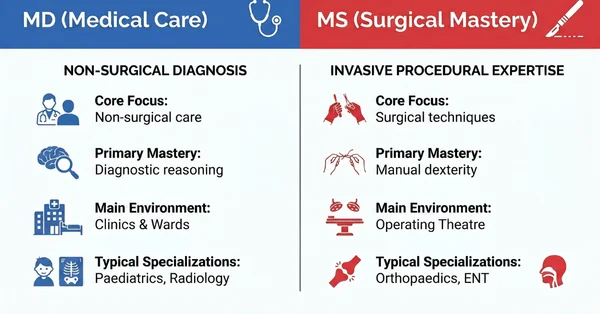
For any medical graduate embarking on postgraduate study, the MD versus MS dilemma presents a significant juncture. Both paths promise prestige, skill, and a rewarding career, but their core focus differs considerably. While MD hones your diagnostic and medical management expertise, MS turns you into a skilled surgeon with precision and procedural excellence.
It is these differences that enable one to align one’s passion with one’s profession. Continue reading for a detailed comparison of both courses: admission and curriculum, lifestyle, and career opportunities.
How Do MD and MS Courses Differ from Each Other?
The key differences between MD and MS lie in their focus area, specialisations, skills developed, and examination patterns. MD candidates focus on medicine & non-surgical care, developing diagnostic, therapeutic, and medical management skills. Meanwhile, MS candidates focus on surgery & procedural mastery, honing skills like surgical techniques, manual dexterity, and operation theatre management.
The most basic definitions of MD and MS revolve around their essence: the MD degree is associated with medical non-invasive diagnosis, treatment, and management of illnesses, while the MS degree focuses on surgical expertise, including proficiency in technical procedures.
At a practical level, imagine the routine clinical practice followed by each stream. An MD-trained physician would guide the patient through the entire process of history taking, differential diagnosis, medical management, and follow-up tracking. Alternatively, an MS-trained surgeon undertakes complex surgical procedures with preoperative planning and navigates postoperative situations, often making decisions in high-stakes situations.
| Aspect | MD (Doctor of Medicine) | MS (Master of Surgery) |
| Focus Area | Medicine & non-surgical care | Surgery & procedural mastery |
| Typical Specializations | General Medicine, Paediatrics, Radiology, Psychiatry, Dermatology | General Surgery, Orthopaedics, Ophthalmology, ENT Surgery |
| Skills Developed | Diagnostic, therapeutic, and medical management | Surgical techniques, manual dexterity, and operation theatre management |
| Examination Pattern | Mostly theory, viva, and clinical case discussions | Theory, rigorous clinical, and surgical practical exams |
| Postgraduate Recognition | Physician/Medical Specialist | Surgeon |
| Course Duration | 3 years | 3 years |
| Patient Interaction | Regular consultation, rounds | Pre-op, peri-op, post-op, surgical procedures |
MD vs MS is more than just what happens in the classroom. MD-trained specialists keep busy with ongoing patient management, chronic disease control, and nonoperative management of patients. Meanwhile, MS-trained specialists spend time with operative skills, perioperative care, and conducting postoperative follow-up.
Ace Your NEET PG Prep With DocTutorials NEET PG Online Live Power Pack
What Specialisations are Available in MD and MS?
MD offers specialisations in internal medicine, paediatrics, dermatology, radiology, and psychiatry. Meanwhile, surgical specialisations available under MS include general surgery, orthopaedics, ENT, and obstetrics & gynaecology. Super-specialisation can be done further in DM or MCh.
Specialisations enable medical students to develop expertise in a particular area, enhancing their career prospects and earning potential. Within the MD and MS classifications, there are some overlaps, and certain areas have been more traditionally represented in MD or MS tracks within the postgraduate medical education systems of various countries.
| MD Specialisations | MS Specialisations |
| Internal Medicine | General Surgery |
| Paediatrics | Orthopedic Surgery |
| Dermatology | Cardiothoracic Surgery |
| Radiology | ENT (Ear, Nose, Throat) |
| Psychiatry | Obstetrics & Gynaecology |
| General Medicine | Ophthalmology |
| Forensic Medicine | Neurosurgery |
| Pharmacology | Urology |
| Pulmonary Medicine | Plastic Surgery |
| Pathology | Paediatric Surgery |
Both MD and MS offer the opportunity for further specialisation (DM and MCh, respectively) upon completion of the primary degree. The specialisation should suit students who wish to develop their clinical reasoning, patient interaction, and procedural skills.
How do MD and MS Differ in Terms of Curriculum and Skillset?
MD students learn clinical skills, reasoning, diagnostic abilities, and how to manage patients through evidence-based medicine. Meanwhile, MS students focus on surgical skills and develop hands-on training to understand technical precision, spatial awareness, and surgical decision-making through intensive practice.
The difference between the MD and MS curricula is reflected in clinical rotations, surgical exposure, and assessment modes. Check out the details below:
| Activity Type | MD Candidate | MS Candidate |
| Ward Work/Patient Management | High | Moderate |
| Operation Theatre/Surgical Exposure | Low | High |
| Diagnostic Techniques | Very High | Moderate |
| Research & Case Studies | Frequent | Frequent |
| Teaching/Hospital Rounds | Daily | Variable |
| Emergency System Exposure | Depends on the speciality | Intensive in the surgical fields |
In reality, an MD student receives extensive clinical exposure, primarily within the context of evidence-based medicine. Alternatively, an MS student develops advanced technical skills such as spatial perception and dexterity through repetitive practice.
What is the Admission Process for MD vs. MS Courses?
If you want admission to either an MD or MS programme, having an MBBS degree from a recognised college and qualifying for the NEET PG are mandatory. After qualifying, the candidates will be allocated seats based on merit, rank, category, and reservation policies. Once allocated, aspirants choose colleges from either government or private institutions based on their preference and other criteria.
For admission to MD or MS courses, aspirants need to clear NEET PG. Here’s an overview of the admission process:
- Eligibility: MBBS degree from a recognised institute.
- Entrance Exam: NEET PG (National Eligibility cum Entrance Test for Postgraduates).
- Seat Allocation: Based on rank, reservation policies, and category.
- College Choice: Government and private institutions offer both MD and MS seats depending on merit and rank.
- Selection Factors: Aspirations, faculty reputation, clinical exposure, and institution-specific criteria.
The admissions landscape is competitive, with demand influenced by speciality preferences, region, and potential career aspirations.
What are the Career Prospects After MD and MS?
MD and MS have their own excellent career options. MD graduates typically teach in hospitals, clinics, or colleges in subjects such as Radiology and Internal Medicine. MS graduates often pursue surgical careers or super-specialisations, such as Cardiothoracic or Plastic Surgery. Both have marvellous earning potentials and growth opportunities.
Both degrees promise good career outcomes. The exact nature of work and market demand shape the further development of career paths. Most students who pursue their MDs eventually join the clinical domain, enter hospitals, enter academia, or work in specialised clinics. The highly demanded MD specialities include Radiology, Internal Medicine, Psychiatry, and Paediatrics.
Surgical practices, hospital surgery units, and specialist clinics are directly accessible to them. Their further specialisation includes Cardio-Thoracic/Vascular Surgery, Plastic Surgery, and Urology, among others. Both options promise securing high salaries within hospitals, lucrative private practice opportunities, and excellent teaching positions. Choices made now may impact leadership roles in the future, as well as positions in academia and research.
What is the Difference in Salary and Lifestyle for MD vs MS?
An MD graduate typically earns an approximate salary ranging from ₹6 lakh to ₹20 lakh annually, while MS graduates usually earn between ₹7 lakh and ₹25 lakh per annum. For both streams, income depends on experience, private practice, and superspecialisation.
Check out the average salary for MD and MS graduates in the table below:
| Parameter | MD Average Range (India) | MS Average Range (India) |
| Early Career | ₹6–₹10 lakh per annum | ₹7–₹12 lakh per annum |
| Mid Career | ₹12–₹20 lakh per annum | ₹14–₹25 lakh per annum |
| Top Government Specialist | Up to ₹30 lakh per annum | Up to ₹35 lakh per annum |
| Private Practice | Highly variable; can exceed hospital roles | Highly variable; can exceed hospital roles |
| Super-Specialist | Up to ₹60 lakh+ per annum | Up to ₹70 lakh+ per annum |
Note: Salaries in the table are approximate and will tend to vary across hospitals based on multiple factors.
When it comes to lifestyle, physicians (MD holders) spend most of their working hours in clinics, rounds, and non-operative care. In contrast, for MS holders, the hours are mostly longer and irregular, often involving surgery and emergency care, resulting in a hectic schedule. The hospital’s location also plays a major role in this regard.
For instance, healthcare facilities in a metro city will generally have a higher caseload compared to a hospital in a town or tier-2 city.
MD vs. MS: Which is Better for You?
Consider MD if you are inclined towards diagnosing, caring for patients, and managing their medical conditions. Alternatively, opt for MS if you prefer performing surgery with precision and working hands-on in dynamic clinical challenges.
Choosing between MD and MS ultimately depends upon your interests, strengths and career goals. Both paths enable you to get ample job prospects in government and private hospitals in both India and abroad. What’s more, both streams enable you to go for superspecialisation after completing the degree.
So, if diagnosis, patient care, and non-operative treatments are your thing, an MD is a strong fit for you. However, if you enjoy hands-on surgical work, complex procedures, and perioperative care, MS will likely satisfy you more. Additionally, consider future ambitions such as leadership roles, academic interests, and the desire to complete superspecialisations.
FAQs about MD vs. MS – Which Path is Right for You?
- Which is better, MD or MS?
It’s not really a universally “better” choice. MD is better attuned to those preferring clinical medicine, diagnosis, and long-term patient care. MS, on the other hand, accommodates those aspiring to surgery and immediate impact through procedures.
- Which offers a better career, MD or MS?
Both degrees are equal in professional stature in the medical hierarchy. Superspecialisation (DM, MCh) offers further professional credentialisation.
- Who earns more, an MS or an MD?
Higher early-career salary rates for MS holders are attributable to the demand patterns prevailing in these specialities. Nevertheless, exceptionally high-end MD specialities have superb earning prospects in private practice settings, such as Radiology or Dermatology. Overall, earnings are dependent on the area of specialisation as well as on the location and practice setting.
- Is MS a bigger qualification than MD?
No, both are postgraduate degrees that are equal in time length and academic stature. Although the specialisation and scope matter, both streams provide ample opportunities for superspecialisation and career growth.
- Which MD is the hardest?
Some MD disciplines, like Neurology, Oncology, Cardiology, and Critical Care Medicine, are considered hard due to variations in clinical complexity and patient acuity. Additionally, perceived difficulty also depends to some extent on one’s aptitude or interest.
6.What specialisations are available in MS vs MD?
MS Specialisations: Orthopaedics, General Surgery, Urology, ENT, Ophthalmology.
MD Specialisations: Paediatrics, Psychiatry, Dermatology, Radiology, Internal Medicine.
7. Can an MD doctor do surgery?
Yes, an MD can do surgery, but only if they complete the necessary postgraduate surgical training (like an MS in Surgery or surgical residency) and get certified for that specific surgical field.
8. What is the duration of MD and MS courses?
Both MD (Doctor of Medicine) and MS (Master of Surgery) are typically three-year, full-time postgraduate programmes. However, certain super-speciality or integrated programmes may have a longer duration.
9. Can a doctor do both MD and MS?
Yes, a doctor can pursue both MD and MS, but it requires additional training and specialisation, which can be a lengthy process.
10. Is NEET-PG mandatory for both MD and MS?
Yes, qualifying for the NEET-PG examination is mandatory for admission into both MD and MS programmes in India.
Conclusion
The choice between MD and MS should be made based on your interest, strengths, and future career aspirations. Both fields have equal growth prospects, and in the long run, the earning prospects depend on factors like hospital location, expertise, the doctor’s reputation, and other factors.
However, before you make your MD vs MS choice, clearing the NEET PG is paramount. To help you in that endeavour, DocTutorials offers a comprehensive NEET PG course, featuring animated video lectures, extensive Question Banks, concise notes, and rapid revision flashcards.
Whether you want to be a top physician or a renowned surgeon, DocTutorials has the structured resources, all focused on the exam, to assist you through your journey. Join DocTutorials today and check out our NEET PG course!


Latest Blogs
-
INI CET Exam Pattern 2027: A Complete Guide with Subject-Wise Weightage
INI CET Exam Pattern 2027: A Complete Guide with Subject-Wise Weightage The Institute of National Importance Combined Entrance Test (INI…
-

NEET PG Registration 2026: An Essential Guide For Exam Prep
The NEET PG registration, which is conducted online, is a crucial step in the exam process. Filling out the NEET…
-

NEET PG Exam 2025- Date, Pattern, Marking Scheme, Subject Wise Weightage, and Exam Mode
NEET PG Exam 2025 is the ultimate gateway for medical graduates aspiring to pursue postgraduate courses in medicine, including MD,…