Understanding Caput Succedaneum: A Comprehensive Guide for Paediatrics PG Residents
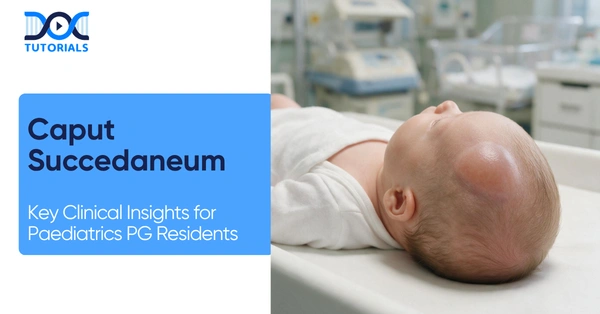
Scalp swellings are frequent encounters in the first 1-2 days of life, making their accurate identification a cornerstone of neonatal care. Accurate diagnosis relies on identifying the specific anatomical layer involved. For PG residents pursuing their specialization in DNB Paediatrics, mastering the clinical nuances of Caput Succedaneum is an absolute necessity for daily ward rounds and board examinations.
Get High Quality, High Yield Pediatrics PG Residency Notes for Free!
The Anatomical Basis of Neonatal Skull Swellings in DNB Paediatrics
When evaluating a newborn in the DNB Paediatrics curriculum, it is vital to understand the anatomical layers of the scalp to accurately diagnose conditions like Caput Succedaneum. The layers, from superficial to deep, include the Skin, Connective Tissue, Aponeurosis (Galea), Loose Areolar Tissue, Periosteum, Skull Bone, and Dura.
There are three main pathologies that every DNB Paediatrics resident must differentiate:
- Caput Succedaneum: Soft tissue edema.
- Cephalohematoma: Subperiosteal bleeding.
- Subgaleal Hemorrhage: Subaponeurotic bleeding, which is a critical condition.
Anatomically, Caput Succedaneum is located in the subcutaneous space, specifically above the periosteum. Understanding this exact location is what allows a DNB Paediatrics practitioner to confidently diagnose Caput Succedaneum over more severe hemorrhages.
Clinical Features and Pathology of Caput Succedaneum
In the realm of DNB Paediatrics, Caput Succedaneum is classified as a benign soft tissue swelling. The pathology behind Caput Succedaneum involves diffuse, poorly defined soft tissue edema.
The clinical hallmark of Caput Succedaneum—and a highly tested concept in DNB Paediatrics—is that the swelling crosses the midline and suture lines (such as the sagittal suture).
When tracking the timeline of Caput Succedaneum, DNB Paediatrics guidelines note that the swelling reaches its maximum size at birth. Typically, Caput Succedaneum resolves within 48 to 72 hours, though it can take up to one week. The etiology of Caput Succedaneum is closely associated with a normal vaginal delivery, specifically in a vertex presentation.
How does a DNB Paediatrics resident distinguish Caput Succedaneum from a Subgaleal Hemorrhage clinically?
While both Caput Succedaneum and Subgaleal Hemorrhage cross suture lines, Caput Succedaneum is at its maximum size at birth and resolves quickly within a week. In contrast, a Subgaleal Hemorrhage is a fluctuant mass that increases in size after birth, posing life-threatening risks like shock and requires immediate monitoring.
Management Protocols for Caput Succedaneum
For residents in DNB Paediatrics, the management of Caput Succedaneum is straightforward but requires strict adherence to conservative principles. The primary management for Caput Succedaneum is supportive therapy only. It is a critical rule in DNB Paediatrics that there should be no incision or drainage of Caput Succedaneum.
Generally, there is no bleeding risk associated with Caput Succedaneum. However, DNB Paediatrics residents must remain vigilant for rare variants of Caput Succedaneum. An ‘Ecchymotic Caput’ presents a bruising and jaundice risk, while a ‘Hemorrhagic Caput’ presents a shock risk requiring transfusion.
| Feature | Caput Succedaneum | Cephalohematoma | Subgaleal Hemorrhage |
| Anatomical Location | Subcutaneous (Above Periosteum) | Subperiosteal | Subaponeurotic (Loose Areolar Tissue) |
| Relationship to Sutures | Crosses midline & sutures | Does NOT cross sutures (Localized) | Crosses sutures (Diffuse/Spreading) |
| Timing & Course | Max size at birth. Resolves <1 week | Appears day 1-2. Resolves 2 weeks – 3 months | INCREASES size after birth. Resolves 2-3 weeks |
| Clinical Risks | Minimal (rarely hemorrhagic) | Jaundice, Linear Fracture (10-25%) | Shock, Anemia, High Mortality (CRITICAL) |
Expanding Neonatal Knowledge in DNB Paediatrics: Metabolic Bone Disease
While mastering Caput Succedaneum is essential, DNB Paediatrics training also heavily emphasizes overall neonatal bone health, specifically Metabolic Bone Disease (MBD) of Prematurity. Also known as Osteopenia of Prematurity (OOP), MBD is defined as a reduction in bone mineral content versus what is expected for gestational age.
For a DNB Paediatrics resident, understanding the incidence is key: it affects approximately 25% of Very Low Birth Weight (VLBW, <1500g) infants and up to 50% of Extremely Low Birth Weight (ELBW, <1000g) infants. The core issue is a lag in bone mineralization driven by prematurity constraints, as 80% of rapid mineral accretion occurs during the active transport phase of the 3rd trimester.
Clinical Presentation Timeline in DNB Paediatrics
Unlike Caput Succedaneum, which is obvious at birth, MBD signs are late, and significant bone loss occurs before detection.
| Phase | Timing | Clinical Presentation |
| Silent Phase | Birth to 4 weeks | Asymptomatic demineralization. |
| Clinical Onset | 4-11 Weeks (Mean 4-5 weeks) | Poor postnatal growth, Craniotabes (‘ping pong ball’ skull softening), costochondral beading. |
| Failure State | Late Stage | Fractures (Requires >80% demineralization), Respiratory failure from rib fractures. |
Biochemical Screening and Nutritional Strategies
In DNB Paediatrics, early screening for MBD is prioritized. Screening should start at 4 weeks, or at 2 weeks if the infant is at high risk (e.g., on TPN >2 weeks or steroids). The primary screeners are Alkaline Phosphatase (ALP) >900 IU/L alongside Serum Phosphorus <5.6 mg/dL. Hypophosphatemia is the primary driver of this condition.
Nutritional management in DNB Paediatrics aims to mimic in-utero accretion. A strict safety rule applies: never administer Calcium without Phosphate for >1-2 days, and maintain a Ca:P ratio of approximately 1.7:1 (mg/kg). Enteral dosing targets include 120-200 mg/kg/day for Calcium, 66-110 mg/kg/day for Phosphorus, and 400-700 IU/kg/day for Vitamin D.
Frequently Asked Questions (FAQs)
1. What exactly is Caput Succedaneum?
In DNB Paediatrics, Caput Succedaneum is defined as a benign soft tissue swelling that presents as poorly defined edema on a newborn’s scalp.
2. Where is Caput Succedaneum located anatomically?
Caput Succedaneum is locate
in the subcutaneous layer, specifically above the periosteum.
3. Does Caput Succedaneum cross suture lines?
Yes, a defining clinical hallmark of Caput Succedaneum is that it freely crosses the midline and cranial suture lines.
4. When does Caput Succedaneum reach its maximum size?
Caput Succedaneum is typically at its maximum size immediately at birth.
5. How long does Caput Succedaneum take to resolve?
Caput Succedaneum usually resolves rapidly within 48 to 72 hours, though it can occasionally take up to one week.
6. What is the standard DNB Paediatrics management for Caput Succedaneum?
Management for Caput Succedaneum is strictly supportive therapy; no incision or drainage should be performed.
7. Are there any bleeding risks associated with Caput Succedaneum?
Usually, there are none. However, rare variants of Caput Succedaneum exist, such as ‘Ecchymotic Caput’ and ‘Hemorrhagic Caput’.
8. What complications are associated with ‘Ecchymotic Caput Succedaneum’?
The ‘Ecchymotic’ variant of Caput Succedaneum carries an increased risk of bruising and subsequent neonatal jaundice.
9. How is Caput Succedaneum differentiated from Cephalohematoma in DNB Paediatrics?
Unlike Caput Succedaneum, a Cephalohematoma is subperiosteal, presents as a well-defined tense mass, and does NOT cross suture lines.
10. What is the primary etiology of Caput Succedaneum?
Caput Succedaneum is most commonly associated with a normal vaginal delivery, particularly when the infant is in a vertex presentation.

Latest Blogs
-

NEET SS Exam 2024: Analysis, Key Dates, Counselling
The NEET SS 2024 exam kicked off on March 29, 2025. Over two days and two slots, candidates across 13…
-
INI SS Topper: 1 Dream, 1 Study Buddy, 1 Rank – The Journey of Dr. Prithivi Raaj, CML 1 & (AIIMS) AML 1 in DM Cardiology
Achieving the top rank in a competitive exam like the INI SS DM Cardiology requires tireless dedication, a structured approach,…
-

INI SS Results: Merit List, Exam Insights, and What Comes Next
The INI SS results for October 2024 are just around the corner. This is a life-changing moment for thousands of…