Master Endocrinology: A Comprehensive Guide for PG Residents
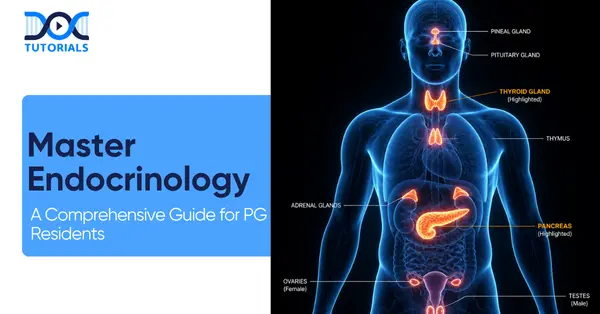
Welcome to our definitive guide on Endocrinology, tailored specifically for PG Residency exams. Understanding every complex Endocrine condition is crucial for your clinical practice and for securing better scores. This blog provides structured, high-yield content to simplify your preparation and ensure you are ready for both theory and clinical case scenarios.
Get High Quality, High Yield Endocrinology PG Residency Notes for Free!
Diabetic Ketoacidosis (DKA): The Prototypical Endocrine Condition
When studying Endocrinology, Diabetic Ketoacidosis (DKA) is a mandatory topic. DKA is defined as the prototype hyperglycemic emergency that is characterized by severe dehydration, metabolic acidosis, and ketosis.
Clinical suspicion for this Endocrine condition should arise in any diabetic patient presenting with abdominal pain, distressed breathing (which is often rapid, shallow, and acidotic), and an altered sensorium ranging from lethargy to coma.
Epidemiology and Pathophysiology
This Endocrine condition heavily affects Type 1 Diabetes Mellitus (DM) patients, who have a 20-50% presentation rate due to a mechanism of total insulin deficiency and a failure to suppress lipolysis or ketogenesis. Conversely, Type 2 DM patients face a 3-4% presentation rate, primarily driven by Ketosis-Prone Diabetes (KPD) or severe stress and infection.
The pathophysiology of this Endocrine condition involves a devastating metabolic cascade. It begins with insulin deficiency combined with a counter-regulatory surge of hormones like glucagon, catecholamines, cortisol, and growth hormone (GH). In adipose tissue, the loss of inhibition on hormone-sensitive lipase leads to increased lipolysis and a massive surge in free fatty acids (FFAs). The liver upregulates the CPT1 transporter via glucagon, shunting FFAs into the mitochondria while suppressing the Krebs cycle. This shunts Acetyl CoA into ketogenesis, producing ketone bodies and driving gluconeogenesis.
Diagnosing DKA Effectively
To formally confirm this Endocrine condition, physicians rely on a specific diagnostic triad:
- Hyperglycemia: Blood glucose levels greater than 250 mg/dL.
- Acidosis: A pH of less than 7.3 or a Bicarbonate level of less than 18.
- Ketosis: Serum Beta-hydroxybutyrate greater than 3 mmol/L or Urine Ketones of 2+ or more.
A major clinical pitfall in Endocrinology is the false negative urine ketone test. Urine strips cannot detect beta-hydroxybutyrate, which is the specific ketone present in DKA. This limitation can lead to a false negative urine dipstick despite the patient being in severe DKA.
What are the common “Pseudo-Abnormalities” to watch out for when managing this Endocrine condition?
When managing this Endocrine condition, watch out for diagnostic traps. Pseudo-Hyponatremia occurs due to the dilutional effect of hyperglycemia; you must calculate the corrected sodium formula. Pseudo-Infection is seen as stress-induced leukocytosis (WBC up to 25k); counts over 25k suggest a true infection. Pseudo-Pancreatitis presents with non-specifically elevated amylase; always check Lipase for a specific diagnosis. Finally, Pseudo-MI occurs when hyperkalemia mimics infarction signs on an ECG.
Stratifying DKA Severity
In Endocrinology, properly staging an Endocrine condition dictates the aggressiveness of the therapy.
| Feature | Mild DKA | Moderate DKA | Severe DKA |
| pH | 7.25-7.30 | 7.00-7.24 | Less than 7.00 |
| Bicarbonate | 16-18 mEq/L | 10-16 mEq/L | Less than 10 mEq/L |
| Sensorium | Alert | Alert/Drowsy | Stupor/Coma |
The Cornerstone of Management: IV Fluids and Insulin
Managing this Endocrine condition requires strict protocols. Phase 1 involves rapid resuscitation with a 1L Normal Saline (0.9%) bolus in the first hour. During Phase 2, repletion follows a sequential taper aimed at restoring the approximately 9L deficit over 48 hours. A critical “Dextrose Switch” occurs when blood glucose drops to 200-250 mg/dL; fluids are changed to 5% Dextrose (D5W) to prevent hypoglycemia while continuing insulin to resolve the ketosis.
When administering insulin for this Endocrine condition, potassium levels are a non-negotiable safety check. If K+ is less than 3.3 mEq/L, you must stop and not start insulin to avoid a fatal arrhythmia. Insulin should only be started 1 hour after fluid resuscitation, known as the “Fluid-Insulin Gap”. When closing the loop, transitioning to Sub-Q basal insulin requires a mandatory 2-hour overlap with IV insulin to prevent rebounding hyperglycemia.
Decoding Hypothyroidism: Another Crucial Endocrine Condition
Endocrinology also heavily focuses on thyroid disorders. Hypothyroidism requires clear differentiation between its etiologies.
Primary vs. Secondary Etiologies
Primary hypothyroidism is caused by an intrinsic thyroid defect, resulting in a high TSH and low T4. The inverse log-linear relationship causes a massive TSH spike. Secondary (Central) hypothyroidism involves pituitary failure and bio-inactive TSH, presenting with low or normal TSH and low T4.
A key clinical differentiator for this Endocrine condition is the presence of myxoedema. High TSH (specific to Primary Hypo) stimulates the fibroblast receptor, leading to the production of glycosaminoglycans (mucin/collagen) which deposit into subcutaneous tissue, causing thickening and swelling. Gross myxoedema argues against Secondary Hypothyroidism because it lacks the high TSH stimulus.
Treatment Protocols and Special Populations
The standard pharmacological treatment for this Endocrine condition is Levothyroxine (T4). It allows for stable, once-daily dosing because 80% of the body’s T3 is converted intracellularly from T4 via the deiodinase enzyme. Standard dosing is 1.6 mcg/kg/day, which is approximately 75-100 mcg per adult.
| Population | Risk / Physiology | Dosing Strategy |
| Elderly (>65) | Osteoporosis (Fractures) & Atrial Fibrillation | Start Low (25-50 mcg). Titrate Slow. Relax TSH targets. |
| Cardiac Disease | Precipitating Heart Failure or MI | Start Conservative (25-50 mcg). Monitor for angina. |
| Pregnancy | Increased demand (hCG stimulation + fetal dependence) | Increase Dose 30-50% immediately. Monitor TSH every 4-6 weeks. |
Frequently Asked Questions (FAQs)
1. What is the classic diagnostic triad for DKA?
The triad includes hyperglycemia (>250 mg/dL), acidosis (pH < 7.3 or Bicarb < 18), and ketosis (Beta-hydroxybutyrate > 3 mmol/L or Urine Ketones >= 2+).
2. Why might a severe DKA patient have a negative urine ketone test?
Urine strips cannot detect beta-hydroxybutyrate, which is the specific ketone present in DKA, leading to a false negative result.
3. What is the mandatory check before starting insulin in a DKA patient?
You must check Potassium (K+) levels; if it is < 3.3 mEq/L, you must hold insulin to prevent fatal arrhythmias and replete K+ first.
4. When should IV fluids be switched to Dextrose in DKA management?
The “Dextrose Switch” occurs when blood glucose drops to 200-250 mg/dL. Change fluids to 5% Dextrose (D5W) to prevent hypoglycemia.
5. What is the Fluid-Insulin Gap?
It is the protocol to start insulin 1 hour after initial fluid resuscitation is given.
6. How do you prevent rebound hyperglycemia when stopping IV insulin?
You must administer Sub-Q Basal Insulin with a 2-hour overlap before stopping the IV insulin drip.
7. How do you screen to catch secondary hypothyroidism?
The screening rule requires you to assess TSH and T4 combined; otherwise, secondary hypothyroidism (which has low/normal TSH) will be missed.
8. Why does myxoedema occur in primary hypothyroidism but not secondary? Myxoedema requires a high TSH stimulus to activate fibroblast receptors and produce glycosaminoglycans, a state only found in primary hypothyroidism.
9. Why do we treat hypothyroidism with T4 instead of T3?
T3 has a short half-life requiring multiple daily doses and causes non-physiological peaks and troughs, whereas T4 allows stable once-daily dosing.
10. How should Levothyroxine dosing change for a newly pregnant patient?
Due to increased demand from hCG stimulation and fetal dependence, the dose must be increased by 30-50% immediately.
Latest Blogs
-

NEET SS Exam 2024: Analysis, Key Dates, Counselling
The NEET SS 2024 exam kicked off on March 29, 2025. Over two days and two slots, candidates across 13…
-
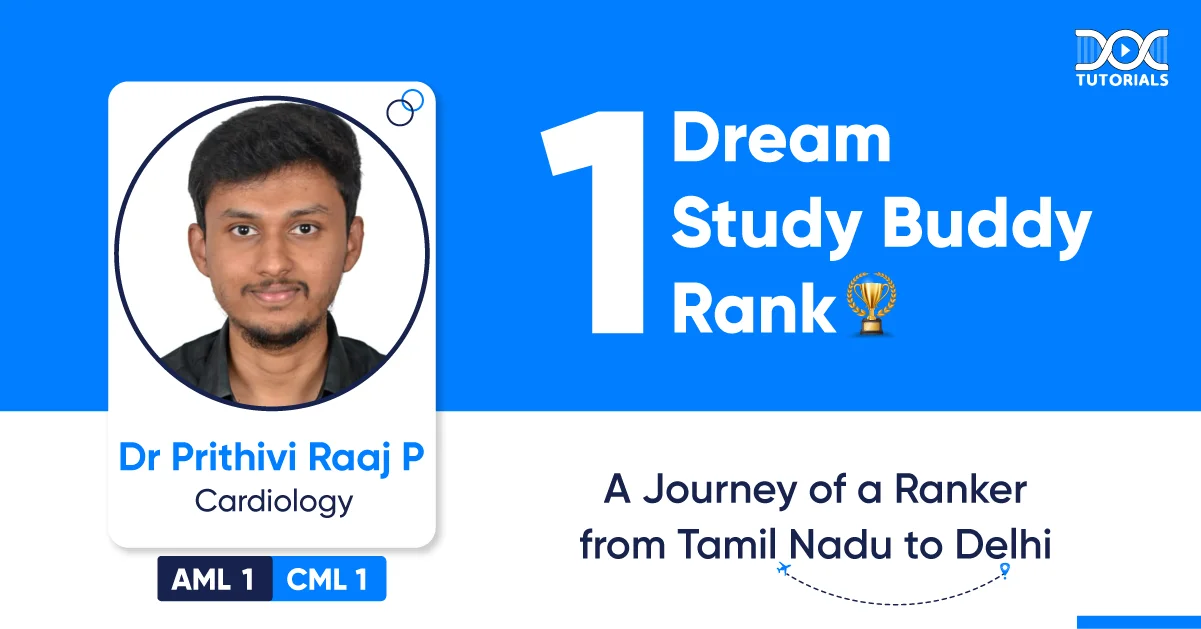
INI SS Topper: 1 Dream, 1 Study Buddy, 1 Rank – The Journey of Dr. Prithivi Raaj, CML 1 & (AIIMS) AML 1 in DM Cardiology
Achieving the top rank in a competitive exam like the INI SS DM Cardiology requires tireless dedication, a structured approach,…
-

INI SS Results: Merit List, Exam Insights, and What Comes Next
The INI SS results for October 2024 are just around the corner. This is a life-changing moment for thousands of…