MD Pediatrics Syllabus: Complete Subject-Wise Breakdown
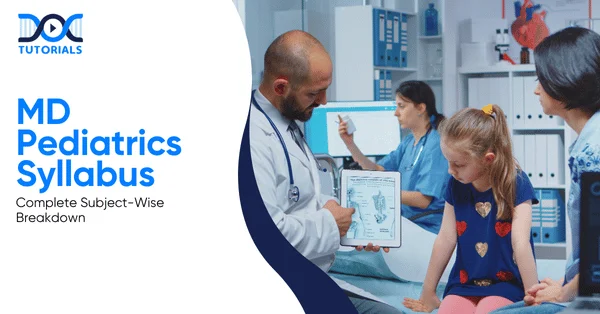
The MD Pediatrics programme is designed for medical graduates who are passionate about providing quality child healthcare and making a meaningful impact in the field. This postgraduate course equips students with in-depth knowledge of pediatric diagnostics, treatment protocols, and preventive healthcare measures.
The syllabus supports theoretical knowledge with clinical exposure, hence students are trained to handle a wide range of pediatric illnesses and also get involved in research and development. It prepares future pediatricians to handle real-world challenges with empathy, precision, and scientific understanding. In this guide, we will provide a complete subject-wise breakdown of the MD Pediatrics syllabus, helping aspirants understand the core topics, clinical components, and assessment structure in detail.
What is MD Pediatrics?
MD Pediatrics is a 3-year MCI-approved postgraduate course specialising in the diagnosis and treatment of medical conditions in children. It requires an MBBS degree and often NEET-PG, leading to careers like Pediatrician or Neonatologist with high initial salary potential.
MD in Pediatrics is a 3-year postgraduate medical programme that primarily deals with the diagnosis and treatment of medical conditions affecting children. During MD Pediatrics, students are taught various concepts and are made aware of different processes related to the pediatric field. The MD Pediatrics course is approved by the Medical Council of India (MCI). This course should be taken by a person who has a strong interest in studying, analysing, and diagnosing children’s psychological and physical health.
At present, there are numerous private and government colleges and institutes across India that offer the MD Pediatrics course. The fees in private colleges are generally higher than in government colleges. The tuition fees for MD Pediatrics can range from ₹5,000 to ₹40,00,000 per year. After acquiring the MD Pediatrics degree, one can choose to work as a Pediatrician, Pediatric surgeon, Pediatric cardiologist, Neonatologist, or in related positions.
Some of the key features of MD Pediatrics courses in India are as follows:
| Name of the Course | MD Pediatrics |
| Level | Postgraduate |
| Duration | 3 Years |
| Exam Type | Semester |
| Minimum Qualification Requirement | MBBS + NEET-PG or equivalent |
| Average Initial Salary | ₹2-8 Lakhs Per Annum |
| Selection Process | Entrance Exams and Interviews |
| Popular Entrance Exams for MD Pediatrics | NEET-PG, AIIMS-PG, JIPMER-PG |
| Top MD Pediatrics Specialisations in India | NeonatologyPediatric OncologyPediatric Critical CareAdolescent Medicine |
| Minimum Aggregate Required for MD Pediatrics Admissions | 50-60% |
| Major MD Pediatrics Recruiters | Fortis, Indian Council of Medical Research, Max Healthcare, Apollo Hospital, Educational Institutions, etc. |
| Top MD Pediatrics Colleges in India | All India Institute of Medical Sciences (AIIMS)Jawaharlal Institute of Medical Education and Research (JIPMER)Christian Medical College (CMC)St John’s Medical CollegePost Graduate Institute of Medical Education and Research (PGIMER) |
What are the Subjects in MD Pediatrics?
The curriculum spans 6 semesters, covering core areas such as Neonatology, Growth & Development, and Respiratory Diseases. Later semesters focus on advanced specialities such as Neurology, Cardiology, Genetics, and Emergency & Critical Care.
During MD Pediatrics, students in each of the 6 semesters are exposed to various subjects related to the pediatrics field. The semester-wise list of the MD Pediatrics course is as follows:
Semester 1:
- Behavioural Disorders
- Neonatology
- Respiratory
- Growth and Development
Semester 2:
- Psychological Disorders
- Endocrinology
- Skin Diseases
- Infections
Semester 3:
- Neurological Disorders
- Infections
- Genetics
- Cardiovascular
- Social Pediatrics
- Nutrition
Semester 4:
- Central Nervous System
- Digestive System
- Eye Diseases
- Foetus Newborn
- Emergency and Critical Care
- Adolescent Health
Semester 5:
- Research Project
- Social Pediatrics II
Semester 6:
- Internship
- Adolescent Health II
Specialisations Available in MD Pediatrics
Some of the MD Pediatrics specialisation subjects are given below:
- Child Abuse Pediatrics
- Pediatric Cardiology
- Pediatric Endocrinology
- Pediatric Gastroenterology
- Adolescent Medicine
- Pediatric Oncology
- Neonatology
- Child Neurology
- Pediatric Critical Care
What is the Year-Wise Breakdown of the MD Pediatrics Syllabus?
The MD Pediatrics syllabus progresses from general health and development (Year 1) to complex conditions and research (Year 2), culminating in clinical mastery, thesis defence, and advanced practice (Year 3) in specialities like Haematology and Gastroenterology.
The MD Pediatrics syllabus is designed in a way that it trains the students with progressive learning of child healthcare, starting from the basics and ending with clinical practice in the third year.
First Year
The first year of the MD Pediatrics is primarily about instilling a thorough knowledge of general health care of children, their growth, and their overall development.
| Semester | Subjects | Description |
| First Semester | General Pediatrics | A foundational course covering child growth, development, and basic healthcare principles. |
| Neonatology | Focuses on the care of newborns, especially premature or critically ill infants. | |
| Growth and Development | Studies physical and mental growth patterns from infancy through adolescence. | |
| Basic Immunology | Covers immune system functions, vaccination schedules, and common immune disorders in children. | |
| Second Semester | Pediatric Cardiology | Deals with the diagnosis and management of congenital and acquired heart diseases in children. |
| Pediatric Nephrology | Focuses on kidney diseases, urinary tract disorders, and their treatment in pediatric patients. | |
| Pediatric Infectious Diseases | Studies related to the prevention and treatment of infections commonly affecting children. | |
| Clinical Rotations | Provides practical training in diverse pediatric specialities and hospital settings. |
Second Year
The second year delves deep into the specialities of the pediatrics field that deal with complex medical conditions, surgical training, and research development.
| Semester | Subjects | Description |
| Third Semester | Pediatric Surgery | Covers surgical methods and operative procedures specific to infants and children. |
| Pediatric Neurology | Focuses on diagnosing and managing neurological disorders in pediatric patients. | |
| Adolescent Medicine | Addresses physical, emotional, and psychological health issues of adolescents. | |
| Thesis Research | Involves selecting and beginning a research project on a relevant pediatric topic. | |
| Fourth Semester | Pediatric Emergency Medicine | Trains students to handle acute medical and trauma emergencies in children. |
| Child Development and Behaviour | Focuses on psychological development, mental health, and behavioural patterns. | |
| Pediatric Endocrinology | Studies hormonal and metabolic disorders that impact child growth and development. | |
| Clinical Rotations | Offers in-depth exposure to specialised pediatric departments and clinics. |
Third Year
The final year of the programme is mainly about the students achieving clinical mastery, completing their research, and practising pediatrics in the real world.
| Semester | Subjects | Description |
| Fifth Semester | Pediatric Haematology and Oncology | Focuses on blood disorders and childhood cancers, including diagnosis and treatment. |
| Pediatric Gastroenterology | Covers gastrointestinal and liver conditions affecting children. | |
| Evidence-Based Medicine | Trains students to apply clinical research and data in pediatric care decisions. | |
| Thesis Submission and Defence | Completion, presentation, and defence of the student’s pediatric research work. | |
| Sixth Semester | Pediatric Rheumatology | Focuses on autoimmune and musculoskeletal disorders in children. |
| Pediatric Infectious Disease Management | Advanced-level training in handling infectious diseases and their complications. | |
| Preparation for Clinical Exams | Involves rigorous revision and mock assessments for final board examinations. | |
| Clinical Practicum | Final internship involves integrating theory, research, and clinical skills in real-world pediatric settings. |
What are the Career Opportunities After MD Pediatrics?
Graduates can secure key roles like General Pediatrician, Pediatric Surgeon, Neonatologist, or Pediatric Cardiologist in hospitals, clinics, and academic institutions, providing specialised care across all stages of childhood.
Some of the job profiles that candidates can opt for after an MD in Pediatrics are given below:
- Pediatrician: A pediatrician is a person who is medically specialised in providing medical care to children from infants to the teenage years. They provide all the healthcare services to children.
- Pediatric Surgeon: A pediatric surgeon is a person who is medically specialised in the surgery of infants and provides them with medical care. They are concerned with the overall treatment of infants.
- Neonatologist: A neonatologist is a subspecialist pediatrician focused on the treatment and care of newborns, particularly those born prematurely or with critical health conditions during the neonatal stage.
- Pediatric Cardiologist: A pediatric cardiologist specialises in diagnosing and treating heart-related disorders in infants and children, ensuring proper cardiac function and overall cardiovascular health.
What is the Average Salary After MD Pediatrics?
Specialised roles command high salaries, with the average yearly income of a Pediatrician at ~ ₹15.4 LPA and of a Pediatric Cardiologist potentially reaching ~ ₹22 LPA, reflecting the high expertise required.
Below is a rough idea of the yearly salary one can expect after completing an MD in Pediatrics for various job roles:
| Job Profiles | Average Salary |
| Pediatrician | ₹15.4 LPA |
| Pediatric Surgeon | ₹15.2 LPA |
| Neonatologist | ₹17.5 LPA |
| Pediatric Cardiologist | ₹22 LPA |
Note: This is just an estimate; actual salaries can vary.
FAQs about MD Pediatrics Syllabus
- How long is the MD Paediatrics course in India?
MD Paediatrics is a 3-year postgraduate programme where the student is introduced to theoretical and practical clinical aspects of child health through hospital rotations and research projects.
- What are the primary topics covered in the MD Paediatrics course?
The course covers General Paediatrics, Neonatology, Paediatric Cardiology, Neurology, Endocrinology, Infectious Diseases, Haematology, and Gastroenterology in addition to the clinical curriculum and research thesis.
- What can I do after MD Paediatrics?
After completing MD Paediatrics, graduates can work as paediatricians, neonatologists, paediatric surgeons, paediatric cardiologists, or researchers in reputed hospitals, healthcare institutions, or medical colleges.
- How can I prepare well for the MD Paediatrics course?
Integrate theory with clinical practice through case discussions and bedside learning to prepare well for the MD Paediatrics syllabus. Besides relying on a standard textbook like Nelson Textbook of Paediatrics, key topics should be revised regularly, and a well-planned study schedule that balances academic study with hospital rotations should be followed.
- What mistakes should be avoided by students when preparing for the MD Paediatrics syllabus?
Students should avoid neglecting clinical exposure, skipping standard textbooks, mismanaging study time, ignoring updated guidelines, and failing to revise regularly.
- Which books are best for preparing the MD Paediatrics syllabus?
The recommended books for MD Paediatrics are Nelson Textbook of Paediatrics, Kumar and Clark’s Clinical Medicine, and Advanced Paediatrics by Arvind Arora. These textbooks cover theory, clinical cases, and exam-oriented topics. Using these standard books ensures a strong foundation, easier revision, and better understanding.
- How is the MD Paediatrics exam structured in India?
The MD Paediatrics exam in India includes theory papers, practical assessments, and viva voce. Theory covers all the paediatric topics, while the practical test covers clinical skills, and patient management. Internal assessments during training also help understand the exam patterns and develop deeper insights into the topic.
- What clinical skills are included in the MD Paediatrics syllabus?
Clinical skills in MD Paediatrics include history taking, physical examination, growth monitoring, neonatal resuscitation, emergency management, and interpreting lab and imaging reports. Students learn procedural skills like IV line insertion, lumbar puncture, and routine vaccinations.
- How can students manage theory and practical studies in MD Paediatrics?
Students should ideally build a daily schedule, allocating sufficient time to academics and the development of practical skills. This can be done by creating a proper study routine that focuses on high-weightage topics, while regular clinical postings prioritise case-based learning, attending ward rounds, and practicing procedures, which improves practical knowledge, allowing students to have an overall balanced schedule.
- What are the most important topics for scoring well in MD Paediatrics exams?
High-yield topics include neonatology, infectious disease, growth and development, pediatric emergencies, nutrition, and common chronic conditions. It is also vital to focus on frequently asked questions, guideline based managements, and also have a look at recent research that improves exam performance.
Conclusion
The MD Pediatrics syllabus is a perfect mix of theoretical knowledge, research, and clinical training in a real-life setting, which is aimed at making medical students competent and empathetic in the area of child healthcare. Apart from acquiring knowledge of neonatology and pediatric cardiology, the student also develops skills in emergency care and adolescent medicine; thus, each stage of this programme leads to the establishment of a medical career of the highest value. Success, however, in this venture is dependent on orderly preparation, professional guidance, and constant revision.
That’s where DocTutorials can make a difference. Being one of the prominent PG residency preparation platforms in India, DocTutorials helps you to prepare well. If you are revising important topics or are strengthening clinical concepts, DocTutorials is there to help you study in a productive and time-saving way for the NEET-PG and MD Pediatrics exams.
MD Pediatrics simplified with DocTutorials!

Latest Blogs
-

NEET SS Exam 2024: Analysis, Key Dates, Counselling
The NEET SS 2024 exam kicked off on March 29, 2025. Over two days and two slots, candidates across 13…
-
INI SS Topper: 1 Dream, 1 Study Buddy, 1 Rank – The Journey of Dr. Prithivi Raaj, CML 1 & (AIIMS) AML 1 in DM Cardiology
Achieving the top rank in a competitive exam like the INI SS DM Cardiology requires tireless dedication, a structured approach,…
-

INI SS Results: Merit List, Exam Insights, and What Comes Next
The INI SS results for October 2024 are just around the corner. This is a life-changing moment for thousands of…