Bailey & Love’s Short Practice of Surgery: A Comprehensive Guide for MS General Surgery Residents
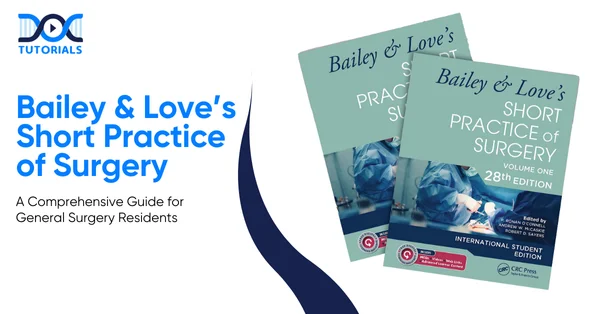
Bailey & Love’s Short Practice of Surgery is one of the most renowned and widely used textbooks in General Surgery. With a legacy spanning over a century, it has become a foundational reference for surgeons across the world. Residents in General Surgery especially value this book for its simplicity in explaining concepts, logical layout, and balanced integration of basic science with clinical practice.
If you are a student of General Surgery searching for reliable study materials, keep reading to understand why Bailey & Love’s Short Practice of Surgery should be at the top of your reading list.
What is Bailey & Love’s Short Practice of Surgery Book About?
Bailey & Love’s Short Practice of Surgery is a detailed yet easy-to-read book that describes core surgical principles and modern techniques in an easily understandable format. Anatomy and disease basics are explained, along with diagnosis, surgery, and postoperative care. Clear diagrams and flowcharts make it really useful for trainees and for exam preparation
First published in 1932, Bailey & Love’s Short Practice of Surgery has gone through many editions to reflect the advances made in the science of surgery. It strikes a good balance in its writing style — detailed without being overwhelming and academic without being inaccessible, which makes it especially suitable for surgical trainees.
The book encompasses basic principles like preoperative care, wound healing, shock, infection control, and organ-specific diseases and operative techniques. It also includes recent developments in surgical practices, including minimally invasive surgery, robotic procedures, surgical technology, and updated guidelines across specialities.
It is designed to assist the trainee in developing a deep understanding of surgical conditions, progressing from anatomy, through pathophysiology and diagnostic principles, to operative management and postoperative care. It provides up-to-date, evidence-based content and hence forms a valuable guide both for exam preparation and day-to-day clinical decisions.
The strength of Bailey and Love Surgery lies in the straightforward and very practical way in which the book connects foundational science to clinical management. Each chapter is enriched with diagrams, charts, flowcharts, and illustrations that enable easy revision and remembering the key points.
Why MS General Surgery Residents Choose Bailey and Love Surgery?
MS General Surgery residents prefer Bailey & Love since it is comprehensive, up-to-date, and simple to follow. It combines basic principles with practical clinical guidance, and the summary boxes, diagrams, and algorithms help with quick revision. This makes it a trusted choice for exam preparation and everyday decision-making in surgery.
Residents especially appreciate the clear focus of the book on the basics, such as wound healing, fluid balance, perioperative care, and surgical anatomy, that form the core of repeated examination questions and daily clinical practice.
Bailey & Love is an all-encompassing textbook. For MS General Surgery residents, this book makes it easier to avoid the hassle of going through several textbooks, as it covers almost all necessary subspecialties. It contains summary boxes that emphasise core knowledge, with a consistent layout of tables, graphics, and diagrams that further assist the reader in understanding central concepts.
The inclusion of algorithms further assists in understanding patient care, making the text both accessible and stimulating. Also, the text is remarkably up to date, covering significant areas of development in surgical practice that are likely to impact practice in the next decade.
With expanded sections on paediatric and transplant surgery, it places even greater emphasis on a multidisciplinary team approach and the engagement of the patient in the often complex decision-making processes.
Written by renowned experts, each chapter has been fully updated to reflect the latest changes in surgical technique and practice. To further enhance learning, readers can visit a companion website containing additional resources, including questions and answers, case studies, videos, and interviews with the authors.
This makes it ideal for MS General Surgery residents who need conceptual clarity as well as clinical applicability.
What is the Table of Contents of Bailey & Love’s Surgery (Latest Edition)?
The latest edition of Bailey & Love’s Short Practice of Surgery has been divided into clear sections on basic principles, paediatrics, perioperative care, trauma, orthopaedics, and all major specialities. This structure aids residents in studying system-wise and helps them understand concepts fast.
The latest 28th edition of Bailey & Love’s Short Practice of Surgery is designed to systematically and comprehensively deliver the knowledge of surgical science to residents. The book is organised around broad themes, making it easy to follow both foundational and speciality-specific topics.
This is a clean description of the common structure followed by this edition. Actual chapter titles remain consistent across versions. The table of contents for the latest version is given below:
Part 1: Basic Principles
| Topics | Writers |
| Metabolic Response to Injury | Iain D. Anderson |
| Shock and Blood Transfusion | Karim Brohi |
| Wounds, Healing, Tissue Repair | Sarah L. Benyon & Kai Yuen Wong |
| Tissue Engineering and Regeneration | Andrew W. McCaskie & Liam M. Grover |
| Surgical Infection | H. Paul Redmond & Zeeshan Razzaq |
| Tropical Infections and Infestations | Sanjay De Bakshi & Pawanindra Lal |
| Basic Surgical Skills | Mark Coleman & Joshua Franklyn |
| Diagnostic Imaging | Mathew Mattson, Muaaze Z. Ahmad & Niall Power |
| Gastrointestinal Endoscopy | Philip Woodland & Dr Rao |
| Principles of Minimal Access Surgery | Ara Darzi & Leanne Harling |
| Tissue and Molecular Diagnosis | Roger Feakins & Rondell P. Graham |
| Principles of Oncology | Grant Stewart & Tim Eisen |
| Surgical Audit and Research | Thomas Pinkney & Birgit Whitman |
| Ethics and Law in Surgical Practice | Robert Wheeler |
| Human Factors, Patient Safety & Quality Improvement | Kenneth Mealy & Deborah McNamara |
| Global Health and Surgery | Christopher B.D. Lavy & Nobhojit Roy |
Part 2: General Paediatrics
| Topics | Writers |
| General Paediatrics | Anthony D. Lander |
| Neonatal Surgery | Anna-May Long |
| Trauma in Children | Elizabeth Gavens |
| Paediatric Urology | Mohan Gundeti |
Part 3: Perioperative Care
| Topics | Writers |
| Pre-operative Care Including the High-risk Patient | Amy J. Thomas |
| Day Case Surgery | Kim Russon |
| Anaesthesia and Pain Relief | Vivek Mehta & Serene H.-L. Chang |
| Postoperative Care, Including Perioperative Optimisation | Anand Sardesai & Anita Balakrishnan |
| Nutrition and Fluid Therapy | Anita Balakrishnan |
Part 4: Trauma
| Topics | Writers |
| Introduction to Trauma | Robert C. Handley & Peter Giannoudis |
| Early Assessment and Management of Severe Trauma | Chris Moran & Dan Deakin |
| Traumatic Brain Injury | Harry Bulstrode & Antonio Belli |
| Torso & Pelvic Trauma | Kenneth D. Boffard & Mansoor Ali Khan |
| The Neck and Spine | John R. Crawford & Douglas Hay |
| Maxillofacial Trauma | Peter Brennan & Rabindra Singh |
| Extremity Trauma | Lee Van Rensburg & Jaikirty Rawal |
| Disaster Surgery | Mamoon Rashid |
| Conflict Surgery | Jon Clasper & Phill Pearce |
Part 5: Elective Orthopaedics
| Topics | Writers |
| History Taking & Clinical Examination in Musculoskeletal Disease | Stephen McDonnell & Hemant G. Pandit |
| Sports Medicine and Sports Injuries | Peter J. Millet & Joseph J. Ruzbarsky |
| The Spine | Brian Freeman & Christopher B.D. Lavy |
| The Upper Limb | David Limb & Samuel R. Vollans |
| The Hip | Vikas Khanduja & Karadi H. Sunil Kumar |
| The Knee | Wasim S. Khan & Andrew J. Porteous |
| The Foot and Ankle | Bob Sharp |
| Musculoskeletal Tumours | W. Paul Cool & Craig Gerrand |
| Infection of the Bones and Joints | Martin A. McNally |
| Paediatric Orthopaedics | Deborah Eastwood |
Part 6: Skin, Plastic & Reconstructive Surgery
| Topics | Writers |
| Skin and Subcutaneous Tissue | Adam R. Greenbaum |
| Burns | John E. Greenwood & Lindsay Damkat-Thomas |
| Plastic and Reconstructive Surgery | James K.-K. Chan & Marc C. Swan |
Part 7: Head and Neck
| Topics | Writers |
| Cranial Neurosurgery | Liam Grey & Harry Bulstrode |
| The Eye and Orbit | Keith R. Martin |
| Developmental Abnormalities of the Face, Mouth & Jaws: Cleft Lip and Palate | David A. Koppel & Mark F. Devlin |
| The Ear, Nose, and Sinuses | Iain F. Hathorn & Alex Bennett |
| The Pharynx, Larynx, and Neck | Vinidh Paleri & Anusha Balasubramanian |
| Oral Cavity | Andrew Schache & John Edward O’Connell |
| Disorders of the Salivary Glands | Prathamesh S. Pai, Deepa Nair & Manish D. Mair |
Part 8: Endocrine and Breast
| Topics | Writers |
| The Thyroid Gland | Richard M. Adamson & Iain Nixon |
| The Parathyroid Glands | Ruth S. Prichard |
| The Adrenal Glands & Other Abdominal Endocrine Disorders | Michael Stechman & David Scott-Coombes |
| The Breast | Anurag Srivastava, Suhani Suhani & Anita Dhar |
Part 9: Cardiothoracic
| Topics | Writers |
| Cardiac Surgery | Mustafa Zakkar |
| The Thorax | Carol Tan & Ian Hunt |
Part 10: Vascular
| Topics | Writers |
| Arterial Disorders | Robert S.M. Davies |
| Venous and Lymphatic Disorders | Ian C. Chetter & Daniel Carradice |
Part 11: Abdominal Surgery
| Topics | Writers |
| History & Examination of the Abdomen | Dhananjaya Sharma |
| The Abdominal Wall, Hernia & Umbilicus | Bruce R. Tulloh & Barbora East |
| The Peritoneum, Mesentery, Greater Omentum & Retroperitoneal Space | J. Calvin Coffey |
| The Oesophagus | Simon Y.K. Law & Ian Y.H. Wong |
| The Stomach and Duodenum | Timothy J. Underwood & John N. Primrose |
| Bariatric and Metabolic Surgery | Richard Welbourn & Dimitri J. Pournaras |
| The Liver | Ashley R. Dennison & Guy J. Maddern |
| The Spleen | Pawanindra Lal |
| The Gallbladder & Bile Ducts | Avinash N. Supe & Ramkrishna Y. Prabhu |
| The Pancreas | Satyajit Bhattacharya |
| Functional Disorders of the Intestine | Charles H. Knowles |
| The Small Intestines | Gordon L. Carlson & Jonathan C. Epstein |
| Inflammatory Bowel Disease | P. Ronan O’Connell & Nicola S. Fearnhead |
| The Vermiform Appendix | Jurgen Mulsow |
| The Large Intestines | Stephen Brown & Cat Boereboom |
| Intestinal Obstruction | James Hill |
| The Rectum | David G. Jayne & Aaron J. Quyn |
| The Anus and Anal Canal | Malcolm A. West & Karen P. Nugent |
Part 12: Genitourinary
| Topics | Writers |
| Urinary Symptoms and Investigations | Rajeev Kumar & John K. Mellon |
| The Kidney and Ureters | Nitin Kekre |
| The Urinary Bladder | Sachin Malde |
| The Prostate & Seminal Vesicles | Anant Kumar & Oussama Elhage |
| Urethra and Penis | Sanjay B. Kulkarni |
| Testis and Scrotum | Tet L. Yap |
| Gynaecology | Monica Mittal, Prasanna Raj Supramaniam & Christian M. Becker |
Part 13: Transplantation
| Topics | Writers |
| Kidney Transplantation & Principles of Transplantation | Michael L. Nicholson |
| Liver Transplantation | Mohamed Rela & Abdul Rahman Hakeem |
| Pancreas Transplantation | James P. Hunter & Peter J. Friend |
| Intestinal & Multivisceral Transplantation | Neil Russell & Andrew Butler |
| Heart and Lung Transplantation | Stephen C. Clark |
This structured approach allows residents to work their way through the book in a systematic way, revising section by section.
What is the Latest Edition of Bailey & Love’s Short Practice of Surgery?
Bailey & Love’s Short Practice of Surgery’s latest edition is the 28th Edition, updating all chapters with modern guidelines and diagrams and adding many digital resources. It retains the classic strengths of this book in examination and surgical basics, but makes its content more relevant for students today.
The latest edition of Bailey & Love’s Short Practice of Surgery is the 28th edition, published in 2023. It came out almost 100 years after the first edition and still manages to remain one of the most sought-after books by medical students and surgery trainees alike. Many students across India, Nepal, Pakistan, Bangladesh, and Sri Lanka rely on it because it explains surgery clearly and connects old principles with new advancements.
The 28th edition retains the core concepts for which Bailey & Love is renowned: good history taking, proper examination, clear thinking, and safe postoperative care. These have not changed despite surgery having advanced significantly.
What’s New in the 28th Edition?
- Updated and Revised Chapters: Each chapter has been updated with the most recent guidelines, state-of-the-art techniques, and the latest clinical practices.
- Focus on Both UG and PG Needs: Content in this edition has been updated to match today’s medical and surgical curricula.
- More Global and Relatable Authors: Most of the new additions are from South Asia, and the book now feels more relevant to patients here.
- Improved Design and Diagrams: The text is more readable, and tables, algorithms, and illustrations have been included to help you grasp each concept more quickly.
- Extra Digital Content: You’ll also get videos, detailed operative steps, and links for further reading that you can’t always find in older editions.
Overall, this 28th edition keeps the soul of the book alive but also brings in everything modern surgery needs. It remains a complete and reliable guide for students, whether you’re just starting or preparing for your postgraduate exams.
How to Use Bailey & Love Effectively for MS General Surgery?
MS General Surgery residents can utilise Bailey & Love effectively by daily system-wise reading during rotations, revising key concepts before each surgery, and relying on clear diagrams and tables for quick exam-friendly revision. It builds strong fundamentals while confidently preparing for OT and viva sessions.
MS residents can get the most out of Bailey and Love Surgery by using it strategically throughout their training:
- Daily Reading: Residents are advised to read Bailey & Love daily, especially during rotations. You can read the system-wise chapters according to your posting. Highlight key tables, diagrams, and flowcharts, and use them as a foundation before moving on to the more advanced texts.
- Preoperative Case Preparation: Before major cases, use the book to swiftly revise aetiology and pathophysiology, clinical features, standard operative steps, and expected complications. This helps you enter the OT with confidence, especially in your early MS general surgery years.
- Use Illustrations and Diagrams: Diagrams in Bailey & Love are simple and examination-friendly. Use them for easy revision, viva preparation, and surgical anatomy knowledge.
FAQs about Bailey & Love’s Short Practice of Surgery
- Who are Bailey and Love?
Bailey and Love is the title of a long-standing, renowned textbook of surgery, formally entitled Bailey & Love’s Short Practice of Surgery by its original authors, Henry Hamilton Bailey and McNeil Love, with many editions developed with multiple collaborators. It represents the standard reference for medical students and surgeons worldwide in the principles and practice of surgical care related to all major specialities.
- How is the anatomy section in Bailey & Love?
The clinical anatomy section is good and comprehensive, organised by region of the body. Each chapter carries a plethora of clinical photographs and images, supplementing the high-quality anatomical diagrams by using the best modality to demonstrate anatomical relevance.
- Should new students in general surgery start with Bailey & Love?
Yes, Bailey & Love is written in a very friendly style for students, so it’s perfect for beginners. You may take a little more time initially because it’s a comprehensive book, but the surgical foundation laid at the beginning of the book helps navigate the text.
- How long does it take to finish reading Bailey & Love?
It really depends on your pace, but most MS General Surgery residents do one thorough reading in a few months. Many students revise selected chapters multiple times during residency rather than trying to finish the whole book in one go.
- Is Bailey & Love useful in practical examinations?
Yes, especially for clinical concepts, common cases, and bedside explanations. Regarding system-wide operational steps and spotters, pairing it with an operative surgery manual is recommended.
- How many editions are there of Bailey and Love’s Short Practice of Surgery?
As of now, there are 28 editions of Bailey and Love’s Short Practice of Surgery, with the latest edition published in March 2023. This comprehensive book on surgery was first published in 1932 and has been with undergraduate and postgraduate students since.
- What is the price of Bailey and Love Surgery, 28th Edition?
Currently, Bailey and Love’s Short Practice of Surgery, 28th Edition sells for ₹4,358, which includes 2 volumes, Volume I and Volume II. The book is published by CRC Press, having more than 1530 pages and is the International Student Edition, imported from the UK.
- What edition of Bailey and Love is best?
Among all the editions, the 28th edition is considered the best to date, as it maintains the originality of the authors, Bailey and Love. Whether studying for your year-end exams or preparing for postgraduate entrance exams, this edition is considered reliable and student-friendly.
- Is Bailey and Love easy to understand?
Bailey and Love is written in a friendly tone, keeping the students in mind; hence, it is the best book for beginners. It may take time, as it is a comprehensive book, but the solid foundation at the beginning helps students as they move forward.
- Is Bailey and Love good for anatomy?
Many students say Bailey and Love have the best theory and explanation, along with the clinical area. Each chapter is filled with ample clinical photographs and images, helping students correlate with real-life situations. Every chapter is structured by body region, making it easy to navigate.
Conclusion
Bailey & Love’s Short Practice of Surgery is considered one of the most widely read and respected textbooks by many students of MS General Surgery and PG Residency. Organised content, explanations in easy-to-understand language, and updated surgical guidelines make this book perfect for daily clinical learning and theory preparation, including case discussions.
Building on an already impressive value, the 28th edition adds many modern surgical updates, visuals, and evidence-based guidance.
To provide residents with additional content for concept building and exam preparation, DocTutorials provides high-yield notes, animated video lectures, mock tests, and more. Join DocTutorials today and get skilled support in your MS General Surgery journey!

Latest Blogs
-

NEET SS Exam 2024: Analysis, Key Dates, Counselling
The NEET SS 2024 exam kicked off on March 29, 2025. Over two days and two slots, candidates across 13…
-

INI SS Topper: 1 Dream, 1 Study Buddy, 1 Rank – The Journey of Dr. Prithivi Raaj, CML 1 & (AIIMS) AML 1 in DM Cardiology
Achieving the top rank in a competitive exam like the INI SS DM Cardiology requires tireless dedication, a structured approach,…
-
INI SS Results: Merit List, Exam Insights, and What Comes Next
The INI SS results for October 2024 are just around the corner. This is a life-changing moment for thousands of…