Oxford Emergency Medicine Handbook: Overview, Features, and Latest Edition
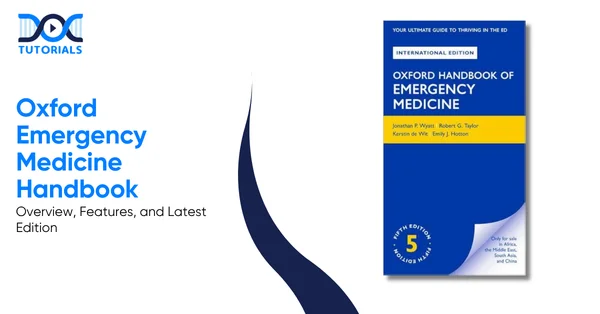
The Oxford Emergency Medicine Handbook is a practical guide that helps you quickly and correctly manage patients in the Emergency Room (ER). It provides clear, evidence-based information that you can refer to during emergencies, without having to go through lengthy theory.
For first-year PG residents, especially during on-call shifts, it simplifies decision-making by offering step-by-step guidance for common emergencies and acute care. Keep reading to know more about the Oxford Emergency Medicine book and other key details.
Oxford Handbook for Emergency Medicine: A Brief Overview
The Oxford Emergency Medicine is a practical and trusted guide used in A&E. It helps clinicians assess and stabilise patients based on their symptoms, especially when a clear diagnosis is not yet known. With its clear and concise format, it supports quick decision-making in emergency situations.
The Oxford Handbook of Emergency Medicine is a widely used guide in A&E practice. It helps clinicians manage patients who present with symptoms before a clear diagnosis is made by focusing on how to assess and stabilise them step by step.
Since its first publication, it has been a trusted resource for junior doctors, nurse practitioners, and paramedics who need quick, practical help in emergency situations.
The book is designed for real-time use, with clear and concise information that supports quick decision-making. It focuses on treating patients based on their symptoms. This helps clinicians stabilise them first and then move towards a final diagnosis.
Key Features of the Oxford Emergency Medicine Book
The Oxford Emergency Medicine’s comprehensive system coverage, visual aids, and diagnostic tools make it a valuable resource during PG residency and beyond. It supports quick access to information, including drug dosages and system-based guidance, helping in efficient clinical decision-making.
Below are the key features of the Oxford Emergency Medicine book. These show how the book stands out from the other reference books for PG Residency:
- Rapid-Reference Format
The book has a concise bullet format. It facilitates an easy search for a drug dose or a diagnostic algorithm. The book places significant emphasis on identifying clinical red flags and initiating immediate life-saving interventions.
- Comprehensive System Coverage
Although compact in size, the book covers an extensive range of topics, including:
- Major Trauma: From injuries of the head to multi-organ failures.
- Toxicology: Managing overdoses and poisoning.
- Environmental Emergencies: Hypothermia, heatstroke, and drowning.
- Specialised Care: Overhauled chapters related to psychiatry, paediatrics, and obstetrics.
- Visual Aids and Diagnostic Tools
There are over 100 extra illusions in the latest edition of the book, such as X-rays and ECGs (Electrocardiograms). These are critical parameters for comparing ‘normal’ versus ‘pathological’ findings.
Oxford Handbook of Emergency Medicine Latest Edition: New Updates
The 5th Edition of the Oxford Emergency Medicine Book (2020) is the most recent one, featuring a modern overhaul. It is well-equipped with updated protocols for sepsis, 100+ clinical identification images, and alignment with NICE and RCEM guidelines.
You’ll notice a significant shift from the traditional system to the modern protocols and technology. With the evolving healthcare dimensions, the updated version reflects:
| Feature | Updates in the 5th Edition |
| New Sections | Treatment escalation, end-of-life care, and updated sepsis protocols. |
| Pediatrics | Completely overhauled for modern pediatric resuscitation and safety. |
| Imaging | 100+ new images, including ‘normal’ examples for better identification. |
| Guidelines | Fully aligned with the latest NICE and RCEM guidelines. |
Why is the Oxford Handbook of Emergency Medicine Important for PG Residency Students?
The Oxford Handbook of Emergency Medicine latest edition guides you in studying anatomy but also in applying it during emergency procedures. It bridges the gap between basic sciences and their clinical applications.
PG Residency students primarily focus on Anatomy, Physiology, and Biochemistry. Gaining early exposure to books such as the Oxford Handbook of Emergency Medicine works like a bridge for these students.
For example, if you are a PG Residency student studying the thoracic cavity, this handbook offers you useful insights into needle thoracocentesis (chest decompression). In this way, you will find relevance in what you study.
At the same time, the book provides a foundation for mastering the positions of the intercostal nerves and vessels. The handbook is good for studying clinical ‘how-to’ procedures and requires a deeper understanding of gross anatomy. You will be interested in studying the following:
- Lumbar Puncture: Requiring knowledge of the vertebral column.
- Chest Drains: Requiring knowledge of the “safe triangle” in the axilla.
- Central Venous Access: Requiring knowledge of the neck and subclavian vessels.
Oxford Handbook for Emergency Medicine vs. Other Mainstream Books: Key Differences
The Oxford Emergency Handbook offers a detailed, clinically focused approach in a compact and accessible format. This makes it a practical and cost-effective resource for everyday use.
The difference between a traditional textbook and this handbook can be understood through the following points:
| Aspect | Oxford Handbook | Large Textbooks (e.g., Tintinalli’s) |
| Portability | Fits in a scrub pocket. | Desk-bound reference. |
| Clinical Use | Used during a shift. | Used for exam preparation at home. |
| Detail | Focused on management. | Deep dive into pathophysiology. |
| Price | Budget-friendly for students. | High investment. |
How Should You Use the Oxford Emergency Medicine Efficiently?
The Oxford Emergency Medicine is designed to be used as a clinical tool rather than just a reading resource. It emphasises practical approaches such as the ‘Golden Rules’ and the ABCDE method.
Using the Oxford Emergency Medicine requires going beyond simply reading it cover to cover. It should be treated as a practical tool for managing real-time clinical situations and supporting quick, informed decisions in emergency care.
Here’s how it helps you:
- Study the “Golden Rules”
The inside covers of the Oxford Emergency Medicine latest edition offer ‘Golden Rules’ for emergency practitioners. These principles focus on patient safety first and help practitioners prevent diagnostic pitfalls.
- Explore the ABCDE Approach
The Oxford Emergency Medicine book has a primary ABCDE approach. ABCDE refers to “Airway, Breathing, Circulation, Disability, Exposure”. Referring to this section before managing a ‘crashing’ patient always helps prevent life-threatening situations.
- Annotate and Personalise
The Oxford Emergency Medicine handbook often provides local hospital bleep numbers and specific antibiotic guidelines. Mark the pages you visit the most with tabs. This annotation makes it easier to use your 900-page book as a 3-second reference tool.
FAQs about Oxford Emergency Medicine Handbook
1. Which is the latest edition of the Oxford Handbook of Emergency Medicine?
The 5th edition (published on 6th August 2020) is the latest one for the Oxford Handbook of Emergency Medicine. The updated version has sections for sepsis, escalating treatments, and pediatric care.
2. Is the Oxford Emergency Medicine suitable for USMLE and NEET PG preparations?
Yes, the Oxford Emergency Medicine book is based on UK guidelines, such as those from NICE and RCEM. These clinical principles are universally accepted for rapid reviews of emergency topics.
3. Is the Oxford Emergency Medicine relevant for Paramedics?
Absolutely, the Oxford Emergency Medicine handbook is highly relevant to both paramedics and nurse practitioners. Majorly, the book focuses on rapid assessments and stabilisation topics.
4. Does Oxford Emergency Medicine cover emergency surgical topics?
Yes, the Oxford Emergency Book has a special section dedicated entirely to surgical emergencies. This section covers broader areas of urological issues, abdominal pains, and neurosurgical referrals.
5. Is Oxford Emergency Medicine available in a digital format?
Yes, several medical apps are offering enhanced search features and hyperlinked content. You can access it via Oxford Medicine Online.
6. How does the Oxford Emergency Medicine compare to the Oxford Handbook of Clinical Medicine?
The Oxford Handbook of Clinical Medicine is broader, covering medicines for ward-based issues. On the other hand, the Emergency Medicine handbook offers insight into the acute and first-contact setting of the ED.
7. Does the Oxford Emergency Medicine handbook cover drug dosages, too?
Yes, the 5th edition of the Oxford Emergency Medicine provides guidance on common emergency drug dosages. However, as a clinical practitioner, it is your responsibility to cross-check the information against local formularies.
8. Does the Oxford Emergency Medicine 5th edition include imaging and X-ray interpretation?
Yes, Oxford Emergency Medicine, 5th edition, includes additional illustrations and X-rays. These are around 100 specifically chosen ones to help you as a clinician identify the ‘normal’ vs ‘abnormal’ findings.
9. Are pediatric emergencies covered in the Oxford Emergency Medicine?
Yes, the Oxford Emergency Medicine, 5th edition, covers pediatric emergencies as well. A few topics in this segment include common childhood illnesses, trauma, and resuscitation. It offers a guided approach to understanding the physiological differences in paediatrics.
10. Whom does the Oxford Emergency Medicine book primarily target?
The Oxford Emergency Medicine, 5th edition, is essential for junior doctors and trainees in the emergency medicine department. It is also a crucial resource for the paramedics, specialist nurses, and general practitioners.
Conclusion
Starting PG residency can feel overwhelming at first. The Oxford Emergency Medicine handbook, 5th edition, serves as a reliable clinical reference throughout this phase. It helps bridge the gap between theoretical knowledge and practical patient care while supporting quick, informed decision-making when it matters most.
For further guidance, DocTutorials can be your study partner. We offer Viva preparation & OSCE, clinical case discussions, patient history-taking, and videos covering the PG Residency syllabus. This helps ensure residents gain clarity over complex medical concepts.
Join DocTutorials today and explore our PG Residency course to excel in your medical career!

Latest Blogs
-

NEET SS Exam 2024: Analysis, Key Dates, Counselling
The NEET SS 2024 exam kicked off on March 29, 2025. Over two days and two slots, candidates across 13…
-

INI SS Topper: 1 Dream, 1 Study Buddy, 1 Rank – The Journey of Dr. Prithivi Raaj, CML 1 & (AIIMS) AML 1 in DM Cardiology
Achieving the top rank in a competitive exam like the INI SS DM Cardiology requires tireless dedication, a structured approach,…
-
INI SS Results: Merit List, Exam Insights, and What Comes Next
The INI SS results for October 2024 are just around the corner. This is a life-changing moment for thousands of…