Pandya’s Practical Guidelines on Fluid Therapy: Overview, Features, and Editions
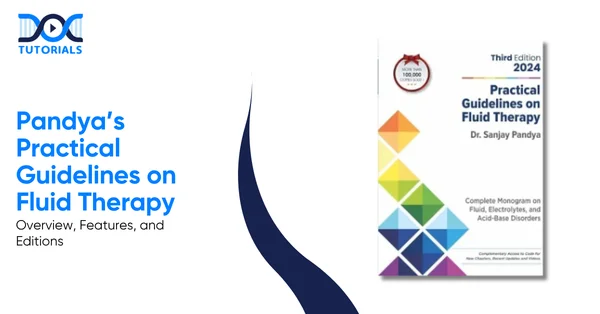
Practical Guidelines on Fluid Therapy is a popular reference in postgraduate training, particularly amongst residents who work with hospitalised and critically ill patients. It is written by the author, Dr Sanjay Pandya. It presents a practical, evidence-based method of IV fluid administration, electrolyte balance, and acid-base fluid disorders.
This guide is an overview of Practical Guidelines on Fluid Therapy as a vital source of PG residency training, and how it will enhance decision-making abilities in fluid, electrolyte and acid-base disorders. Keep reading to know more.
Overview of Practical Guidelines on Fluid Therapy
Practical Guidelines on Fluid Therapy is a concise, bedside-focused monograph that deals with IV fluids, electrolytes and acid-base disorders. It emphasises practical implementation with dosing algorithms, clinical knowledge, and troubleshooting in the medical, surgical, pediatric, and obstetric cases.
Practical Guidelines on Fluid Therapy is designed to represent an easy-to-understand monograph of IV fluid, electrolytes, and acid-base disorders. It does not focus exclusively on theory; it is more about bedside implementation, using dosing algorithms, clinical understanding, and informal troubleshooting of standard clinical cases.
Its main focus is to help clinicians manage the salt-water imbalances safely and efficiently among different patient groups (medical, surgical, pediatric, and obstetric). The book highlights some of the important practical features contributing to effective decision-making in a real-life environment.
Key characteristics include:
- Comprehensive Content: The book includes both basics (physiology of fluids, IV solutions) and advanced (electrolyte disorders, acid-base, parenteral nutrition) issues.
- Clinical Focus: It focuses on the application of IV fluids. The composition and the indications of crystalloids and colloids are explained, with contraindications and guidelines for rapid response to fluid problems.
- Problem-oriented Layout: Specific chapters deal with medical and surgical patients affected by fluid/electrolyte problems. For example, a chapter on the complications of hypotonic saline, shock resuscitation, burn formulas, renal and endocrine disease, etc. This assists residents in finding solutions to certain clinical cases.
- Clear and Simplified Approach: Complex concepts are broken down into charts and stepwise plans. The text contains tables, algorithms, and bullet points to reflect decision steps (e.g. when to use a fluid bolus).
Structure of Pandya’s Practical Guidelines on Fluid Therapy, 3rd Edition
The structure of Pandya’s Practical Guidelines on Fluid Therapy outlines the book’s organisation into parts and chapters. It highlights key topics and chapters most relevant to surgical residents, monitoring and parenteral nutrition.
Practical Guidelines on Fluid Therapy is organised into 12 parts. Each part groups related chapters:
Part 1
1. Basic Physiology
Part 2
2. Overview of Intravenous Fluids
3. Dextrose and Sodium Chloride Solutions
4. Balanced Solutions
5. Colloid Solutions
Part 3
6. Principles of Fluid Therapy
7. Maintenance Fluid Therapy
8. Resuscitation Fluids
9. Fluid Therapy in the Elderly
Part 4
10. Calcium and Hypertonic Dextrose Solutions
11. Hypertonic Saline
12. Magnesium Sulfate
13. Potassium Chloride and Phosphate
14. Sodium Bicarbonate
Part 5 (Online Access)
15. Fluid Assessment and Monitoring
16. Basic and Non-Invasive Hemodynamic Monitoring
17. Static Hemodynamic Monitoring
18. Fluid Responsiveness Techniques
19. Cardiac Output Monitoring
Part 6
20. Hyponatremia
21. Hypernatremia
22. Hypokalemia
23. Hyperkalemia
24. Hypocalcemia
25. Hypercalcemia
26. Hypophosphatemia
27. Hyperphosphatemia
28. Hypomagnesemia
29. Hypermagnesemia
Part 7
30. Basic Understanding and Approach to Acid-Base Disorders
31. Metabolic Acidosis
32. Metabolic Alkalosis
33. Respiratory Acid-Base Disorders
Part 8
34. Gastrointestinal Losses and Upper GI Bleeding
35. Ascites in Cirrhosis
36. Hepatic Encephalopathy
37. Hepatorenal Syndrome
38. Acute Pancreatitis
39. Fluid Therapy in Bronchial Asthma, ARDS, and in Ventilation
40. Diabetic Ketoacidosis
41. Neurological Disorders
Part 9
42. Preoperative Fluid Therapy
43. Intraoperative Fluid Therapy
44. Postoperative Fluid Therapy
45. TURP Syndrome
46. Burns
47. Urinary Diversion
Part 10
48. Resuscitation and Maintenance Fluid in Children
49. Replacement Fluid Therapy in Children
50. Oral Rehydration Therapy
Part 11 (Online Access)
51. Fluid Management during Pregnancy
52. Fluid Management for Cesarean
53. Fluid Management in Preeclampsia and PPH
54. Hyponatremia during Labour
Part 12 (Online Access)
55. Parenteral Nutrition: Principles and Requirements
56. Parenteral Nutrition in Specific Diseases
57. Parenteral Nutrition: Administration and Complications
Key Features of Pandya’s Practical Guidelines on Fluid Therapy
Fluid Therapy by Sanjay Pandya presents some major upgrades, including separate pediatric and obstetric units, a detailed discussion of hemodynamic monitoring methods, and a thorough discussion of total parenteral nutrition. The book provides a contemporary, holistic view of fluid therapy, with digital materials, increased imagery, and an emphasis on fluid stewardship.
Practical Guidelines on Fluid Therapy by Dr Sanjay Pandya is characterised by its practical bedside-based approach to fluid, electrolyte, as well as acid-base management.
The most recent version further expands the clinical relevance through the introduction of modern concepts, increased coverage, and evidence and is useful to postgraduate trainees and practising clinicians.
Key comparative enhancements include:
- Specialised Patient Cohorts: The introduction of completely new chapters on pediatric resuscitation, oral rehydration therapy, and maternal fluid control in pregnancy, cesarean delivery, and labour.
- Advanced Hemodynamic Monitoring: A shift of the established methods of static monitoring with the newer, provocative, dynamic parameters of fluid responsiveness, including passive leg raise and pulse contour.
- Total Parenteral Nutrition: An extensive new section describing the principles, clues, disease-specific needs, and complications in parenteral nutrition.
- Digital Integration: The newer upgrade bridges the gap between physical textbooks and digital learning by having a free access code that people can use to keep updating continuously, to access future chapters and even instructional clinical videos.
- Expanded Topics: New information on fluid stewardship (e.g., four rights of fluid prescribing) and risks of overhydration is introduced.
Current critical care practice is integrated in the chapters on dynamic monitoring (passive leg raise, stroke volume variation).
- Visual aids: It introduces additional figures, flowcharts, and insight tables to accelerate lookups. Colour-coding and boxes highlight vital information for easy access during rounds.
- Global perspective: Even though the 3rd edition was written in India, it is oriented toward international readers. Both high and low resource settings are discussed with recommendations that include oral rehydration (in cases of cholera).
Practical Guidelines on Fluid Therapy, 3rd Edition
The Practical Guidelines on Fluid Therapy, 3rd edition, was released in April 2024. Being the latest version, it represents significant progress in evidence-based practice, revised clinical guidelines, and developing fluid, electrolyte, and acid-base management. This edition builds upon the previous editions and turns the book into a clinically useful tool.
The most recent edition is an entirely revised and expanded monograph of more than 750 pages, arranged in 12 parts and 57 chapters.
It has been published under the supervision of Sanjay Pandya and made available through medical publishing houses such as Nirali Prakashan, and has since expanded into a detailed reference text familiar to postgraduate trainees and clinicians.
New issues are added regularly to align with fast changes in critical care and nephrology. The 2024 edition is based on the earlier editions with a number of significant upgrades, such as:
- Integrates recent guidelines in fluid resuscitation, electrolyte replacement, and critical care guidelines.
- Covers a wider scope of topics, including specialised sections in clinical situations of different disciplines.
- Provides access to online updates, additional chapters, and instructional videos, forming a hybrid model of learning.
- Includes more in-depth coverage of areas like advanced hemodynamic monitoring, obstetric fluid therapy, and parenteral nutrition.
- Integrates an elaborate print format and digital resources, which can be accessed easily by the learners in various environments.
Editions and Updates of Pandya’s Practical Guidelines on Fluid Therapy
The first edition appeared in 2002; the 3rd edition (2024) is fully revised with current evidence. Compared to previous editions, which only treated and looked at basic fluid and electrolyte care, the revised 3rd edition (2024) includes recent evidence, more coverage, and specialised areas, making it a comprehensive modern resource.
With the initial publication in 2002, the awareness of IV resuscitation, electrolyte balance, and hemodynamic monitoring has increased greatly, with major trials reorganising treatment regimes and necessitating the need for updated resources.
At first, the editions concentrated on fundamental concepts such as fluid computations, IV pharmacology and routine electrolyte disorders. Although simple and clear, they were predominantly adult-oriented and covered little on pediatric and obstetric aspects, highlighting the need for a more comprehensive text.
Practical Guidelines on fluid therapy, 3rd edition (2024), exemplifies a significant change. Completely updated and developed, it becomes a detailed monograph with a wider focus, revised evidence, and at least a chapter on specialised groups of patients. It renders it a more comprehensive and clinically relevant resource.
The table below provides an outline of the structural development of the textbook throughout its editions:
| Feature | 1st & 2nd Editions (2002) | 3rd Edition (2024) |
| Length | Around 325 pages | Expanded to 750+ pages |
| Content Structure | Limited core chapters | 57 detailed chapters across 12 parts |
| Pediatric Coverage | Minimal focus | Specialised sections about neonates and children. |
| Obstetric Coverage | General guidelines only | Dedicated section on preeclampsia, labour and cesarean care. |
| Nutritional Support | Basic IV supplementation | Comprehensive discussion of total parenteral nutrition. |
| Learning Format | Print-only resource | Has access to online chapter and instructional videos. |
Practical Guidelines on Fluid Therapy: Comparison with Leading Textbooks
Practical Guidelines on Fluid Therapy by Dr Sanjay Pandya takes a special place in fluid and electrolyte textbooks, and strikes a balance between clinical utility and adequate theoretical foundation. Other books have detailed physiology, visual learning, or niche care, whereas the book by Pandya balances out these with a problem-oriented approach.
In clinical medicine, Practical Guidelines on Fluid Therapy is often compared to texts such as Clinical Physiology of Acid-Base and Electrolyte Disorders by Burton David Rose, The Fluid, Electrolyte and Acid-Base Companion by Sarah Faubel and Joel Topf, and the handbook by the American Society for Parenteral and Enteral Nutrition.
The book by Pandya emphasises practical, algorithmic bedside care, whereas the books by Burton, David Rose, Sarah Faubel, and Joel Topf stress simplified learning, and the American Society for Parenteral and Enteral Nutrition implements protocol-driven nutrition care. Therefore, Pandya has the most versatile text to be used in everyday clinical practice.
In general, Pandaya succeeds in filling the gap between theory and practice. Although Burton David Rose has unparalleled physiological depth, Sarah Faubel and Joel Topf make learning easy, and the American Society for Parenteral and Enteral Nutrition is more concerned with nutrition-based care, the book by Pandya remains the most practical and versatile resource for everyday clinical use.
The table below describes the major key differences of the features across major fluid therapy resources:
| Analytical Area | Pandya’s Practical Guidelines on Fluid Therapy | Burton Rose | Faubel & Topf Companion | ASPEN Handbook |
| Core Approach | Problem-centred, algorithmic, bedside-focused. | Deep physiological and molecular knowledge. | Q&A, visual, interactive learning. | Protocol-driven, nutrition-focused. |
| Clinical Utility | High- best suited to real-time decisions. | Moderate- best conceptual clarity. | Moderate – most appropriate in early learning. | High but limited to nutrition/ICU scope. |
| Content Depth | Balanced (Equal emphasis on theory and application). | Very elaborate basic science. | Focused on core concepts. | Focused, niche coverage. |
| Target Audience | Residents, doctors, intensivists. | Nephrology fellows, academicians. | Junior residents, medical students. | Pharmacists, ICU teams, and nutritional professionals. |
| Scope of Topics | Broad multi- specialty (medical, surgical, pediatric, obstetric). | Primarily renal physiology. | Core electrolytes and acid-base only. | Nutrition and fluid balance. |
| Distinct Strength | Bridges’ theory, including bedside fluid prescription. | Gold standard for pathophysiology. | Very pictorial and simple to grasp. | Strong integration with nutrition support. |
Practical Guidelines on Fluid Therapy: Clinical Relevance for PG Surgical Residents
Fluid therapy plays an important role in enhancing patient outcomes in the field of surgery. This part will describe how the topics of the book are applicable to surgical training, such as perioperative care, trauma resuscitation, and complication management.
The concept of fluid management is an everyday requirement for a surgical trainee. Dr Pandya’s book addresses key surgical scenarios:
- Perioperative Management: Guides pre- and post-operative fluid planning, such as dehydration testing, intravenous fluids requirements and schedule of oral intake.
- Intraoperative Care: Covers the use of fluid to replace blood and insensible losses, risk factors such as overload or coagulopathy.
- Burn Resuscitation: Gives formulas and monitoring points to control significant increases or decreases of fluids in burn patients.
- TURP Syndrome: Explains the process of water intoxication caused by glycine irrigation and how it can be treated.
- Trauma/Sepsis: Provides shock management algorithms that are in line with existing sepsis protocols.
- Complication Prevention: Offers guidance on electrolyte balance, particularly, safe correction of sodium to avoid neurological complications.
FAQs about Sanjay Pandya’s Fluid Therapy
- What is the Practical Guidelines on Fluid Therapy book about, and who is it for?
It is a clinical handbook which is authored by Sanjay Pandya and encompasses IV fluids, electrolytes and acid-base disorders. It is aimed at doctors, surgeons, and, specifically, the postgraduate residents, with a brief, case-based format to be used in clinical applications.
- What makes the Practical Guidelines on Fluid Therapy book different from standard textbooks?
Unlike heavy-theory texts, Practical Guidelines on Fluid Therapy is practice-based; it includes step-by-step management, quick tables, and direct treatment guidelines to make decisions at the bedside.
- What is new in the 3rd edition (2024) of Practical Guidelines on Fluid Therapy?
The most recent version of Practical Guidelines on Fluid Therapy has new evidence, revised sepsis protocols (e.g., 30 mL/kg fluids), new monitoring techniques and improved visuals for clarity.
- Does the Practical Guidelines on Fluid Therapy book cover surgical fluid management?
Yes, the Practical Guidelines on Fluid Therapy gives extensive coverage of surgical scenarios, such as how to plan perioperative situations, intraoperative fluid losses, postoperative burn resuscitation, and complications, such as TURP syndrome.
- Are the recommendations evidence-based in Practical Guidelines on Fluid Therapy?
Yes, the Practical Guidelines on Fluid Therapy book aligns with international guidelines as well as the latest studies in critical care, making fluid therapy practices safe, up to date, and clinically relevant.
- Is the Practical Guidelines on Fluid Therapy book useful for exam preparation?
Absolutely. The Practical Guidelines on Fluid Therapy book addresses high-yield concepts of fluid calculations, electrolyte imbalances, and shock management, and provides brief summaries and tables, making it helpful in a quick revision.
- Do the Practical Guidelines on Fluid Therapy contain real clinical situations?
Yes, the content is case-based and problem-driven, which helps the reader to understand how concepts might be applied to an actual clinical situation.
- What is the Practical Guidelines on Fluid Therapy’s contribution to routine practice?
The Practical Guidelines on Fluid Therapy book provides rapid-reference algorithms, stepwise managerial plans, and valuable suggestions that enable quick and accurate bedside decision-making.
- Is there a digital or e-book version available of the Practical Guidelines on Fluid Therapy?
Yes, the Practical Guidelines on Fluid Therapy book can be accessed digitally, so users can search, highlight interesting ideas and access the book at any time they wish to during clinical work.
- Why are the Practical Guidelines on Fluid Therapy popular among the residents?
The Practical Guidelines on Fluid Therapy book is practical, brief and bedside oriented, which makes it ideal for busy residents who are in search of quick, reliable guidance when handling patients.
Conclusion
Practical Guidelines on Fluid Therapy equips postgraduate residents with a strong foundation of the evidence-based approach to fluid, electrolyte, and acid-base management practices. The latest version aligns with the current set of guidelines, which help trainees make accurate, fluid decisions and improve patient outcomes.
For further guidance, DocTutorials can be your study partner. We offer Viva preparation & OSCE, clinical case discussions, patient history-taking, and videos covering the PG Residency syllabus. This helps ensure residents gain clarity over complex medical concepts.
Join DocTutorials today and explore our PG Residency course to excel in your medical career!

Latest Blogs
-

NEET SS Exam 2024: Analysis, Key Dates, Counselling
The NEET SS 2024 exam kicked off on March 29, 2025. Over two days and two slots, candidates across 13…
-

INI SS Topper: 1 Dream, 1 Study Buddy, 1 Rank – The Journey of Dr. Prithivi Raaj, CML 1 & (AIIMS) AML 1 in DM Cardiology
Achieving the top rank in a competitive exam like the INI SS DM Cardiology requires tireless dedication, a structured approach,…
-
INI SS Results: Merit List, Exam Insights, and What Comes Next
The INI SS results for October 2024 are just around the corner. This is a life-changing moment for thousands of…