Tintinalli’s Emergency Medicine: PG Residency: Overview, Features, and Latest Edition
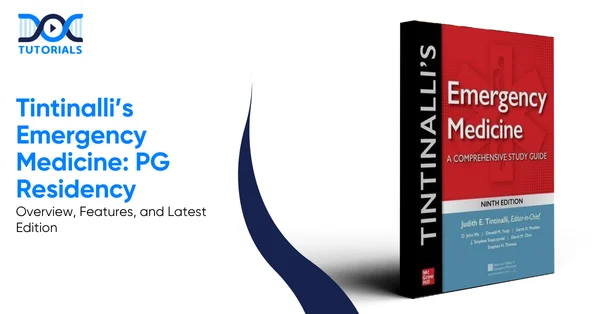
Tintinalli’s Emergency Medicine textbook is a leading reference text commonly used in postgraduate training in emergency medicine. The textbook is an important resource for residents in clinical training and certification exams.
Its structured clinical discussions and evidence-based approach help learners develop the decision-making skills required in emergency departments. Keep reading to learn more about Tintinalli’s Emergency Medicine, including its key features, subject coverage, and its role in developing clinical competence among emergency medicine residents.
Overview of Tintinalli’s Emergency Medicine
Tintinalli’s Emergency Medicine is the ultimate book on emergency care, covering prehospital, disaster, resuscitation, and specialised emergency care. It is trusted by students, residents, and physicians and offers evidence-based guidance in adult, pediatric, and neonatal care.
Tintinalli’s Emergency Medicine is one of the most popular reference books in the field of emergency care and for those teaching emergency medicine.
This is a complete textbook that includes the entire range of emergency medicine. It includes prehospital and disaster medicine, as well as advanced resuscitation and major medical, traumatic, and environmental emergencies across all age groups.
Medical students, residents, and practising physicians use the text routinely to prepare for the exams as well as for clinical advice. The textbook gives a detailed explanation of the emergency medicine concepts, procedures, and patient care.
Its chapters include the simple resuscitation and trauma management to the more specialised ones like toxicology, obstetrics and paediatric emergencies.
Key Features of Tintinalli’s Emergency Medicine
Tintinalli’s Emergency Medicine is the most popular resource in postgraduate training to embrace the entire range of emergency presentations, processes, and acute care of all ages. It is edited by leading emergency physicians and provides high-quality, evidence-based information in line with the existing best practices and guidelines.
Tintinalli’s Emergency Medicine excels in specialised areas crucial for PG training. Its major areas of focus include:
- Comprehensive Scope: Addresses all significant emergency presentations and practice, such as prehospital care, disaster management, resuscitation (basic and advanced), procedural expertise, and management of a variety of acute conditions in adults, children and neonates.
- Authoritative Content: The text is peer-reviewed by leading emergency physicians and is brought up to date regarding the best practices. It is revised on a regular basis to incorporate the most current clinical recommendations and research.
- Exam Support: The book is regarded as an essential tool during in-training and board examinations because of its comprehensiveness, which can equip residents for certification exams. It comprises learning review questions and references.
- Rich Learning Aids: The text is being formatted with many tables, figures and algorithms. It is designed in full colour with additional tables to provide significant information more coherently.
Editions of Tintinalli’s Emergency Medicine
Over the decades, Tintinalli’s Emergency Medicine has undergone several editions, with the latest version being expanded and updated as the field has evolved. The latest (9th) edition was released in 2019, continuing the tradition of major updates every 4–5 years.
Tintinalli was initially published in 1978 and has been revised regularly to mirror progress in emergency care. The 8th edition was published in 2017, the 9th in 2019. The editions are continuously updated with new evidence, guidelines, and emerging topics.
For instance, the 8th edition extended the focus on such areas as transgender patient care, procedural sedation, and opioid emergencies. However, the 9th edition included additional updates, such as the recent resuscitation guidelines, a new approach to diagnosis, and lessons from recent global health events.
The publisher (McGraw-Hill) provides detailed tables of contents for each edition. In general, new editions feature:
- Major Content Updates: Adding new studies, evolving clinical practice (e.g. sepsis, stroke, trauma treatment), and recent public health matters (e.g. how to manage COVID-19).
- Revised Organisation: Streamlined chapters and sections for clarity. New chapters are added as needed.
- Enhanced Visuals: Subsequent editions have more colour figures, tables and pictures to facilitate learning (the 9th ed. adopted a full-colour format, with more tables than ever).
Some university syllabi recommend Tintinalli’s Emergency Medicine Manual, 9th Edition, as a supplement to the reading. It is a detailed guide, and a streamlined manual is also used today to train programs.
Tintinalli’s Emergency Medicine, Latest Edition
The 9th Edition of Tintinalli’s Emergency Medicine was published in 2019. As the most recent version, it builds upon the strengths of the 9th Edition with current material and potentially the addition of new chapters or sections due to the recent developments in the emergency care field.
The Tintinalli’s Emergency Medicine latest edition is the 9th Edition (which was published in 2019). Published by McGraw-Hill, the series is regarded as one of the most widely used textbooks in emergency medicine worldwide.
New releases are usually issued every 4-5 years, and the 9th Edition is the successor to the 2017 Eighth Edition. While a full breakdown of new chapters is not yet widely published, one can expect the 9th Edition to include:
- Updated Evidence and Guidelines: Recent guidelines on common conditions (e.g. recent changes in ACLS/PALS guides, new stroke interventions, COVID-19 treatment and care) based on the recent literature.
- Expanded Digital Resources: The 8th Edition already featured online videos of the procedures; the Ninth Edition probably follows the trend or adds to the amount of multimedia (simulations, online modules).
- Evolving Clinical Topics: The introduction of new topics, i.e., the utilisation of telemedicine during emergencies, the trend of substance misuse, global health threats, and the use of precision medicine in the ED.
- Cost and Availability: The 9th Edition is available in hardcover. In India, institutional procurement lists show the 9th Edition priced around ₹4,610, reflecting its status as a major textbook.
Table of Contents of the Tintinalli Emergency Medicine Latest Edition
The latest widely used edition of Tintinalli’s Emergency Medicine is the 9th edition (2019). It is a comprehensive emergency medicine reference with 26 major sections and more than 200 chapters, covering prehospital care, resuscitation, trauma, medical emergencies, toxicology, and special situations in emergency departments.
Below is a structured outline of the main contents (sections) of the latest edition:
1. Prehospital Care
2. Disaster Management
3. Resuscitation
4. Resuscitative Procedures
5. Analgesia, Anaesthesia & Procedural Sedation
6. Wound Management
7. Cardiovascular Disease
8. Pulmonary Disorders
9. Gastrointestinal Disorders
10. Renal and Genitourinary Disorders
11. Obstetrics and Gynaecology
12. Pediatrics
13. Infectious Diseases
14. Neurology
15. Toxicology
16. Environmental Injuries
17. Endocrine Disorders
18. Hematologic and Oncologic Disorders
19. Eye, Ear, Nose, Throat, and Oral Disorders
20. Dermatology
21. Trauma
22. Orthopaedics
23. Musculoskeletal Disorders
24. Psychosocial Disorders
25. Abuse and Assault
26. Special Situations
8th vs 9th Edition of Tintinalli’s Emergency Medicine: Key Differences
The 8th and 9th editions are very similar in scope and particular to the knowledge of EM at their respective times. The 8th Edition (2017) has full-colour formatting and a wide range of new topics. That content is further updated in the 9th Edition with the most recent clinical guidelines and research findings added.
A comparison between the 8th and 9th editions of Tintinalli’s Emergency Medicine provides insights into the development of the textbook.
The major updates in the current versions of Tintinalli’s Emergency Medicine are reflected in improved readability, increased clinical coverage, and the inclusion of the latest practices in emergency care. Refer to the table below:
| Feature / Area | 8th Edition (2017) | 9th Edition (2019) |
| Design and Layout | Added a full-colour redesign with additional tables and figures for clearer summaries and improved readability. | Carries on the contemporary design, featuring presumably new visuals and better presentation. |
| Procedural Learning | Added over 100 online procedural videos, such as demonstrations of emergency techniques, and point-of-care ultrasound (POCUS). | Predicted to have new multimedia materials to facilitate procedural training. |
| Pediatric Content | Enlarged pediatric emergency section, with a broader coverage of neonates, infants, and children. | Likely revised to include current pediatric emergency instructions and clinical practices. |
| Clinical Updates | Significant changes in obstetric/gynecologic emergencies, toxicology, procedural sedation, and discussions on opioid use disorder and transgender patient care. | Integrates new evidence-based updates in all specialities, trauma, cardiology, infectious disease, and critical care. |
| Algorithms and Illustrations | Added more diagrams, tables and descriptive summaries. | New clinical illustrations or pictures and updated algorithms (e.g. stroke, sepsis, asthma). |
| Emerging Topics | Introduced new and recent topics of interest to contemporary ED practice. | Updated to contain more recent changes, including the management of COVID-19, new antimicrobials, and disaster-response lessons. |
Since the 9th Edition is current, postgraduate students should aim to study from it when possible, but the 8th Edition remains highly valuable. Both versions discuss fundamental EM principles, and the changes are primarily due to advances in medicine.
Tintinalli vs Rosen: Core Textbook Comparison
Tintinalli’s Emergency Medicine and Rosen’s Emergency Medicine both cover core exam topics but differ in style. Tintinalli focuses on concise, practical clinical guidance, while Rosen emphasises detailed pathophysiology and conceptual understanding.
In academic emergency medicine, a common comparison is drawn between Tintinalli’s Emergency Medicine: A Comprehensive Study Guide and Rosen’s Emergency Medicine: Concepts and Clinical Practice. This analogy usually influences residency reading schedules, journal clubs and teaching sessions.
Although the two books include the main board-certification material, they differ in teaching style and format. Tintinalli has been appreciated because of its clinical practicality and readability, concise chapters, tabular presentations, bullet points, and quick-reference algorithms reflecting the decision-making of the emergency department.
Conversely, Rosen provides more of an academic explanation where pathophysiology and disease processes are explained in advance of management, and attract the student who wants to have a more conceptual grasp.
The statistical analysis comparing the contents of the 2 textbooks with the national qualifying examination blueprints indicates some variation in the representation of topics. They are:
| Clinical Topic Area | Rosen’s Content Representation | Tintinalli’s Content Representation |
| Environmental Disorders | More focus on environmental pathologies and the mechanisms involved. | Slightly less detail, with a more brief overview. |
| Traumatic Disorders | Well-structured and strong trauma coverage. | Trauma coverage of exceptional detail and with a practical management orientation. |
| Cutaneous Disorders | Normal dermatological coverage within emergency provisions. | Extended focus on cutaneous presentations and emergency dermatology. |
| Obstetrics and Gynaecology | Standard coverage on obstetric and gynecologic emergencies. | Highly detailed emphasis on obstetric crisis and acute management |
| Formatting and Style | More in-depth pathophysiology explanation through narratives and written explanations. | Bullet points, tables, and algorithms emphasising clinical pragmatism |
How to Use Tintinalli’s Emergency Medicine for PG Residency and Exam Preparation?
Tintinalli’s Emergency Medicine is a foundational study resource among PG residents in emergency medicine. It gives coverage to learn complex cases and facilitates exam preparation (both in-training and board-level).
To postgraduate trainees, the textbook by Tintinalli plays multiple functions. It serves as a clinical reference to rare conditions and elaborate instructions, and as an exam review guide, frequently viewed as essential for in-training and university examinations.
Tintinalli’s Emergency Medicine’s best practices include the following:
- Strategic Reading: Instead of reading cover-to-cover, residents tend to read high-yield chapters applicable to their rotations (i.e. trauma, toxicology, resuscitation). In Tintinalli, every chapter begins with an outline and objectives which may guide targeted study.
- Conceptual Understanding: Tintinalli does a great job of explaining the pathophysiology and the rationale for management. It can be used by PG students to gain a better understanding of the fundamental concepts.
- Integration with Clinical Work: Residents can consult Tintinalli’s for evidence-based treatment algorithms or unusual presentations (e.g. rare environmental emergencies). This enforces learning as well as ties theory with practice.
- Exam Preparation: Numerous training courses recommend revision of Tintinalli sections prior to examinations. The Tintinalli’s Emergency Medicine Manual 9th Edition can also be consulted for a quick overview of facts and tables just before examinations.
Active learning strategies should be used to supplement Tintinalli. Retention is enhanced through case discussions, MCQ practice and attending simulation labs. Although Tintinalli provides the core knowledge framework, practice and review questions are necessary to master the subject.
FAQs about Tintinalli’s Emergency Medicine
- How often is Tintinalli last edition updated?
Tintinalli is generally revised every 4-5 years to correspond with the development in emergency medicine. The latest versions are the 8th (2017) and 9th (2019) editions, with several additional clinical guidelines and research integrated into them.
- Is there a Tintinalli’s 9th Edition manual?
Yes, the Tintinalli’s Emergency Medicine Manual is a pocket-sized supplement to the primary textbook, and the latest version that is widely available now is the 9th edition.
- What is the Tintinalli’s Emergency Medicine Manual?
Tintinalli’s Emergency Medicine Manual is a pocket-sized, condensed version of the primary textbook, featuring brief chapters on general complaints, diagnoses, and emergency management for quick clinical reference.
- Should you buy the Tintinalli’s Emergency Medicine 10th edition, 9th or 8th edition?
The 9th edition (2019) is the most preferred as it bears the latest guidelines. Nevertheless, the 8th edition is still a credible source of fundamental emergency medicine concepts.
- Is the Tintinalli Emergency Medicine latest edition enough for PG exam preparation?
Tintinalli is conceptually covered. MCQ questions, question banks, and revision resources are also useful in preparing for the PG exam.
- How does Tintinalli compare with Rosen’s textbook?
Tintinalli tends to be much more compact and focused on the clinical aspect of the cases and is therefore easier to study quickly, whereas the Rosen is more specific on the theoretical and pathophysiology explanations.
- How can PG residents use Tintinalli effectively?
Residents typically read chapters according to their rotations at any given time, read the summary tables and algorithms, and refer to the text at the time of complex or unfamiliar cases.
- Is the manual of Tintinalli useful for residents?
Yes. The manual is used by many residents to do rapid revision, quick lookup, and bedside reference when performing clinical work.
- Does the Tintinalli latest edition include updated guidelines?
Yes. New editions combine recent clinical research, new protocols and emerging emergency care practices.
- Should Tintinalli be combined with other study methods?
Yes. Active learning techniques, like making notes, flashcards, case discussions, and solving MCQs, can be used to strengthen ideas and improve exam performance.
Conclusion
Tintinalli’s Emergency Medicine helps residents in the PG develop this foundation through extensive coverage of key emergencies. It can be studied systematically and applied in clinical practice to aid residency training or board exam preparation.
For further guidance, DocTutorials can be your study partner. We offer Viva preparation & OSCE, clinical case discussions, patient history-taking, and videos covering the PG Residency syllabus. This helps ensure residents gain clarity over complex medical concepts.Join DocTutorials today and explore our PG Residency course to excel in your medical career!
Latest Blogs
-

NEET SS Exam 2024: Analysis, Key Dates, Counselling
The NEET SS 2024 exam kicked off on March 29, 2025. Over two days and two slots, candidates across 13…
-

INI SS Topper: 1 Dream, 1 Study Buddy, 1 Rank – The Journey of Dr. Prithivi Raaj, CML 1 & (AIIMS) AML 1 in DM Cardiology
Achieving the top rank in a competitive exam like the INI SS DM Cardiology requires tireless dedication, a structured approach,…
-
INI SS Results: Merit List, Exam Insights, and What Comes Next
The INI SS results for October 2024 are just around the corner. This is a life-changing moment for thousands of…