neet-pg Archives -

NEET PG Books for 2027: Your Essential Resources to Crack the Exam
NEET PG Books | DocTutorials

Preparing for NEET PG? The right NEET PG books can make all the difference between an average score and a top rank. NEET PG books play a crucial role in exam preparation. The quality of a candidate’s preparation largely depends on the study materials they use, including books and notes.

Selecting the best options from a wide range becomes a challenge for many students. Whether you are aiming to strengthen your basics or master high-yield topics, the right study material can streamline your preparation. In this guide, you will learn about the best NEET PG books for each subject, how to use them effectively, and key strategies to enhance your preparation.

Which Are the Best Books for NEET PG Preparation?

The following is a list of the best books to prepare for the NEET PG exam 2027:

SubjectsBooks nameAuthor Name
PharmacologyReview of PharmacologyGobind Rai Garg, Sparsh Gupta, Ranjan Patel
AnatomyENT for the entrance examRajesh Kaushal 
ENTSelf-assessment and review of basic anatomy and forensic medicineManisha Sinha and Sachin Budhiraja
Forensic MedicineSelf-assessment and review of BiochemistryFinal Edge Image-Based
BiochemistrySelf assessment and review of BiochemistryRebecca James
MicrobiologySelf-assessment and review of obstetrics & GynecologyRachna Chaurasia / Apurba Sastry / Ananthanarayan 
MedicineComplete review of medicine for NBEDeepak Marwah or Mudit Khanna
PathologyReview of Pathology and GeneticsSparsh Gupta & Devesh Mishra
PediatricsReview of Microbiology and ImmunologyTaruna Mehra or OP Ghai
PhysiologyReview of PhysiologyDr. Soumen Manna Dr. Krishna Kumar
PSMCommunity medicine (PSM)Vivek Jain
SurgerySurgery essencePritesh Singh SRB
OBS and GynaeFinal Edge Image-BasedSakshi Arora
RadiologyReview of RadiologyRajat Jain
OphthalmologyComprehensive OphthalmologyAK Khurana Ruchi Rai
OrthopedicsOrthopedics quick reviewApurv Mehra
PsychiatryReview of PsychiatryPraveen Tripathi
AnesthesiaPROAFS Anesthesia for NBEProfs by Vivek Jain
DermatologyReview of DermatologySaurabh Jindal
Image-BasedFinal Edge Image BasedDeepak Marwah

How to Use NEET PG Books Effectively for Exam Preparation?

To ensure complete coverage of the syllabus, you must use your NEET PG study materials wisely. Referring to the right resources minimises the chances of missing out on important topics. A well-structured study plan and the best books for NEET PG can help streamline your preparation for the NEET PG exam 2027.

  1. Choose the Right Books

Selecting books by reputed authors is crucial for comprehensive preparation. Look for study materials that cover a major portion of the NEET PG syllabus. Some of the recommended books include Review of Physiology,  Review of Radiology, and Review of Pathology and Genetics. Adopting a subject-wise approach is the most effective strategy. You must focus on one subject at a time, strengthen your understanding, and then move on to the next.

  1. Follow a Subject-Wise Plan

Organising your preparation subject-wise ensures that you give equal attention to all topics. Research each topic thoroughly and take notes, as they will be invaluable for revision. Having structured notes makes it easier to retain key concepts and revise efficiently.

  1. Practice MCQs Regularly

Once you are confident about your concepts, start solving multiple-choice questions. Practicing from a book for NEET PG MCQ will help you get familiar with the exam pattern and improve problem-solving skills. Additionally, solving questions from the PYQ NEET PG book will give you insight into frequently asked questions and help you assess your performance.

  1. Focus on Concept-Based Learning

Instead of rote memorisation, focus on understanding the core concepts. Superficial reading will not help you tackle complex questions. A strong conceptual foundation allows you to answer confidently, no matter how the questions are framed.

  1. Prioritise Thorough Revision

Revision is just as important as learning new topics. After completing each subject, review it multiple times before the exam. You must aim to revise every subject at least three to four times, ensuring that you retain crucial information and reinforce your understanding. A well-planned revision strategy can make a significant difference in your final performance.

What Are the Benefits of the NEET PG Books for 2027?

NEET PG books for 2027 play a crucial role in exam preparation by offering comprehensive knowledge, concept clarity, and ample practice opportunities. Here are the key benefits of using them:

  • Complete Syllabus Coverage: NEET PG books thoroughly cover the entire syllabus, ensuring you gain all the essential information required for the exam.
  • In-Depth Concept Explanations: These books provide well-structured explanations, often supplemented with diagrams, tables, and illustrations, making it easier to understand and retain information.
  • Extensive Practice Material: With multiple-choice questions (MCQs), as well as short and long-answer questions, these books offer plenty of practice exercises to evaluate your understanding and pinpoint weak areas.
  • Regular Updates: The content is frequently revised to align with the latest syllabus and exam pattern changes, ensuring you always study with up-to-date material.

Preparation Strategy for NEET PG 2027 Exam

The following are some key tips to help you prepare efficiently and stay on track for the exam:

  1. Effective Time Management

Start by analysing how you currently spend your time and then create a structured daily schedule. Use a calendar and set reminders for important tasks, allocating specific time slots for each activity. Staying consistent with your routine is key to maintaining a steady study pace.

  • Keep a journal and a calendar
  • Set priorities
  • Follow a proper schedule
  • Take care of your health
  • Establish a disciplined routine
  1. Practice with Sample Papers

Incorporating NEET PG sample papers into your study plan is crucial. Aim to solve at least one mock test or a previous year’s paper daily. Choosing the best book for NEET PG previous year question papers can give you an edge by helping you understand question patterns, assess your performance, and get familiar with the difficulty level of the exam.

  1. Understand the Exam Pattern

Your study strategy should align with the NEET PG exam format and marking scheme. While answering questions, stay calm and focused to avoid unnecessary mistakes that could affect your final score.

  1. Go Through the Syllabus Thoroughly

A thorough understanding of the NEET PG syllabus is the foundation of your preparation. Simply skimming through topic names is not enough—you need to grasp the key subjects and subtopics covered in the exam. Identify high-weightage topics and focus more on them while ensuring you do not neglect less emphasised sections.

NEET PG Exam Pattern 2027

Having a clear understanding of the NEET PG exam pattern is essential for effective preparation. Here is a detailed breakdown of the exam structure:

Exam ComponentDetails
Mode of ExaminationComputer-based (Online Mode)
Language of ExaminationEnglish only (No regional languages)
Exam Duration3.5 hours (9:00 AM – 12:30 PM)
Types of QuestionsObjective-type (Multiple Choice Questions)
Total Marks720
Total Number of Questions186
Marking Scheme+4 for each correct answer, -1 for each incorrect answer
Number of Questions Per SectionPart A: 50 questions
Part B: 100 questions
Part C: 150 questions

FAQs on NEET PG Books

  1. What is the top book for Pharmacology?

For Pharmacology, Review of Pharmacology by Gobind Rai Garg, Sparsh Gupta, and Ranjan Patel is widely regarded as the best choice.

  1. Which anatomy book is the best for NEET PG?

Among the numerous anatomy books for NEET PG, Self-Assessment and Review of Anatomy by Rajesh Kaushal stands out as the most recommended book for Anatomy.

  1. How many books are necessary for NEET PG preparation?

Instead of focusing on the number of books, you should prioritise the quality of study materials. As long as you have a thorough understanding of the concepts, the number of books they use becomes less important.

  1. What is the mode of NEET PG 2026 counselling?

The NEET PG 2026 counselling process will take place online. To participate, candidates must first register and then select their preferred colleges and specialties for admission to postgraduate courses.

  1. Do top NEET PG books contain practice questions?

The majority of NEET PG books provide sample test papers for practice.

  1. How many hours should I study daily for NEET PG?

For NEET PG, it is not necessary to study for long hours. Quality is preferred over quantity. One should ideally study for 6-8 hours a day. This will help you be consistent and stay on track with your studies. It is ideal to have 45-50 minutes of in-depth study followed by short breaks in between.

  1. What is the best way to revise for NEET PG?

It is necessary to revise for NEET PG regularly. Revisions should be done in a scheduled manner and strictly followed. This will help you cover all your subjects well before the exam.

  1. Is solving MCQs important for NEET PG preparation?

Yes, it is necessary to solve MCQs for NEET PG. This will help you get familiar with the exam and gain confidence to face it well.

  1. Can I buy all NEET PG books online in one place?

Yes, you can buy almost all NEET PG preparation books, including complete sets, subject-wise guides, and previous year question banks (PYQs) from a single source using trusted online platforms.

  1. Which subject book should I buy first for NEET PG preparation?

For NEET PG, it’s best to begin with high-yield, foundational subjects to build a strong base. Pathology (using Review of Pathology by Sparsh Gupta or Devesh Mishra) and Anatomy (using Review of Anatomy by Rajesh Kaushal or DAMS) are ideal starting points, as they are core subjects with high exam weightage.

Conclusion 

The NEET PG 2027 books serve as essential resources to strengthen your concepts, enhance problem-solving skills, and streamline your preparation. By selecting the right books, following a structured study plan, and consistently revising, you can improve your chances of securing a top rank. Understanding the exam pattern, practising MCQs, and managing time effectively will further boost your confidence. With the right strategy and dedication, you can stay ahead in your preparation and achieve success in NEET PG 2027.

With DocTutorials, you gain access to a comprehensive question bank, previous years’ questions, high-yield study materials, and expert-led practice sessions tailored to the latest exam trends. Their structured approach ensures you stay ahead in your preparation and maximise your performance.

Start your journey with DocTutorials today and take a step closer to achieving your NEET PG 2027 goals.
NEET PG Online Live Power Pack
DocTutorials App Download Now

Latest Blogs

Cracking NEET PG in 150 Days: The Ultimate 5 Month Study Plan for Aspirants 

NEET PG 150 Day Study Plan

If you are looking for a perfect 5 Month Study Plan for NEET PG, your search ends right here. Five months or roughly 150 days is the absolute sweet spot for medical post-graduate preparation. It is just enough time to cover the vast syllabus comprehensively without risking the severe burnout that often accompanies year-long study marathons. 

However, time is a double-edged sword. Having 150 days can trick you into thinking you have unlimited time, leading to procrastination. You need a ruthlessly efficient, high-yield strategy that translates directly into active MCQ solving skills, preventing you from getting lost in standard textbooks. 

This guide breaks down exactly how to structure your time, which subjects to prioritize, and how to execute this flawless 5 Month Study Plan for NEET PG effectively. 

Why a Structured 5 Month Study Plan for NEET PG is Critical 

When you have a slightly longer runway of five months, the trap of complacency is very real. Pulling random reading sessions without a clear, week-by-week direction will waste this golden window. You need a strategy that actively focuses on high-yield facts, conceptual clarity, and recognizing pattern-based questions right from day one. 

A well-designed 5 Month Study Plan for NEET PG stops you from wandering aimlessly. It ensures you dedicate appropriate time to the subjects that actually move the needle on your final score, while strategically allocating time for multiple revisions. 

The exam consists of 200 multiple-choice questions (MCQs), carrying 800 total marks. Securing a top rank requires smart execution and a ruthless focus on the subjects that carry the most weight. Let’s look at the numbers. 

Subject Weightage Breakdown in the 5-Month Study Plan for NEET PG 

To study smart, you must follow the weightage trends. The National Board of Examinations (NBE) historically divides the 200 questions across pre-clinical, para-clinical, and clinical subjects. Any effective 5 Month Study Plan for NEET PG allocates time proportionately to these specific sections. 

Here is the general breakdown of the examination structure you should keep in mind: 

Here is the general breakdown of the examination structure you should keep in mind: 

Section Category Number of Questions Estimated Marks Priority Level 
Pre-Clinical (Anatomy, Physio, Biochem) ~50 Questions 200 Marks Medium – Highly Volatile 
Para-Clinical (Patho, Pharma, Micro, Forensic) ~50 Questions 200 Marks High – Concept Builders 
Clinical (Med, Surg, OBGYN, PSM, Minors) ~100 Questions 400 Marks Very High – Rank Deciders 
Total 200 Questions 800 Marks N/A 

Clinical subjects dominate the paper. Your preparation timeline over the next 150 days must strictly mirror this exam pattern. 

The Master Timetable: Your Entire 5 Month Study Plan for NEET PG 

To give you a bird’s-eye view of your preparation trajectory, here is the complete macro-schedule for your 5 Month Study Plan for NEET PG. Sticking to these monthly targets is non-negotiable if you want to finish with ample revision time. 

Timeline (Months) Primary Focus Subjects Key Study Objectives 
Month 1 Anatomy, Physiology, Biochemistry, Pathology First reading of core basic sciences. Build the foundation. Solve 50 MCQs daily. 
Month 2 Pharmacology, Micro, Forensic, PSM Linking basics to diseases. Heavy conceptual focus. Take 1 Grand Test. 
Month 3 Medicine, Surgery, OBGYN, Pediatrics Core clinical application. 100+ MCQs daily. 2 Grand Tests this month. 
Month 4 All Short Subjects & 1st Complete Revision Finish ENT, Ophthal, Derma, Psych, etc. Start rapid revision of Months 1-3. 
Month 5 2nd Rapid Revision, GTs, & Image-Based Qs 2-3 Full GTs weekly. 100% focus on revision, PYQs, and fixing weak areas. 

Executing Your 5 Month Study Plan for NEET PG: Phase-by-Phase 

Breaking down your timeline into distinct phases is the best way to retain such a massive syllabus. With 150 days, you have the luxury of one comprehensive reading and two complete revisions. Let’s dive deep into how your 5-Month Study Plan for NEET PG should unfold. 

Months 1 & 2: Building the Core Foundation 

Your first 60 days should target the high-weightage core subjects and build a very strong foundation. This includes Anatomy, Physiology, Pathology, Pharmacology, and PSM. These subjects form the backbone of the medical curriculum. 

In this phase of your 5-Month Study Plan for NEET PG, focus on reading standard notes, attending high-yield lectures, and solving 50 to 75 MCQs daily to reinforce what you learn. Do not rush; build concepts that will last until the exam day. Create flashcards for volatile topics like drug side effects or biochemical pathways right now, so they are ready for Month 5. 

Month 3: Clinical Integration and Core Subjects 

During the third month of your 5-Month Study Plan for NEET PG, your focus must shift aggressively to the “Big Three”—Medicine, Surgery, and OBGYN. Passive reading must transition completely into active application. 

Start solving 100 to 120 MCQs daily. As you complete these heavy clinical subjects, ensure you are simultaneously taking subject-wise mock tests. Make a dedicated “mistake log” to document why you got a question wrong. Was it a genuine knowledge gap, or just a careless reading error? 

Q: Can I comfortably finish the entire syllabus if I start my 5 Month Study Plan for NEET PG today without any prior serious preparation?  

A: Yes, absolutely. Five months is the ideal timeframe to build concepts from scratch and revise them at least twice, provided you study consistently for 8 to 10 hours a day. The key is to rely on high-yield, exam-focused notes rather than trying to read comprehensive textbooks from cover to cover. A strict 5 Month Study Plan for NEET PG ensures you cover 100% of the heavily tested topics without wasting time on low-yield material. 

Month 4: Minor Subjects and The First Revision 

The fourth month is where average students fall behind and toppers pull ahead. Dedicate the first two weeks to wrapping up the short subjects (Dermatology, Psychiatry, Anesthesia, Radiology, Orthopedics). 

The remaining two weeks of this month mark the beginning of your First Revision. The harsh reality is that if you cannot revise it, it is as good as unread. Your 5 Month Study Plan for NEET PG must include solving full-length Grand Tests (GTs) every 7 to 10 days during this phase. 

Month 5: Final Consolidation and Mock Drills 

The final 30 days are purely about consolidation. Take a GT every 4 to 5 days, strictly mirroring the actual exam’s 3.5-hour timing. This builds the mental stamina required for the real exam. 

In the final phase of your 5 Month Study Plan for NEET PG, limit yourself to volatile topics like biochemistry cycles, numerical values, and high-yield radiological images. Stop reading anything new and rely 100% on your mistake log and GT analyses. 

Pro Tips to Enhance Your 5 Month Study Plan for NEET PG 

Following a timeline is great, but how you study matters just as much. Keep these golden rules in mind to maximize the efficiency of your 5 Month Study Plan for NEET PG. 

First, stop resource shopping. Switching to a new video lecture series or a different set of notes halfway through month three will completely reset your visual memory. Stick to the resources you chose on day one. 

Second, utilize spaced repetition. Use digital flashcard apps during your commute, while eating meals, or during short breaks to review volatile information. It prevents the forgetting curve from erasing everything you studied in Month 1. 

Finally, do not let low mock scores demoralize you in the middle of your 5 Month Study Plan for NEET PG. The purpose of a GT is to identify your weak spots and fix them, not to perfectly predict your final exam rank. Treat every mistake as a learning opportunity. 

Frequently Asked Questions (FAQs) 

  1. How many hours a day does the 5 Month Study Plan for NEET PG require?  

You should aim for 8 to 10 hours of high-quality, focused study daily. Because you have 5 months, you don’t need to push 14-hour days right away, which helps prevent early burnout. 

  1. Should I make my own notes in these 5 months?  

No. Writing comprehensive notes from scratch takes too much time. Use pre-printed notes or concise high-yield materials and annotate them with extra points from your MCQ practice. 

  1. Which subjects carry the highest weightage?  

Clinical subjects completely dominate the exam. General Surgery, General Medicine, Obstetrics and Gynecology, Pathology, and Preventive and Social Medicine (PSM) usually carry the highest number of questions. 

  1. How many mock tests should I attempt overall?  

Over the course of 5 months, aim for 15 to 20 full-length Grand Tests. Start with one every two weeks, and increase the frequency to twice a week in the final month. 

  1. How important are Previous Year Questions (PYQs)?  

PYQs are arguably the most crucial part of your preparation. Concepts, topics, and sometimes exact questions frequently repeat. You must know the last 3 to 5 years of papers inside out. 

  1. Is 5 months enough for a repeater?  

More than enough. For repeaters, a 5-month plan allows for deep diagnosis of past weak areas, heavy MCQ practice, and multiple cycles of rapid revision. 

  1. When should I start giving Grand Tests?  

Start giving GTs from the middle of Month 2, even if your syllabus is incomplete. GTs train your time management and guesswork skills early on. 

  1. How do I handle negative marking?  

Use the process of elimination. If you can confidently eliminate two out of the four options on a question, it is mathematically beneficial to make an educated guess. 

  1. What is the ideal time to review a Grand Test (GT)? 

 You should review your GT on the exact same day or the very next morning. Spend at least 3 to 4 hours analyzing your mistakes, reading the explanations, and updating your error log. 

  1. What should I do in the final week of the exam?  

Stop solving new MCQs. Simply revise your mistake logs, high-yield images, formulas, and volatile memory-based topics. Prioritize sleep to keep your mind sharp for exam day. 

Conclusion: Turn Your 150-Day Sprint into Success 

The journey to securing a top medical seat in 150 days is undoubtedly intense, but with unwavering discipline and the right 5 Month Study Plan for NEET PG, it is absolutely achievable. Remember, success in this exam is less about reading every single page of your textbooks and much more about revising high-yield topics consistently. 

If you want to streamline your preparation, eliminate the guesswork, and maximize your daily output, DocTutorials is your ultimate companion. With perfectly curated high-yield content, an extensive clinical Q-bank, and direct guidance from expert faculty, DocTutorials ensures you focus only on what truly matters for the exam. Their targeted resources simplify complex clinical scenarios, making it significantly easier to crack NEET PG and secure the rank you deserve. 

Stick to your timetable, trust the expert resources at your disposal, and walk into the exam hall with absolute confidence. Your dream branch is just 150 days away! 

NEET PG Online Live Power Pack
DocTutorials App Download Now

Latest Blogs

Cracking NEET PG in 90 Days: The Ultimate 3 Month Study Plan for Aspirants 

NEET PG in 90 Days

If you are looking for a perfect 3 Month Study Plan for NEET PG, your search ends right here. This guide breaks down exactly how to structure your time, which subjects to prioritize, and how to execute this flawless 3 Month Study Plan for NEET PG effectively. 

Why a Structured 3 Month Study Plan for NEET PG is Critical 

When you are only a few months away from the actual exam date, pulling marathon reading sessions is no longer viable. You need a strategy that actively focuses on high-yield facts, active recall, and recognizing pattern-based questions. 

A well-designed 3 Month Study Plan for NEET PG stops you from wandering aimlessly. It ensures you dedicate appropriate time to the subjects that actually move the needle on your final score. 

The exam itself consists of 200 multiple-choice questions (MCQs), carrying 800 total marks. You get +4 for every correct answer and -1 for every incorrect one. Securing a top rank requires smart execution and a ruthless focus on the subjects that carry the most weight. Let’s look at the numbers. 

Subject Weightage Breakdown 

To study smart, you must follow the weightage trends. The National Board of Examinations (NBE) historically divides the 200 questions across pre-clinical, para-clinical, and clinical subjects. Any effective 3 Month Study Plan for NEET PG allocates time proportionately to these specific sections. 

Section Category Number of Questions Estimated Marks Time Allocation 
Pre-Clinical 50 Questions 200 Marks 45 Minutes 
Para-Clinical 50 Questions 200 Marks 45 Minutes 
Clinical 100 Questions 400 Marks 120 Minutes 
Total 200 Questions 800 Marks 3 Hours 30 Mins 

The Master Timetable: Your Entire 3 Month Study Plan for NEET PG 

To give you a bird’s-eye view of your preparation trajectory, here is the complete macro-schedule for your 3-Month Study Plan for NEET PG.  

Timeline Primary Focus Subjects Key Objectives 
Weeks 1-4 (Month 1) Medicine, Surgery, OBGYN, PSM Complete high-yield notes, solve 50-75 MCQs daily. 
Weeks 5-8 (Month 2) Pathology, Pharmacology, Microbiology, Pediatrics Integrate basics with clinicals. 100+ MCQs daily. Take 1 Grand Test every 10 days. 
Weeks 9-10 (Month 3 Early) Anatomy, Physio, Biochem, ENT, Ophthal & Short Subjects Rapid review of volatile memory-based facts, subject-wise mock tests. 
Weeks 11-12 (Month 3 Late) Grand Tests (GTs), Image-based Questions, Mistake Logs 2-3 Full GTs weekly. 100% focus on revision and fixing weak areas. 

Executing Your 3 Month Study Plan for NEET PG: Phase-by-Phase 

Breaking down your timeline into distinct phases is the best way to retain such a massive syllabus. Let’s dive deep into the specific months. 

Month 1: Core Foundation and High-Yield Focus 

Your first 30 days should heavily target the high-weightage core subjects. This includes General Medicine, General Surgery, Obstetrics & Gynecology (OBGYN), and PSM. These subjects form the backbone of the curriculum and carry immense weight. For example, Surgery and Medicine historically account for around 23 and 21 questions respectively. 

Do not start a new primary resource at this stage. Stick strictly to the notes you have already made. Your goal is to run through the most critical concepts, focusing on frequently tested exam topics. Keep your resources limited to one primary text and a solid question bank in your 3-Month Study Plan for NEET PG. 

Month 2: Active Recall and MCQ Integration 

During the second month of your 3-Month Study Plan for NEET PG, your focus must shift aggressively from reading to application. Passive reading might feel productive, but active recall is what actually sticks under pressure. 

Start solving 100 to 150 MCQs daily. As you complete Para-Clinical subjects like Pathology and Pharmacology, ensure you are simultaneously taking subject-wise mock tests. Make a dedicated “mistake log” to document why you got a question wrong. 

Q: Can I really clear the exam if I strictly follow a 3-Month Study Plan for NEET PG starting from scratch? 

A: While starting completely from scratch is very challenging, if you have a decent medical foundation from your MBBS years, a focused 3 Month Study Plan for NEET PG can absolutely secure a competitive rank. By heavily prioritizing high-yield topics, mastering Previous Year Questions (PYQs), and consistently taking mock tests, you can outscore competitors who studied passively for a year. 

Month 3: Final Revision and Grand Tests 

The final 30 days are purely about consolidation. The harsh reality is that if you cannot revise it, it is as good as unread. Your 3-Month Study Plan for NEET PG should dedicate this entire month to full-length Grand Tests (GTs) and rapid revision of your mistake log. 

Take a GT every 3 to 4 days, strictly mirroring the actual exam’s sectional timing. This builds the mental stamina required to sit for three and a half hours without losing focus. In the final 7 days, limit yourself to volatile topics like biochemistry cycles, numerical values, and high-yield radiological images. 

Setting a Daily Timetable for Your 3 Month Study Plan for NEET PG 

A strategic plan is only as good as its daily execution. You should aim for 10 to 12 hours of focused study per day. Here is an ideal daily schedule to incorporate into your 3-Month Study Plan for NEET PG: 

Time Slot Activity Type Specific Focus Area 
Morning (8:00 AM – 1:00 PM) Deep Focused Study Core Clinical Subjects (e.g., Surgery or Medicine) 
Afternoon (2:00 PM – 5:00 PM) Active Recall & Practice Solving 100+ MCQs & reviewing PYQs 
Evening (5:30 PM – 8:30 PM) Secondary Subject Minor subjects or Para-Clinical topics 
Night (9:30 PM – 11:00 PM) Rapid Review Going over flashcards and the daily mistake log 

Consistent execution of this schedule will compound your knowledge rapidly over 90 days. 

Pro Tips to Enhance Your 3 Month Study Plan for NEET PG 

Following a timeline is great, but how you study matters just as much. Keep these golden rules in mind as you navigate your 3 Month Study Plan for NEET PG. 

First, stop resource shopping. Switching to a new video lecture series or a different set of notes just because a peer recommended it will only reset your visual memory. Stick to what you know. 

Second, utilize spaced repetition. Use flashcards during your commute, while eating meals, or during short breaks to review volatile information. It prevents the forgetting curve from erasing everything you studied in Month 1. 

Finally, do not let low mock scores demoralize you. The purpose of a GT is to identify your weak spots, not to perfectly predict your final exam rank. Treat every mistake as a learning opportunity. 

Frequently Asked Questions (FAQs) 

1. How many hours a day does the 3-Month Study Plan for NEET PG require? 

You should aim for 10 to 12 hours of high-quality, focused study daily to comfortably cover and revise the entire medical syllabus. 

2. Should I read completely new topics in the last three months? 

No. Stick to your existing notes and high-yield topics. Trying to learn completely foreign concepts now will only increase anxiety and waste precious time. 

3. Which subjects carry the highest weightage? 

Clinical subjects completely dominate the exam. General Surgery, General Medicine, Obstetrics and Gynecology, Pathology, and Pharmacology usually carry the highest number of questions. 

4. How many mock tests should I attempt weekly? 

In the first month, take one test every two weeks. By the third month, you should be taking 2 to 3 full-length Grand Tests per week. 

5. How important are Previous Year Questions (PYQs)? 

PYQs are arguably the most crucial part of your preparation. Concepts, topics, and sometimes exact questions frequently repeat. You must know the last 3 to 5 years of papers inside out. 

6. Can a 90-day prep plan help a repeater? 

Absolutely. For repeaters, a 90-day plan is perfect for diagnosing what exactly went wrong last time and aggressively targeting weak subjects through heavy MCQ practice. 

7. Should I change my primary study resource now? 

No. Changing books or notes mid-preparation disrupts your visual memory. Stick to the materials you used during your initial reading phase. 

8. How do I handle negative marking? 

Use the process of elimination. If you can confidently eliminate two out of the four options on a question, it is mathematically beneficial to make an educated guess. 

9. What is the ideal time to review a Grand Test (GT)? 

You should review your GT on the exact same day you take it. Spend at least 3 to 4 hours analyzing your mistakes, reading the explanations, and updating your error log. 

10. What should I do in the final 7 days of the exam? 

Stop solving new MCQs. Simply revise your mistake logs, high-yield images, formulas, and volatile memory-based topics. Prioritize sleep to keep your mind sharp for exam day. 

Conclusion 

The journey to securing a top medical seat in just 90 days is undoubtedly intense, but with unwavering discipline and the right 3 Month Study Plan for NEET PG, it is absolutely achievable. Remember, success in this exam is less about reading every single page of your textbooks and much more about revising high-yield topics consistently. 

If you want to streamline your preparation, eliminate the guesswork, and maximize your daily output, DocTutorials is your ultimate companion. With perfectly curated high-yield content, an extensive clinical Q-bank, and direct guidance from expert faculty, DocTutorials ensures you focus only on what truly matters for the exam. Their targeted resources simplify complex clinical scenarios, making it significantly easier to crack NEET PG and secure the rank you deserve. 

NEET PG Online Live Power Pack
DocTutorials App Download Now

Latest Blogs

Top Books for MS General Surgery: Authors, Price in India, Features Comparison 

Top books for Ms General Surgery

As a surgical resident, your hands do the healing, but your mind needs to be sharp with the right knowledge. The real secret to surviving the long shifts and tough exams? Pick the right textbooks early on. You do not need to buy every single book in the store. Instead, you need a smart, focused collection that helps you clear your concepts and prepare for your future super specialty goals. Let us help you navigate the sea of medical literature with this crisp guide to the best MS General Surgery books available in India. 

Must-Have Books for Your Surgery Residency 

When you start your residency, the sheer volume of the syllabus can be intimidating. Having standard textbooks gives you a reliable reference point for your daily ward rounds, case presentations, and theory exams. Here is a quick look at the top books preferred by top medical colleges across India, along with their approximate prices. 

Name of the Textbook Author / Publisher Approximate Price (INR) 
Sabiston Textbook of Surgery Courtney M. Townsend Jr. et al. ₹6,500 
Bailey & Love’s Short Practice of Surgery Norman S. Williams et al. ₹5,500 
Schwartz’s Principles of Surgery F. Charles Brunicardi et al. ₹7,500 
SRB’s Manual of Surgery Sriram Bhat M ₹1,500 
Clinical Surgery Pearls Babu R Dayananda ₹1,200 

How Do These Masterpieces Compare? 

Buying a book is an investment of your time. Every textbook has its own unique flavor—some are great for building your foundation, while others are absolute lifesavers right before your practical exams. Here is a breakdown of what makes each book special. 

Textbook Key Features Best Used For 
Sabiston Textbook of Surgery Deep biological basis of diseases, highly detailed, excellent algorithms. NEET PG preparation, deep conceptual reading, and final year exams. 
Bailey & Love Very comprehensive, easy-to-read language, rich in history and basic concepts. First-year residents building their foundation. 
Schwartz’s Principles Focuses heavily on advanced surgical techniques and evidence-based medicine. Clinical rounds and understanding complex international protocols. 
SRB’s Manual Bullet points, exam-oriented structure, high-yield summaries. Quick revisions and clearing Indian university theory exams. 
Clinical Surgery Pearls Case-based approach, practical scenarios, highlighted boxes. Ward rounds, clinical presentations, and viva-voce exams. 

Take Your Preparation to the Next Level with DocTutorials 

Reading standard textbooks is the first step, but if you are dreaming of cracking PG exams after your MBBS, having the right guidance is just as crucial. DocTutorials NEET PG Coaching is your ultimate partner for this journey. We offer top-notch, structured coaching for NEET PG and INI CET. DocTutorials brings expert faculties, clinical case scenarios, and grand tests right to your fingertips. Preparing with the right coaching ensures your hard work translates into top ranks. 

The Big Question: Which Book Should You Read First? 

For a first-year resident, it is highly recommended to start with Bailey & Love alongside SRB’s Manual of Surgery. Bailey & Love will help you build a very strong, readable foundation in surgical principles without overwhelming you. Meanwhile, SRB will give you the point-wise, exam-oriented approach that is very helpful in the Indian medical college setup.  

Once you are comfortable with the clinical basics and are moving towards your second year or actively preparing for your super specialty entrance, you must shift your primary focus to the Sabiston Textbook of Surgery. Sabiston covers the deep biological basis of modern surgical practice, which is exactly what examiners love to test in higher-level competitive exams. 

Conclusion 

Your MS General Surgery residency is a transformative time. The long hours in the operation theatre paired with late-night reading sessions will shape the surgeon you become. Start with a solid foundation using Bailey & Love, clear your exams with SRB, and master the depths of surgery with Sabiston. And remember, when it is time to take the next big leap into PG, DocTutorials NEET PG Coaching is there to support you. With comprehensive coverage across 19 Subjects for NEET PG and INI CET, they give you the exact edge you need to succeed. Keep reading, keep scrubbing in, and trust the process! 

Frequently Asked Questions (FAQs) 

1. Which is the absolute best book for MS General Surgery in India? 

Sabiston Textbook of Surgery and Bailey & Love are the two gold standards universally recommended by professors. 

2. Is SRB enough for passing MS General Surgery exams? 

SRB is excellent for passing your university theory exams because of its structured format, but you need Sabiston or Bailey for a deeper clinical understanding and practical application. 

3. Which book is best for practical exams and ward rounds? 

Clinical Surgery Pearls by Babu R Dayananda is highly recommended for ward rounds, as it focuses on clinical cases and physical signs. 

4. How much does the Sabiston textbook cost in India? 

The latest South Asian or international paperback editions usually range between ₹6,000 to ₹7,000. 

5. Do I need to buy Schwartz if I already have Sabiston? 

Not necessarily. Both are excellent standard textbooks, but Sabiston is slightly more preferred by Indian residents for SS exam preparation. 

6. Are there specific books I should buy for operative surgery? 

Yes, Farquharson’s Textbook of Operative General Surgery is a fantastic add-on specifically for understanding surgical steps. 

7. Can I rely only on online notes instead of reading textbooks? 

Textbooks are crucial for building your core concepts and understanding the “why” behind surgeries. Notes are great for quick revision, but they cannot replace textbook reading during residency. 

8. Is it okay to use older, second-hand editions of these books? 

Medicine is an ever-changing field. It is always best to use the latest editions to stay updated on recent staging, guidelines, and surgical advancements.

NEET PG Online Live Power Pack
DocTutorials App Download Now

Latest Blogs

DocTutorials DT SAT: The Ultimate Scholarship Test For FMGE And NEET PG Aspirants 

DT-SAT scholarship

Medical graduates across India work day and night to clear their licensing and entrance exams. Whether you are an international graduate aiming for FMGE to get your registration, or a local student targeting NEET PG for a top clinical branch, the pressure to perform is immense. But what if you could test your exam readiness and win huge financial rewards at the exact same time? The DocTutorials DT SAT is here to make that dream a reality for every hardworking medical student. 

What Is the DocTutorials DT SAT? 

The DT SAT is a national level online scholarship exam created exclusively for medical students. It acts as a massive mock drill for those appearing for the upcoming FMGE and NEET PG exams. While the test covers the syllabus for both examinations, it serves as a golden opportunity specially tailored for Foreign Medical Graduates to check their clinical knowledge before their main attempt.  

By participating in this exam, you get to compete with thousands of dedicated aspirants across the country and grab a rightful share of the grand 1 Crore plus scholarship pool. 

DT SAT Exam Details 

Feature Details 
Exam Name DocTutorials Scholarship and Aptitude Test 
Target Audience FMGE And NEET PG Aspirants 
Total Questions 50 Multiple Choice Questions 
Exam Duration 40 Minutes 
Mode Of Exam Online On DocTutorials App 
Total Rewards Over 1 Crore Rupees 

Why FMGE Candidates Must Take This Test 

For students returning from abroad, clearing the FMGE on the very first try is the ultimate goal. The DT SAT provides you with a real exam environment that builds your confidence. The questions exactly match the latest pattern set by the National Board of Examinations. 

You will solve complex clinical cases and image-based questions that challenge your memory and application skills. Taking this test early helps you discover your weak subjects so you can fix them long before the big exam day arrives. 

Question: I am focusing entirely on FMGE right now, will the NEET PG syllabus included in the DT SAT confuse my current preparation? 

Answer: Not at all! The core medical subjects and foundational concepts for both FMGE and NEET PG are practically the same. Participating in the DT SAT will only sharpen your clinical knowledge and greatly improve your time management skills.  

The questions are expertly balanced by top faculty to help both FMGE and NEET PG aspirants gauge their true standing. Furthermore, securing a top rank gives you completely free access to specialized FMGE resources to boost your scores. 

Supercharge Your Prep with DocTutorials Coaching 

If you want to clear your medical exams without the usual stress, DocTutorials is your perfect learning partner. For FMGE students, the Vijeta Plus Live Powerpack offers an amazing 360-degree learning experience. You receive highly structured video lectures, clinical Question Bank, and Critical Points Recap sessions for quick last-minute revision. 

 NEET PG aspirants also get exclusive access to elite test series and integrated MCQs. The notes are crisp, highly visual, and exactly what you need to score high. Do not wait for luck to favor you. Join DocTutorials today and learn directly from the top medical faculty in India! 

Scholarship Benefits and Ranking Tiers 

Your consistent hard work deserves the best possible rewards. The primary goal of the DT SAT is to make premium medical coaching affordable and accessible for every dedicated student. Depending on your final rank, you can win huge fee waivers on all DocTutorials premium subscription plans. 

Scholarship Rewards Structure 

Rank Category Reward Offered 
Top 100 Ranks Up To 100 Percent Free Access 
Ranks 101 To 500 Flat 50 Percent Off on Premium Plans 
Ranks 501 And Above Flat 30 Percent Off and Special Discounts 

Frequently Asked Questions 

1. What is the DocTutorials DT SAT? 

It is a combined scholarship exam for both FMGE and NEET PG aspirants designed to evaluate preparation and award premium coaching access. 

2. Is there any registration fee to take the DT SAT? 

No, the registration is absolutely free for all medical students on the platform. 

3. How long is the test duration? 

Students have exactly 40 minutes to solve the entire paper. 

4. How many questions will be asked? 

The exam contains 50 multiple choice questions covering all major medical subjects. 

5. Is the test genuinely helpful for Foreign Medical Graduates? 

Yes, it is highly recommended for FMGE students to test their clinical readiness and improve their exam time management. 

6. Can I attempt the exam on my laptop or desktop? 

Currently, the test is exclusively available on the DocTutorials mobile application for Android and iOS devices. 

7. Will there be any negative marking in the test? 

The exact marking scheme is clearly mentioned on the main instruction page right before you start the test. 

8. What is the highest scholarship I can possibly win? 

Top rankers can win up to a complete 100 percent fee waiver on their chosen study plans. 

9. Are the questions based on the latest NBE pattern? 

Yes, expert faculty members have carefully curated the test to match current clinical and integrated exam standards. 

10. When will the final results be declared? 

Your rank and final score will be updated directly on the app shortly after the exam window ends for the day. 

NEET PG Online Live Power Pack
DocTutorials App Download Now

Latest Blogs

The NEET PG DT-SAT: Your Secret Weapon to Win ₹1 Crore+ Scholarships 

DT-SAT scholarship

The journey to securing a top NEET PG seat is filled with late-night studies, endless revisions, and high stress. But what if you could ease your financial burden while finding out exactly where you stand among your peers? DocTutorials is back with India’s biggest scholarship test for medical graduates: the NEET PG DT-SAT. This is a rare opportunity to test your knowledge, check your exam readiness, and win incredible rewards to make your dream of grabbing a top clinical branch a reality. 

What exactly is the NEET PG DT-SAT? 

The DT-SAT stands for the DocTutorials Scholarship & Aptitude Test. It is a specially designed online test tailored for all NEET PG aspirants across India. If you are preparing for the upcoming NEET PG exam, think of this test as a grand mock exam with massive rewards attached to it. 

The test is carefully created to evaluate your clinical knowledge and quick decision-making skills. By participating, you not only get a realistic feel of the competition but also stand a chance to claim your share of a ₹1 Crore+ scholarship pool. Depending on your performance and all-India rank, you can unlock premium DocTutorials study content at huge discounts, or even absolutely free. 

NEET PG DT-SAT Exam Details 

Feature Details 
Exam Name NEET PG DT-SAT (DocTutorials Scholarship & Aptitude Test) 
Target Audience NEET PG Aspirants 
Total Questions 50 Multiple Choice Questions (MCQs) 
Test Duration 40 Minutes 
Exam Mode Online (Exclusively on the DocTutorials App) 
Total Scholarship Pool ₹1 Crore+ 

Why You Should Not Miss the DT-SAT 

Taking the DT-SAT is about much more than just the prize money; it is about self-assessment. The questions are drafted by top medical faculty who closely follow the changing patterns of the National Board of Examinations (NBE). You will encounter integrated, clinical, and image-based questions that challenge your core concepts. Taking this test helps you identify your strong subjects and highlights the weaker areas that need more attention before the actual exam. 

I am already enrolled in another online platform for my preparation, so should I still bother taking the NEET PG DT-SAT? 

Yes, without a doubt! Even if you are already relying on other notes or platforms, attempting the DT-SAT is incredibly beneficial. It gives you an unbiased, real-time reality check on your speed and accuracy against thousands of other serious aspirants. The strict, time-bound environment trains your brain to handle exam-day pressure.  

Plus, scoring well not only boosts your confidence but also gives you free access to highly rated DocTutorials resources like the Test Series and Qbank, which are excellent tools for extra practice. 

Boost Your Rank with DocTutorials NEET PG Coaching 

If you want to secure a top-ranking clinical seat, relying on standard preparation might not be enough. DocTutorials NEET PG Coaching is designed to give you that extra edge. Known for its comprehensive and highly structured curriculum, DocTutorials offers top-tier resources like the updated Clinical Question Bank and the highly popular Last Minute Revision Plan (LMRP). With detailed video lectures from India’s top medical faculty and grand mock tests that simulate the real NEET PG interface, you get everything you need in one place. The notes are crisp, highly visual, and easy to revise. Step up your preparation game and let DocTutorials guide you to success! 

Scholarship Tiers and Rankings 

The core idea of the DT-SAT is to reward true talent and hard work. The better you score, the bigger the scholarship you take home. This ensures that quality medical education is affordable and accessible to deserving students. Here is how scholarship rewards are divided. 

DT-SAT Scholarship Rewards Structure 

Rank Category Scholarship Benefit 
Top 100 Ranks Up to 100% Scholarship (Free access to premium plans) 
Ranks 101 – 500 Flat 50% Scholarship on NEET PG Plans 
Ranks 501 & Above Flat 30% Scholarship & Special Discounts 

Frequently Asked Questions (FAQs) 

1. What does DT-SAT stand for? 

It stands for DocTutorials Scholarship & Aptitude Test, designed specifically for NEET PG and FMGE aspirants. 

2. Do I have to pay to take this scholarship test? 

No, the registration and the test are completely free of charge on the DocTutorials app. 

3. What is the format of the NEET PG DT-SAT? 

The exam features 50 multiple-choice questions (MCQs) that focus heavily on clinical scenarios. 

4. How much time will I get to complete the test? 

You will be given exactly 40 minutes to solve all 50 questions. 

5. Can I attempt the DT-SAT on my laptop? 

Currently, the DT-SAT is conducted exclusively on the DocTutorials mobile app (Android and iOS). 

6. What is the maximum scholarship I can win? 

If you secure a rank in the top 100, you can win up to a 100% scholarship on DocTutorials NEET PG premium plans. 

7. Are the test questions aligned with the latest NBE pattern? 

Yes, the questions are framed by expert faculty to match the latest integrated and clinical NEET PG pattern. 

8. Is there negative marking in the DT-SAT? 

The exact marking scheme is displayed on the instruction screen right before the test begins on the app. 

9. Why is DocTutorials NEET PG Coaching highly rated? 

It offers crisp notes, an updated clinical Qbank, comprehensive video lectures, and the famous LMRP for quick revisions. 

10. When will I get my DT-SAT rank and results? 

The results, along with your all-India rank, are published on the app shortly after the exam window ends. 

NEET PG Online Live Power Pack
DocTutorials App Download Now

Latest Blogs

NBEMS NEET PG 2026: What the NBEMS Portal Offers, Login Process, and Key Features Explained 

NBEMS NEET pg 2026

NEET PG 2026 is considered one of the most crucial medical entrance exams in India for students who hold an MBBS degree and want to enrol in post-graduation courses like MD, MS, PG Diploma, DNB, and DrNB. The exam is conducted by the National Board of Examinations in Medical Sciences (NBEMS), and is the sole entrance to post-graduate medical education in the country. With more than 2.42 lakh candidates appearing for the examination in recent years, the competition continues to grow each year. 

To simplify application, examination and result-related processes, NBEMS has a dedicated portal as a central hub for all candidates. Understanding how the NBEMS portal works, its login process, and its key features can help aspirants navigate the NEET PG journey more efficiently. Continue reading to learn about NBEMS NEET PG 2026 and its role in assisting candidates during the admission process.

About NEET PG 2026

The NEET PG 2026 is a mandatory national-level computer-based entrance examination conducted for MBBS graduates aspiring to secure admission into MD, MS, PG Diploma, and DNB courses across India. It serves as the single gateway for 50% of All India Quota seats, private medical colleges, and armed forces institutions, excluding premier Institutes of National Importance like AIIMS and JIPMER.

The National Eligibility cum Entrance Test for Postgraduate courses (NEET PG) is a national-level entrance examination conducted for admission to various MD, MS, PG Diploma, Post DNB, and NBEMS Diploma programmes across India.

Qualifying the NEET PG 2026 examination is mandatory for candidates seeking admission to MCI/NMC-recognised government and private medical colleges offering postgraduate medical courses, except for Institutes of National Importance (INIs). Admissions to INI institutions are conducted separately through the INI-CET examination. Besides, if foreign nationals want to take admission to a PG Diploma or MD/MS program in India, they will also have to pass NEET PG.

NEET PG 2026 serves as the gateway for admission to the following:

  • All India Quota seats are available at 50% in the States and UTs.
  • Private medical colleges and medical institutes across the country (deemed universities).
  • Medical institutions under the Armed Forces Medical Services.
  • Post-MBBS DNB courses with NBEMS Diploma programmes.

Admissions to the following institutions are not conducted through NEET PG:

  • AIIMS, New Delhi and other AIIMS institutions
  • PGIMER, Chandigarh
  • JIPMER, Puducherry
  • NIMHANS, Bengaluru
  • SCTIMST, Thiruvananthapuram

NEET PG 2026 Highlights

To prepare for the entrance exam for the postgraduate medical program, candidates must have an understanding of the important information and test format. The NEET PG 2026 application form can be submitted online through the official NBEMS portal.

The table below provides an overview of the examination:

ParticularsDetails
ExaminationNEET PG – National Eligibility cum Entrance Test for Postgraduate Courses
Conducting AuthorityNational Board of Examinations in Medical Sciences (NBEMS)
Exam LevelNational Level
FrequencyOnce Every Year
Mode of ExaminationComputer-Based Test (CBT)
LanguageEnglish
Duration3 Hours 30 Minutes
Number of Questions180
Maximum Marks720
Marking Scheme+4 marks for each correct answer, -1 mark for each incorrect answer, and 0 marks for unanswered questions
Negative Marking25% negative marking, i.e., -1 mark per incorrect response

Conducting Body of NEET PG

The National Board of Examinations in Medical Sciences (NBEMS) was set up in 1975 as the official body to ensure uniformity in postgraduate medical education and conduct the NEET PG exam. Beyond managing student results and merit lists, NBEMS oversees several other critical medical screening and certification tests nationwide, including NEET-MDS, NEET-SS, and FMGE.

The National Board of Examinations in Medical Sciences (NBEMS) was established by the Government of India in 1975 with the objective of enhancing the quality of medical education and maintaining uniform standards in postgraduate medical examinations throughout the country. The organisation also strives to maximise the use of the existing healthcare infrastructure to increase medical training and assessment.

NBEMS is the conducting body of the NEET PG exam, the declaration of the NEET PG result and providing the NEET PG merit list to the designated counselling authorities for seat allotment.

NBEMS organises several medical examinations at the national level apart from NEET PG, such as:

  • NEET-MDS
  • NEET-SS
  • DNB-PDCET (Post Diploma Centralised Entrance Test)
  • Fellowship Entrance Test (FET)
  • Foreign Medical Graduate Examination (FMGE)
  • Foreign Dental Screening Test (FDST)
  • MRE/DRE
  • Fellowship Exit Examination (FEE)
  • DNB/DrNB Final Examinations (Theory and Practical)

The examinations are used by NBEMS to set a national standard for the assessment of the knowledge, skills and competency of medical graduates and postgraduate candidates in different medical domains.

How to Complete the NEET PG 2026 Application Through the NBEMS Portal

To apply online, candidates must register on the official portal and provide all the personal, academic, and internship details and then generate the Applicant ID. To complete the submission successfully, applicants must select their preferred exam city on a first-come, first-served basis, upload properly formatted documents, and pay the requisite registration fee online.

The NEET PG 2026 application process is conducted entirely online through the NBEMS portal. An official notification and information bulletin by the National Board of Examinations in Medical Sciences (NBEMS) will be issued that will include important dates, criteria and detailed instructions for applying. The process for the application, based on the admission cycle in the last year, is expected to be as follows:

  1. Register on the NBEMS Portal

Candidates need to refer to the official NBEMS examination website and link the NEET PG 2026 application after it gets activated. Applicants will need to fill in basic details at the time of registration, including their name, date of birth, mobile number, email address and other personal information.

Once successful registration is completed, a unique Applicant ID and Applicant password are generated. These credentials are necessary for future logins, application updates, downloading of the admit card and other activities related to the result.

  1. Complete the NEET PG 2026 Application Form

After logging in, candidates need to fill out the online application form with accurate information. The typical form will request information on:

  • Personal information
  • MBBS qualification details
  • Medical college and university information
  • Internship commencement and completion dates
  • Medical registration details
  • Category information (General, OBC, SC, ST, EWS, etc.)
  • Preferred examination cities

Applicants should carefully verify all entries before submission. Information submitted in the application form is considered official and may be used throughout the admission and counselling process.

  1. Upload Required Documents

The NBEMS portal requires candidates to upload scanned copies of specific documents according to prescribed guidelines. These generally include:

  • Recent passport-size photograph with a plain background
  • Scanned signature
  • Thumb impression image
  • Additional supporting documents, if required

Depending on the notification, candidates may also need to provide documents such as:

  • MBBS degree or provisional certificate
  • Internship completion certificate
  • Category or reservation certificates

NBEMS specifies file size, dimensions, and format requirements in the information bulletin. Adhering to these guidelines will help avoid rejection of your application because of image problems.

  1. Choose Your Preferred Exam City

Candidates need to opt for their choice of city in which they wish to appear for the examination from the list of available test centres in India. City allotment is typically on a first-come, first-served basis.

Since exam city selection often follows a first-come, first-served approach, early registration increases the chances of securing a preferred location. When the number of applicants for a given city exceeds the capacity, they will be required to choose a different city.

  1. Pay the Examination Fee Online

Once the candidate has filled out the application form, they need to pay the examination fee using the online payment gateway by the candidate through any of the following methods:

  • Credit Card
  • Debit Card
  • Internet Banking
  • Other approved digital payment methods

Based on past years, the fee structure is anticipated to be as follows:

  • ₹3,500 for GEN/OBC/EWS candidates
  • ₹2,500 for SC, ST & PWD candidates

Additional taxes and transaction fees may apply. Before moving on, candidates must ensure that the payment is confirmed as successful.

  1. Download the Confirmation Page

Once completed the application form and payment process are completed, candidates need to download the application/confirmation page.

The confirmation page consists of the following information:

  • Application number
  • Personal details of the candidate
  • Exam city preferences
  • Payment confirmation

It is advised to maintain a copy of the application/confirmation page for future reference, especially during the counselling and verification of documents.

  1. Use the NBEMS Correction Window if Needed

The correction facility is usually provided by NBEMS after the application’s closing. During this period, candidates can modify certain editable details in their submitted applications.

A separate window for correcting images is also provided to candidates whose uploaded photo/signature/thumb impression does not meet the prescribed criteria.

  1. Download NEET PG 2026 Admit Card

The admit card can be downloaded by candidates whose applications get approved before taking the examination.

The admit card consists of the following details:

  • Date and timing of examination and shift
  • Time of reporting at the centre
  • Exam centre detail
  • Instructions to the candidates

It is the responsibility of the candidates to download, print and bring the admit card along with a valid photo ID proof to the exam centre.

  • Important Guidelines for Using the NBEMS Portal

The candidates are strictly advised to follow the official NBEMS application process and notifications while filling out the application form. Don’t click on unofficial websites, agents or third-party services that promise admissions or help with applications.

Always double-check website addresses and directions printed in the official information bulletin. Using the official NBEMS portal ensures accurate information, secure application submission, and timely updates regarding NEET PG 2026.

Key Features and Services Offered on the NBEMS Portal

The NBEMS portal is a single multi-user platform that acts as a digital single window solution offering login gateways for institutes, trainees and faculty directly involved in training and academic records management. It also provides separate dedicated portals for institutional accreditation, examination schedules, grievance redressal, and post-qualification degree or convocation services.

The NBEMS portal serves as an integrated platform for all medical graduates, trainees, faculty and institutions affiliated with NBEMS. It simplifies access to exams, accreditation services, training management and other vital academic and administrative processes.

The following are the main sections and services within the NBEMS portal:

  • Institute Login

The Institute Login section is meant to enable NBEMS-accredited institutions to carry out their official online activities. Institutions can update records, submit necessary documents and manage trainees’ information through this portal, and ensure regulatory compliance. It serves as a communication centre between NBEMS and institutions.

  • Trainees Login

The Trainees Login portal provides access to all important academic and training-related information for post-graduate trainees. Users have the ability to monitor progress in their training, submit required reports, update personal information and access notifications for their NBEMS training. It assists trainees in effectively navigating their learning process.

  • Faculty Login

The Faculty Login section is for the faculty members of institutions affiliated with NBEMS. It allows them to carry out teaching activities, check trainee activities, provide academic information and engage in various NBEMS-related activities. This helps to ensure transparency and proper academic supervision.

  • Accreditation Section

The Accreditation Section offers resources and services to institutions that are applying for accreditation or renewal of NBEMS. Institutions can submit applications, upload compliance documents, monitor accreditation status and view guidelines. This section ensures that educational facilities are fit for the training of postgraduate medical students.

  • Exams Conducted by NBEMS

This section gives information about all the medical entrance/certification exams conducted by NBEMS, such as NEET PG, DNB, DrNB and more. Notices, application form, admit card, exam schedule, result notification, etc. are made available on the website for the candidates. It gives the primary source of information for examinations.

  • Grievance Redressal Portal

The Grievance Redressal Portal is a platform where candidates, trainees, faculty and institutions can raise their concerns and ask for resolutions on their issues. Through the portal, users can submit complaints, track complaints, and get updates.

  • Training & Monitoring

The Training & Monitoring section supports NBEMS in monitoring and ensuring the quality of and progress in all postgraduate medical education programs. It provides an easy means of submitting and reviewing training records, assessments and compliance reports.

  • Degree & Convocation Services

This section contains information about the issuance of degrees, convocation ceremonies and certification of degrees provided by NBEMS. Qualified candidates can get updates on degree distribution, eligibility and important convocation announcements.

FAQs About NBEMS NEET PG 2026

  1. Who conducts NEET PG 2026 and NEET MDS 2026?

Both NEET PG 2026 and NEET MDS 2026 are being organised by the National Board of Examinations in Medical Sciences (NBEMS). The organisation is responsible for managing the examination process, releasing results, and coordinating with counselling authorities.

  1. What is the role of the NBEMS portal for NEET PG aspirants?

The NBEMS portal serves as the official online platform for NEET PG-related activities, including registration, application submission, admit card download, result access, and official notifications. It acts as a central hub throughout the admission process.

  1. Is qualifying NEET PG compulsory for PG admissions in India?

Yes, it is mandatory to clear NEET PG to enrol in MD, MS, PG Diploma, DNB and DrNB courses provided by various medical institutions in India.

  1. How can candidates register on the NBEMS portal?

The candidates can register on the official NBEMS website using their personal information, email address, and mobile number. Upon successful registration, an Applicant ID and password are generated for future logins.

  1. What documents are generally required while filling out the NEET PG application form?

Typically, candidates are required to submit a photo, their signature, a thumbprint and other required documents (as detailed in the information bulletin). All files must be of the required size and format.

  1. Can candidates edit their NEET PG application form after submission?

Yes, in general, NBEMS offers an application correction window where the applicant can change some editable information after the due date for application submission. Discrepancies related to the image can also be corrected separately.

  1. How are exam cities allotted for NEET PG 2026?

Exam city allocation typically depends on the availability of the exam city when the application is submitted. Candidates who have completed the application forms early will have better chances of getting their desired examination city.

  1. What services are available under the Trainees Login section of the NBEMS portal?

The Trainees Login section allows post-graduate trainees to keep track of training progress, upload academic records, update personal details and receive pertinent notifications regarding their NBEMS training programmes.

  1. How does the Grievance Redressal Portal help candidates?

The Grievance Redressal Portal allows candidates, trainees, faculty and institutions to file their complaints and queries. Users can also track the progress and resolution status of their grievances online.

  1. What is the function of the Training & Monitoring section?

The Training & Monitoring section supports NBEMS to assess the quality and progress of postgraduate medical training programmes. It facilitates institutions and trainees to submit training records, assessments and compliance reports.

Conclusion

The NBEMS portal plays a crucial role in simplifying the entire NEET PG 2026 journey, from registration and application submission to admit card download, result access, and post-examination services. It is the official digital platform of NBEMS where candidates, trainees, faculty members and institutions can have a central system to handle the important academic and administrative processes. The knowledge of the portal’s login procedure, application process, and essential features can guide aspirants to avoid common pitfalls and remain informed during the entire admission process.

NEET PG Online Live Power Pack
DocTutorials App Download Now

Latest Blogs

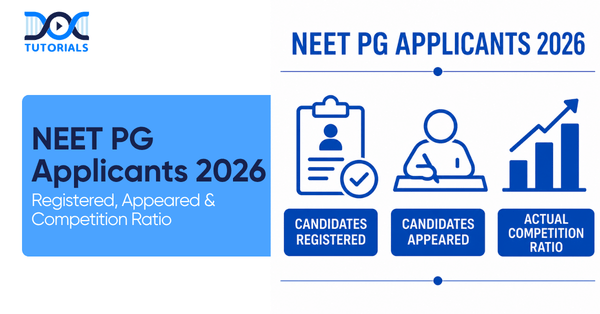
NEET PG Applicants 2026: How many candidates registered, appeared, and the actual competition ratio 

NEET PG Applicants

Lakhs of candidates appear for NEET PG annually to get admissions in MD/MS, PG diploma, and DNB courses. One such question often asked by candidates preparing for NEET PG exams is the following: How many candidates apply for the NEET PG exam, and what is the actual degree of competition among those who appear in the NEET PG?

Although the numbers of registrations and appearances were lower in previous years, the official data for the most recent cycle shows a clear picture of rising competition.

Discover how many candidates took NEET PG in the last 5 years, find out the total PG seats available in each state, and see which specialities are trending! Click below to grab the PDF now!

What Is NEET PG?

NEET PG is a national-level entrance examination organised by NBEMS for getting admission in postgraduate medical programmes. It acts as an entry test for MD/MS, PG Diploma, and DNB courses. 

This exam is computer-based, and according to the latest pattern, there are 180 multiple-choice questions with a total of 720 marks. 

How Many Students Registered for NEET PG?

Over the last few years, the number of candidates applying for NEET PG has been continuously above two lakh.

YearRegistered Candidates
20242,28,540
20252,42,493
20262,73,096

The record number of 2,73,096 applicants in 2026 reflects the increasing interest of medical graduates in opting for specializations in postgraduate courses. 

How Many Students Actually Appeared?

Not all applicants appear in the examination. But their participation ratio is always very high.

YearAppeared Candidates
20242,16,136
20252,30,114
20262,65,980

In NEET PG 2026, a massive 2,65,980 candidates appeared for the examination out of 2,73,096 registrations. This means that over 97 percent of registered candidates ultimately took the exam. 

NEET PG 2027: Expected Number of Candidates

As of now, NBEMS has not officially provided any statistics regarding the exact number of candidates for the upcoming NEET PG 2027. However, looking at the consistent upward trend, multiple reports estimate that the total number of competitors in the examination will easily exceed 2.8 lakh candidates next year.

The exact number will only become known when NBEMS shares the final examination statistics.

What Is the Actual Competition Ratio in NEET PG?

The competition in NEET PG becomes clearer when the number of candidates is compared with the available postgraduate seats.

According to the latest 2026 seat matrix data, there are around: 

  • 42,936 government PG medical seats 
  • 86,360 total PG medical seats in government medical colleges, private institutes, deemed universities, and DNB hospitals. 

Considering the overall numbers from the latest 2026 data: 

  • Number of candidates appeared: 2,65,980 
  • Total number of PG seats: 86,360 This makes up to one seat for approximately three candidates overall. 

Considering only the highly competitive government PG medical seats: 

  • Number of candidates appeared: 2,65,980 
  • Number of government PG seats: 42,936 It means that one government seat is shared among roughly six applicants. 

These numbers prove NEET PG to be one of the most competitive examinations for admission to PG colleges among all medical entrance tests held in India.

Why the Competition Is So High?

Two main reasons determine the level of competition:

1. Candidate Pool Size

Over two lakh MBBS graduates participate in NEET PG every year. Each year, the size of the candidate pool grows with the increasing number of medical colleges producing MBBS graduates.

2. Limited Number of PG Medical Seats

Even though the number of PG medical seats keeps growing every year, there are still fewer places than the number of candidates registering to appear in the NEET PG examination.

What This Means for Aspirants

Statistics clearly demonstrate that securing a postgraduate medical seat requires much more than simply passing the exam. You will be competing against top MBBS graduates nationwide for a highly limited number of clinical seats. 

Looking at the most recent NEET PG 2026 data: 

  • 2,73,096 registered candidates 
  • 2,65,980 appeared as candidates 
  • Over 2.8 lakh candidates are expected to apply for NEET PG 2027 
  • Approximately 86,360 total PG seats are available across India 

Therefore, it is incredibly important that future applicants prepare properly to secure their desired medical specialization and dream college. 

Frequently Asked Questions

1. How many students will register for NEET PG 2027?

While the official numbers for NEET PG 2027 will only be revealed closer to the exam date, current trends indicate that well over 2.8 lakh candidates are expected to register next year.

2. How many students appeared for NEET PG 2026?

According to the latest official exam statistics, exactly 2,65,980 students appeared for the NEET PG 2026 exam out of the 2,73,096 candidates who successfully registered.

3. How many candidates appeared for NEET PG 2025?

During the 2025 cycle, a total of 2,30,114 candidates appeared for the examination, while 2,42,493 had officially registered.

4. What is the actual competition ratio in NEET PG?

When looking at the latest 2026 figures, over 2.65 lakh candidates competed for approximately 86,360 total postgraduate medical seats. This brings the overall ratio to roughly one seat for every three candidates, though competition for top government clinical seats is much steeper at roughly one seat for every six applicants.

5. How many government PG medical seats are offered through NEET PG?

India currently offers approximately 42,936 government postgraduate medical seats according to the most recent 2026 seat matrix updates.

6. Is NEET PG one of the most competitive medical entrance exams in India?

Yes. With well over two lakh candidates taking the test every year for a limited pool of seats, NEET PG remains one of the toughest and most competitive medical entrance exams in the country.

7. Why is NEET PG so competitive?

The primary reason for such high competition is the sheer volume of graduating MBBS doctors who appear every year, combined with a strong preference for highly limited clinical branches like General Medicine or Radiodiagnosis.

8. Does registering for NEET PG guarantee a seat?

No, simply registering only confirms your eligibility to take the test. Actual admission depends entirely on your final score, your All India rank, seat availability, category reservations, and your choices during the counselling rounds.

9. How many questions are asked in the NEET PG exam?

Following the latest updated exam pattern, NEET PG now consists of 180 multiple choice questions. The exam carries a total of 720 marks, where every correct answer awards 4 marks and 1 mark is deducted for every wrong answer.

10. When will the candidate statistics for NEET PG 2027 be released officially?

The NBEMS typically publishes official registration and attendance numbers shortly after the exam is conducted. Statistics for the 2027 session will most likely be made public around August 2027.

Conclusion

Although the exact numbers for NEET PG 2027 are not yet available, recent exam trends show a massive surge in medical graduates pursuing higher education. During the recent 2026 session, a record-breaking 2,73,096 candidates registered, and 2,65,980 actually appeared for the exam. With the total postgraduate medical seat count sitting around 86,360, the competition remains incredibly high.

Only dedicated preparation, consistent practice, and a clear understanding of the new exam pattern will help you secure your desired clinical seat in the upcoming session. Unlock your potential with DocTutorials! Our comprehensive support in preparation, revision, and expert faculty makes conquering NEET PG not just achievable, but a stepping stone to your dreams. Join our meticulously crafted NEET PG Plans today and take the decisive step towards your success!

NEET PG Online Live Power Pack
DocTutorials App Download Now

Latest Blogs

AIIMS Cut Off 2026 for INI-CET: Branch-wise Expected Cut-off Ranks Based on Historical Data

AIIMS CUT OFF

AIIMS cut-off 2026 for INI CET refers to the minimum percentage of marks required to qualify for the exam. The All India Institute of Medical Sciences determines the cut-off marks based on factors such as the difficulty level of the examination, the total number of candidates, and the availability of seats. It is released with the INI CET result for each session. 

Candidates who secure marks above or equal to the cut-off are eligible for counselling and the admission procedure. Before applying for counselling, candidates should check category-wise cut-off marks, as they vary by category.

Keep reading to learn more about the INI CET cut-off marks 2026, how to check the cut-off, and the factors that affect it!

What is the Cut-off for INI CET January 2026 Admission?

INI CET previous year admission cut-off ranks were determined by round-wise seat allotment results. In Round 1, UR candidates needed rank 7621, rising to 10022 in Round 2. EWS went from 17596 to 25907, OBC from 11318 to 14062, SC from 20266 to 22540, and ST from 27569 to 30606 across both rounds.

The cut-off for the previous year’s admission rank in INI CET is provided in the table below. It is decided as per the result of the round-wise seat allotment.

CategoryAdmission Cut-off Rank of Round 1Admission Cut-off Rank of Round 2
UR762110022
EWS1759625907
OBC1131814062
SC20266 22540
ST2756930606

What is the Expected Cut-off for INI CET July 2026?

Based on previous counselling data, top clinical branches in INI CET July 2026 will close at competitive ranks in round 2 and open rounds. MD Dermatology (less than 150), MD General Medicine (less than 250), and MD Radiodiagnosis (less than 400) have very high competition, while MD Community Medicine and Pathology have moderate competition, with ranks below 12000 and 8000, respectively.

As per the previous year’s counselling data, it is expected that top clinical branches will close at competitive ranks, mostly in round 2 counselling and open round. The table below explains the branch-wise cut-off marks for July 2026:

BranchExpected UR Closing RankCompetition Level
MD Community MedicineBelow 12000Moderate
MD PathologyBelow 8000Moderate
MD AnaesthesiologyBelow 2500Moderate to High
MS OrthopaedicsBelow 1800High
MS Obstetrics & GynaecologyBelow 1500High
MS General SurgeryBelow 1200High
MD PaediatricsBelow 800High
MD Radio DiagnosisBelow 400Very High
MD General MedicineBelow 250Very High
MD DermatologyBelow 150Very High

What is the AIIMS Delhi Cut-off Distribution Over the Past 5 Years?

AIIMS Delhi INI CET cut-offs in the last 4-5 years have shown very high competition for top programs. MD Radiology within the top 50, MD General Medicine within the top 100, both highly competitive. MS General Surgery (top 150) and MD Paediatrics (top 200) continue to face extremely high competition, suggesting strong demand for these prestigious clinical specialities at India’s premier institute.

The cut-off distribution of AIIMS Delhi INI CET over the past 4 to 5 years is provided in the table below:

ProgramReported Cut-off (General Type)Trend (Last 4-5 Years)
MD (Radiology)Top 50 RankExtremely Competitive
MD (General Medicine)Rank in Top 100Extremely Competitive
MS (General Surgery)Top 150 RankVery High
MD (Paediatrics)Top 200 RankVery High

How to Check INI CET Cut-off 2026?

AIIMS cut-off 2026 will be released on aiimsexams.ac.in shortly after the results are announced. The candidates have to log in and click on ‘Academic Courses’, select INI CET 2026 and open the cut-off notification. The document provides the category-wise cut-off percentiles with ranks, which help applicants check their qualification status and expected chances of admission across categories.

The AIIMS cut-off 2026 is available through the official examination portal of AIIMS. Cut-off details are usually released shortly after the result is announced. Candidates can access the cut-off marks in the following steps:

Step 1: Log in to aiimsexams.ac.in, the official website of AIIMS

Step 2: Select the tab for “Academic Courses” for any type of examination-related updates

Step 3: Click on the link for INI CET 2026

Step 4: Check for the “INI CET cut-off 2026” notification and click to open the document.

Step 5: It will display category-wise cut-off percentiles and corresponding ranks.

How to Calculate the INI CET Cut-off 2026?

INI CET Cut-off 2026 uses the percentile method, ranking candidates by relative performance. Raw score, number of candidates, and performance of all candidates are considered while calculating cut-off marks. AIIMS publishes the minimum qualifying percentiles and closing ranks for all the specialisations of AIIMS, JIPMER, PGIMER and NIMHANS.

The INI CET Cut-off 2026 is calculated using the percentile method, which ranks candidates based on their relative performance compared to all other test-takers. 

The variables used while calculating the cut-off marks are:

  • The candidate’s raw score
  • Total number of applicants who appeared for the exam
  • Relative performance of all test-takers

AIIMS then publishes the minimum qualifying percentile and closing ranks for each specialisation across participating institutes such as AIIMS, JIPMER, PGIMER, and NIMHANS.

What are the Factors that Influence INI CET Cut-off 2026?

AIIMS cut-off 2026 is based on 4 important factors: the number of applicants, the availability of seats, the difficulty level, and high-demand subjects. More candidates mean increased competition and cut-off, more seats mean lower cut-off, harder exams mean lower cut-off, and easier exams mean higher cut-off. The popular branches like Radiology, Dermatology and Medicine at AIIMS Delhi have a significantly higher cut-off.

The following are the key factors that determine the AIIMS cut-off 2026:

  • Number of Applicants

If the number of candidates is higher, the competition will be higher, increasing the cut-off marks.

  • Availability of Seat

If a greater number of seats are available, the cut-off marks will be lower, and if fewer seats are available, the cut-off marks will be higher.

  • Difficulty Level of the Paper

In case of a harder exam, the cut-off marks are set slightly lower. However, for easier exam papers, it is higher.

  • Institute and Specialisation Demand

Popular branches like Radiology, Dermatology, Medicine, etc., at AIIMS Delhi have a significantly higher cut-off.

FAQs about AIIMS Cut-off 2026 for INI CET

  1. Which INI CET cut-off categories are available?

The categories available for INI CET cut-off marks are EWS, General, OBC, SC, and ST. You need to score at least the cut-off marks for your category. 

  1. In the INI CET cut-off data, which states and college types are prevalent?

Assam, Bihar, Chhattisgarh, Delhi, and Punjab are the top states in the INI CET cut-off data. AIIMS is the top college category in this regard, and the cut-off marks are decided based on several factors.

  1. What level of rank is sufficient for the INI CET?

There is no single safe rank for INI CET admission, as cut-offs vary by category, preferred institute, speciality, and counselling round. Since INI CET admission cut-offs are generally compared through closing ranks, candidates should check the latest course-wise and institute-wise closing ranks for their category. As a rule, a numerically lower rank gives better chances. For a realistic estimate, compare your rank with the last three to five years’ closing ranks and shortlist options where your rank is equal to or better than the recent closing cut-off.

  1. Which universities take the INI CET?

NIMHANS, AIIMS Jodhpur, AIIMS Bhopal, AIIMS Bhubaneswar, and AIIMS Patna are among the top universities according to INI CET cut-off statistics.

  1. Which courses are most popular among colleges that accept INI CET?

M.Ch. in Paediatric Surgery, MD in Anaesthesia, MD in Anaesthesiology, MD in Anatomy, and MD in Paediatrics are among the top courses (by college coverage) for INI CET.

Conclusion

The AIIMS cut-off 2026 is determined by the authorities after considering factors such as the difficulty level of the examination, the number of candidates who appeared, and the availability of seats. Candidates should prepare themselves to score higher marks so that the cut-off does not become an issue in securing their seats in a reputed college.

In this regard, online coaching like DocTutorials can be of great help. We offer professional guidance through video lectures, Quick Revision Programmes, high-quality study materials, and more. Join our INI CET course for more information! 

NEET PG Online Live Power Pack
DocTutorials App Download Now

Latest Blogs

What is the INI-CET exam? Eligibility, Conducting Body, Structure and Career Outcomes Explained

what is INI CET EXAM

Doctors in India who want to gain admission to top postgraduate medical universities or institutions should take the INI CET exam. It is one of the crucial entrance examinations conducted for admission to PG medical and dental courses at reputed government medical institutions.

INI CET or Institute of National Importance Combined Entrance Test qualified candidates can study in AIIMS, JIPMER, PGIMER, NIMHANS, or SCTIMST. Keep reading to learn more about what is INI-CET exam, its eligibility criteria, conducting body, exam pattern, and career outcomes. 

What is the INI-CET Exam?

The INI CET exam is conducted by AIIMS, New Delhi, for candidates seeking admission to PG medical courses such as MS, MD, MCh, MDS, etc. It is a computer-based entrance exam for medical students who want to seek admission to reputed government medical colleges.

The INI CET is a computer-based national-level entrance examination for candidates seeking admission to PG medical courses such as MS (Master of Surgery), MD (Doctor of Medicine), MDS (Master of Dental Surgery), MCh, and DM.

AIIMS New Delhi conduct this examination on behalf of all the other participating INIs (Institutes of National Importance).

What are the Eligibility Criteria for Candidates Appearing for the INI-CET Exam?

To apply for the INI CET exam, candidates must fulfil certain eligibility requirements. Each candidate should have a valid MBBS degree from a recognised institution and complete the compulsory 12-month internship. General and OBC candidates should have scored a minimum of 55% marks in MBBS or BDS, and for SC or ST, the minimum score is 50%.

Candidates applying for the INI CET exam should meet the eligibility criteria as set by the conducting bodies. Every candidate should know the eligibility criteria to ensure that they fulfil them. Here are the eligibility criteria for the INI CET exam:

  • You should have a valid MBBS degree for MS, MD, DM (6 years), BDS, or MCh (6 years) degree from any NMC (National Medical Commission) or MCI (Medical Council of India) recognised institution.  
  • General, EWS, or OBC candidates should have obtained a minimum aggregate mark of 55% in MBBS or BDS to appear for the INI CET exam. For SC or ST candidates, the minimum marks are 50%.
  • Each candidate should have completed a compulsory 12-month internship before applying for the INI CET exam. They need to provide the internship completion certificate while applying. 

Who is the Conducting Body for INI-CET Exam?

INI-CET application, examination, result, counselling and seat allocation are conducted by AIIMS, New Delhi. It has several Institutes of National Importance participating, including AIIMS campuses, PGIMER Chandigarh, NIMHANS Bengaluru, SCTIMST Trivandrum and JIPMER Puducherry.

The conducting body for the INI CET exam is AIIMS, New Delhi. It manages the application process for this exam, conducts the exam, announces the result, and handles the counselling and seat allocation process. No individual institute conducts any separate PG entrance exam for the above-mentioned courses. However, several institutions participate in INI CET examinations. Here they are:

  • AIIMS (multiple campuses across India)
  • PGIMER Chandigarh
  • NIMHANS Bengaluru
  • SCTIMST Trivandrum
  • JIPMER Puducherry

Given the research output, academic standards, and clinical exposure of these institutes, they are designated as Institutes of National Importance.

What is the INI-CET Exam Structure?

Candidates appearing for the INI CET exam must understand the exam pattern to prepare strategically. It is a postgraduate medical entrance exam conducted by AIIMS, New Delhi, in online mode. The exam lasts 3 hours and includes 200 multiple-choice questions.

Before starting your preparation for the INI CET exam, you should understand the structure of the examination. It helps your preparation, revision, and practise. Despite their hard work, some candidates underperform due to misalignment with the exam pattern.

The table below provides a clear overview of the INI CET exam pattern:

FeaturesDetails
Name of the ExamINI CET 2026
Type of the ExamPG medical entrance
Conducting BodyAIIMS, New Delhi
Mode of ExamCBT (Computer-Based Test) 
Offered CoursesMS, MD, MCh (6 years), DM (6 years), MDS
Duration of Exam180 minutes (3 hours)
Language of ExamEnglish
Total Questions200 MCQs
Marking Scheme+1 for each correct answer, -1/3 for a wrong answer, and 0 for unanswered questions
Question TypeMCQs (Multiple Choice Questions)

What are the Career Options Available for INI-CET Qualified Candidates?

Candidates completing the INI CET exam can pursue a career in orthopaedics, obstetrics, general surgery, dermatology, paediatrics, dental sciences, neurosurgery, etc.

There are multiple career options for candidates who have successfully completed their INI CET exams. They are eligible for the following PG programmes:

  • Master of Surgery (MS): Candidates can pursue a career in General Surgery, as an Obstetrician and Gynaecologist, Orthopaedics, etc.
  • Doctor of Medicine (MD): Candidates can pursue a career as specialists in Paediatrics, Internal Medicine, and Dermatology.
  • Doctorate of Medicine (DM): Candidates can pursue a career as a super-specialist in Neurology and Cardiology.
  • Master of Dental Surgery (MDS): Candidates can pursue a career in advanced dental sciences. 
  • Master of Chirurgiae (MCh): Candidates can pursue a career in advanced surgical training in Neurosurgery and Cardiothoracic Surgery.

Graduates can select fields that fit their interests and strengths thanks to the distinctive career pathways offered by each of these specialisations.

FAQs about INI-CET Exam

  1. What is the INI CET exam?

All India Institute of Medical Sciences (AIIMS) administers the Institute of National Importance Combined Entrance Test (INI CET) 2026, a national entrance exam for admission to MD, MS, MDS, DM, and MCh programs in prestigious medical schools.

  1. Who can appear for the INI CET in 2026?

Candidates must finish the required internship by the deadline and hold an MBBS or BDS degree from an accredited university.

  1. How often does INI CET take place in a year?

The INI CET is held twice every year. The first session occurs in January, and the second one in July. Candidates can apply in any of these sessions as per their preference and preparation.

  1. How many questions should I try to answer safely?

Candidates should aim to answer at least 180–185 questions with 90% accuracy. Since there is a -1/3 penalty for wrong answers, candidates should focus on answering as many questions correctly as possible to avoid negative marking.

  1. Do all subjects have the same importance?

Candidates should pay attention to high-weight subjects like pathology, medicine, surgery, and OBGYN, but don’t overlook low-weight subjects that account for 15–20% of your final score.

Conclusion

For medical graduates hoping to pursue postgraduate studies at India’s top medical institutions, INI CET 2026 is an essential test. The exam, administered by AIIMS New Delhi, guarantees a uniform, open admissions process for MD, MS, MDS, DM, and MCh programs across Institutes of National Importance. 

To guarantee a top rank, candidates should carefully follow official notifications, fulfil eligibility criteria, and prepare strategically. Besides, candidates can join online coaching like DocTutorials for professional guidance. Our course includes video lectures, quality study materials, and Quick Revision Programmes by expert faculty.

Join our INI CET course for more updates!

NEET PG Online Live Power Pack
DocTutorials App Download Now

Latest Blogs

NEET PG Online Live Power Pack
DocTutorials App Download Now