neet-pg Archives - Page 9 of 20 -

Septic Arthritis: Causes, Symptoms, Diagnosis, and Treatment Options

Septic Arthritis | DocTutorials

Septic arthritis is a serious, painful infection that affects the joint fluid and tissues of specific joints in your body. People affected with septic arthritis experience severe pain, swelling, and difficulty in moving the affected joint.

It is generally caused by bacteria, but can also be caused by a fungus or a virus. These germs can travel from other parts of your body through the bloodstream and cause infection. However, it can also develop when germs enter a joint directly from an injury.

Keep reading for a detailed analysis.

What is Septic Arthritis?

Septic arthritis is a severe infection of a joint caused by germs entering the joint space. It leads to pain, swelling, and inflammation, most often affecting large joints like the hips or knees.

Septic arthritis, also known as infectious arthritis, is a serious infection in the joint (synovial) fluid and its connective tissues. The infection develops when harmful germs reach the joint space, causing severe infections that can damage the joints permanently if not treated immediately.

It causes inflammation in the cartilage surface (a type of connective tissue) that lines your joints and the synovial fluid that lubricates the joints. The infection commonly affects the larger joints in the lower half of your body, such as the hips and the knees.

However, it can also affect other joints in the body, like the shoulders, ankles, sacroiliac joints (the joints that connect your pelvis and lower spine), and sternoclavicular joint (the joint that connects your collarbone to your breastbone).

What are the Causes of Septic Arthritis?

Bacteria are the main cause of septic arthritis, but viruses, fungi, or other germs can also cause it. The infection usually spreads to the joint from another part of the body through the bloodstream.

Septic arthritis is usually caused by bacteria. However, the infection can also arise from fungus, mycobacteria, a virus, or other pathogens. It mostly begins somewhere else in the body and then spreads to your joints through the bloodstream.

Here are the specific organisms that are known to cause septic arthritis:

  • Staphylococcus Aureus: Also known as Staph, this bacterium mostly causes septic arthritis in children and adults.
  • Methicillin-resistant Staphylococcus Aureus (MRSA): It is a type of staph infection that doesn’t respond to certain antibiotics. People who use IV drugs, or those with HIV (Human Immunodeficiency Virus) infection, or individuals suffering from diabetes, are at a higher risk of developing septic arthritis from MRSA.
  • Groups A and B Streptococci: Elderly individuals with chronic conditions like diabetes and cirrhosis are most likely to be affected by septic arthritis arising from streptococci bacteria.
  • Neisseria Gonorrhoeae: This bacterium usually causes gonorrhea, a sexually transmitted infection (STI). People suffering from gonorrhea are at an elevated risk of developing gonococcal arthritis, a form of septic arthritis.
  • Neisseria Meningitidis (Meningococcus): This bacterium is responsible for causing meningitis, a condition that causes inflammation of the protective membranes covering your brain and spinal cord. It can potentially cause septic arthritis, but it is a rare condition.

What are the Risk Factors of Septic Arthritis?

Risk factors for septic arthritis include a weak immune system, existing joint diseases, or previous joint injuries. People with artificial joints, skin infections, or those taking immunosuppressant medicines are also at a higher risk.

Apart from bacterial attack, several other factors can also heighten the risk of septic arthritis:

  • Low Immunity: A weakened immune system caused by chronic conditions like diabetes, liver damage, kidney problems, or immunosuppressant drugs can increase the risk of septic arthritis.
  • Artificial Joints: If you have undergone joint replacement surgery, germs might reach the artificial joints through the wound or other parts of the body.
  • Skin Sensitivity: If you have sensitive skin that is easily damaged but heals slowly, it can allow bacteria to enter the body more easily. Skin issues like psoriasis, eczema, and infected skin wounds raise the risk of septic arthritis. Regular injection of drugs into the skin can also pose an increased risk of infection.
  • Existing Joint Problems: Chronic conditions that affect the joints, such as osteoarthritis, gout, rheumatoid arthritis, or lupus, can increase the risk of septic arthritis. Previous joint injuries can also contribute to the infection.
  • Rheumatoid Arthritis: Individuals with rheumatoid arthritis are prescribed immunosuppressant medications, which can weaken the immune system, increasing the risk of infection. However, the diagnosis of septic arthritis is difficult in these patients due to similar symptoms.

What are the Symptoms of Septic Arthritis?

Symptoms of septic arthritis usually start suddenly and are severe. They include intense joint pain, swelling, redness, fever, fatigue, and difficulty moving the affected joint.

Symptoms of septic arthritis often appear suddenly and are unbearable. However, some early symptoms of septic arthritis can include:

  • Severe joint pain and tenderness, usually in the hip or the knee.
  • Inflammation, redness, and warmth in the affected joint area.
  • Fever and Chills
  • Constant fatigue
  • Reduced movement in the affected joint
  • Severe pain that makes patients reluctant to move their affected joint
  • General discomfort or malaise

How is Septic Arthritis Diagnosed?

Septic arthritis is diagnosed through a physical examination and confirmatory tests. These include joint fluid aspiration, blood tests, and imaging modalities such as X-rays, ultrasound, and MRI to assess joint damage and infection.

After the physical examination of the joint, if the doctor suspects an infection, then he may prescribe these tests to diagnose septic arthritis:

  • Aspiration: Synovial fluid will be withdrawn from the affected joint with a fine needle to detect the presence of bacteria. This is called synovial fluid aspiration.
  • Blood Tests: The doctor may also prescribe blood tests to assess whether the immune system is responding to the infection. It also helps to detect other possible issues arising from the infection.
  • X-rays: If X-rays of the bones show a widened joint or soft-tissue bulge, it can indicate septic arthritis.
  • Ultrasound: Ultrasound is performed before aspiration to assess joint swelling and visualise the synovial fluid during aspiration.
  • MRI (magnetic resonance imaging): It uses a large magnet and radio waves to take accurate images of the organs and bones in your body. An MRI of the joints can help detect early cases of septic arthritis.

What are the Treatment Options for Septic Arthritis?

Septic arthritis is treated by removing the infected joint fluid and giving antibiotics. In some cases, surgery and physiotherapy are needed to restore joint function and movement.

Here are the treatment options available for septic arthritis, depending on your condition:

  • Drainage of Synovial Fluid

The medical practitioner will use a fine needle to withdraw the infected fluid from the joint. It is done more than once as you recover gradually.

  • Surgery

It is done to remove the inflamed tissue through surgical debridement. Open surgery is performed for adequate drainage of the infected fluid from joints like the hip, which are harder to access.

Whereas anthropic surgery is done by inserting a camera-equipped tube into the joint through a small incision. Then, additional small incisions are made to allow the drainage of infected fluid.

  • Antibiotics

After identifying the infection-causing bacteria, the doctor may prescribe intravenous antibiotics initially. After some time, the patient is shifted to oral antibiotics. The treatment can last for around 2-6 weeks.

  • Physiotherapy

Physical therapy is generally recommended to restore joint function and to prevent weakening of muscles around the affected joint area.

  • Removal of Artificial Joint

In case the infection has affected an artificial joint, then the doctor removes the artificial joint and replaces it with a joint spacer, a device made of antibiotic cement. A few months after recovery, the doctor will replace your artificial joint.

  • Joint Preservation

If the artificial joint can’t be removed, the doctor will clean it and remove the damaged tissue. The patient is then put on long-term antibiotic treatment to prevent the recurrence of infection.

What is the Prevention of Septic Arthritis?

Septic arthritis can be prevented by avoiding infections and keeping wounds clean. Managing long-term illnesses, using safe practices, and treating infections early also help reduce risk.

To reduce the risk of septic arthritis, you can take these few preventive measures, such as:

  • Proper Wound Care

Clean and dress all cuts and wounds properly to avoid infection, which could lead to septic arthritis. Keep a close eye on signs of infection, such as redness, warmth, or pus.

  • Avoid Drug Misuse

Refrain from frequent injection of drugs as it increases the risk of infection through contaminated needles.

  • Proper Management of Chronic Conditions

Individuals with chronic health issues like diabetes or immunodeficiency disorders should effectively manage their health with proper medication and regular health check-ups.

  • Practice Safe Sex

Use appropriate protection during any sexual activity and maintain an open conversation about sexual health history with your partner.

  • Monitor Artificial Joints

People with prosthetic joints should pay close attention to any kind of changes in joint function or discomfort.

  • Proper Treatment of Infections

Several infections, such as urinary tract infections and wounds, should be treated promptly to prevent bacterial spread to joints and other areas of the body.

FAQs about Septic Arthritis

  1. Can I recover from septic arthritis permanently?

Yes, with early diagnosis and effective treatment, patients can make a full recovery from septic arthritis. However, nearly one-third of patients experience some kind of permanent joint dysfunction or chronic pain.

  1. What is the most common bacterium that causes septic arthritis?

Staphylococcus aureus and Methicillin-resistant Staphylococcus aureus (MRSA) are the most common bacteria responsible for causing septic arthritis. Apart from this, Streptococcus is found in some cases, whereas Neisseria gonorrhoeae bacteria cause septic arthritis in sexually active young adults.

  1. How serious is septic arthritis?

The severity of septic arthritis depends on the organism causing it. Despite antibiotic treatments, septic arthritis has a mortality rate of 7% to 15%, whereas Staphylococcus aureus infections carry a mortality rate of up to 50%.

  1. Is septic arthritis contagious?

No, septic arthritis is not contagious. It can’t pass through casual contact. However, it may spread from person-to-person contact if proper hygiene is not maintained or wounds are left open and untreated.

  1. Can septic arthritis spread to other areas in my body?

Yes, septic arthritis can spread to other areas in the body. If left untreated for a long time, the infection can enter the bloodstream and cause sepsis. This severe systemic infection can affect multiple organs, including the heart, lungs, and kidneys.

Conclusion

Septic arthritis is a serious joint infection that requires early diagnosis and prompt medical care. It can be managed effectively through surgery, antibiotic treatment, proper drainage of infected fluid, and targeted physical therapy. 

People with chronic health conditions and existing joint problems should actively monitor their health and promptly report any joint discomfort to their doctor. To understand more such complex NEET PG concepts, DocTutorials can be your study partner.

We offer crisp videos, clinical Qbank, exam-focused notes, flashcards, and mindmaps to ensure complete clarity across these concepts. Join DocTutorials and explore our NEET PG course to excel in your medical career!


NEET PG Online Live Power Pack
DocTutorials App Download Now

Latest Blogs

Latex Allergy: Causes, Symptoms, Diagnosis, and Treatment

Latex Allergy | DocTutorials

Latex is a natural product extracted from trees to manufacture products such as gloves and rubber. While most people remain unaffected in the presence of latex, people with latex allergy experience a runny nose, watery eyes, and swelling when they come into contact with latex.

Read more to learn about the meaning of latex allergy, its causes, types, symptoms, diagnostic tests, and treatment options available.

What is Latex Allergy?

When the body perceives latex as a harmful foreign body, it mounts a hypersensitive reaction to flush it out, which is known as latex allergy.

A latex allergy is defined as a hypersensitive reaction of the body to the natural rubber protein latex that is extracted from the sap of the rubber tree.

The reactions can cause skin itching, rashes, skin redness, and watery eyes. The symptoms get worse with increased exposure.

What are the Types of Latex Allergy?

There are three types of latex allergies: Irritant Contact Dermatitis, Allergic Contact Dermatitis, and Immediate Allergic Reaction or Latex Hypersensitivity, which can be managed with appropriate drug therapy.

Three types of latex allergy are seen commonly, and they are:

  1. Irritant Contact Dermatitis: This is the mildest form of allergic reaction that occurs from repeated exposure to chemicals in latex gloves and causes dryness, scaling, burning, and other skin problems. It usually appears 12 to 24 hours after exposure to latex.
  2. Allergic Contact Dermatitis: Symptoms being same as irritant contact dermatitis; allergic Contact Dermatitis is a reaction to the additives used for processing the latex.

This reaction is more severe than the above type and gradually spreads to other parts of the body—the symptoms last longer, with them appearing within 1 to 4 days of exposure.

  1. Immediate Allergic Reaction: This is the most serious form of allergic reaction, which can turn out to be life-threatening if not managed on time. The symptoms include tremors, chest pain, low BP, troubled breathing, fever-like symptoms, nasal allergy, etc.

What are the Causes of Latex Allergy?

Latex allergy occurs when our body perceives latex protein as a harmful foreign body and attempts to eliminate it. After exposure, our body produces IgE antibodies that attach to immune cells and seek out latex proteins. 

Whenever the body is exposed to latex again, IgE recognises it and triggers the release of histamine that flushes it out. Histamine also causes vasodilation, which manifests as hives, a runny nose, and respiratory distress. With each subsequent exposure, the reactions worsen.

What are the Risk Factors of Latex Allergy?

The risk factors of people developing latex allergy are occupational exposure, undergoing frequent surgeries, and having food allergies.

Latex allergy might be present in anybody; however, some people are more prone to developing latex allergy, and they are:

  • People with Occupational Exposure: People working in healthcare or food preparation, where latex gloves are used extensively, may become sensitised to latex and gradually develop a latex allergy.
  • People Undergoing Frequent Surgeries: Children and adults who undergo frequent surgeries may develop a latex allergy from the gloves and catheters used during the procedure.
  • People with Food Allergies: People with a latex allergy may also be allergic to certain foods, such as chestnuts, avocados, bananas, and kiwis. This phenomenon is known as latex-food syndrome.

What are the Symptoms of Latex Allergy?

The symptoms of latex allergy range from mild to severe, depending on the amount and time of exposure. Some common symptoms include wheezing, a runny nose, itching, skin redness, and a rash.

Go through the following section to get an idea about mild, moderate, and severe symptoms when someone with latex allergy gets exposed to latex or latex products:

  • Mild Symptoms

Mild allergic symptoms include:

  1. Skin Redness
  2. Itching
  3. Hives or Rashes
  • Moderate Symptoms

Some of the moderate symptoms are:

  1. Runny Nose
  2. Wheezing
  3. Cough
  4. Difficulty Breathing 
  5. Scratchy Throat 
  6. Itchy and Watery eyes 
  7. Sneezing
  • Severe (Anaphylactic Symptoms)

Anaphylaxis is known to be the most severe allergic reaction that can turn out to be life-threatening. Some of the anaphylactic reactions are:

  1. Hives or Swelling
  2. Confusion
  3. Rapid or Weak Pulse 
  4. Dizziness
  5. Loss of Consciousness 
  6. Wheezing
  7. Nausea and Vomiting 
  8. Drop in Blood Pressure

How to Diagnose Latex Allergy?

Latex allergy is diagnosed using blood tests and skin tests. However, it is essential to provide a detailed history of your job and food habits.

An allergist will examine you and ask about your symptoms after you have been exposed to latex. They may ask:

  • Your food habits
  • Your family history of allergies
  • Your exposure to latex
  • Your past medical and surgical history

After a detailed history taking, the allergist might suggest:

  • Blood Tests: Blood is drawn for an IgE-mediated latex allergy test, in which the presence of IgE antibodies is detected upon exposure to latex.
  • Skin Tests: In this procedure, the allergist scratches or pricks the skin with a small amount of latex, and the resulting skin reaction is measured.

What are the Treatment Options for Latex Allergy?

Latex allergy cannot be treated permanently, and only symptomatic management is available to reduce its severity.

As of now, there is no permanent cure for latex allergy, apart from avoiding latex and latex products. However, to reduce the allergic reaction, the following group of drugs is prescribed:

  • Anti-histamines: This group of drugs will help you minimise your symptoms if you get exposed to latex.
  • Epinephrine: Epinephrine comes in the form of injectable pens that are used to prevent severe anaphylaxis till you reach a healthcare facility.
  • Steroids: Steroids are prescribed to calm the immune system and reduce the systemic swelling that has developed due to the anaphylaxis.

What are the Preventive Tips for Latex Allergy?

Latex allergy can be prevented by avoiding latex products and letting everyone know that you are allergic to latex. The allergic person should also note objects and foods that might trigger the latex allergy.

The best way to prevent latex allergy is to avoid latex products. This means that every product label should be checked, starting from clothing to bandages. The person should:

  • Inform everyone about his latex allergy.
  • Avoid areas where latex products are used and where latex is in the air.
  • If available, go for a medical alert bracelet to let everyone know about your allergy during a medical emergency.
  • Before any medical procedure, inform your health care provider to use latex-free equipment.
  • If diagnosed with IgE-mediated latex allergy, carrying injectable epinephrine is advisable.
  • When eating out, request that the food be prepared with latex-free gloves.

The products containing latex include:

  • Gloves
  • Sanitary napkins, condoms, and diaphragms
  • Pacifiers and nipples for bottle feeding
  • Makeup products and masks as a part of the costume

A person with a latex allergy should avoid foods such as chestnuts, apples, melons, and papayas, as well as some vegetables, such as potatoes and carrots.

FAQs about Latex Allergy

  1. How do you diagnose a latex allergy?

A skin test should be done by pricking the skin with a small amount of latex, which will cause a raised bump if the result is positive.

  1. How do you treat a latex allergy?

The best medicine for treating latex allergy is to avoid latex and latex products. However, during severe allergic reactions, the patient should be immediately injected with epinephrine.

  1. What are the seven symptoms of an allergic reaction?

The seven symptoms of an allergic reaction are:

  • Runny or Stuffy Nose
  • Itchy or Watery Eyes 
  • Fatigue
  • Skin Rashes or Hives 
  • Sneezing
  • Coughing or Wheezing
  • Throat Irritation
  1. Is there a blood test for latex allergy?

Doctors usually order an IgE-mediated blood test to confirm a latex allergy diagnosis.

  1. What is a Type 4 latex allergy?

Type 4 latex allergy, also known as contact dermatitis, is characterised by redness and itching that occur upon exposure to latex products.

Conclusion

Living with a latex allergy can be challenging, as a lot of products that surround us are made with latex. However, contacting an allergist and following preventive tips can reduce the risk of exposure. Learning about the signs of allergy will help you get the treatment as soon as possible.

If you want to learn more about latex allergy and its associated topics, DocTutorials can be your study partner. We offer crisp videos, a clinical Qbank, exam-focused notes, flashcards, and mind maps to ensure aspirants have a clear grasp of concepts across NEET PG topics.

Join DocTutorials today and explore our NEET PG course to excel in your medical career!

NEET PG Online Live Power Pack
DocTutorials App Download Now

Latest Blogs

Genetic Disorders | Causes, Classification, and Management

Genetic Disorders | DocTutorials

Genetic disorders are among the most complex health conditions known to medicine. These are disorders that result from an abnormal change in an individual’s genetic material. The change then affects the way the body grows, functions, or protects itself.

They occur in 2–5% of all live births, contribute to up to 30% of pediatric hospital admissions, and are responsible for nearly 50% of childhood deaths in industrialised nations. In this article, we will explore the different types of genetic disorders, their causes, common symptoms, and available treatment options.

Keep reading for a detailed insight.

What are Genetic Disorders?

Genetic disorders are health problems caused by abnormalities in a person’s genetic material, ranging from single-gene mutations to changes in chromosome number or structure.

Genetic disorders are diseases or conditions caused by a genetic abnormality in a person’s DNA (deoxyribonucleic acid). There are various kinds of genetic disorders. Sometimes, a genetic mutation in a single gene can cause a disease or condition in a person.

On the other hand, a gene might not have a mutation, but a person might have more or fewer copies of the gene than the average, which can cause the disease or condition. Some health conditions result from an individual having an abnormal number of chromosomes or when a segment of a chromosome is missing, duplicated, or misplaced.

These structural changes can deeply affect normal development and the body’s functions. Nevertheless, a vast number of genetic disorders do not originate from a single mutation only. Rather, they are attributable to the combined effects of several genetic variations along with lifestyle factors and environmental exposures.

These are referred to as complex conditions, which indicate the sophisticated interaction between our genes and the surrounding ​‍​‌‍​‍‌​‍​‌‍​‍‌world.

What are the Types of Genetic Disorders?

Genetic disorders are broadly categorised into Mendelian (single-gene), Chromosomal (numerical/structural changes), Multifactorial (gene-environment interaction), and Mitochondrial inheritance patterns.

Here are various types of genetic disorders:

  1. Mendelian Disorder

Mendelian disorders are genetically caused by mutations in a single gene, and identification of such disorders through pedigree analysis is simple. Mendelian disorders could be autosomal dominant disorders, autosomal recessive disorders, sex-linked dominant, sex-linked recessive, or mitochondrial.

The examples of the most common Mendelian disorders include:

  • Cystic fibrosis (autosomal recessive)
  • Haemophilia (sex-linked recessive)
  • Albinism (autosomal recessive)
  • Sickle cell anaemia (autosomal recessive)
  1. Chromosomal Disorder

Chromosomal disorders are those diseases that result from any change in the number or structure of chromosomes. Losing or gaining a whole chromosome is sometimes the case in such a disorder. This kind of disorder usually leads to death since it affects a large number of genes.

A few of the major chromosomal abnormalities are:

  • Down’s syndrome- the addition of a chromosome 21 (trisomy)
  • Turner’s syndrome-absence of an X chromosome (XO)
  • Kleinfelter’s syndrome, addition of an X chromosome (XXY)
  1. Multifactorial Genetic Inheritance

This pattern is known as polygenic inheritance, where multiple genes work together to shape the condition. These disorders arise from a combination of gene mutations and external factors rather than a single genetic change.

Examples of such complex conditions include:

  • Heart disease
  • High blood pressure
  • Alzheimer’s disease
  • Obesity
  • Diabetes
  • Cancer
  • Arthritis
  1. Mitochondrial Inheritance

This kind of genetic disorder results from the mutations occurring in mitochondrial DNA, which is not in the nucleus. Mitochondrial DNA comes from the mother. Some of the diseases caused by mitochondrial inheritance include:

  • Leber’s Hereditary Optic Atrophy (LHON)
  • Myoclonic epilepsy with ragged red fibres
  • Mitochondrial encephalopathy
  • Lactic acidosis

What are the Causes of Genetic Disorders?

Causes of genetic disorders include inherited mutations (Autosomal Dominant, Autosomal Recessive, X-linked), de novo spontaneous mutations, chromosomal abnormalities, and exposure to environmental mutagens.

Recognising the causes of genetic disorders is essential for early diagnosis and will form the basis of appropriate medical care for patients.

Some of the causes of genetic disorders are:

1. Inherited Changes

The genes may become altered in the parents and then be transmitted to children. These changes follow certain rules of inheritance:

  • Autosomal Dominant: Only one altered gene copy is needed (e.g., Huntington’s).
  • Autosomal Recessive: Both alleles of the gene must be mutated (e.g., cystic fibrosis).
  • X-linked: The mutation occurs on the X chromosome, and hence, the changes are more severe in males (e.g., haemophilia).

2. De Novo (Spontaneous) Mutations

Sometimes, mutations can occur spontaneously in an individual, often during early embryonic development. These changes aren’t inherited from parents and can explain isolated cases of certain conditions, including some forms of Down syndrome.

3. Chromosomal Abnormalities

Alterations in the number or structure of chromosomes can disrupt several genes at once. These may include:

  • Trisomies or monosomies, such as those seen in Down syndrome or Turner syndrome
  • Deletions or duplications of chromosomal segments, as in Cri-du-chat syndrome

4. Environmental Mutagens

External factors like radiation, certain infections, or harmful toxins, particularly during pregnancy, can trigger genetic mutations and result in congenital abnormalities.

What are the Symptoms of Genetic Disorders?

Symptoms of genetic disorders are diverse, depending on the disorder, and can include developmental delays, cognitive deficits, breathing problems, limb/facial anomalies, and neurological issues like seizures.

Signs vary depending on the type of disorder, the organs involved, and the severity of the disorder. You might have:

  • Behavioural changes or disturbances.
  • Breathing problems.
  • Cognitive deficits occur when the brain can’t process information as it should.
  • Developmental delays that include challenges with speech or social skills.
  • Eating and digestive issues, such as difficulty swallowing or an inability to process nutrients.
  • Limb or facial anomalies, which include missing fingers or a cleft lip and palate.
  • Movement disorders due to muscle stiffness or weakness.
  • Neurological issues such as seizures or stroke.
  • Poor growth or short stature.
  • Vision or hearing loss.

What are the Risk Factors of Genetic Disorders?

Key risk factors involve a family history of the disorder, advanced parental age (especially maternal), and a combination of complex diseases running in the family.

The different risk factors that are associated with genetic disorders can increase the probability of getting these conditions. This includes:

  1. Family History: It significantly raises the risk of inheriting or passing on the condition to the next generations.
  2. Parents’ Age: Older parents, especially mothers, are more likely to have children with chromosomal abnormalities such as Down syndrome.
  3. Combination of Diseases: When multiple conditions, such as heart disease and diabetes, tend to appear together across generations, it indicates shared genetic and lifestyle influences.

How are Genetic Disorders Diagnosed?

Identification of genetic disorders primarily involves genetic counselling and specialised DNA testing, such as carrier testing, prenatal screening, prenatal diagnostic testing, and newborn screening.

Genetic counselling might be a good option for you if a genetic disorder is prevalent in your family. Afterwards, testing may be recommended based on counselling. Most of the time, lab tests can reveal gene mutations that cause the condition.

In many instances, the person carrying the mutation will not necessarily develop the disease. A genetic counsellor will give you the risk details and will also tell you if there are any precautions you can take to remain healthy.

When family history exists, DNA testing for genetic diseases can play a vital role in planning for a family. There are options such as:

  • Carrier Testing: This is a blood test that tells if you or your partner is a carrier of a gene mutation that leads to genetic diseases. This is a must-do test for everyone who is planning a pregnancy, even if there has never been a genetic disorder in the family.
  • Prenatal Screening: The procedure normally includes taking a blood sample from a pregnant mother. It provides the probability that the fetus has a common chromosomal condition.
  • Prenatal Diagnostic Testing: Determining whether the fetus is at a high risk of certain genetic diseases is possible. The test is done on a fluid sample taken from your uterus (amniocentesis).
  • Newborn Screening: This test uses a sample of your newborn baby’s blood and is done on all babies born in Ohio. Early detection of genetic disorders in infants can facilitate timely intervention if necessary, thus helping the child’s development.

What is the Management and Treatment for Genetic Disorders?

Management strategies for genetic disorders include medications (like Enzyme Replacement Therapy), emerging gene therapy, stem cell transplants, and various supportive therapies and nutritional interventions.

Not all genetic disorders are curable, but quite a few are manageable through a combination of medical, surgical, and supportive strategies. They include:

1. Medications

  • Enzyme Replacement Therapy (ERT): For lysosomal storage diseases like Gaucher or Fabry disease
  • Gene-Targeted Drugs: e.g., Ivacaftor in cystic fibrosis
  • Hormone Therapy: Growth hormone for Turner syndrome

2. Gene Therapy (Emerging)

The primary goal of innovative strategies is to either fix or inactivate the defective gene. Gene​‍​‌‍​‍‌​‍​‌‍​‍‌ therapy is an optimal treatment for:

  • Hemophilia
  • Sickle cell disease
  • Inherited retinal dystrophies

3. Stem Cell and Bone Marrow Transplants

Indications for:

  • Hematologic conditions (e.g., thalassemia, SCID)
  • Restoring immune and blood cell production

4. Supportive Therapies

  • Physical and Occupational Therapy: Generally required in muscular and neurodevelopmental disorders
  • Speech Therapy: Mainly for Fragile X syndrome or cleft-related conditions
  • Psychosocial Support: Professional help and peer support groups facilitate coping and a better quality of life

5. Nutritional and Lifestyle Interventions

  • Special Diets: PKU needs phenylalanine restriction
  • Enzyme Supplements: Used in cystic fibrosis to help digestion
  • Continuous Monitoring: For the timely detection of ​‍​‌‍​‍‌​‍​‌‍​‍‌complications

6. Genetic Counseling and Family Support

Genetic​‍​‌‍​‍‌​‍​‌‍​‍‌ counseling plays a major role in the control of hereditary diseases. It is a support program that enables families to:

  • Recognise the modes of inheritance and calculate the probability of occurrence
  • Make informed reproductive decisions
  • Deal with the situation through therapeutic interventions and ​‍​‌‍​‍‌​‍​‌‍​‍‌guidance

FAQs about Genetic Disorders

  1. What causes genetic disorders?

Mutations in genes, chromosomal abnormalities, or inherited genetic traits cause genetic disorders. The factors may be spontaneous mutations, environmental exposure (radiation, chemicals), or inheritance from parents.

Down syndrome, cystic fibrosis, and sickle cell anaemia are examples of disorders that result from defective or missing genes, thereby affecting normal body function and development.

  1. Is autism a genetic disorder?

Autism is a neurodevelopmental disorder, and its cause is primarily genetic, although some environmental factors are involved as well. Several gene mutations and variations contribute to autism by interfering with brain development.

In contrast to a purely genetic disorder like cystic fibrosis, genetic changes that are inherited or happen spontaneously increase the risk of autism spectrum disorder (ASD).

  1. Is bipolar disorder genetic?

Yes, bipolar disorder has a significant genetic component, and people with a family history of the disorder are more likely to be affected. There are multiple genes involved, but no single gene is responsible for the disorder. In addition to that, environmental factors such as stress and trauma can trigger the disorder as well.

  1. Could genetic disorders be inherited from the mother or father?

Yes. Since a baby receives half of their genetic material from each parent, a mutation in even one of those genes can lead to what is known as a single-gene disorder. Such diseases may be transmitted through different inheritance patterns, depending on whether the defective gene comes from the mother, the father, or both.

  1. Can you live a normal life with a genetic disorder?

Several individuals with less severe genetically caused conditions can reach adulthood and lead somewhat normal lives, although some may have a shorter lifespan and face health issues related to their disorder. In cases where the condition has a gentler course, people may enjoy a normal lifespan with minimal complications.

Conclusion

Genetic​‍​‌‍​‍‌​‍​‌‍​‍‌ disorders are diseases caused by changes in genes or chromosomes, and depending on the nature of the mutations. Now, genetic tests are important for risk assessment, thereby enabling early disease detection and informed decisions about care and lifestyle.

Moreover, patient communities and local programs can help you find your way, offer emotional support, and provide practical assistance. To understand more such complex NEET PG concepts in a simplified manner, DocTutorials can be your study companion. We offer crisp videos, clinical Qbank, flashcards, and mindmaps, ensuring aspirants are well-prepared before their exam.
Join DocTutorials today and explore our NEET PG course to excel in your medical career!

NEET PG Online Live Power Pack
DocTutorials App Download Now

Latest Blogs

NEET PG 2026 Answer Key: How to Check, Challenge & Calculate Your Score

NEET PG 2026 Answer Key | DocTutorials

NEET PG is one of the biggest milestones for medical graduates in India. Every year, lakhs of students sit for this exam, hoping to grab a seat in MD, MS, or PG-Diploma programs. Since the competition is tough and the cutoff is unpredictable, students often rely on the answer key to estimate their performance.

This article will walk you through everything you need to know about the NEET PG 2026 answer key, including who releases it, how to check it, and what you can or can’t challenge. 

Keep reading for a detailed insight.

NEET PG Answer Key: Important Dates

The NEET PG answer key usually comes out a few days after the exam, but since the 2026 schedule isn’t out yet, we can go by previous patterns. Typically, the provisional answer key and response sheet get released first, followed by the final key after objections are reviewed. 

Students can go through the NEET PG 2026 answer key dates below:

EventsImportant Dates
NEET PG 2026 Exam Date 30th August 2026
Official NEET PG 2026 Answer Key September 2026

How to Check NEET PG 2026 Answer Key?

Checking the NEET PG 2026 answer key is simple; it hardly takes a minute if you have your login details ready. Students can follow the steps below to download and verify their answers.

Here are the steps to follow to check the NEET PG answer key:

  • Step 1: Go to the official website of NBEMS, nbe.edu.in. That’s the only place answer keys will be released, so don’t fall for any other random links.
  • Step 2: On the homepage, click the link that says, “NEET PG 2026 Answer Key.” Sometimes it is located under the more recent announcements, so you may need to scroll.
  • Step 3: Log in with your registration ID and password. If you forgot your password, there is an option to “Forgot Password”.
  • Step 4: After logging in, download the answer key of NEET PG in PDF format along with your response sheet. The two documents will pop up on the screen. You can download them with one click.
  • Step 5: Compare your answers with the ones given in the official answer key. This is where you’ll be able to calculate your estimated score. It won’t be the final score, but it definitely gives you a clear idea of how your exam went.

Ace Your NEET PG Prep With DocTutorials NEET PG Online Live Power Pack

NEET PG 2026 Marking Scheme

NEET PG 2026 follows a straightforward marking system where every correct answer adds 4 marks, while each wrong answer deducts 1 mark. With 180 MCQs in total, every response matters, so guessing blindly can cost you marks.

Before you start checking the answers, it is good to know how NEET PG 2026 marks every response. The marking pattern is simple and is unlikely to change from NEET PG 2025. 

There are 180 multiple-choice questions, and each of them affects your score directly — either positively or negatively. Here’s the breakdown of the marking scheme:

Response TypeMarks Awarded
Correct Answer+4 marks
Incorrect Answer–1 mark
Unanswered Question0 marks

This system rewards accuracy and punishes random guessing. For example, if you got 150 correct and 20 wrong, your score would be:

  • Marks from correct answers: 150 × 4 = 600
  • Marks lost due to incorrect answers: 20 × 1 = 20
  • Final score = 600 – 20 = 580

Since the paper contains 180 questions, the highest score you can obtain is 720. Knowing this scheme helps you make a quick estimate of your NEET PG score and avoids the last-minute confusion once the answer key is released.

How to Challenge the Official NEET PG Answer Key?

Challenging the NEET PG answer key is a chance to inform NBE about the discrepancies in the answers. When the provisional answer key is released, the National Board of Examinations also publishes an official public notice explaining how long the objection window will remain open.

Students can then carefully review the answers and raise objections if they believe there’s a mistake. You can’t challenge after the window closes, so timing matters. Here’s how you can challenge the NEET PG answer key in a step-by-step manner:

  • Step 1: Access the official website of the National Board of Examinations at www.nbe.edu.in. Only this website will feature the challenge link; any other unofficial site should not be trusted.
  • Step 2: Click the “NEET PG Answer Key Challenge” link on the homepage. It usually appears under the latest notifications section.
  • Step 3: Log in using your user ID and password. Without these, you will not be able to access the challenge portal.
  • Step 4: Lodge your objections online. You must upload your reasoning or proof for each objection. Furthermore, you must pay the prescribed fee of ₹1000 for each challenge.

The board will not review your objection unless the fee is paid. Once submitted, all objections are checked by the NBE. If your challenge is found valid, the answer will be corrected in the final answer key.

But remember, the final answer key can’t be challenged again, hence review everything carefully before submitting.

FAQs about NEET PG 2026 Answer Key

1. Who publishes the answer key for NEET PG?

The answer key for NEET PG is published by the National Board of Examinations in Medical Sciences (NBEMS/NBE).

2. What is the official website for the NEET PG result?

The official website to view the NEET PG result is https://natboard.edu.in.

3. Can students challenge the NEET PG 2026 answer key?

Yes, the students can raise objections once the provisional answer key is published. NBEMS does provide a window to challenge before the final key and result are published.

4. How do students calculate their NEET PG 2026 score? 

You use the marking scheme: +4 for every correct answer, -1 for wrong, 0 for no attempt. Then count correct and wrong attempts to get the estimated score.

5. Is the complete question paper given along with the answer key? 

No, the question paper is not released along with the answer key because of confidentiality/non-disclosure agreements. Only the answer key/response sheet/question IDs are shared, but not the complete question paper.

6. Is there a cost involved in raising an objection to the NEET PG answer key?

Yes, candidates are required to pay a nominal fee for each question they challenge. After receiving the objections, the board examines them carefully and updates the answer key wherever corrections are found to be valid.

7. What score is considered safe for NEET 2026?

For NEET 2026, candidates aiming for an MBBS seat in a Government Medical College under the General category should ideally target a score in the range of 610 to 650 or higher. Due to intense competition each year, scoring within this bracket significantly improves the chances of securing a seat in a top government institution.

8. How much do candidates have to pay to challenge a question in the NEET PG 2026 answer key?

Candidates are allowed to raise objections to individual answers by paying a fee of ₹200 for each question. The payment must be made online through the official NBE portal within the objection window. 

9. What happens if the objections raised against the NEET 2026 answer key are found to be correct?

If the review committee confirms that an objection against the provisional answer key is valid, the concerned question is removed from evaluation. Marks for that question are then awarded to all candidates, irrespective of whether they attempted it or not.

10. In what way does the NEET PG answer key influence my rank?

The NEET PG 2026 answer key allows you to predict your approximate score ahead of the official results. Scoring higher generally leads to a stronger rank, which plays a key role in determining your counselling choices and the colleges you can aim for.

Conclusion

In short, the NEET PG answer key is released by NBEMS along with the question paper. The students check their responses, calculate their estimated marks, and even raise challenges if they find something off. And legitimate updates are available on the official NBEMS website, so you shouldn’t rely on random social media posts.

For added guidance for the NEET PG exam, DocTutorials can be your study partner. We offer crisp videos, a clinical Qbank, exam-focused notes, flashcards, and mindmaps, ensuring aspirants are well-prepared for the exam with complete clarity on NEET concepts.

Join DocTutorials today and explore our NEET PG course to excel in your medical career!

NEET PG Online Live Power Pack
DocTutorials App Download Now

Latest Blogs

MCC NEET PG Counselling 2026: Complete Guide to Registration, Schedule, and Documentation

MCC NEET PG Counselling | DocTutorials

The Medical Counselling Committee (MCC) conducts counselling for the NEET PG (National Eligibility Cum Entrance Test – Postgraduate). Eligible candidates seeking admission to PG medical courses can visit the official MCC website to apply for NEET PG counselling.

Keep reading to learn more about the MCC NEET PG counselling process, choice filling, eligibility, documentation, and more.

What is MCC NEET PG Counselling?

Candidates who have successfully cleared the NEET PG exam must participate in counselling to secure a postgraduate medical seat. It is a centralized process for allocating seats to qualified doctors based on their All India rank, reservation category, and preferred college choices. 

Conducted online by the Medical Counselling Committee (MCC), this seat allotment process primarily manages admissions for the 50 percent All India Quota (AIQ) seats in government medical colleges across the nation. In addition to the AIQ, the MCC also conducts 100 percent of the counselling for Central Institutes, Deemed Universities, ESIC hospitals, and Armed Forces Medical Services (AFMS) seats. The remaining 50 percent of state government seats, along with all regular private medical college seats, are handled entirely by respective state-level counselling authorities. 

The MCC counselling process is typically conducted in multiple rounds, such as round 1, round 2, round 3, and a final stray vacancy round to ensure maximum seat occupancy. This digital system guarantees complete transparency, ensuring seats are allotted purely based on merit, structured choice filling, and official guidelines before candidates physically report to their allotted colleges. 

Ace your NEET PG preparation with DocTutorials’ NEET PG Online Live Power Pack. Highest Exam Strike Rate!

What is the procedure for NEET PG counselling?

The NEET PG counselling is conducted in several steps. First, you need to complete registration and pay the applicable fees. Then, you can lock the seats of your preference and wait for seat allocation. Once you are allocated to any of your preferred seats, you can report to the college and take admission within the given time.

Here are the steps to follow for an MCC NEET PG counselling registration:

  • Step 1: Complete the Registration Process 

First, log in to the official MCC website and sign up using your NEET PG rank and roll number. Fill in all the necessary personal and academic details. Pay the online counselling fee based on your category and the type of medical institution you are applying for. Make sure to complete the registration and fee payment within the allotted week to avoid missing out. 

  • Step 2: Choice Filling and Choice Locking 

Once you access the portal after signing up, arrange your college and course preferences from highest to lowest. To make a smart choice, it is highly recommended to check the cutoff scores from previous years. Complete your choice filling within the given week. Always remember to lock your choices manually, though the system will automatically finalize your saved selections once the deadline passes. 

  • Step 3: Seat Allocation 

Your locked choices will be processed during the seat allotment week. The MCC will officially assign you a seat based entirely on your NEET PG rank, your reservation category, and the preference order you submitted. 

  • Step 4: Reporting to Your Allocated College 

Selected candidates must travel and report to their allotted medical colleges within the designated reporting week. When reporting for admission, you must carry all your original documents, a set of photocopies, the fee payment receipt, and your official allotment letter. If you fail to report within the given timeline, the authorities will cancel your allotted seat, and you will have to wait to try again in the next round of NEET PG Counselling. 

Important Details for the NEET PG Counselling Schedule 2026 

The central MCC NEET PG Counselling takes place in four distinct rounds. Each round has a specific timeline for registration, choice filling, seat allotment, and college reporting. The fourth and final phase is formally known as the online stray vacancy round. 

Since the exam results are expected by the end of September, the highly anticipated NEET PG Counselling Schedule 2026 is projected to begin by the third week of October 2026. The entire admission process will wrap up with the final stray vacancy round in early 2027. 

The tables below show the expected week-wise timeline for registration and choice filling across all four rounds: 

Round 1 

Events Expected Timeline 
Registration for NEET PG Counselling Third week of October 2026 
Choice filling and locking Fourth week of October 2026 
Result date for seat allotment First week of November 2026 
Reporting and admission date First to second week of November 2026 

Round 2 

Events Expected Timeline 
Registration for NEET PG Counselling Third week of November 2026 
Choice filling and locking Third to fourth week of November 2026 
Result date for seat allotment Fourth week of November 2026 
Reporting and admission date First week of December 2026 

Round 3 

Events Expected Timeline 
Registration for NEET PG Counselling Second week of December 2026 
Choice filling and locking Second week of December 2026 
Result date for seat allotment Third week of December 2026 
Reporting and admission date Third to fourth week of December 2026 

Round 4 (Online Stray Vacancy Round) 

Events Expected Timeline 
Registration for NEET PG Counselling First week of January 2027 
Choice filling and locking First week of January 2027 
Result date for seat allotment Second week of January 2027 
Reporting and admission date Second to third week of January 2027 

What documents are required when reporting for NEET PG 2026?

Eligible candidates must submit specific documents when reporting to their allotted medical colleges. These include your photo ID proof, MBBS degree certificates and mark sheets, birth certificate, NEET PG admit card and scorecard, the official allotment letter issued by the MCC, and your internship completion certificate. 

When reporting to the allotted college for admission confirmation, you need to carry these crucial documents in their original form along with self-attested photocopies. Keep the following documents handy: 

  • Admit Card and Scorecard of NEET PG 
  • Valid Photo ID Proof like Aadhaar Card, PAN Card, or Passport 
  • Category or Caste Certificate if applicable 
  • Birth Proof like a Birth Certificate or Class 10 Certificate 
  • MCC issued Allotment Letter 
  • MBBS Degree Certificate and all year-wise Mark Sheets 
  • Permanent or Provisional Registration Certificate issued by the NMC or State Medical Council 
  • Certificate of Internship Completion 
  • Disability Certificate if applicable 

What are the Registration Fees for MCC NEET PG Counselling?

The registration fee for MCC NEET PG Counselling varies based on your reservation category and the type of institution you are applying to. For instance, General category candidates must pay a non-refundable application fee of ₹1,000 for All India Quota seats and ₹5,000 for Deemed Universities. The application charges are comparatively lower for SC, ST, and OBC candidates. 

Below is the detailed fee structure, which includes the non-refundable application fee and the refundable security deposit: 

Category of Candidates Fee for Deemed Universities Fee for All India Quota (AIQ) 
Application fee for General candidates ₹5,000 ₹1,000 
Security deposit for General candidates ₹2,00,000 ₹25,000 
Application fee for SC, ST, or OBC ₹5,000 ₹500 
Security deposit for SC, ST, or OBC ₹2,00,000 ₹10,000 

(Note: The security deposit for Deemed Universities remains ₹2,00,000 for all candidates regardless of their category.) 

FAQs about MCC NEET PG Counselling

  1. Where is MCC NEET PG counselling conducted?​

The entire MCC NEET PG counselling process is conducted online via the official website mcc.nic.in. This portal handles registration, choice filling, and seat allotment. Candidates only need to report physically to their allotted medical colleges for document verification and admission confirmation after the allotment results are declared.

  1. Do I need to register again for each counselling round?​

No, registration for MCC NEET PG counselling is generally a one time process. Candidates who registered in Round 1 can skip registering again for Round 2 or Round 3. However, fresh registrations are permitted in the initial rounds if you missed Round 1. Please note that fresh registrations are usually closed by the final stray vacancy round.

  1. Who conducts NEET PG counselling for AIQ seats?​

The Medical Counselling Committee conducts the counselling for the 50 percent All India Quota seats in MD, MS, and Diploma courses across government colleges. They also handle 100 percent of the seats in Deemed Universities, Central Universities, and ESIC hospitals. State authorities separately handle the remaining 50 percent state quota seats.

  1. What is the eligibility for MCC PG counselling?​

Candidates must qualify the NEET PG 2026 exam, hold a recognized MBBS degree with a completed one year internship, and possess a valid NMC or State Medical Council registration. Since AIQ seats are purely merit based, you do not need any state domicile certificate to participate.

  1. Can choices be edited after locking in MCC NEET PG counselling?​

No, you cannot make any changes once you lock your choices on the MCC portal. You are free to edit or rearrange your college preferences before the deadline. If you forget to lock them manually, the system automatically locks your most recently saved preferences at the deadline.

  1. How many choices can a student fill in for MCC NEET PG counselling?

During the choice-filling window, candidates can enter an unlimited number of college and course preferences from the available seat matrix. It is highly advisable to enter as many choices as possible in your order of priority to maximize your chances of getting a seat.

  1. What happens if a student skips Round 1 of MCC counselling?​

If you do not register or participate in Round 1, you remain completely eligible to register freshly and participate in the subsequent rounds, such as Round 2 or Round 3, as long as you meet the eligibility criteria and register within the specific open windows.

  1. Is the security deposit refundable for MCC NEET PG counselling?​

Yes, the security deposit is fully refundable if you do not get any seat allotted throughout the process or if you join your allotted seat and complete the admission formalities. However, your deposit will be forfeited if you are allotted a seat in Round 2 or later and choose to leave it without following the official exit rules. Refunds are processed only after all counselling rounds conclude.

  1. What documents are required for MCC Counselling 2026?

You must prepare original and self-attested photocopies of key documents, including your NEET PG admit card, scorecard, valid photo ID like an Aadhaar Card or Passport, MBBS degree with mark sheets, internship completion certificate, NMC registration, and category certificates if applicable.

  1. How to lock choices in MCC counselling 2026?

To lock your choices, you must first finish adding and arranging your preferences on the MCC portal within the allotted time. Once you review your final list, click the Lock Choices option before the deadline. If you miss this step, the system automatically locks your last saved choices when the time runs out.

Conclusion

The MCC NEET PG counselling registration helps eligible candidates secure their postgraduate seats in MD, MS, or Diploma courses. Candidates must have a thorough knowledge of the counselling procedure, choice filling, timelines, seat allocation, etc.

However, before all these, you need to clear the NEET PG exam successfully. In this regard, you need professional assistance, such as DocTutorials, to help you clear the exam in one go. We provide crisp videos, clinical Qbank, mind maps, flash cards, exam-focused notes, etc., to prepare the aspirants for NEET PG.

For more guidance, join DocTutorials and explore our NEET PG course today!

NEET PG Online Live Power Pack
DocTutorials App Download Now

Latest Blogs

NEET PG Topper: Merit List, Marks, How to Download, and Success Strategy

NEET PG 2025 Toppers | DocTutorials

The NBEMS (National Board of Examinations in Medical Sciences) has declared the NEET PG 2025 results. The NEET PG 2025 topper list proves that stern dedication, proper guidance, and the right strategy make all the difference.

We at DocTutorials are dedicated to preparing candidates in the best possible way so they can achieve their desired success in the NEET PG exam. The topper list includes many of our candidates, and we are eager to share their success stories to inspire the upcoming NEET PG aspirants.

Keep reading to stay tuned with our topper’s success stories!

NEET PG 2025 Topper List

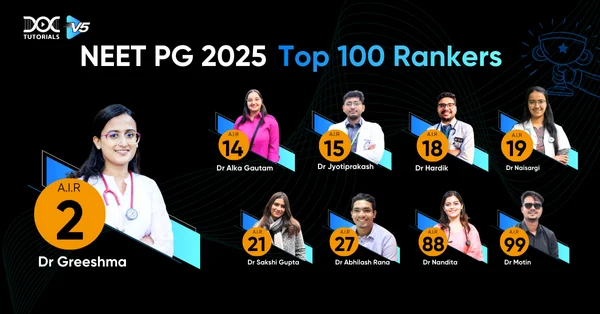
The NEET PG 2025 topper list includes the candidates’ names who secured AIR (all India rank) between 1 and 10. Dr. Pooshan Mahapatra has scored 707 marks in NEET PG and secured the first rank. The candidates with second and third ranks are Dr. Greeshma and Dr. Asutosh, and both of them have scored 705 marks.

The NEET PG 2025 topper list is provided below with the candidate’s name, rank, and score:

Name of the CandidateAll India NEET PG RankNEET PG Score
Dr. Pooshan Mahapatra1707
Dr. Greeshma2705
Dr. Asutosh3705
Dr. Kartikeya4701
Dr. Adarsh5695
Dr. Tanveer 6695
Dr. Sanjay7692
To be Updated8692
Dr. G Barath Kumar9691
To be Updated10691

How to Download the NEET PG Topper List?

You can download the NEET PG 2025 topper list and merit list from the official website of NBEMS, natboard.edu.in. The NEET PG merit list for the 50% AIQ was published on 28th August 2025, after the results were released on 19th August. You can log in to the website using your ID and password to download the personal scoreboard.

Here are the steps to follow while downloading the NEET PG topper marks:

  • Step 1: Log in to the official website of nbe.edu.in
  • Step 2: Select the option for “NEET PG Result”
  • Step 3: Navigate to the “Download NEET PG Merit List PDF” link under the counselling or results section
  • Step 4: Log in with your ID and password within the specified period, then download the personalised scoreboard that includes the candidates’ names, marks, and ranks.

Note: You don’t need to log in to download the public merit list.

Ace Your NEET PG Prep With DocTutorials NEET PG Online Live Power Pack

What are the Cutoff Marks for NEET PG?

NBEMS released the qualifying cutoff marks for NEET PG 2025 while releasing the results on 19th August 2025. It helps determine the counselling eligibility of 230,114 candidates, out of which 128,116 candidates qualified. The cutoff mark for the unreserved category is 50%, general PWD candidates is 45%, and SC, ST, or OBC is 40%.

To ensure fairness, cutoffs are percentile-based and vary by category based on normalised scores out of 800. The table below represents the cutoff percentage and score for different categories:

CategoryPercentileCutoff Score
Unreserved (UR)50th276​
SC/ST/OBC40th235​
General-PWD45th255​

These scores indicate a moderate level of exam difficulty, with slightly higher AIQ merit list cutoffs (e.g., 291 for General 50th percentile).

Candidates who surpass the cutoffs, such as Dr. Pooshan Mohapatra (725 marks, AIR 1), proceed for the MCC counselling starting in mid-September. Participation in MD, MS, and PG Diploma seats is disqualified for scores below.

What are the Preparation Strategies of the NEET PG Toppers?

Upcoming NEET PG aspirants can effectively prepare their study plan by analysing the strategies of NEET PG toppers. The toppers shared their suggestions and study plan to make the NEET journey smoother for candidates preparing for the exam.

The NEET PG 2025 toppers have shared their preparation strategies, which can help the upcoming aspirants. Here are the stories of some of the top scorers:

  • Rank 1: Dr. Pooshan Mahapatra

Dr. Pooshan Mahapatra, an MBBS graduate from Odisha in 2024, has scored 707 marks in the NEET PG exam 2025 and secured the 1st rank. His preparation strategy includes a daily study schedule of 10 – 12 hours for 5 months from April to August, including mock tests and structured study.

To sharpen his speed and accuracy, he has practised multiple mock tests. Online video lectures have also helped him in revising the concepts thoroughly.

  • Rank 2: Dr. Greeshma Gautham

Dr. Greeshma Gautham, an MBBS graduate from Thiruvananthapuram Medical College, Kerala, secured 2nd rank in NEET PG 2025 with 705/800 marks. She attributes her success to a consistent study routine, following a structured 8–9 month plan that intensified to 12 hours daily in the final week. Regular note-reading, revision, and mock tests formed the core of her preparation strategy.

  • Rank 14: Dr. Alka Gautham

Dr. Alka secured the 14th rank in NEET PG and shared with us her struggles with GTs. However, she thanked DocTutorials for our video explanations of questions. She found reading 180 questions and their explanations difficult, but with our videos, she could easily revise and review through passive learning.

She also added that our quick revision programmes and the last 15-day Hit programme are helpful for candidates who cannot jot down their notes. With these programmes, you can learn all the important stuff.

  • Rank 15: Dr. Jyotiprakash

Dr. Jyotiprakash, the 15th rank holder in NEET PG, shared his experience with us regarding his preparation. He said that when he got tired from studying for long hours, our 20-20 series (mini-test) helped him regain momentum before the exam.

As per him, all our questions are highly exam-oriented and helped him strengthen his preparation for the NEET PG exam.

NEET PG 2024 Topper List

The NEET 2024 topper list includes the name of the candidates, their ranks, and scores. Dr. Vaibhav Garg secured the 1st rank in 2024, scoring 100% marks. While Dr. Anjali Shekhawat secured the second position, she also scored 100% marks. Dr. Saikumar was in the 3rd position in the NEET PG 2024 topper list, and he scored 99.99% marks.

Here is a tabular representation of the NEET PG 2024 topper list:

Candidate’s NameAll India NEET PG RankNEET PG Score
Dr. Vaibhav Garg1100 percentile​
Dr. Anjali Shekhawat2100 percentile​
Dr. Saikumar399.9990752 percentile​
Dr. Naisargee Ankur Raval499.9990737 percentile​
Dr. Ravi Bansal599.9990737 percentile​
Dr. Sonali699.9981505 percentile​
Dr. Hamsavardhini799.9981474 percentile​

NEET PG 2023 Topper List

The NEET PG 2023 topper list includes the candidate’s name, their rank in the All-India NEET PG, and their score. Dr. Aarushi Narwani scored 725 out of 800 and secured the first rank in 2023. With a score of 721 marks, Dr. Prem Tilak secured the second rank, while Dr. Rupesh Thaila secured the third rank with the same score.

The table below includes the NEET PG 2023 topper list with the candidate’s name, their rank, and score:

Candidate’s NameALL India NEET PG RankNEET PG Score
Dr. Aarushi Narwani1725​
Dr. Prem Tilak2721​
Dr. Rupesh Thalia3721​
Dr. Aakash Sethi4718​
Dr. Ameya Machave5717​
Dr. Keshav Garg6716​
Dr. Jui7716​
Dr. Swayam Shakti Tripathi8715​
Dr. Rahul9711​
Dr. Sagar10711​

FAQs about NEET PG Topper List

  1. Who is the NEET PG 2025 topper?

Dr. Pooshan Mohapatra from Odisha secured AIR 1 with 707 marks out of 800 in the NEET PG 2025 exam. His strategy involved a combination of mock tests and a consistent study plan.

  1. What are the NEET PG topper marks for 2024?

Dr. Vaibhav Garg achieved 100 percent marks and secured AIR 1, while Dr. Anjali Shekhawat secured AIR 2 with the same percentage. Raw scores are undisclosed due to normalisation.

  1. How did the NEET PG 2025 topper prepare?

Dr. Pooshan Mohapatra and Dr. Greeshma Gautham both followed strict routines of long hours of consistent study. Besides, they focused on practising mock tests for effective preparation.

  1. What strategies do NEET PG toppers use?

Toppers prioritise concepts, daily MCQs, 8-10 revisions, mock analysis, high-yield subjects such as PSM, and mental health through sleep or exercise. All these help them maximise their skills and secure top ranks in NEET PG.

  1. What is the role of DocTutorials in NEET PG success?

DocTutorials’ Live Power Pack offers live classes, QBanks, mock sessions, etc., to ensure that all their candidates can adopt an effective study plan. Rankers like Dr. Alka Gautham (AIR 14) and Dr. Jyotiprakash (AIR 15) credit the faculty and test sessions for top scores.

  1. How many toppers are included in the NEET PG Topper List?

The NEET PG topper list does not have a fixed number of candidates. Typically, the list highlights the top rank holders, often the top 10, top 50, or top 100, depending on the official notification or media release. The complete merit list, however, includes all qualified candidates ranked according to their scores.

  1. Does the NEET PG Topper List include category toppers?

Yes, extended versions of the NEET PG Topper List often include category-wise toppers such as General, OBC, SC, ST, and EWS alongside overall AIR rankings. These lists help aspirants benchmark performance against peers in their respective reservation categories.

  1. Can studying toppers’ strategies guarantee success?

No, studying the success strategies of NEET PG toppers cannot guarantee success. Still, it provides valuable insights into effective preparation patterns, discipline, revision routines, and resource use, which, when combined with hard work and consistency, can improve a candidate’s chances.

  1. What are some tips and tricks to crack the NEET-PG postgraduate entrance test successfully?

Top aspirants recommend disciplined planning, focused conceptual clarity, regular revision, extensive practice of mock tests, and structured mistakes analysis. Emphasis on high-yield subjects, quality resources, and consistent time management are common components of a successful NEET-PG preparation strategy.

  1. To what extent does coaching factor in the success mantra of a topper?

Coaching can provide structured guidance, expert mentorship, curated study materials, and regular assessments, which many toppers use effectively. However, individual dedication, daily discipline, self-study, and strategic revision play equally critical roles; coaching alone does not ensure success. 

Conclusion

The NEET PG 2025 topper list includes the names of all successful candidates, along with their secured positions and scores. The top scorers, such as Dr. Pooshan Mohapatra and Dr. Greeshma Gautham, have achieved excellent marks through their stern dedication and consistent practice.

 Guidance from a professional coach is essential in this regard to channel the candidates on the right path. With DocTutorials’ effective study plan, clinical Q-banks, flash cards, 20-20 series mini-tests, etc., candidates remained active and motivated throughout their preparation phase.

For further information, join DocTutorials today and explore our NEET PG course now!

NEET PG Online Live Power Pack
DocTutorials App Download Now

Latest Blogs

Complete Guide to NEET PG 2025 Allotment List & Previous Years’ Seat Allotments  

NEET PG 2025 Allotment List

Among the most important steps for medical graduates to get into MD, MS, and PG Diploma seats in different medical colleges across the country, NEET PG rank-wise seat allotment plays a major role. 

As MCC released the NEET PG 2025 allotment list for Round 1 on November 22, candidates can check the allotment of colleges and specialities according to their All India Rank. Counselling is done in multiple rounds for seats under AIQ, Deemed, Central Universities, ESIC, and AFMS, and so it becomes necessary to understand the pattern of allotment. 

Here, we have discussed an overall view of the NEET PG allotment list, closing ranks, counselling flow, and key updates for aspirants of the year 2025.

Keep reading!

What Does NEET PG Rank-Wise Seat Allotment Entail?

NEET PG rank-wise seat allotment refers to the procedure through which MCC allots MD/MS/PG Diploma seats to applicants by considering their All India Rank, preferences of choice, reservation policies, and availability of the seat. After every counselling session, MCC posts an allotment list in the PDF format, and the selected candidates are required to reach their respective assigned colleges for document verification and fee payment. 

NEET PG rank-wise seat allotment refers to a step-by-step process adopted by the MCC to distribute the postgraduate medical seats of various colleges to candidates, all in accordance with their performance in the NEET PG exam. 

Once each round of counselling is completed, MCC publishes an exhaustive NEET PG seat allotment list PDF, listing candidates who secured seats in their desired colleges and specialities.

The allotment of seats is based on several key factors: All India Rank (AIR), the choices of colleges and courses filled during counselling, the availability of seats at respective institutes, reservation policies, and category-specific norms. 

Candidates whose names appear on the allotment list must report to their allotted college, complete the document verification process, and deposit the prescribed tuition fee to confirm their NEET PG 2025 admission.

A major element tracked by students includes the speciality or branch they are likely to pursue. Since NEET PG rank-wise seat allotment is guided by closing ranks, aspirants are able to estimate their chances of securing preferred branches like Radiology, Dermatology, Medicine, Paediatrics, or Surgery. 

Understanding these closing ranks helps candidates to set realistic expectations and make informed choices during counselling.

Ace Your NEET PG Prep With DocTutorials NEET PG Online Live Power Pack

NEET PG 2025 Rank-Wise Seat Allotment Dates

The rank-wise seat allotment dates of NEET PG 2025 will outline the entire schedule of the provisional and final results declared post each counselling round. While MCC has already issued the results for Round 1 and Round 2, other dates regarding Round 3 and the dates of the Stray Vacancy Round will be notified soon. Staying updated with the timelines will help one seek counselling and admission in an efficient way.

Below is the official schedule released by MCC for the NEET PG 2025 allotment process:

ParticularsDates
Round 1 provisional seat allotment resultNovember 21, 2025
Round 1 final seat allotment resultNovember 22, 2025
Round 2 provisional seat allotment resultDecember 16, 2025
Round 2 final seat allotment resultDecember 17, 2025
Round 3 seat allotment resultTo be announced
Stray vacancy round seat allotment resultTo be announced

Types of NEET PG Rank-Wise Seat Allotment

NEET PG rank-wise seat allotments are displayed in two formats, depending on whether the counselling is done by MCC or by the state authorities. MCC handles seats related to AIQ, deemed universities, central universities, ESIC, and AFMS institutions. States handle their quota and private college seats. Understanding these two types of allotments helps candidates to track their results on the correct platforms. 

The NEET PG seat allotment system is categorised into two types based on the authority conducting the counselling, and each authority releases its own rank-wise allotment list. Candidates have to check the respective official portal depending on the seat category they apply for:

  1. Counselling Conducted by MCC

The first type is the allotment done through counselling by MCC, which covers 50% of the All India Quota and 100% of the seats in Central Universities, Deemed Universities, ESIC, and AFMS institutions. 

Rank-wise lists of allotment results for these seats are published only on https://mcc.nic.in/, and the process is highly competitive and strictly merit-driven at the national level.

  1. Counselling Conducted by State Authorities

The second category includes state-conducted counselling, covering the 50% State Quota seats, along with 100% of seats in private medical colleges within every state. 

Such lists of seat allocation are issued by the respective state counselling authorities on their official websites and are based on state-specific rules governing domicile eligibility and reservation policies.

NEET PG Rank-Wise Seat Allotment 2025 Result

MCC releases the rank-wise seat allotment result for the NEET PG 2025 after each counselling round, showing the names of candidates to whom seats are allotted based on ranks, choices, and categories. Candidates can also refer to previous years’ rank-wise allotment lists to understand closing ranks and seat trends.

After every counselling round, the NEET PG rank-wise seat allotment result is published by MCC, reflecting the allotment details for all participating institutions. The result will be an essential guide for candidates assessing their chances across different branches and institutions, as seat allocation is fully dependent on AIR, preferences, and registration criteria. 

While the complete allotment results of the 2025 session will be released round by round, candidates may go through previous years’ allotment lists to understand the pattern and the expected closing ranks.

The allotment list for NEET PG 2025, updated for each round by MCC, is as follows:

Counselling RoundsRank-Wise Seat Allotment Result 2025
Round 1NEET PG seat allotment 2025 (Provisional)NEET PG seat allotment 2025 (Final)
Round 2NEET PG seat allotment (Provisional)
Stray Vacancy RoundWill be provided soon
Mop-up RoundWill be provided soon
Special Stray Vacancy RoundWill be provided soon

What Are the NEET PG Rank-Wise Seat Allotment Lists for Previous Years?

NEET PG rank-wise seat allotment lists include the exact rank at which top medical colleges and premium clinical branches, such as Radio-Diagnosis, General Medicine, Dermatology, and Ophthalmology, are allotted. Analysing previous years’ trends helps candidates estimate realistic branch expectations based on rank.

Here is a comprehensive year-wise compilation of the top 10 NEET PG rank-wise seat allotments from 2024 to 2021, covering both Round 1 and Stray Rounds for major medical colleges and courses:

NEET PG Rank-Wise Seat Allotment 2024: Round 1 (Top 10 Allotments)

RankQuotaAllotted InstituteCourse AllottedAllotted CategoryCandidate CategoryRemarks
1All IndiaPGIMER, DR. RML Hospital, Cannaught Place, New Delhi, ABVIMS, DR. RML Hospital, Baba Kharak Singh Marg, Cannaught Place, New DelhiMD (General Medicine)OpenGeneralAllotted
2All IndiaSawai Man Singh Medical College, JaipurMD (Radio-Diagnosis)OpenGeneralAllotted
3All IndiaVardhman Mahavir Medical College, New DelhiMD (Radio-Diagnosis)OpenGeneralAllotted
4All IndiaB. J. Medical College, AhmedabadMD (General Medicine)OpenGeneralAllotted
5All IndiaPGIMER, DR. RML Hospital, Connaught Place, New DelhiMD (General Medicine)OpenGeneralAllotted
6All IndiaVardhman Mahavir Medical College, New DelhiMD (Obst. and Gynae)/MS (Obstetrics and Gynaecology)OpenGeneralAllotted
7All IndiaMadras Medical College, ChennaiMD (General Medicine)OpenGeneralAllotted
8All IndiaMaulana Azad Medical College, DelhiMD (Radio-Diagnosis)OpenGeneralAllotted
9All IndiaPGIMER, DR. RML Hospital, Connaught Place, New DelhiMD (General Medicine)OpenEWSAllotted
10All IndiaVardhman Mahavir Medical College, New DelhiMD (Radio-Diagnosis)OpenGeneralAllotted

NEET PG Rank-Wise Seat Allotment 2024: Stray Round (Top 10 Allotments)

Serial NumberRankQuotaAllotted InstituteCourse AllottedAllotted CategoryCandidate CategoryRemarks
11192All IndiaGrant Medical College, MaharashtraM.D. (DERM., VENE. and Leprosy)/(Dermatology)/(Skin and Venereal Diseases)/(Venereology)OpenSTAllotted
21281All IndiaMahatma Gandhi Memorial Medical College, IndoreMD (Radio-Diagnosis)OpenGeneralAllotted
31313All IndiaM. P. Shah Government Medical CollegeMD (Radio-Diagnosis)OpenGeneralAllotted
41490All IndiaBangalore Medical College and Research InstituteMD (Radio-Diagnosis)OpenGeneralAllotted
52099All IndiaGovt Medical College, ThrissurM.D. (DERM., VENE. and Leprosy)/(Dermatology)/(Skin and Venereal Diseases)/(Venereology)OpenOBCAllotted
62186All IndiaGandhi Medical College, BhopalMD (Radio-Diagnosis)OpenGeneralAllotted
72506All IndiaIndira Gandhi Institute of Medical Sciences, PatnaMD (General Medicine)OpenGeneralAllotted
83246All IndiaThanjavur Medical College, ThanjavurMD (General Medicine)OpenGeneralAllotted
93258All IndiaGovt. Medical College, BarodaM.D. (DERM., VENE. and Leprosy)/(Dermatology)/(Skin and Venereal Diseases)/(Venereology)EWSEWSAllotted
103338All IndiaMaulana Azad Medical CollegeM.S. (Ophthalmology)OpenGeneralAllotted

NEET PG Rank-Wise Seat Allotment 2023: Round 1 (Top 10 Allotments)

Serial NumberRankQuotaAllotted InstituteCourse AllottedAllotted CategoryCandidate CategoryRemarks
11All IndiaVardhman Mahavir Medical College, New DelhiMD (Radio-Diagnosis)OpenGeneralAllotted
23All IndiaVardhman Mahavir Medical College, New DelhiMD (Radio-Diagnosis)OpenGeneralAllotted
35All IndiaLokmanya Tilak Medical College, MumbaiMD (General Medicine)OpenGeneralAllotted
46All IndiaMaulana Azad Medical CollegeMD (General Medicine)OpenGeneralAllotted
57All IndiaSeth Gordhandas Sunderdas Medical College, MumbaiMD (Radio-Diagnosis)OpenGeneralAllotted
68All IndiaPGIMER, DR. RML HospitalMD (General Medicine)OpenGeneralAllotted
79All IndiaPGIMER, DR. RML HospitalMD (General Medicine)OpenGeneralAllotted
810All IndiaVardhman Mahavir Medical CollegeMD (Radio-Diagnosis)OpenGeneralAllotted
913All IndiaVardhman Mahavir Medical CollegeMD (Radio-Diagnosis)OpenGeneralAllotted
1014All IndiaPGIMER, DR. RML HospitalM.D. (DERM., VENE. and Leprosy)/(Dermatology)/(Skin and Venereal Diseases)/(Venereology)OpenGeneralAllotted

NEET PG Rank-Wise Seat Allotment 2023: Stray Round (Top 10 Allotments)

Serial NumberRankQuotaAllotted InstituteCourse AllottedAllotted CategoryCandidate CategoryRemarks
1787All IndiaSawai Man Singh Medical College, JAIPURMD (General Medicine)OpenGeneralAllotted
21685All IndiaTopiwala National Medical CollegeMD (Radio-Diagnosis)OpenOBCAllotted
31884DNB QuotaYashoda Super Speciality Hospital, Telangana (NBEMS)Radio-DiagnosisOpenGeneralAllotted
42156All IndiaSawai Man Singh Medical College, JAIPURMD (General Medicine)OBCOBCAllotted
52265All IndiaGovernment Medical College, AurangabadMD (Radio-Diagnosis)OpenGeneralAllotted
62815All IndiaGovernment T D Medical College, AlappuzhaMD (General Medicine)OpenOBCAllotted
72903All IndiaRangaraya Medical CollegeMD (General Medicine)EWSEWSAllotted
82911All IndiaGovt. Medical College, BarodaMD (Radio-Diagnosis)OpenGeneralAllotted
93166All IndiaM. P. Shah Government Medical CollegeMD (Radio-Diagnosis)OpenGeneralAllotted
103248All IndiaShyam Shah Medical CollegeMD (Radio-Diagnosis)OpenGeneralAllotted

NEET PG Rank-Wise Seat Allotment 2022: Round 1 (Top 10 Allotments)

Serial NumberRankQuotaAllotted InstituteCourse AllottedAllotted CategoryCandidate CategoryRemarks
112All IndiaNizams Institute Of Medical SciencesMD (General Medicine)OpenGeneralAllotted
213All IndiaPGIMER, DR. RML HospitalMD (General Medicine)OpenGeneralAllotted
314All IndiaMaulana Azad Medical CollegeMD (Radio-Diagnosis)OpenGeneralAllotted
418All IndiaVardhman Mahavir Medical CollegeMD (Radio-Diagnosis)OpenGeneralAllotted
519All IndiaMaulana Azad Medical CollegeMD (General Medicine)OpenGeneralAllotted
620All IndiaMaulana Azad Medical CollegeMD (General Medicine)OpenGeneralAllotted
722All IndiaVardhman Mahavir Medical CollegeMD (Radio-Diagnosis)OpenEWSAllotted
823All IndiaMaulana Azad Medical CollegeM.S. (Ophthalmology)OpenGeneralAllotted
924All IndiaB. J. Medical College, AhmedabadMD (General Medicine)OpenGeneralAllotted
1025All IndiaMadras Medical College, ChennaiMD (General Medicine)OpenEWSAllotted

NEET PG Rank-Wise Seat Allotment 2022: Stray Round (Top 10 Allotments)

Serial NumberRankQuotaAllotted InstituteCourse AllottedAllotted CategoryCandidate CategoryRemarks
158Delhi University QuotaLady Hardinge Medical CollegeM.S. (General Surgery)OpenGNAllotted
2396All IndiaSawai Man Singh Medical College, JaipurM.D. (DERM., VENE. and Leprosy)/(Dermatology)/(Skin and Venereal Diseases)/(Venereology)OpenGNAllotted
31620All IndiaTata Memorial Centre, MumbaiMD (Radio-Diagnosis)OpenGNAllotted
42239All IndiaOsmania Medical CollegeMD (Radio-Diagnosis)OpenGNAllotted
53538All IndiaGrant Medical College, MaharashtraMD (General Medicine)OBCOBCAllotted
63651All IndiaMysore Medical College And Research InstituteMD (Radio-Diagnosis)OpenGNAllotted
73684All IndiaGovernment Medical College, SuratM.D. (Radio-Diagnosis)OpenOBCAllotted
83705All IndiaGandhi Medical College, BhopalMD (General Medicine)OpenGNAllotted
93717All IndiaMaulana Azad Medical CollegeMD (Obst. and Gynae)/MS (Obstetrics and Gynaecology)OpenGNAllotted
103988All IndiaVijayanagara Institute Of Medical Sciences, BallariMD (General Medicine)OpenGNAllotted

NEET PG Rank-Wise Seat Allotment 2021: Round 1 (Top 10 Allotments)

Serial NumberRankQuotaAllotted InstituteCourse AllottedAllotted CategoryCandidate CategoryRemarks
11All IndiaIPGME&R and SSKM Hospital Kolkata IPGME&R andSSKM Hospital Kolkata, West Bengal, 700020M.S. (GENERAL SURGERY)OpenGNAllotted
24All IndiaSeth Gordhandas Sunderdas Medical College,MUMBAI Seth Gordhandas Sunderdas MedicalCollege, Acharya Donde Marg Parel MUMBAI,Maharashtra, 400012M.D. (RADIO-DIAGNOSIS)OpenGNAllotted
35All IndiaSeth Gordhandas Sunderdas Medical College,MUMBAI Seth Gordhandas Sunderdas MedicalCollege, Acharya Donde Marg Parel MUMBAI,Maharashtra, 400012M.D. (RADIO-DIAGNOSIS)OpenGNAllotted
46All IndiaVardhman Mahavir Medical College,  New DelhiVardhman Mahavir Medical College, New Delhi,Delhi (NCT), 110029M.D. (RADIO-DIAGNOSIS)OpenGNAllotted
57All IndiaMaulana Azad Medical College Maulana Azad MedicalCollege, Delhi (NCT), 110002M.D. (GENERAL MEDICINE)OpenGNAllotted
68All IndiaLOKMANYA TILAK MEDICAL COLLEGE MUMBAILOKMANYA TILAK MEDICAL COLLEGE MUMBAI,Maharashtra, 400022M.D. (RADIO-DIAGNOSIS)OpenGNAllotted
79All IndiaVardhman Mahavir Medical College, , New DelhiVardhman Mahavir Medical College, , New Delhi,Delhi (NCT), 110029M.D. (RADIO-DIAGNOSIS)OpenGNAllotted
811All IndiaSeth Gordhandas Sunderdas Medical College,MUMBAI Seth Gordhandas Sunderdas MedicalCollege, Acharya Donde Marg Parel MUMBAI,Maharashtra, 400012M.S. (ORTHOPAEDICS)OpenGNAllotted
912All IndiaGovernment Medical College Kozhikode GovernmentMedical College Kozhikode, Kerala, 673008M.D. (PAEDIATRICS)OpenGNAllotted
1013All IndiaVardhman Mahavir Medical College, , New DelhiVardhman Mahavir Medical College, , New Delhi,Delhi (NCT), 110029M.D. (RADIO-DIAGNOSIS)OpenGNAllotted

NEET PG Rank-Wise Seat Allotment 2021: Stray Round (Top 10 Allotments)

Serial NumberRankQuotaAllotted InstituteCourse AllottedAllotted CategoryCandidate CategoryRemarks
1419All IndiaLady Hardinge Medical CollegeMD (General Medicine)OpenGNAllotted
2459Delhi UniversitiesLady Hardinge Medical CollegeMD (General Medicine)OpenGNAllotted
33465All IndiaGovt Medical College, ThrissurMD (General Medicine)OpenOBCAllotted
44027All IndiaB.J. Government Medical College, PuneMD (General Medicine)OpenGNAllotted
54145All IndiaPGIMER, DR. RML HospitalMD (Paediatrics)OpenGNAllotted
64276All IndiaStanley Medical CollegeMD (General Medicine)OpenGNAllotted
74591All IndiaVardhman Mahavir Medical College, New DelhiMD (Obst. and Gynae)/MS (Obstetrics and Gynaecology)OpenGNAllotted
85109All IndiaRangaraya Medical CollegeMD (Radio-Diagnosis)OpenGNAllotted
95249All IndiaGovt. Medical College, BhavnagarMD (General Medicine)OpenGNAllotted
105460DNB QuotaKIMS Hospital (NBEMS)NBEMS) RADIO-DIAGNOSISOpenGNAllotted

NEET PG Rank-wise Seat Allotment Breakdown

Seat allotment in NEET PG varies across Rounds 1, 2, and 3 for each category. Each round depicts varied cut-off trends and seat availability. There is considerable rank movement after Round 1, which gives better opportunities for mid- and lower-ranked candidates. Understanding how each round functions helps you plan choices more strategically and predict outcomes more accurately.

Discussed below is a concise breakdown of how ranks move and seats open up across all three rounds of NEET PG counselling:

  1. Round 1: Highest Competition and Stringent Cut-offs

Round 1 is considered the most competitive phase in the entire counselling process because it witnesses the earliest filling of top clinical branches and government college seats. The cut-offs are always the highest across all categories, including reserved categories. 

AIQ seats are also highly sought-after, with hardly any scope for upgrading. Thus, this round mainly benefits top-ranked candidates aiming for premium branches or reputed institutes.

  1. Round 2: Major Movement and Better Opportunities

Round 2 experiences the most significant movement in rank since many students go for upgradation, withdraw, or fail to report, thus creating the scope for new seats. In this round, cut-offs come across a significant drop, and seat availability in several branches and colleges improves due to reshuffling. 

A few seats may still be retained in popular government colleges, thus making this round perfect for mid-range ranks targeting better options. 

  1. Round 3 (Mop-Up Round): Maximum Flexibility for Mid/Low Ranks 

Round 3 has the lowest cut-offs because many seats reopen in this round due to non-joining and resignations, leading to large rank shifts. Clinical branches, particularly in DNB and deemed universities, often get reopened. 

In this round, SC category candidates receive an added advantage, and this becomes the best chance for ranks above 10,000–15,000 for clinical or speciality seats.

FAQs about NEET PG Rank-Wise Seat Allotment

  1. What is the procedure for granting seats in NEET PG according to ranks?

The NEET PG seat allotment process involves matching your All India Rank with the preferences you provided, your category, and the seats left for that round. The system will look at your list starting from the top and allot the first seat that your rank qualifies for.

  1. How come some lower-ranked candidates get better seats in NEET PG counselling?

A lower-ranked candidate may get a better seat if they placed it higher in their choices and it was still available at their turn. Different categories have separate seat pools, so you might not be competing for the same seats. Besides, seat availability also keeps changing, and sometimes the right seat simply remains open when their turn comes.

  1. What does the NEET PG seat matrix represent in rank-wise allotment?

The seat matrix determines the number of seats allocated for every category in each college and for each specialisation. Your allotment is completely dependent on the seats that are still open at the time your rank gets processed by the system.

  1. Can I change my choices for Round 2 if I do not like my Round 1 NEET PG counselling allotment?

Yes, MCC and most of the state counselling authorities allow fresh choice filling for Round 2. You will be able to add, delete, or change the order of options according to the outcomes of Round 1 and the newly vacated seats.

  1. What documents should I prepare immediately after NEET PG counselling seat allotment?

You need to keep the originals plus self-attested copies of the following documents: NEET PG admit card, scorecard, MBBS degree, internship completion, photo ID, and valid reservation certificates. These are required for reporting and verification purposes.

  1. How many seats are there in NEET PG for the general category?

The NEET PG general category seats are not fixed as an absolute number because seats are distributed through the reservation policy. In All India Quota and most government institutions, reservation typically includes 27% OBC, 15% SC, 7.5% ST, and 10% EWS, leaving the remaining seats under the unreserved/general category. Exact numbers vary each year based on the total seat matrix.

  1. Does the NEET PG cutoff vary by category?

Yes, the NEET PG cutoff differs category-wise due to the reservation policy and percentile-based qualification criteria. Traditionally, the qualifying percentile is around 50th percentile for General and 40th percentile for SC/ST/OBC, though authorities may lower cutoffs depending on seat vacancies or policy decisions in a given year.

  1. How many seats are reserved for OBC in NEET PG?

The OBC reservation in NEET PG seats is generally 27% under the central government reservation policy for All India Quota seats and most central institutions. However, actual availability may vary slightly across states depending on local reservation policies and seat matrix distribution.

  1. What is a good score in NEET PG for the SC category?

A good NEET PG score for the SC category depends on the target branch and college. For top clinical branches, expected cut-offs are often around 400–450+ marks, while mid-tier clinical or paraclinical branches may require lower scores. Exact requirements vary yearly based on exam difficulty and counselling trends.

  1. What is the expected closing rank for major branches in NEET PG Seat Allotment 2025?

Expected NEET PG 2025 closing ranks for top branches are very competitive. For example, estimated General category closing ranks include: Radiology (~300–800), Dermatology (~400–1100), General Medicine (~800–2500), and General Surgery (~4000–9000). These vary by counselling round, institute, and seat quota.

Conclusion

Understanding the counselling rounds, closing ranks, and speciality-wise competition trends will make navigating the NEET PG rank-wise seat allotment much easier. This is because MCC releases the NEET PG 2025 allotment list round by round. 

It helps aspirants take informed, strategic decisions with confidence regarding branch and institute preferences. After you secure your desired seat, it is crucial to select the right study partner who can help simplify concepts and take your knowledge base to the next level. 

With our updated high-yield study materials, expert faculty, personalised mentorship, and exam-specific resources, DocTutorials helps unleash your full potential.

Check out our NEET PG courses today!

NEET PG Online Live Power Pack
DocTutorials App Download Now

Latest Blogs

NEET PG Government Medical Seats in India 2026

NEET PG Government Medical Seats | DocTutorials

Compared to the last 10 years, we have seen a remarkable increase in the number of government NEET PG seats in 2025-26. NMC (National Medical Commission) has approved a total of 2,337 seats, with significant additions in Gujarat, Andhra Pradesh, and other states. 

NEET PG is an entrance exam conducted by NBEMS (National Board of Examinations in Medical Sciences) for MBBS doctors who wish to pursue postgraduate medical courses in India. The NEET PG counselling determines eligibility for postgraduate courses across government medical colleges.

In this article, we will explore the NEET PG seat allocation process and the state-wise list of government medical seats in different postgraduate branches. Scroll down to learn more!

Ace Your NEET PG Prep With DocTutorials NEET PG Online Live Power Pack

NEET PG Government Medical Seat Allocation Process

Seat allocation is done through a counselling process conducted by the MCC. The NEET PG government medical seats are allocated to registered candidates based on merit, seat reservation, and seat availability at the chosen government medical college. 

NEET PG seat allocation happens through a counselling process based on the merit list published by the NBEMS. The merit list contains the names of candidates, ranked by their NEET PG scores, who are eligible to participate in counselling in the 50% AIQ (All India Quota) category.

This counselling helps eligible candidates take admission to DNB, MD, or MS programs in government medical colleges across the country. Of all the seats, 50% are handled by the MCC (Medical Counselling Committee), while the respective state counselling bodies handle the remaining 50%.

Candidates need to go through the following steps to participate in the NEET PG counselling:

  • Step 1: Visit the official MCC website.
  • Step 2: Register the candidate on the MCC official website.
  • Step 3: Fill in the details correctly.
  • Step 4: Pay the registration fee using net banking or cards.
  • Step 5: Enter the candidates’ preferred courses and colleges in the correct sequence.

After the registration process, candidates are asked to wait for the seat allotment result, which is based on their AIR and the choice filling of medical colleges. The AIQ seats go through four rounds of counselling:

  • First Round
  • Second Round
  • Mop-Up Round 
  • Stray Vacancy Round

The NEET PG government medical seat distribution is based on various factors, including merit, reservation, and seat availability at preferred government medical colleges.

State-Wise List of NEET PG Government Medical Seats in Medical Colleges

For 2025-26, the total number of government medical seats for NEET PG aspirants exceeds 35,000, including DNB and CPS seats in over 278 government medical colleges. 

The following table lists the number of government medical colleges along with the total number of NEET PG seats in the respective states:

StateNumber of Government Medical CollegesTotal Number of NEET PG Government Medical Seats in Each State
West Bengal 261791
Uttarakhand 51572
Uttar Pradesh352301
Tripura 185
Telangana 281504
Tamil Nadu382765
Sikkim00
Rajasthan262255
Punjab5408
Puducherry2314
Orissa12725
Nagaland 10
Mizoram10
Meghalaya 137
Manipur3255
Maharashtra 323576
Madhya Pradesh151489
Kerala 121077
Karnataka 241856
Jharkhand 7263
Jammu and Kashmir 11606
Himachal Pradesh7264
Haryana 6432
Gujarat232186
Goa 1137
Delhi82889
Dadra and Nagar Haveli10
Chandigarh1585
Bihar 13908
Assam13738
Arunachal Pradesh10
Andhra Pradesh181923
Andaman and Nicobar Islands 10

Branch-Wise NEET PG Government Medical Seats

Some of the top branches in MD and MS add up to around 39,817 seats in government medical colleges in India.

The following table lists some of the top branches and the number of government seats in the respective branches:

Branch (MD/MS)Estimated Govt. Seats
MD-General Medicine 3,190
MD-Anaesthesiology2,920
MS-General Surgery2,890
MS-Obstetrics and Gynaecology2,400
MD-Paediatrics2,100
MS-Orthopaedics1,800
MD-Pathology1,730
MD-Radiology (Radio-Diagnosis)1,550
MS-Ophthalmology1,200

Apart from these, government medical colleges offer other clinical and non-clinical branches with a bright future as well.

FAQs about NEET PG Government Medical Seats in India 2026

  1. How many government PG seats are there in India?

On average, there are more than 35,000 government medical NEET PG seats in India.

  1. Is 18,000 a good rank in NEET PG?

Though 18,000 will not secure you a seat in radiology or dermatology, it is a decent rank in NEET PG.

  1. How many seats are there in NEET PG All India Quota?

50% of the total government medical college PG seats are under the All India Quota and are available to candidates from any state through the NEET PG counselling process.

  1. Is 29,000 a good rank in NEET PG?

Yes, a rank of 29,000 in NEET PG is good and can get you into a good government medical college. However, the choice filling needs to be done properly.

  1. Which branch has the highest cutoff in NEET PG?

Among all the clinical and non-clinical branches, dermatology and radiology have the highest cutoff in NEET PG.

  1. What is the NEET PG seat allocation process?

The NEET PG seat allocation process is conducted through centralised online counselling by the Medical Counselling Committee (MCC) for All India Quota seats and by state authorities for state quota seats. Allocation is based on NEET PG rank, reservation category, seat availability, and candidate preferences across multiple counselling rounds.

  1. Which states have the highest number of government & private NEET PG seats?

States with the highest NEET PG seat numbers include Tamil Nadu, Karnataka, Maharashtra, Uttar Pradesh, Telangana, and Rajasthan. These states have a strong mix of government medical colleges and private institutions, offering large numbers of MD/MS and diploma seats, making them highly competitive during both All India and state-level counselling.

  1. What are the major seat categories in NEET PG counselling?

The NEET PG seat categories include All India Quota (50% of government seats), State Quota (50%), Deemed University seats, Central Universities, ESIC, and Armed Forces medical seats. Each category follows specific eligibility rules, fee structures, and counselling authorities, which significantly affect seat availability and competition levels.

  1. Which PG specialisations are most popular?

The most popular NEET PG specialisations are General Medicine, Radiology, Paediatrics, Dermatology, Orthopaedics, and Obstetrics & Gynaecology. These branches are highly preferred due to clinical exposure, career stability, and earning potential, resulting in very high cut-off ranks—especially in government medical colleges across India.

  1. How do reservation categories affect NEET PG admissions?

Reservation in NEET PG admissions plays a major role in seat allotment, with categories such as SC, ST, OBC, EWS, and PwD receiving designated seat percentages as per government norms. Reservation applies separately in All India and State Quota counselling, directly influencing cut-off ranks and seat availability.

Conclusion

NEET PG government medical seat allocation is a well-organised process for medical aspirants who wish to pursue postgraduate courses for a brighter future. There are over 35,000 government seats that need to be filled by candidates carefully making their choice, filling them so that they secure their dream branch with the best seat possible.

For added guidance in the NEET PG exam, DocTutorials can be your study companion. We offer crisp videos, clinical Qbank, exam-focused notes, flashcards, and mindmaps, ensuring aspirants are well-prepared with complete clarity before the exam.

Join DocTutorials today and explore our NEET PG course to excel in your medical career!

NEET PG Online Live Power Pack
DocTutorials App Download Now

Latest Blogs

Ewing’s Sarcoma: Causes, Symptoms, Diagnosis, and Treatment

Ewing’s Sarcoma | DocTutorials

Ewing’s sarcoma is a rare but highly aggressive bone and soft-tissue tumour that mostly affects children and adolescents. It accounts for about 6–8% of all primary bone cancers and is most common in adolescents and young adults.

Since it spreads early and requires multimodal treatment, understanding its basics is crucial for both exams and clinical practice. Read below to get a detailed, high-yield understanding of Ewing’s sarcoma.

What is Ewing’s Sarcoma?

Ewing’s sarcoma is a bone or soft-tissue tumour with rapid growth, generally occurring during teenage years, and usually originating in the pelvis or long bones. It tends to be disseminated early.

Ewing’s sarcoma is an uncommon and aggressive malignancy that arises in bones or their surrounding soft tissues. It can arise in almost any bone, but most often in the pelvis and the long bones of the legs. Sometimes it appears in ribs, arms, chest wall, abdomen, or other soft tissues.

Fortunately, treatment outcomes have massively improved: many young patients now survive long-term thanks to multimodal therapy. However, since chemo and radiation are intense, survivors usually need lifelong monitoring for late treatment effects.

What are the Stages of Ewing’s Sarcoma?

The stages of Ewing’s Sarcoma are explained below:

  1. Localised Ewing Sarcoma: The cancer is still in the bone or soft tissue where it started. It may have grown into nearby tissue or lymph nodes, but hasn’t spread far.
  2. Metastatic Ewing Sarcoma: At this stage, the cancer has spread from the original site. In bone Ewing sarcoma, it typically spreads to the lungs, other bones, or the bone marrow.
  3. Recurrent Ewing Sarcoma: It means that the cancer has returned after treatment. The return can occur either within the same location or in another part of the body.

What are the Types of Ewing’s Sarcoma?

Ewing’s sarcoma comprises a family of closely related tumours that can start in bone, soft tissue, or the chest wall, and they all share the same genetic fingerprint. Three types of Ewing’s Sarcoma include Ewing sarcoma of the bone, extraosseous Ewing tumour, and peripheral primitive neuroectodermal tumour.

Ewing’s sarcoma is not a single tumour but actually part of a group of related small round blue cell tumours. These tumours appear similar under the microscope, share genetic abnormalities, and therefore respond to treatment in a nearly identical manner.

The main types are listed below:

1. Ewing Sarcoma of Bone

This is the most common and the “classic” form. It originates directly in the bone. Dr James Ewing first described it in 1921 and noted that it was distinct from osteosarcoma.

The cells did not resemble osteosarcoma cells under the microscope, and interestingly, they were more responsive to radiation. Since it arises in the bone, it’s the type most students picture when they think of Ewing’s sarcoma.

2. Extraosseous Ewing tumour (EOE)

Extraosseous Ewing tumours arise from the soft tissues that envelop the bones. They behave almost exactly like Ewing sarcoma of bone and also share the same histologic features. 

They are sometimes called extraskeletal Ewing sarcomas because they don’t arise from the bone itself. Despite the different sites of origin, the diagnostic and therapeutic approach doesn’t change much.

3. Peripheral Primitive Neuroectodermal tumour (PPNET)

The PPNET is a rare childhood tumour that may originate in either soft tissues or bone. Clinically and pathologically, it shares many features with both Ewing’s sarcoma and EOE. The well-known subtype is the Askin tumour, arising in the chest wall. Although the name sounds different, it is actually part of the same spectrum.

Similar genetic abnormalities, particularly characteristic translocations involving the EWSR1 gene, have been identified in Ewing’s sarcoma, EOE, and PPNET. They also express similar proteins. Because of these striking similarities, it is believed that all three arise from the same type of primitive cells.

The basic differences lie in their presentation and location, but clinically they are managed the same way. That’s why you’ll often see them grouped under the Ewing Sarcoma Family of tumours (ESFT).

What Causes Ewing’s Sarcoma?

No single cause of Ewing’s sarcoma has been identified, but it usually originates from the alterations in DNA, notably the fusion of the EWSR1 gene, which triggers an uncontrollable division of cells.

The exact cause of Ewing’s sarcoma is still not fully understood. What is known is that the disease begins when certain cells undergo abnormal changes in their DNA. 

Since DNA controls how cells grow, divide, and die, any disruption in these instructions can cause cells to multiply uncontrollably, eventually forming a tumour. Here are the potential causes:

1. How Normal Cells Differ from Cancerous Cells

In healthy cells, DNA guides the cell to grow at a regulated pace and to die at the end of its lifecycle. The changed DNA in Ewing’s sarcoma gives an abnormal set of instructions. These mutated cells divide much faster than normal cells and survive longer than they should. 

As they continue to multiply, they form a mass that can invade the surrounding tissues, and if the cancer cells enter the bloodstream or lymphatic system, the disease can spread to distant organs.

2. Role of the EWSR1 Gene

Mutations in the EWSR1 gene cause many cases of Ewing’s sarcoma. The presence of this change is so typical of the disease that this mutation is often examined exclusively when tumour tissue of patients is tested.

3. Chromosomal Translocation and Tumour Growth

Translocations involving chromosomes 11 and 22 are among the most common genetic anomalies in Ewing’s sarcoma. During that process, a segment of chromosome 11 fuses with the EWS gene on chromosome 22.

This fusion results in the inappropriate activation of genes, leading to uncontrollable cell division. In cases where chromosome 22 might fuse with another chromosome partner, the core mechanism of the process is similar.

What are the Risk Factors of Ewing’s Sarcoma?

Unlike many cancers, Ewing’s sarcoma doesn’t have strong, clearly defined risk factors. Still, a few patterns have been observed. It mostly affects the younger generation and is far more common among individuals of European ancestry.

The common risk factors observed for Ewing’s Sarcoma are: 

  • Young Age: Most frequent in children and young adults.
  • European ancestry: Individuals of European ancestry demonstrate an increased risk. It is far less common in individuals of African or East Asian origin.

There is no known way to prevent Ewing’s sarcoma, since the genetic changes occur randomly and aren’t inherited from the parents. Researchers have also not found any environmental or lifestyle exposures that increase the risk.

What are the Symptoms of Ewing’s Sarcoma? 

Symptoms of Ewing’s sarcoma first tend to appear in and around the affected bone. Since this cancer most often involves the long bones of the legs and the pelvis, one of the common early signs is pain or swelling in these regions.

There are several symptoms to identify Ewing’s Sarcoma, and they are categorised as follows:

1. Local Symptoms

These symptoms appear directly where the tumour is growing:

  • Bone pain that may worsen with activity or at night.
  • Swelling or tenderness around the affected area.
  • A palpable lump in the arm, leg, chest, or pelvis.
  • Pathological fractures develop because the tumour weakens the bone structure.

Some patients may initially dismiss the pain, thinking it’s just a sports injury; therefore, diagnosis can sometimes be delayed.

2. Systemic Symptoms

Ewing’s sarcoma does not always remain confined to local sites. Because it is an aggressive tumour, systemic symptoms can also appear due to the body’s inflammatory response or because of metastatic spread:

  • Fever, without any apparent infection.
  • Unintentional weight loss
  • Fatigue or general tiredness, which doesn’t improve easily.

Systemic features are not always present, but when they are, there is often a greater tumour burden or disseminated disease.

What is the Diagnosis of Ewing’s Sarcoma?

Ewing’s sarcoma remains difficult to diagnose because it shares a similar appearance with other small round blue-cell tumours. Thus, doctors use clinical evaluation, imaging, laboratory studies, and, finally, biopsy with genetic testing.

The diagnostic process for Ewing’s Sarcoma usually begins with an appropriate medical history and a physical examination. When something suspicious is found, such as persistent bone pain, swelling, or a mass, your clinician will proceed to targeted tests.

Diagnosis is essentially made by:

  • Ruling out other small round blue-cell tumours
  • Confirming the EWSR1-related translocation through molecular tests
  • Correlating clinical findings with imaging and pathology

Key Diagnostic Tests for Ewing’s Sarcoma

Below is a structured table to break down the major tests and why they’re used:

Test/ProcedureWhat it DoesWhy it’s Important
X-rayUses electromagnetic waves to capture images of bones.Often, the first step may show bone destruction or periosteal reaction.
Radionuclide Bone ScanInjects radioactive dye that collects in active bone lesions.Helps detect additional bone abnormalities or metastasis.
MRI (magnetic resonance imaging)Uses magnets + radio waves to produce detailed soft-tissue images.Best for assessing tumour extent, soft-tissue involvement, and surgical planning.
CT (computed tomography) ScanCombines X-rays and computer tech to create thin “slice” images.Useful for evaluating bone detail and detecting lung metastases.
PET (positron emission tomography) ScanUses radioactive glucose to highlight high-metabolism tissues, such as tumours.Detects small metastases and monitors treatment response.
Blood TestsIncludes CBC and chemistries.Not diagnostic, but helps assess overall health and treatment readiness.
Tumour BiopsyRemoves tissue (needle or surgical) for microscopic analysis.Essential for confirming Ewing’s sarcoma and ruling out similar tumours.
Bone Marrow Aspiration/BiopsySample marrow from the hip bone.Checks for bone marrow involvement—important for staging.

What are the Treatment Options for Ewing’s Sarcoma?

Multimodal therapy, including chemotherapy, surgery, and radiation, is given with the intention of shrinking the tumour, surgical removal, or controlling whatever is left behind. 

Management of Ewing’s sarcoma requires a coordinated, expert team usually consisting of a pediatric oncologist, surgeons, radiation oncologists, rehabilitation specialists, psychologists, and fertility counsellors. 

Treatment plans depend on the patient’s age and health, tumour site and size, and the presence of metastasis.

TreatmentPurposeKey Points
ChemotherapyTo shrink the tumour and treat micrometastasisStandard regimen: VDC (vincristine, doxorubicin, cyclophosphamide) alternating with IE (ifosfamide, etoposide); usually first-line; given before and after local therapy; lasts 6–12 months
SurgeryTo remove the primary tumourLimb-sparing preferred; may require grafts or implants; amputation only when absolutely needed; adjuvant chemo/radiation may follow
Radiation TherapyTo control the tumour when surgery isn’t possible or to treat residual diseaseExternal beam radiation; used for unresectable tumours, function-critical areas, residual cancer, or palliation
Stem Cell TransplantTo allow high-dose chemotherapy in high-risk casesPrimarily used for recurrent/aggressive disease; stem cells are collected, frozen, and then reinfused after chemo
Supportive & Rehabilitation CareTo manage side effects and restore functionIncludes antibiotics, pain control, prosthetics (if needed), physical therapy, fertility counselling, psychosocial support

FAQs about Ewing’s Sarcoma

  1. Is stage 4 Ewing sarcoma curable?

While in theory, Stage 4 Ewing’s sarcoma is curable, the outcomes are not very promising. Most Stage 4 patients did not respond well to the treatment, and the disease often recurred even after aggressive therapy.

  1. What are the risk factors for Ewing sarcoma?

No lifestyle-related risk factors have been identified so far. Studies have not found any links with chemicals, radiation, or environmental exposure. The main risk factors remain age, mostly among children and teens; gender, slightly more common among males; and race, with a higher incidence among Caucasians.

  1. Is Ewing sarcoma genetic?

It’s genetic in that it is due to a specific gene mutation, but it’s not hereditary-the mutation doesn’t pass down through generations, and we still have no clue why it arises in the first place.

  1. Can adults get Ewing sarcoma?

Ewing’s sarcoma predominantly affects children and adolescents. It does not completely spare adulthood either, though it is uncommon in this age group.

Conclusion 

Ewing’s sarcoma is a highly aggressive small round blue-cell tumour that typically arises in the long bones and pelvis of children and adolescents. Owing to its rapid growth and early metastasis, this core feature is essential for any NEET PG aspirant to know.

To understand more such complex NEET PG concepts, DocTutorials can be your study partner. We offer crisp videos, clinical Qbank, exam-focused notes, flashcards and mindmaps to ensure aspirants gain clarity over these concepts.

Join DocTutorials today and explore our NEET PG course to excel in your medical career!

NEET PG Online Live Power Pack
DocTutorials App Download Now

Latest Blogs

Burn Resuscitation: Techniques, Management, and Complications

Burn Resuscitation | DocTutorials

Burns are still among the most difficult surgical emergencies due to the need they entail for immediate evaluation, accurate burn calculation, fluid resuscitation, and observation. Major burns result in severe physiological disturbances. 

Burn resuscitation as an immediate intervention prevents burn shock and significantly decreases mortality rates. To prepare for the exam as a NEET PG student, it is necessary to have an understanding of burn percentage calculation, knowledge about what ‘TBSA’ stands for as ‘Total Body Surface Area’, and knowledge about ‘Parkland Formula’.

Keep reading for a detailed insight.

What is Burn Resuscitation?

Burns resuscitation represents controlled fluid replacement after major burns to stabilise circulation, maintain tissue perfusion, prevent burn shock, and sustain functions with constant and specific patient adjustment.

Burns resuscitation is a process that mainly involves the replacement of fluid loss associated with extensive thermal injuries. Large areas of epidermal destruction increase capillary permeability.

Consequently, a massive movement of fluid occurs from the intravascular space to the interstitial tissues. This causes dehydration at the cellular and body levels in patients. The goals of burn resuscitation are:

  • Stabilising circulation
  • Maintaining tissue perfusion
  • Promoting organ function
  • Optimising conditions for wound healing

Further, a crucial point to remember is that burn resuscitation is a continuous process that requires frequent changes, depending on the patient’s physiological condition, rather than predetermined volumes.

Why is Burn Resuscitation Needed?

Burn resuscitation plays an important role in responding to fluid loss, preventing burn shock, maintaining blood volume, enhancing cell metabolism and renal function, and preventing life-threatening complications.

Severe burns result in large fluid shifts and circulatory failure, and thus resuscitation becomes necessary. Let’s discuss in detail some reasons behind its necessity:

  • Prevention of Burn Shock: Severe burns result in plasma loss, capillary leakage, hypovolemia, and decreases in cardiac output, culminating in burn shock due to a loss of fluids.
  • Maintenance of Intravascular Volume: Volume loss reduces circulating volume, causing hypotension, inadequate perfusion, and metabolic acidosis. Fluid resuscitation corrects hemodynamic abnormalities.
  • Promoting Cell Metabolism: Effective perfusion maintains adequate oxygenation for ATP generation, repair, and prevention of lactic acidosis.
  • Prevention of Renal Failure: Perfusion reduces GFR, causing oliguria and acute tubular necrosis. Fluids support renal function and prevent shutdown.
  • Reducing Mortality and Complications: Appropriate resuscitation decreases the risk of multi-organ dysfunction, compartment syndromes, ARDS, and mortality. 

The resuscitation of burns is thus an essential and life-saving process when it comes to taking care of severe burn victims.

What are the Types of Burn Resuscitation?

Burn​‍​‌‍​‍‌​‍​‌‍​‍‌ resuscitation is phased distinctly into acute, intermediate, and maintenance stages, and each stage is characterised by different objectives. Initially, there is a need for a different amount of fluids due to the capillary leak.

The resuscitation of a burn victim can be broken down into phases that correspond with the phases of response seen with a burn. Here’s a detailed examination of each phase:

1. Acute Resuscitation Phase (0-24 hours)

It is the most critical phase that follows a burn. The objective at this stage would be to regain perfusion, correct hypovolemia, and prevent burn shock. During this phase:

  • Rapid fluid shifts occur because of widespread capillary leakage.
  • A large amount of plasma shifts into the interstitial space.
  • Aggressive crystalloid infusion is necessary to maintain circulation.

2. Intermediate Phase (24-48 hours)

During this stage, it becomes necessary to make precision adjustments to achieve an optimal volume without exceeding it. As vascular integrity begins to improve, fluid needs begin to change in the following manner:

  • Colloids can be used to encourage fluid return to the vessels.
  • Crystalloid fluid infusion rate decreases when oedema is excessive.
  • Electrolyte imbalance is monitored and regulated as an essential step.

3. Maintenance Phase (> 48 hours)

Once the hemodynamics have stabilised, the focus shifts toward ongoing support:

  • Daily maintenance fluids are provided based on physiologic needs.
  • Evaporative losses from the burn surface are replaced.
  • Nutrition and metabolic management become central to recovery.

Each of these stages addresses a different physiological issue, ensuring a smooth transition for the patient from stabilisation to healing.

What are the Techniques of Burn Resuscitation?

Burn resuscitation involves organised methods, from the correct estimation of TBSA to the prompt institution of IV fluids; ongoing monitoring, fluid manipulation, and supportive adjuncts.

The methods below outline the structured clinical process required to provide adequate fluid resuscitation. These methods guarantee that every step, from evaluation to adjustment, is performed accurately.

1. True Burn Size Percentage Calculation (TBSA Assessment)

Since total fluid volume is based solely on burn size, the Burns Area Assessment constitutes the foundation for resuscitation planning. Regular testing methods include:

  • Rule of Nines: A quick estimation technique widely practised on adults in emergency conditions.
  • Lund and Browder Chart: It reproduces accuracy. It is useful for pediatric and varied-depth burns.
  • Palmar Method: Using the patient’s palm, a 1% TBSA measurement can be performed for small, dispersed burns.

Accurate estimation prevents both under-resuscitation, which can lead to shock, and over-resuscitation, which can cause oedema and complications such as compartment syndrome.

2. Establishing IV Access and Initiating Fluids

As soon as the burn area is ascertained, fluid resuscitation should be initiated without any delay. Clinical procedures include:

  • Use of two large-bore IV cannulas for reliable access.
  • Immediately began warm crystalloid resuscitation for hypovolemia.
  • Early intervention, as delay leads to a significantly worse outcome.

This step helps stabilise circulation, promote perfusion of vital organs, and prepare the patient for constant observation.

3. Continuous Physiological Monitoring

Resuscitation for burn victims is an ongoing process. It requires hour-to-hour monitoring. Important monitoring parameters include:

  • Urine Output:
    • Adults: 0.5 mL/kg/hr
    • Children: 1-1 mL/kg/hr
  • Vital Signs: Heart rate, blood pressure, and respiratory rate, which are important indicators of hemodynamic response.
  • Perfusion Markers: Capillary refill, skin temperature, and mental status, which indicate tissue oxygenation.
  • Biochemical Values: Lactate, base deficit, and hematocrit help evaluate metabolic stability.

These criteria assist practitioners in determining whether fluids are within limits, excessive, or low.

4. Dynamic Adjustment of Fluids

Changes in fluid requirements occur very rapidly within the first 24 hours. Fluids should be increased if:

  • Urine output drops
  • Tachycardia persists
  • Blood pressure decreases

Fluids should be decreased if:

  • Urine output is higher than required
  • Pulmonary crackles suggest early fluid overload
  • Oedema progresses too quickly

This titration helps prevent serious complications like ARDS, Abdominal compartment syndrome, and swelling.

5. Use of Clinical Adjuncts

Some supportive steps improve resuscitation and help prevent early complications. Important adjuncts include:

  • Oxygen therapy is based on suspicion of inhalation injury or airway compromise. 
  • Temperature control is necessary for burn victims, who lose body heat quickly.
  • Escharotomy, as early as possible, in circumferential burns, for the prevention of vascular compromise.
  • Pain control and sedation, as needed, to reduce the stress response and improve compliance.
  • Monitoring for compartment syndromes in limbs, chest, or abdomen.

These additional options will supplement fluid therapy and help maintain the patient’s stability during the initial treatment stage of burns.

What is Burn Resuscitation Management?

Burn resuscitation management includes rapid stabilisation, accurate assessment of burns, timely institution of fluids, and continued monitoring. Clinicians make constant adjustments in therapy to maintain perfusion, avoid complications such as fluid overload and safely transition the patient through the critical resuscitation phase.

Burn resuscitation management involves the following measures for the management and stabilisation of the patient:

1. Primary Survey and Stabilisation

Management starts with the treatment of immediate life threats via the trauma sequence. This assesses the airway for possible inhalation injury, supports breathing by providing oxygen, stabilises circulation, quickly evaluates neurologic status, and fully exposes the patient while preventing hypothermia.

2. Assessment and Classification of Burns

Once the patient is stable, the burn is assessed for TBSA, depth of injury, and mechanism of injury. Any associated injuries are also taken into consideration. This classification guides the intensity of resuscitation and the overall treatment plan.

3. Instituting Fluid Therapy

Fluid resuscitation is promptly initiated once the TBSA is estimated. Early infusion ensures adequate perfusion while the volume is adjusted as the patient’s condition evolves.

4. Monitoring Response to Resuscitation

The response is monitored through assessing the urine output, hemodynamic status, metabolic markers such as lactate, and changes in mentation. These guides need to increase or decrease fluids.

5. Complications of Resuscitation and Their Prevention.

Care is directed for avoiding fluid overload, pulmonary oedema, compartment syndromes, and electrolyte imbalances. The early identification and correction of these problems contribute to the limitation of morbidity and the allowance of improved outcomes.

What is the Formula of Burn Resuscitation?

Burn resuscitation formulas provide organised initial points for estimating the first-day fluid needs in adults and children. Every formula varies in how volume is calculated and in its clinical purpose, which helps clinicians maintain proper resuscitation levels and reduces the risk of fluid overload.

Below is the table comparing common burn resuscitation formulas:

FormulaCalculation BasisFirst-Day Fluid VolumeNotes
Parkland FormulaWeight (kg) × TBSA (%) ×4 ml4 ml/kg/% TBSA of Ringer’s lactateGive 50% in the first 8 hours, and the remaining 50% over the next 16 hours.
Modified Brooke FormulaWeight (kg) × TBSA (%) ×2 ml2 ml/kg/% TBSA of crystalloid (e.g., Ringer’s lactate)Uses less fluid; may reduce the risk of over-resuscitation and complications like abdominal compartment syndrome.
Galveston Formula (Children)Body Surface Area (BSA)5000 ml/m2 burn +2000 ml/m2 maintenanceUsed only in paediatrics; uniquely includes maintenance requirements in the initial calculation.

What are the Complications of Burn Resuscitation?

There are complications involved with burn resuscitation that arise due to high and low fluid volumes, which result in shock, oedema, and organ failure. The rescue process requires careful manipulation and monitoring for successful outcomes.

Some commonly occurring complications that arise due to resuscitation efforts that are inadequate, excessive, and improperly monitored are:

1. Under Dehydration

 Dehydration occurs due to:

  • Continuous hypovolem
  • Burns shock
  • Renal failure
  • Lactic acidosis
  • Poor wound healing

2. Over-Resuscitation

Excessive fluid administration can be just as harmful as dehydration. There are several consequences, such as:

  • Pulmonary oedema
  • Abdominal compartment syndrome
  • Limb compartment syndrome
  • Worsening oedema of both burned and unburned tissues

3. Electrolyte Imbalances

Disturbances in fluid volumes, causing electrolyte imbalances, result in:

  • Hyponatremia
  • Early hyperkalemia
  • Late hypokalemia

4. Organ Dysfunction 

Unchecked and severe resuscitation problems can lead to:

  • ARDS or Acute Respiratory Distress Syndrome
  • Acute kidney injury
  • Liver dysfunction

All these complications emphasise the importance of careful observation and fluid management.

FAQs about Burn Resuscitation

1. What does the abbreviation TBSA stand for?

TBSA translates as Total Body Surface Area. It provides an estimate of the burn extent as a percentage of the body’s total area.

2. Which fluid should be given within the first 24 hours?

Ringer’s Lactate solution is the fluid of choice for resuscitation due to burn injuries, which should be given within the first 24 hours.

3. When is burn resuscitation required?

Resuscitation should be attempted in:

  • Adults: Burns covering more than 20% TBSA
  • Children: Burns exceeding 10% Total Body Surface Area

4. Which burn resuscitation formula is most widely employed?

The equation most commonly employed for initial fluid calculation is the Parkland formula.

5. Why are colloids avoided during the early phase? 

Within the first 24 hours, capillary permeability increases, leading to colloid leakage into tissues and oedema, so they are generally avoided early on.

Conclusion

Understanding the burn percentage calculation and the concepts associated with fluid resuscitation helps a clinician avoid complications related to burn shock. With this basic knowledge, NEET PG candidates and junior doctors can handle life-threatening surgical situations effectively.

For added guidance, DocTutorials can be your study companion. We offer crisp videos, clinical Qbank, exam-focused notes, flashcards, and mindmaps to ensure aspirants have complete clarity over complex NEET PG concepts and are always well-prepared.
Join DocTutorials today and explore our NEET PG course to excel in your medical career!

NEET PG Online Live Power Pack
DocTutorials App Download Now

Latest Blogs

NEET PG Online Live Power Pack
DocTutorials App Download Now