neet pg preparation Archives - Page 5 of 8 -

NEET PG 2026 Counselling Dates: Eligibility, Dates, Registration Process, and Documents Required

NEET PG Counselling

For MBBS graduates in India, obtaining postgraduate medical education is a significant accomplishment. NEET PG serves as the prerequisite for admission to MD, MS, and PG Diploma programmes. For those who have appeared in the exam, the counselling phase is crucial in determining your college and branch, significantly impacting training quality and career opportunities.  

To help you successfully claim your top-choice seat, it is essential to understand the round-specific procedures, eligibility requirements, documentation, etc., for NEET PG 2026 counselling. 

Here’s more on it! 

What is NEET PG Counselling?

The MCC conducts NEET PG counselling to allocate seats to the successful candidates. 50% of the seats are allocated under the All-India Quota, with students admitted to prestigious institutions such as AIIMS, JIPMER, PGIMER, etc. The remaining 50% of seats fall under the state quota. 

Candidates who pass the NEET PG exam are assigned seats in a variety of MD/MS and PG Diploma programmes. These seats are offered by government and private medical colleges through the NEET PG counselling process. Through several rounds, including mop-up and stray vacancy rounds, this counselling process guarantees a transparent, merit-based seat distribution.  

It is carried out by the Medical Counselling Committee (MCC) for the All-India Quota (AIQ) and deemed universities. However, state quota seats are administered by the relevant state authorities. 50% of the seats are allocated to government medical colleges and universities, such as AIIMS, PGIMER, JIPMER, etc.; the other 50% is handled by the state authorities. 

Ace Your NEET PG Prep With DocTutorials NEET PG Online Live Power Pack

What is the NEET PG 2026 Counselling Procedure?

MCC NEET PG counselling 2026 conducts the counselling process in multiple rounds and categories on its official website. The first round of counselling was done for AIQ, deemed universities, and DNB. The reservation criteria are 15% for SC, 7.5% for STD, and 27% for OBC.

You can log in to the official website of the Medical Counselling Committee at www.mcc.in to begin registration for NEET PG counselling. The counselling process and rounds of the exam are provided below:

Counselling Process and Rounds

There are four counselling rounds:

RoundsCounselling Type
MCC conducted registration round 1Deemed university, AIQ, DNV, and central universities
MCC conducted registration round 2Deemed university, AIQ, DNV, and central universities
MCC conducted a mop-up roundDeemed university, AIQ, DNV, and central universities
MCC conducted a stray vacancy roundDeemed university, AIQ, DNV, and central universities

Here are the open seat-domiciles:

  • 50% seats for AMU
  • 50% seats for BHU
  • 50% seats for All India Quota
  • 50% seats for All India Quota of DU or central institutions, such as ESIC, VMMC & SJH, ABVIMS, etc.
  • 100% DNB

Reservation Criteria

Here is the Central Government’s Reservation Policy of NEET PG counselling for All-India Quota:   

CategoryReservation of Seats
OBC27%
SC15%
EWS10%
ST7.5%
PwD5%

Who is Eligible for NEET PG 2026 Counselling?

Candidates applying for NEET PG counselling must have qualified for the exam with the minimum cutoff marks. They should have MBBS degrees from recognised universities and have completed their internship by the specified date.

To be eligible for counselling, candidates must:

  • Have achieved the minimum cutoff score to pass the NEET PG 2026 exam.
  • Hold an MBBS degree or a provisional pass certificate that has been approved by the National Medical Commission or the Medical Council of India.
  • Have completed their internship or are expected to complete it by the deadlines set by MCC and state counselling authorities.
  • If applying under state quotas, fulfil any additional eligibility requirements specific to the state or category.

How to Register for NEET PG 2026 Counselling?

Successful candidates can opt for the NEET PG counselling by visiting the official mcc.nic.in portal. You need to enter the required information and details and pay the registration fee to register for NEET PG counselling.

Here are the steps to follow for NEET PG 2026 counselling: 

Step 1: Visit the MCC official portal at mcc.nic.in for AIQ and deemed universities. Visit the official website of the relevant state medical counselling authority to find out about state quota seats.

Step 2: Enter your personal information, NEET roll number, rank, and category accurately.

Step 3: Upload the necessary paperwork, including your MBBS degree, internship certificate, NEET PG rank card, and identity verification.

Step 4: Pay the counselling registration fees. The General and Reserved categories have different fees. We accept payments made online.

Step 5: To proceed with seat allocation, select your preferred colleges and courses, and lock your choices within the allotted time.

Step 6: Following the results, candidates must download the seat allotment letters and present original documentation to the designated colleges by the deadline.

NEET PG 2026 Counselling Schedule (Tentative Dates)

As the dates for NEET PG counselling 2026 have not been announced, tentative dates are being used as a guide. Based on past patterns, the official notification will be released between February and March, and counselling registration will start in September. The entire process is likely to be completed by November.

The dates for NEET PG 2026 counselling have not been announced yet. Here are the tentative dates for each:

StageTentative Date
Official Notification ReleaseYet to be released.
Online Counselling RegistrationDate yet to be announced.
Counselling Fee PaymentDate yet to be announced.
Choice Filling & LockingDate yet to be announced.
Round 1 Seat Allotment ResultDate yet to be announced.
Round 1 Reporting to CollegesDate yet to be announced.
Round 2 RegistrationDate yet to be announced.
Mop-up Round RegistrationDate yet to be announced.
Mop-up Round Seat AllotmentDate yet to be announced.

Please note these dates are tentative and subject to official confirmation. Candidates should regularly check mcc.nic.in for updates.

Documents Required for NEET PG Counselling

Candidates eligible for NEET PG counselling 2026 must provide some documentation for verification and admission. This includes a rank letter or scoreboard for the exam, an MBBS degree certificate, ID proof, a medical registration certificate, etc.

Candidates must keep the following documents ready for verification during counselling and admission:

  • NEET PG 2026 Scorecard/Rank Letter
  • MBBS Degree Certificate/Provisional Certificate
  • Internship Completion Certificate or Bond
  • Medical Registration Certificate
  • Identity Proof (Aadhar Card, Passport, etc.)
  • Passport-size Photographs
  • Category Certificate (if applicable)
  • Disability Certificate (if applicable)

Important Instructions for NEET PG Counselling

Here are some essential tips for the NEET PG counselling:

  • Candidates may be disqualified if they register more than once with valid credentials.
  • Incomplete filling and locking may result in the loss of a seat allotment opportunity. So, choice filling and locking are essential steps.
  • To confirm admission, you must physically appear at the designated college within the allotted time.
  • All submitted documents should be photocopied for future use.
  • Stay updated on the latest NEET PG 2026 counselling date news and any last-minute changes by following MCC notifications and circulars.

FAQs on NEET PG 2026 Counselling

  1. When will NEET PG 2026 counselling start?

NEET PG counselling 2026 is expected to begin in September 2026 after the declaration of results. Official dates will be announced on the MCC website.

  1. Who conducts the NEET PG counselling?

The Medical Counselling Committee (MCC) is responsible for the counselling for 50% of the All India Quota and deemed universities, while state authorities conduct counselling for state quota seats.

  1. How do I register for NEET PG counselling?

Registration for AIQ seats is done online at mcc.nic.in. For state quotas, candidates must register on their respective state counselling authorities’ portals.

  1. Can I participate in both AIQ and state quota counselling?

Yes, candidates can participate in both rounds separately as per the guidelines, but must fulfil the eligibility criteria for the respective quota.

  1. What documents are required for counselling?

Important documents include NEET PG scorecard, MBBS certificate, internship completion certificate, medical registration, identity proof, and category certificates if applicable.

6. When will the official NEET PG 2026 counselling dates be announced?

It is expected that the Medical Counselling Committee (MCC) will release the official NEET PG 2026 counselling dates from February to March 2026. The notification will be released on the official website of MCC, followed by the detailed counselling schedule and registration dates.

7. Are NEET PG 2026 counselling dates the same for AIQ and state quota seats?

NEET PG 2026 counselling dates for All India Quota (AIQ) seats are released and organised by MCC, while the state quota counselling dates are announced separately by the respective state authorities.

Even if their timelines may have overlapped, candidates must follow each of these timelines separately (if they are seeking to apply under both quotas).

8. How many rounds are conducted during NEET PG 2026 counselling?

As per previous trends, NEET PG 2026 counselling dates will include four rounds, that is, Round 1, Round 2, Mop-up Round, and Stray Vacancy Round. Each round offers candidates an opportunity to upgrade or secure seats based on merit, preferences, and seat availability.

9. What happens if I miss the NEET PG 2026 counselling registration date?

If you miss the NEET PG 2026 Counselling dates for registration, you will not be able to participate in that particular round. However, such candidates can still apply for further rounds i.e Round 2 or Mop-up, when the registration window is reopened by MCC or States.

10. Do NEET PG 2026 counselling dates affect choice filling and seat allotment?

 Yes, NEET PG 2026 counselling dates strictly govern choice filling, locking, and seat allotment timelines.

Candidates must complete each step within the specified window; failure to do so may result in forfeiture of seat allotment or inability to upgrade preferences in later rounds.

Conclusion

Successful candidates can register for the NEET PG 2026 counselling on the scheduled date. Thus, candidates must focus on preparation and evaluation to ensure success in NEET PG. For adequate preparation, you can always rely on DocTutorials. 

We provide professional guidance to each candidate through video lectures, exam-focused notes, clinical Q-banks, flashcards, and more. With us, you can live your dream to pursue PG courses from reputed institutions.

So, why wait? Join our NEET PG online coaching today!

NEET PG Online Live Power Pack
DocTutorials App Download Now

Latest Blogs

NEET PG 2027: Exam Date, Eligibility, Pattern, and Preparation Tips

NEET PG 2027

The NEET PG 2027 exam is conducted by the NBEMS (National Board of Examinations in Medical Sciences) for admission to MS, MD, and PG Diploma courses. The application procedure for NEET PG 2027 is expected to start in early July 2027, and admit cards will be provided in August 2027, ahead of the tentative exam date in late August 2027.

Candidates must bring their admit card and a valid ID card when they enter the examination centre. Here’s more about the important dates, eligibility criteria, syllabus, and pattern of NEET PG 2027.

Ace Your NEET PG Prep With DocTutorials NEET PG Online Live Power Pack. Highest Exam Strike Rate Guaranteed!

What are the important dates for NEET PG 2027?

The NEET PG 2027 exam is tentatively expected to be scheduled around July or August 2027, based on recent examination cycles followed by NBEMS.

The anticipated dates for the NEET PG 2027 timetable are listed below.

Event Expected Dates (Tentative) 
Application Window Open First Week of June 2027 
Last Date to Register Last Week of June 2027 
Admit Card Release First Week of August 2027 
NEET PG 2027 Examination Date July to August 2027 
Result Declaration By First Week of September 2027 

Note: Candidates appearing for the NEET PG 2027 exam should check the official NBEMS website regularly for the exact registration and exam dates.

What are the Eligibility Criteria for NEET PG 2027?

Candidates appearing for the NEET PG 2027 exam must meet the eligibility criteria as decided by the NBE. Eligible candidates should have a valid MBBS degree from a recognised institution under the MCI and a certificate of rotatory internship.

The eligibility criteria for candidates of the NEET PG 2026 exam are as follows:

  • Candidates must have a valid MBBS degree or a provisional certificate from a recognised institution under the MCI (Medical Council of India).
  • They must have completed a rotatory internship.
  • Candidates must have a permanent or provisional certificate issued by the State Medical Council or the MCI.
  • If a candidate has pursued an MBBS degree outside India, they must first qualify for the FMGE exam and then appear for the NEET PG exam.

What is the syllabus for NEET PG 2027?

The syllabus of NEET PG 2027 includes clinical, pre-clinical, and para-clinical subjects.

  • Clinical Subjects: General Surgery, General Medicine, Paediatrics, Ophthalmology, Obstetrics and Gynaecology, Radiology, Dermatology, Orthopaedics, ENT, Psychiatry, and Anaesthesia.
  • PreClinical Subjects: Physiology, Anatomy, and Biochemistry.
  • Para-Clinical Subjects: Pharmacology, Forensic Medicine, Pathology, Microbiology, Preventive and Social Medicine (PSM)

What is the exam pattern for NEET PG 2027?

The exam pattern for NEET PG 2027 is provided in the table below:

ParticularsDetails
Mode of ExamComputer-Based Test (CBT)
Total Number of Questions180
Question TypeMultiple Choice Question (MCQ)
Duration of Exam3 hours and 30 minutes
Time-Bound SectionsA, B, C, D, and E
Section-Wise Distribution36 questions (Per Section)
Marking Scheme+4 marks for each correct answer, -1 mark for each wrong answer, and 0 for unanswered questions.

How to Prepare for NEET PG 2027?

NEET PG is one of the most crucial and challenging medical entrance examinations, so candidates appearing for it must prepare strategically. Revision over two to three rounds can help them crack the NEET PG 2027 in one go.

Here are some of the preparation tips for candidates who are appearing for the NEET PG 2027:

  • Create a systematic study plan with dedicated hours for each subject. 
  • Try to finish the syllabus within 2 to 3 months, allocating adequate time for each subject. 
  • You can study the MBBS class notes, as they are among the best study resources. 
  • Complete the high-weightage subjects first, then go to the ones that carry fewer marks. 
  • If you want to score a high rank, aim to give at least two to three revisions after completing the syllabus. 
  • Practice previous year’s question papers and solve mock test papers to understand the question pattern and prepare accordingly. 
  • Assess your mock exam result to identify your weak areas and work on them. 

How to Apply for NEET PG 2027?

​Once the portal for NEET PG 2027 registration opens, candidates who want to apply for the exam must complete the registration process and then fill out the application form. Next, they need to upload the required documents and pay the application fee to complete the process.

Here is a step-by-step guide for the NEET PG application process:

  • Step 1: Visit the official NBEMS website and register by providing your name, contact information, and other required details. 
  • Step 2: Use your credentials to log in and complete the NEET PG 2027 application form. You need to enter your personal details and educational qualifications here. Also, you need to select your preferred exam centre. 
  • Step 3: Upload scanned copies of your required documents, such as MBBS certificates, internship certificates, passport-size photographs, and your signature. 
  • Step 4: Complete the payment of the application fee online. Following a recent fee reduction implemented by the NBEMS, the NEET PG 2027 application fee for general, unreserved, OBC, and EWS candidates is exactly ₹3,500 and for SC, ST, and PwD candidates, it is ₹2,500. Payment must be made through online modes such as credit card, debit card, net banking, or UPI. 
  • Step 5: Submit the application form after reviewing all the details. Take a printout of this page for future use. 

What are the Exam Day Guidelines for NEET PG 2027?

Candidates must follow certain guidelines on exam day to ensure a smooth exam. They should also avoid carrying any prohibited items, such as mobile phones, smart watches, and metallic or electronic devices.

Here are some guidelines that a NEET PG candidate must follow on the exam day:

  • Arrive at the exam centre well before the reporting time to avoid last-minute stress and complete entry formalities smoothly. 
  • Carry essential documents, such as the NEET PG 2027 admit card with a passport-size photo, a valid photo ID (Aadhaar, Driving License, PAN, etc.), and a copy of the permanent/provisional MCI/SMC registration certificate. 
  • Do not bring prohibited items inside the exam hall, such as mobile phones, smartwatches, calculators, bags, food items, jewellery, belts with metal buckles, or any electronic/communication devices. 
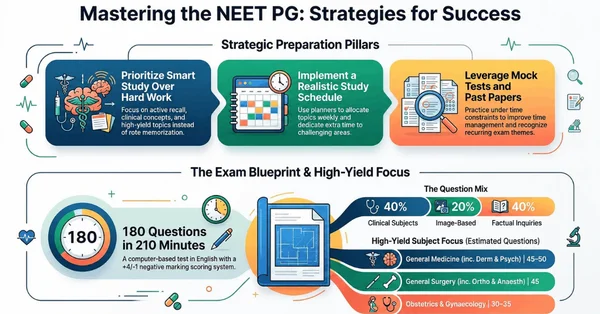
  • The exam is computer-based with 180 multiple-choice questions divided into 5 sections of 36 questions each. 
  • Each section has a fixed time limit of 42 minutes, and candidates must complete one section before moving to the next. The marking scheme is +4 for correct answers, -1 for incorrect answers, and 0 for unanswered questions. So, avoid answering the questions you are not sure about. 
  • Follow exam staff’s instructions carefully and maintain composure throughout the exam. 

FAQs about NEET PG 2027 Exam Date

  1. What is the minimum educational qualification required to be eligible for NEET PG?

Candidates must hold an MBBS degree or provisional pass certificate from a recognised medical college, have completed a one-year compulsory internship by the specified date, and possess valid medical registration with NMC or State Medical Council.

  1. How much time should candidates ideally spend preparing for NEET PG?

Candidates typically require around 3 to 5 months to prepare effectively for NEET PG. This includes 2 months for studying topics, 1 month for revision, and the remaining time for mock tests and practice papers.

  1. Are there any age or attempt limits for the NEET PG exam?

Candidates of any age can appear for the NEET PG exam after completing their MBBS degree. Also, there are no limitations on the number of attempts. You can appear for the exam multiple times unless you crack it.

  1. When will the NEET PG exam take place in 2027?

The NEET PG 2027 exam date is expected to be in the second week of August 2027. However, for the exact date, please check the official website.

  1. Who can apply for the NEET PG exam 2027?

Candidates who have completed their MBBS degree from a recognised institute and completed their internship can apply for the NEET PG exam 2027.

6. What is the expected difficulty level of NEET PG 2027?

The NEET PG 2027 exam is considered moderate to difficult as per the trends of recent exams. Questions may be geared more toward clinical reasoning, integrated concepts and application of facts rather than simple memorisation. A strong understanding of the concept is key, and multiple revisions are required.

7. Is the NEET PG 2027 syllabus different from previous years?

The NEET PG 2027 syllabus is expected to remain largely unchanged, covering all MBBS subjects across pre-clinical, para-clinical, and clinical disciplines.

However, recent trends show increased emphasis on clinical subjects, integrated questions, and real-life case scenarios, making conceptual understanding more important than rote learning.

8. How many attempts are considered safe in NEET PG 2027?

For NEET PG 2027, around 130–150 accurate attempts are generally considered safe, depending on the paper’s difficulty level. Accuracy plays a crucial role due to negative marking.

Attempting fewer questions with higher precision is often more beneficial than attempting all 180 questions blindly.

9. Is internship completion mandatory before appearing for NEET PG 2027?

Yes, completing a one-year compulsory rotatory internship by the prescribed cut-off date is mandatory for NEET PG 2027 eligibility. Candidates who do not complete their internship on time will not be allowed to appear for the exam, even if they meet all other criteria.

10. How important are mock tests for NEET PG 2027 preparation?

Mock tests play a key role in NEET PG 2027 preparation. They aid candidates in practising better time management, accuracy and exam temperament.

Frequent mock tests reveal weak points and acquaint the candidates with the CBT form of the actual examination, as well as boost their confidence.

Conclusion

The NEET PG 2027 is a medical entrance exam for candidates seeking admission to postgraduate medical courses. If you are appearing for the exam, you must meet the eligibility criteria and go through the syllabus thoroughly. Adopting a comprehensive study plan is essential to crack this exam.

In this regard, you can take guidance from trusted online coaching platforms like DocTutorials. We provide professional assistance with crisp video lectures, clinical Qbank, exam-focused edition notes, flashcards, and much more.

For further assistance, join DocTutorials today and explore our NEET PG online coaching!

NEET PG Online Live Power Pack
DocTutorials App Download Now

Latest Blogs

How Many Marks are Required in NEET PG for Admission to a Government College?

NEET PG Marks Cut Off for Govt Colleges

For most MBBS graduates, getting admission to a government medical college via NEET PG is their top priority. However, with several applicants and only a limited number of seats available, the competition is always intense. Candidates may wonder how many marks are needed to get into a government college in such a scenario.

Every year, the response changes based on factors such as candidate category, exam difficulty, and seat availability. For better understanding, students should study past years’ cut-off trends, including the NEET PG 2026 cut-off, expected ranks, and the counselling process, to establish realistic career goals.

Keep reading to learn more.

What is the Required Score for Admission to Government Medical Colleges?

The NEET PG cut-off score in government medical colleges depends on the speciality you expect to apply for, your category, and the state in which you will apply. Clinical branches and top-tier institutes require a higher rank, while the trends shift yearly based on the level of difficulty that year.

While passing the NEET PG is essential, obtaining a seat in a government medical college, particularly in a clinical speciality, requires significantly higher scores.

Ace your NEET PG preparation with DocTutorials’ NEET PG Online Live Power Pack. Highest Exam Strike Rate!

This side-by-side comparison shows the expected minimum safe scores (out of 800) required to secure a government medical college seat through the 50% All India Quota (AIQ). 

Specialization General (UR) OBC SC ST 
MD Dermatology 550+ 515+ 450+ 395+ 
MD Radio-Diagnosis 545+ 535+ 500+ 443+ 
MD General Medicine 535+ 500+ 435+ 350+ 
MD Paediatrics 510+ 485+ 405+ 360+ 
MS Obstetrics & Gynaecology 500+ 475+ 405+ 305+ 
MS Orthopaedics 490+ 480+ 395+ 300+ 
MS General Surgery 480+ 465+ 385+ 310+ 
MS Ophthalmology 450+ 435+ 370+ 295+ 
MS ENT 440+ 430+ 370+ 280+ 
MD Anaesthesiology 430+ 410+ 414+ 350+ 

(Note: The EWS category typically tracks very closely with the OBC category, often landing just 2 to 5 marks lower depending on the specific branch). 

Key Takeaways on Category Relaxations 

  • The Rank vs. Score Illusion for OBC/EWS: The score relaxation for top clinical branches like Radiology and Orthopaedics is extremely tight—often just a 10 to 15-mark difference from the General category. However, because thousands of students cluster at these high scores, a 10-mark drop can actually equate to a relaxation of 3,000+ ranks. 
  • The SC/ST Margin: There is a much wider margin of safety for these categories. For example, an SC candidate scoring around 435 might comfortably secure MD General Medicine, whereas a General category candidate with that exact same score would likely only be competitive for Anaesthesiology or Pathology. 
  • The State Quota Advantage: If you fall short of these AIQ target scores, remember that your 50% State Quota counselling will generally have slightly lower score requirements for your home state’s government colleges across all categories. 

NEET PG Cut-Off to Get Admission in a Government Medical College

The NEET PG 2026 cut-off for government medical colleges is predicted to lie within a range of 285-295 for the General category and 245-260 for the Reserved and PwBD categories. Knowing these category-wise benchmarks helps aspirants understand the score trends and estimate the ranks required for various courses.

The expected NEET PG cut-off for 2026 is likely to reflect the previous year’s cut-off ranks. Here is the category-wise NEET PG cut-off required for admission to a government medical institution in India:

CategoryExpected NEET PG Cut-Off (Out of 720)
General (UR)285–295
SC250–260
ST245–255
OBC250–260
UR-PwBD260–270
OBC/SC/ST – PwBD245–255

Tips to Achieve Excellent Marks and Successfully Clear the NEET PG Exam

Scoring high in the NEET PG and securing a government medical college seat essentially requires a prudent, structured, and disciplined preparation strategy. Mastering concepts, consistent revision, and practising exam-oriented techniques will help aspirants enhance their performance level.

Discussed below are the most effective strategies to score excellent marks and successfully clear NEET PG:

  • Continuous Note-taking

Taking notes and revising them from time to time will ensure revisions before the examination. Conducting daily reviews of your notes strengthens memory retention and, consequently, prevents last-minute overload. As notes summarise big topics into crisp points, they become your best asset during final revision.

  • Create a Smart Study Schedule

Create a well-scheduled study routine that aligns with the needs of the exams by covering all pre-clinical, para-clinical, and clinical subjects using previous-year papers and mock tests. Do not spend too much time on strong areas; instead, allocate more hours to high-yield and weak subjects. A structured timetable enhances efficiency and prevents burnout.

  • Select the Appropriate Study Resources

Instead of spending so much time searching for additional materials, stick to trusted textbooks and reliable lecture platforms. Consistent resources prevent conceptual confusion and ensure accuracy. High-quality lectures, summaries, and MCQs from top faculty build a strong foundational understanding.

  • Clear Doubts Promptly

Unresolved doubts turn into big mistakes at the time of the examination. Whenever doubts arise, clarify them with peers, seniors, or teachers. Thorough preparation improves clarity about concepts and boosts confidence.

  • Emphasise Focused Revision

Revision is essential for retaining what you have studied. Use notes and MCQs to reinforce memory and assess for weak areas. Allocate revision time according to the difficulty of each subject and incorporate regular short reviews to ensure long-term memorisation.

  • Participate in Mock Tests

Mock tests simulate the actual exam environment, thereby strengthening your time management skills and exam mindset. Analyse your performance after each test to understand errors and adjust your study plan accordingly. Regular practice brings speed, accuracy, and confidence.

  • Master PYQs for Pattern Recognition

Past-year questions reveal recurring topics and help decode examination patterns. Solving 100–150 questions daily with in-depth analysis ensures deep learning. Reviewing mistakes made within 24–48 hrs notably improves retention and reduces repetition.

  • Follow a High-Yield Revision Strategy

Core subjects that generally contribute significantly to the exam are Pathology, Microbiology, Pharmacology, Medicine, and Surgery. Focus on quick revisions by using flashcards, creating concise summaries, and drawing diagrams.

  • Start Early for Maximum Benefit

An early start to preparation means plenty of time for conceptual development, doubt-clearing, and repeated revisions. Certainly, as competition increases with every year, starting early comes with an enviable advantage. Long-term preparation lays a strong foundation in subjects and enhances overall performance in the examination.

  • Monitor Progress

Divide your study window into monthly, weekly, and daily targets. Regularly test your preparedness with subject-specific tests to identify your strengths and weaknesses.

  • Balance Learning and Revision Using Spaced Repetition

Use spaced revision to strengthen memory—revisit the topics after hours, days, and weeks. This technique can lead to immense improvements in long-term memorisation and help prevent forgetting. It ensures every concept remains fresh until exam day.

  • Manage Distractions and Maintain Discipline

Avoid distractions by limiting phone use and preparing a study-conducive environment. Count the number of real productive hours and work on increasing them. Consistent discipline, rather than the length of time, is more effective.

  • Choose the Best Books and Resources

Use fresh editions of NEET PG books based on the latest pattern of the examination. Always cross-check recommendations from credible sources or experienced mentors. A well-curated resource list bolsters preparation and avoids unnecessary overload.

FAQs about Marks Required to Get Admission in a Government College

  1. How can I check the NEET PG 2026 cut-off marks?

To check the NEET PG 2026 cut-off, visit the official NBEMS websites nbe.edu.in or natboard.edu.in once the results are announced. On the homepage, click the link marked “NEET PG 2026 Result/Cut-off” to open the official PDF.

Download and save this document for future reference, as it contains the category-wise cut-off marks and qualifying percentiles essential for government college admissions.

  1. What are the best government colleges in India after NEET PG?

Some of the finest government colleges in India to pursue your desired medical course after clearing NEET PG include Maulana Azad Medical College, New Delhi, Vardhman Mahavir Medical College (VMMC), New Delhi, Government Medical College, Thiruvananthapuram, Madras Medical College, Chennai, Nizam’s Institute of Medical Sciences, Hyderabad, and so on.

  1. What is the cut-off for NEET PG 2026 for government colleges?

Getting admission to a government medical institution is quite challenging. Candidates must score over 650 marks to have a higher chance of getting admission to a reputable government college.

  1. How many marks are required in NEET PG to secure a government college?

While the NEET qualifying score is set at around 138, government colleges typically require a score of 550 or above.

  1. What are the required documents for NEET PG 2026?

Essential documents include 10th and 12th mark sheets, transfer certificates, caste certificates, and entrance scorecards.

  1. What is the estimated NEET cutoff for 2026?

The expected safe score varies by category. General candidates need 720-162 marks, OBC/SC/ST need 161-127, and General-PH needs 161-144. The cutoff depends on factors like exam difficulty and the number of applicants.

  1. Why does the NEET PG cutoff change every year?

The NEET PG cutoff changes due to several factors like the number of students appearing, the difficulty level of the exam, and seat availability in government colleges.

  1. What are the minimum NEET marks for a government MBBS seat?

For general category students, a score of 610–660+ is generally required to secure a seat in a government medical college under the All India Quota (15% seats).

  1. What is the difference between NEET PG qualifying and admission cutoffs?

Qualifying marks (e.g., 137-162 for General) only make you eligible for counselling, while admission cutoffs (600+) are the actual scores at which seats are filled.

Conclusion

In summary, the NEET PG marks for admission to a government college fluctuate annually in accordance with the examination pattern, competition, and reservation policies for different categories.

Although the NEET PG previous year cut-offs provide an idea, aspirants must score the maximum marks and prepare strategically for counselling. Knowing the rank requirements for different branches and institutions will help candidates make informed choices.

To ensure you prepare well for the NEET PG exam, we at DocTutorials provide informative, crisp videos, a clinical Qbank, exam-focused edition notes, flashcards, and much more to ensure aspirants are well-prepared.

Join DocTutorials today and explore our NEET PG course to excel in your medical career!

NEET PG Online Live Power Pack
DocTutorials App Download Now

Latest Blogs

NEET PG Marks vs Branch: In-Depth Analysis

NEET PG Marks vs Branch

The NEET PG exam is not just a competitive exam, but also a process that determines your postgraduate path and future medical career. With numerous candidates competing for a limited number of seats in a reputed medical college, a slight marks difference can change your ranking and affect the branch and institution you get into.

You can match your score with realistic opportunities by comprehending the details about NEET PG marks vs the branch. It is important to study marks and competition before making your branch preferences, regardless of whether your career goals are radiology, dermatology, medicine, or DNB.

Keep reading for a detailed insight.

NEET PG Branch-Wise Cut-off: What Does it Mean?

Every year, the cut-offs for different branches depend on the level of difficulty, competition, and the number of seats available. If you are aware of how NEET PG marks vs branch trends work, you can easily tell which specialities are going to be your match score-wise. This shows how cut-offs can affect your chances among the top and newly coming branches.

Ace Your NEET PG Prep With DocTutorials NEET PG Online Live Power Pack. Highest Exam Strike Rate!

The NEET PG branch-wise cut-off is the minimum score that guarantees admission within the specific MD/MS specialities. The cut-offs in the clinical branches that are most desired by the students—Dermatology, Radiology, and General Medicine—tend to be the highest due to the smaller number of seats and competition.

For instance, Dermatology may close around 550, Radiology near 545, and Medicine around 535, while Orthopaedics is about 490 and Psychiatry is about 455. Knowing this distribution of cut-offs, candidates can shortlist the realistic branch options for themselves based on their score and the overall competition.

NEET PG 2026 Branch-Wise Cut-off: Expected Scores for Major Specialities

Knowing what to expect in terms of branch-wise scores is crucial to predict which speciality suits your NEET PG marks. Specialities carry the highest expected UR cut-offs in NEET PG 2026, making them the most competitive choices.

As per the counselling trends observed in the previous year, there is an estimated computation of the NEET PG score-based seat allotment for 2026 across various fields of study. The scores corresponding to each branch are detailed below:

Branch NameEWSOBCSCSTUR
Radiodiagnosis527540500434545
Anaesthesiology407414350295424
Dermatology502540465435545
Emergency Medicine485492425337508
General Medicine419525431370540
Obstetrics & Gynaecology475481425350500
Paediatrics495500430365517
Pathology305450305270376
Psychiatry475440365280460
Radiotherapy395410362275420
Respiratory Medicine478495430350495
ENT425438385315444
General Surgery472475407325485
Ophthalmology424440395315450
Orthopaedics475481410337497

NEET PG Rank vs Branch: Expected NEET PG 2026 Rank Cut-off for Top Medical Colleges

Understanding how NEET PG marks convert into branch allocation is key to analysing top medical colleges’ rank cut-offs, since higher-ranked institutes will determine branch availability and competitiveness. This trend of ranks will help the candidates have an idea about which branches are accessible at different levels of scores.

The anticipated NEET 2026 PG rank cut-off for leading institutions will vary for each college and will be influenced by the specific category. Students can refer to the expected NEET PG 2025 rank cut-off for prominent colleges listed below:

Name of the Medical CollegeExpected Rank Cut-off 2026
Maulana Azad Medical College, New Delhi29,321
Gajra Raja Medical College, Gwalior77,575
Government Medical College, Nagpur79,533
B.J. Medical College, Ahmedabad75,406
Guntur Medical College, Guntur48,030
Government Medical College, Thiruvananthapuram41,496
Madras Medical College, Chennai42,414
VMMC and SJ Hospital, New Delhi40,194
Nizam Institute of Medical Sciences, Hyderabad40,743
Seth GS Medical College, Mumbai74,960

NEET PG Rank vs Branch: Expected Category-wise NEET PG 2026 Cut-off Scores

Cut-offs for categories define the minimum marks a candidate needs to qualify for NEET PG 2026. Category-wise cut-off scores directly influence branch eligibility before competing for their preferred speciality. These cut-offs help the aspirants assess how their NEET PG marks align with the branches they select.

The projected NEET PG 2026 cut-off scores, which are category-specific, will vary across different categories, along with their respective percentiles. Candidates can find the anticipated NEET PG cut-off for 2026 provided below:

CategoryExpected Qualifying PercentileExpected Score Range
Unreserved (UR) / EWS50th Percentile275 – 320
SC / ST / OBC40th Percentile245 – 275
UR-PwD45th Percentile260 – 290
SC / ST / OBC-PwD40th Percentile245 – 275

Note: These qualifying cut-offs help students assess exam readiness and eligibility before targeting branches.

NEET PG Rank vs Branch: Factors Affecting Branch Selection

Your choice of branch after NEET PG depends on many linked academic, personal, and work-related things. Knowing these helps students pick options that match their scores and long-term plans.

Here’s a breakdown of what truly shapes your NEET PG branch decision:

  • Personal Interest: Typically, this decision is to be taken as per your interest and comfort level with the chosen medical speciality. A speciality that is appealing to you leads to motivation and productivity over time.
  • Professional Advancement: Some branches provide greater possibilities for variety, pay, and often the opportunity for advancement. Students tend to select specialities that demonstrate demand and some stability over the short or long term.
  • Work-Life Balance and Lifestyle: Each branch has different workloads, stress levels, and hours of work. Candidates weigh their suitability level with a well-organised schedule against a competitive and dynamic clinical atmosphere.
  • Cut-Off and Competition: Exceptional scores are required for specialities that have a greater demand, such as dermatology and radiology. Make sure that you check the cut-offs periodically, as they can change from year to year.
  • Mentoring/Advice: Your colleagues, faculty, and mentors can help guide you towards specialities that suit you the best. Observing different departments during your internship also gives you a better understanding of the preferences of each branch.
  • Long-Term Vision and Personality: Some branches require direct interaction with patients, while other specialities involve patients through testing or procedures. Selecting a speciality that matches your preference promotes job satisfaction.

How to Calculate Your Expected NEET PG Rank?

You can predict which branches you can realistically target by estimating your NEET PG rank based on your marks. Knowing where you stand helps you plan your preferences because rank distribution has a significant impact on NEET PG rank vs branch trends.

Here is how you will be able to evaluate your expected NEET PG rank:

  • Use NEET PG Rank Predictor Tools

Rank predictor tools available online allow candidates to get a quick idea of their expected rank by considering their projected score and comparing it using historical trends.

You can simply put your marks, exam year, and category (General, SC, or ST) into the tool, and the statistical model will generate a rank.

  • Calculate Using Percentiles

Percentile-based scoring allows you to see where you stand in relation to other NEET PG test takers.

By checking and comparing percentile distributions from previous years and their adjacent branches, you will have an accurate idea of what branches you have a chance to enter based on your expected score. This is especially useful if you are targeting a highly competitive speciality.

  • Analyse Score Versus Rank Trends

Evaluate past cycles of NEET PG marks to rank trends to understand how your raw score converts to rank. For example, you can use comparable data points to forecast your own position if a score of about 600 usually falls close to rank 1,000.

This directly helps in estimating the likelihood of branches, whether they are in high demand or have moderate competition.

  • Adapt to Exam Difficulty

The difficulty of each NEET PG exam varies. While an easier paper has more competition, a harder paper typically results in higher ranks for the same marks. You can more accurately predict your rank and, consequently, the branch you can target by modifying your expectations according to difficulty.

Conclusion

It is not just about marks that one has to choose a speciality—it is about clarity, strategy, and understanding the real rivalries in each branch. As you unravel NEET PG marks vs branch trends and decide your next move, it will be of great help if you have the right guidance.

To provide added guidance on your medical journey, DocTutorials can be a reliable partner. We offer crisp videos, clinical Qbanks, exam-focused edition notes, and flashcards to ensure students are well-prepared for their exams.

Join DocTutorials now and explore our NEET PG course to excel in your medical career!

FAQs about NEET PG Marks vs Branch

  1. What is the basic relationship between NEET PG rank and branch allotment?

The higher NEET PG ranks open higher and in-demand branches like Radiology, Dermatology, and General Medicine for the candidates. Lower ranks reduce branch options, shifting eligibility toward mid- or low-competition specialities.

  1. How does the NEET PG rank influence branch cut-offs?

The branch cut-offs go up or down depending on how competitive the speciality is and what ranks are opting for it. Higher ranks secure premium branches, and lower ranks usually meet cut-offs for less popular options.

  1. Are the para-clinical and pre-clinical branches easier to get into?

Yes, these branches generally have lower cut-offs because fewer candidates prefer them compared to clinical specialities. Students with moderate or lower ranks can usually secure seats in them without heavy competition.

  1. Does a higher score ensure a top branch in NEET PG?

An excellent score significantly enhances the chances of getting a top clinical branch, though final allocation also depends upon category, seat availability, and counselling trends. Score strength improves probability, not certainty.

  1. How can I predict which branch I might get based on my rank?

A comparison of your rank with previous branch-wise cut-offs and counselling trends gives you a realistic idea about probable branches. Higher ranks match with competitive specialities, and mid-range ranks match with mid-tier branches.

  1. Why is branch-wise cut-off analysis so important in NEET PG?

The branch-wise cut-off analysis helps candidates understand the exact marks required for the different specialities because each branch has a different level of competitiveness. It helps students realistically set goals, target branches that align with their scores, and prepare for the entrance exam based on trends specific to each branch.

  1. How do the rank cut-offs differ between government and private colleges in various NEET PG branches?

Government colleges have higher rank cut-offs for popular branches, since the fees are low and demand is high, thus making them more competitive. Private colleges have comparatively lower cut-offs and give a wider range of branch options for students with moderate marks, though at higher costs.

  1. What is the expected score for NEET PG 2026 vs rank?

A NEET PG 2026 rank of 10,000 will fall in the NEET PG score range of 550 to 541. This can be considered a good NEET PG rank 2026. However, students must aim to secure a NEET PG Rank 2026 between 1 and 9,800 to secure admission into the top PG medical colleges in India.

  1. Will there be some changes in NEET PG 2027 pattern?

The National Board of Examinations in Medical Sciences (NBEMS) is unlikely to change the NEET PG 2027 pattern. The exam pattern is released along with the official information brochure online. The exam pattern comprises crucial details pertaining to the exam, including mode, medium, total number of questions, their type, and marking scheme.

  1. Which branch has the highest cut-off in NEET PG?

Dermatology, Radiology (Radiodiagnosis), and MD General Medicine consistently have the highest NEET PG cutoffs due to high demand and better earning potential.

NEET PG Online Live Power Pack
DocTutorials App Download Now

Latest Blogs

NEET PG Marks vs Rank: In-Depth Analysis & Career Impact

NEET PG Marks vs Rank

For every student who wants to secure a consistent post-graduation seat, knowing how NEET PG marks influence marks and rank is vital. Precisely, getting a better mark uplifts your AIR (All India Rank).

Since the whole evaluation is done based on a percentile-based approach, having a clear insight into these trends helps one set realistic goals and plan more effectively. Keep reading to learn more about NEET PG marks vs rank!

Keep reading for a detailed insight.

Ace Your NEET PG Prep With DocTutorials NEET PG Online Live Power Pack. Highest Exam Strike Rate Guaranteed!

NEET PG Marks vs Rank: Projected Rank Ranges

The prior predictions of marks in NEET PG 2026 enable candidates to guess their possible AIR marks out of 720. In fact, those who score higher marks come within the top ranks, while a minimal difference in scores may impact in terms of ranking because of intense competition and percentile-based evaluation.

Based on historical data and expert analysis, the following are approximate marks versus rank estimations for NEET PG 2027:

Total Marks (Out of 720)Expected All India Rank (AIR)
720 – 7011 – 20
700 – 69120 – 40
690 – 68140 – 90
680 – 67190 – 160
670 – 661160 – 280
660 – 651280 – 450
650 – 641450 – 700
640 – 631700 – 1,000
630 – 6211,000 – 1,500
620 – 6111,500 – 2,200
610 – 6012,200 – 3,000
600 – 5913,000 – 4,000
590 – 5814,000 – 4,501
580 – 5714,500 – 6,401
570 – 5616,400 – 8,000
560 – 5518,000 – 9,800
550 – 5419,800 – 12,000
540 – 53112,000 – 14,000
530 – 52114,000 – 16,500
520 – 51116,500 – 19,000
510 – 50119,000 – 21,500
500 – 49121,500 – 24,500
490 – 48124,500 – 28,000
480 – 47128,000 – 31,000
470 – 46131,000 – 34,500
460 – 45134,500 – 38,500
450 – 44138,500 – 42,000
440 – 43142,000 – 46,000
430 – 42146,000 – 50,000
420 – 41150,000 – 54,500
410 – 40154,500 – 59,000
400 – 39159,000 – 63,500
390 – 38163,500 – 68,500
380 – 37168,500 – 73,000
370 – 36173,000 – 78,500
360 – 35178,500 – 83,500
350 – 34183,500 – 89,000
340 – 33189,000 – 94,500
330 – 32194,500 – 1,00,000
320 – 3111,00,000 – 1,06,000
310 – 3011,06,000 – 1,13,000
300 – 2911,13,000 – 1,19,000
290 – 2811,19,000 – 1,26,000
280 – 2711,26,000 – 1,31,000
270 – 2611,32,000 – 1,38,000
260 – 2511,39,000 – 1,45,000
250 and below1,46,000 – 1,50,000

NEET PG Marks vs Rank for SC, ST, EWS, and OBC Categories

The reason why NEET PG score vs rank varies is that they are categorised on the basis of required percentiles for getting admissions and the reservation policy for distribution of seats. This category-centric NEET PG marks and rank comparison thus helps candidates focus on more realistic marks and consequently, make a choice of an ideal college for the counselling phase.

The table below indicates the NEET PG 2027 expected marks versus rank across categories based on recent year exam trends:

CategoryExpected Cut-Off MarksExpected Rank RangeQualifying Percentile
OBC245–250Up to 60,00045th percentile 
ST220–230Up to 75,00040th percentile
SC230–240Up to 70,00040th percentile
General275–280Up to 50,00050th percentile 
EWS250–260Up to 55,00045th percentile

Factors Affecting NEET PG Marks vs Rank 

Marks obtained in NEET PG marks versus rank typically differentiate every year based on certain variables such as the difficulty of question standards, the total volume of candidates participating in the exam, percentiles, and the allocation of seats.

The factors below are responsible for shaping the NEET PG 2027 score-to-rank conversion:

  • Complexity of Exams 

The degree of complexity of the question standard influences overall scores and the distribution of ranks significantly. Considerably a more challenging exam narrows the score range, enabling candidates to obtain better ranks.

Similarly, an easy paper increases competition, where the paper examiner checks papers intensely, allowing few marks, which can alter rank positions.

  • Volume of Candidates

An increased number of participants typically increases the level of competition, making it hard to score and rank. When more candidates participate in the test, even a variance of 2 to 3 marks can bring variation in rank, making precision and accuracy all the more critical.

  • Percentile System and Normalisation

Since NEET PG focuses on percentile-based ranking, your performance tends to be judged relative to other candidates. Additionally, normalisation is particularly crucial in years when the exam takes place in multiple shifts, as it ensures fairness even with variations in the difficulty of different question papers.

  • Seat Matrix and Reservation Policies

The closing rank depends on seat availability under AIQ and State Quota, as well as category-based reservations. For instance, highly competitive clinical branches such as Dermatology, Radiology, and Medicine require significantly higher ranks due to their limited number of seats.

  • Tie-Breaking Rules and Subject Weightage

These factors come in when candidates score identical marks. These include the number of correct/incorrect attempts, age, and MBBS aggregate. Furthermore, performance in high-weight subjects, such as Medicine, Surgery, and Pathology, contributes to the overall score and enhances the final merit list.

How to Utilise NEET PG Marks vs Rank Data for Counselling?

Use NEET PG rank vs marks data to accurately estimate your position, compare it with past cut-offs, and prioritise colleges and branches. Do not miss any official counselling updates, keep documents ready, and have multiple options as a backup to increase your chances in every round.

Here’s how you can use the NEET PG marks vs rank effectively during counselling:

  • Estimate Your Rank Accurately: Use authentic NEET PG rank predictor tools to get a close idea about your AIR. Cross-check your estimated rank with previous years’ marks–rank charts to understand your position. This gives you a clear starting point for planning.
  • Compare Your Rank with Past Cut-Offs: Go through the cut-off trends of 2023 and 2024 to identify the colleges and branches that matched your score range. It will help you create realistic expectations for shortlisting.
  • Prioritise Colleges and Specialisations: Keep a balanced list of options prepared, comprising top-tier dream colleges, mid-tier safe options, and backup choices like DNB or private seats. This way, for every counselling round, you will be prepared for any possible outcome.
  • Follow Official Counselling Updates Closely: Track notifications from MCC and State Counselling Boards to ensure no dates are missed. Keep yourself informed about the announcement of schedules, registration dates, and changes in seat matrices.
  • Organise All Essential Documents in Advance: Keep your MBBS documents, NEET PG scorecard, internship certificate, category proof, and identity documents ready. Having everything prepared avoids last-minute stress during counselling.
  • Develop a Backup Strategy: If your rank does not allow entry into your top choices, strong alternatives could be DNB programmes or slightly less competitive branches. You can also prepare to reattempt next year with improved focus.
  • Be Flexible Throughout the Rounds: Keep checking for vacancy updates and upgrade opportunities between rounds. Seats often emerge when other candidates withdraw or move to explore better options.

Conclusion

In summary, a clear understanding of the trends of NEET PG marks vs rank helps candidates make their study plan better, aim appropriately, and always stay one step ahead in preparation. However, it is through consistent guidance and high-quality learning support that a real difference is made.

To stay ahead in your medical life, DocTutorials can be your study buddy. Our NEET PG course provides crisp videos, clinical Q&As, flashcards, and exam-focused edition notes.

Join DocTutorials today and explore our NEET PG course!

FAQs about NEET PG Marks vs Ranks

  1. What rank can you expect with 500 marks in NEET PG?

A score of about 500 marks in NEET PG usually results in a rank ranging from 10,000 to 20,000. The specific rank can vary each year based on the exam’s difficulty and the total number of candidates.

  1. What is a good score in NEET PG?

Typically, a good score in NEET PG is 600 marks or higher. This score helps you stay competitive for MD/MS programmes in leading government colleges throughout India.

  1. What rank can you expect with 500 marks in NEET PG?

A score of about 500 marks in NEET PG usually results in a rank ranging from 10,000 to 20,000. The specific rank can vary each year based on the exam’s difficulty and the total number of candidates.

  1. Do candidates with identical marks in the exam receive different rankings?

Yes, NEET PG employs a percentile-based ranking system alongside tie-breaking criteria such as the number of correct answers. This ensures that when several candidates score the same marks, their academic background and relative performance help determine the exact rank order.

  1. What distinguishes NEET PG marks from percentile?

Marks indicate your total score out of 720, whereas the percentile reflects your performance in comparison to other candidates. For instance, scoring in the 90th percentile signifies that you outperformed 90% of the test-takers.

  1. How many questions will there be in the NEET PG 2027 exam?

The NEET PG 2027 question paper will comprise 180 questions. The total marks will be 720. Students will be provided three and half hours to answer question papers.

  1. What is considered a good score in NEET PG?

A good NEET PG score is usually 600 marks or above. This range keeps students competitive for MD/MS programmes in top government colleges across India.

  1. How is rank decided in NEET PG for the same marks?

Tie-breaking rules apply: when multiple candidates score the same marks, the ranking is decided using official tie-break criteria by higher number of correct answers, age preference, and aggregate MBBS marks.

  1. How is rank calculated in NEET PG?

Since NEET PG is conducted in a single session, no normalisation is applied. Instead, rankings are based on the raw marks scored by candidates. However, the exam uses the percentile-based scoring system to determine eligibility.

  1.  How to check NEET PG category rank?

The result of NEET PG 2027 will be published as a live link on the official website of NBEMS. Students who have appeared for the exam can access this link to check the PDF marksheet or rank list by entering their login credentials

NEET PG Online Live Power Pack
DocTutorials App Download Now

Latest Blogs

INI CET vs NEET PG: Key Differences Every Aspirant Should Know

NEET PG Vs INI CET

For medical graduates seeking a postgraduate degree in India, the key question is which exam to pursue: INI-CET or NEET PG. While both are tickets to notable MD, MS, and DNB programmes, they are structurally different in terms of toughness, eligibility, and the institutions wherein they are organised.

Therefore, having a proper clarity on these differences has never been more crucial, as it helps students plan their preparation to excel in their desired exam. Keep reading for a detailed insight into the key differences between INI CET and NEET PG.

INI CET Examination: Overview

INI CET is a computer-based postgraduate medical entrance test comprising 200 MCQs divided into four sections of 50 questions each. Candidates will have a total of 3 hours, with 45 minutes allotted to each section, and will need to select the correct option from among the four choices for each question.

INI CET stands for the Institute of National Importance Combined Entrance Test. It is a postgraduate medical entrance test conducted by AIIMS New Delhi for admission to prestigious national institutions, such as AIIMS, JIPMER, PGIMER, and NIMHANS.

Ace your NEET PG preparation with DocTutorials’ NEET PG Online Live Power Pack. Highest Exam Strike Rate!

The examination consists of objective-type questions from the broad sections of preclinical, para-clinical, and clinical subjects taught during the MBBS programme. A computer-based test held twice a year, it emphasises clinical application and thorough understanding rather than mere rote knowledge.

NEET PG Examination: Overview

NEET PG stands for National Eligibility cum Entrance for postgraduate medical courses and is considered a single eligibility test for admission to MD/MS/PG Diploma courses in India. It assesses an aspirant’s in-depth knowledge of medical subjects as well as the eligibility and ranking of candidates for admission.

This is an entrance examination that provides access to various medical institutions across the nation for courses such as MD, MS, PG Diploma, and DNB, excluding AIIMS, JIPMER, PGIMER, and NIMHANS. The exam assesses your understanding of the concepts you learnt during your MBBS.

INI-CET vs NEET PG Examination: Key Differences

Understanding the differences between NEET PG and INI CET is crucial for goal-orientated preparation, as each exam tests different skills, uses distinct scoring patterns, and opens doors to different institutions. 

  • NEET PG: Conducted once a year, this national-level exam covers the broad MBBS syllabus through 200 questions. It serves as the primary gateway for admission into more than 800 medical colleges across India. 
  • INI CET: Organised twice a year, this exam is exclusively for premier autonomous institutes like AIIMS, JIPMER, NIMHANS, and PGIMER. Its 200 questions heavily emphasise clinical, image-based, and analytical problem-solving. 

The following section discusses the difference between the INI CET and NEET PG exams:

AspectINI CETNEET PG
Full FormINI CET stands for the Institute of National Importance Combined Entrance Test.NEET PG stands for the National Eligibility cum Entrance Test for Postgraduate.
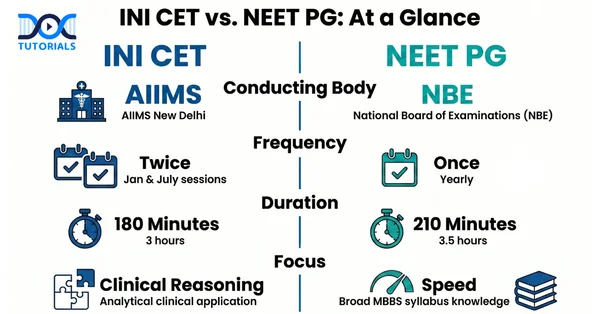
Conducting BodyAIIMS, New Delhi, conducts INI CET.NEET PG is conducted by the National Board of Examinations (NBE).
DurationThe time allowed for candidates in the INI CET exam is 180 minutes (3 hours).The time allowed for candidates in the NEET PG exam is 210 minutes (3.5 hours).
FrequencyINI CET is held twice a year in January and July.NEET PG is held once a year.
Sectional TimingINI CET does not have sectional timing, but it divides the questions into four parts of 50 questions each.NEET PG has equal sectional timing for each part of the exam.
EligibilityINI CET is for MBBS or BDS graduates who have completed their mandatory internship.NEET PG is for MBBS graduates who have completed their mandatory internship.
Marking SchemeIn the INI CET exam, each question is worth 1 mark for a correct answer and deducts 1/3 mark for a wrong answer.NEET PG exam questions are worth 4 marks for a correct answer and 1 mark for a wrong answer.
Courses CoveredINI CET provides admission to MD, MS, DM, MCh, and MDS courses.NEET PG provides admission to MD, MS, PG Diploma, and DNB courses.
Institutions CoveredINI CET scores are accepted by Institutes of National Importance such as AIIMS, JIPMER, NIMHANS, and PGIMER.NEET PG scores are accepted by over 800 government and private medical colleges across India.
SpecialisationsINI CET covers both medical and dental specialisations, including MD, MS, DM, MCh, and MDS.NEET PG primarily covers medical specialisations like MD, MS, PG Diploma, and DNB.
Syllabus EmphasisINI CET emphasises an in-depth understanding of subjects and tests clinical application and analytical skills.NEET PG emphasises broad coverage of MBBS subjects and tests speed and accuracy.
Difficulty LevelINI CET is considered more difficult and requires a strong conceptual understanding.The NEET PG is moderately difficult and requires both speed and a broad knowledge base.
Exam Strategy ImplicationINI CET preparation focuses on deep conceptual clarity, analytical skills, and clinical reasoning.NEET PG preparation focuses on efficiently completing the extensive syllabus and practising speed.
Official WebsiteThe official INI CET website is https://www.aiimsexams.ac.in/.  The official NEET PG website is https://natboard.edu.in/.

INI CET vs NEET PG Exam: Which is Better to Choose?

Choosing between INI CET and NEET PG depends on where one wishes to pursue their postgraduate journey. Although there is significant overlap in the syllabus between the two exams, the question styles are vastly different.

NEET PG mainly focuses on recall and essential clinical principles, so it becomes easier if you are well-versed with the MBBS syllabus. On the other hand, INI CET has a strong emphasis on integrated clinical reasoning, scenarios, and assertion-reason types that test deep conceptual understanding.

Most candidates opt for both, as INI CET happens earlier, and the conceptual preparation for it naturally strengthens the foundation for NEET PG. If you aim for top-ranking institutions, the INI CET is more challenging, but the skills you acquire will also give you an edge in NEET PG. The selection ultimately depends on your life goals and learning curve.

FAQs about INI CET and NEET PG Differences

  1. What do INI CET and NEET PG stand for?

The full forms of INI CET and NEET PG are Institute of National Importance Combined Entrance Test and National Eligibility-cum-Entrance Test (Postgraduate), respectively.

  1. Is INI CET more difficult than NEET PG?

The answer is yes. INI-CET is recognised as a more concept-focused and challenging exam than NEET PG. However, the exam’s difficulty mainly relies on your skills in clinical reasoning and quick recall.

  1. Are the topics in the INI CET syllabus different from those in the NEET PG?

Yes, the topics in the INI CET syllabus are somewhat different from those in the NEET PG. For instance, it includes Community Medicine, whereas NEET PG includes Social and Preventive Medicine. Moreover, NEET PG has a broader scope in General Medicine and General Surgery than the INI CET exam.

  1. Can I give both INI CET and NEET PG examinations?

Yes, you can appear for both INI CET and NEET PG exams. Many candidates choose to take INI CET before NEET PG because it helps build a solid clinical understanding, which in turn aids broader revision for NEET PG.

You have the chance to leverage the conceptual depth of INI CET to adapt easily to a wider syllabus in NEET PG and its +4/–1 pattern of marks.

  1. What is the INI CET exam?

The INI-CET exam is a centralised PG medical entrance exam conducted by AIIMS, New Delhi. This exam provides access to some of the most prestigious colleges, such as AIIMS, JIPMER, PGIMER, and NIMHANS. It is specifically designed to emphasise conceptual understanding, clinical application, and image-based problem solving. 

  1. How many attempts are there in INI CET?

There is no limit to the number of attempts for a candidate. Candidates can appear in INI CET as often as they want. There is no limit to the nationality of a candidate. All Indian, foreign, OCI and NRI candidates are eligible to appear in the exam.

  1. What courses do NEET PG and INI CET cover?

Both exams cover MD (Doctor of Medicine) and MS (Master of Surgery) courses. INI CET also includes MDS (Master of Dental Surgery), DM (Doctorate of Medicine), and MCh (Master of Chirurgiae) courses.

  1. What is the exam format of NEET PG and INI CET?

Both exams are computer-based tests (CBT) featuring multiple-choice questions (MCQs). NEET PG consists entirely of MCQs, whereas INI CET may include questions with multiple correct answers.

  1. What are the eligibility criteria for NEET PG and INI CET?

Candidates must have completed their MBBS degree and meet specific age and qualification requirements, which are important for understanding NEET PG vs INI CET exam eligibility.

  1. Can an individual take both NEET PG and INI CET?

Yes, candidates can apply for both exams, but they should ensure they meet the specific criteria for each one.

Choosing between INI-CET and NEET PG depends on the preparation strategy you adopt to build the foundation of your medical career. NEET PG is accepted across India, while INI-CET is aimed at prestigious institutions that require a sharp focus.

With disciplined preparation, high-quality resources, and thoughtful planning, aspirants can navigate through the competitive landscape with confidence and secure their desired postgraduate seat.

DocTutorials helps bridge the gap between these two exams and prepares aspirants smartly with focused INI CET and NEET PG courses. We offer animated video lectures, systematic notes, PYQ banks, and faculty-led guidance. With DocTutorials by your side, you will go into both exams with stronger concepts and a sharper edge.

Join DocTutorials today and explore our NEET PG and INI CET courses to excel in your medical career!

NEET PG Online Live Power Pack
DocTutorials App Download Now

Latest Blogs

MD vs. MS – Which Path is Right for You?

MD Vs MS

For any medical graduate embarking on postgraduate study, the MD versus MS dilemma presents a significant juncture. Both paths promise prestige, skill, and a rewarding career, but their core focus differs considerably. While MD hones your diagnostic and medical management expertise, MS turns you into a skilled surgeon with precision and procedural excellence. 

It is these differences that enable one to align one’s passion with one’s profession. Continue reading for a detailed comparison of both courses: admission and curriculum, lifestyle, and career opportunities.

How Do MD and MS Courses Differ from Each Other?

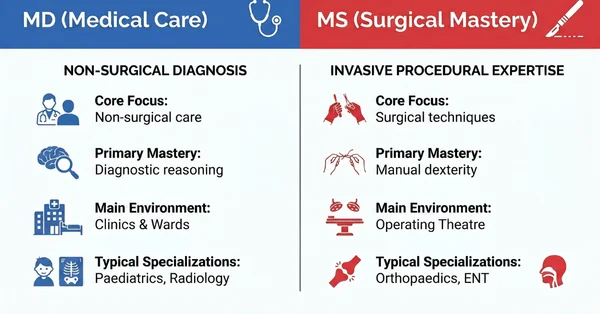
The key differences between MD and MS lie in their focus area, specialisations, skills developed, and examination patterns. MD candidates focus on medicine & non-surgical care, developing diagnostic, therapeutic, and medical management skills. Meanwhile, MS candidates focus on surgery & procedural mastery, honing skills like surgical techniques, manual dexterity, and operation theatre management.  

The most basic definitions of MD and MS revolve around their essence: the MD degree is associated with medical non-invasive diagnosis, treatment, and management of illnesses, while the MS degree focuses on surgical expertise, including proficiency in technical procedures.

At a practical level, imagine the routine clinical practice followed by each stream. An MD-trained physician would guide the patient through the entire process of history taking, differential diagnosis, medical management, and follow-up tracking. Alternatively, an MS-trained surgeon undertakes complex surgical procedures with preoperative planning and navigates postoperative situations, often making decisions in high-stakes situations.

AspectMD (Doctor of Medicine)MS (Master of Surgery)
Focus AreaMedicine & non-surgical careSurgery & procedural mastery
Typical SpecializationsGeneral Medicine, Paediatrics, Radiology, Psychiatry, DermatologyGeneral Surgery, Orthopaedics, Ophthalmology, ENT Surgery
Skills DevelopedDiagnostic, therapeutic, and medical managementSurgical techniques, manual dexterity, and operation theatre management
Examination PatternMostly theory, viva, and clinical case discussionsTheory, rigorous clinical, and surgical practical exams
Postgraduate RecognitionPhysician/Medical SpecialistSurgeon
Course Duration3 years3 years
Patient InteractionRegular consultation, roundsPre-op, peri-op, post-op, surgical procedures

MD vs MS is more than just what happens in the classroom. MD-trained specialists keep busy with ongoing patient management, chronic disease control, and nonoperative management of patients. Meanwhile, MS-trained specialists spend time with operative skills, perioperative care, and conducting postoperative follow-up.

Ace Your NEET PG Prep With DocTutorials NEET PG Online Live Power Pack

What Specialisations are Available in MD and MS?

MD offers specialisations in internal medicine, paediatrics, dermatology, radiology, and psychiatry. Meanwhile, surgical specialisations available under MS include general surgery, orthopaedics, ENT, and obstetrics & gynaecology. Super-specialisation can be done further in DM or MCh.

Specialisations enable medical students to develop expertise in a particular area, enhancing their career prospects and earning potential. Within the MD and MS classifications, there are some overlaps, and certain areas have been more traditionally represented in MD or MS tracks within the postgraduate medical education systems of various countries.

MD SpecialisationsMS Specialisations
Internal MedicineGeneral Surgery
PaediatricsOrthopedic Surgery
DermatologyCardiothoracic Surgery
RadiologyENT (Ear, Nose, Throat)
PsychiatryObstetrics & Gynaecology
General MedicineOphthalmology
Forensic MedicineNeurosurgery
PharmacologyUrology
Pulmonary MedicinePlastic Surgery
PathologyPaediatric Surgery

Both MD and MS offer the opportunity for further specialisation (DM and MCh, respectively) upon completion of the primary degree. The specialisation should suit students who wish to develop their clinical reasoning, patient interaction, and procedural skills.

How do MD and MS Differ in Terms of Curriculum and Skillset? 

MD students learn clinical skills, reasoning, diagnostic abilities, and how to manage patients through evidence-based medicine. Meanwhile, MS students focus on surgical skills and develop hands-on training to understand technical precision, spatial awareness, and surgical decision-making through intensive practice.

The difference between the MD and MS curricula is reflected in clinical rotations, surgical exposure, and assessment modes. Check out the details below:

Activity TypeMD CandidateMS Candidate
Ward Work/Patient ManagementHighModerate
Operation Theatre/Surgical ExposureLowHigh
Diagnostic TechniquesVery HighModerate
Research & Case StudiesFrequentFrequent
Teaching/Hospital RoundsDailyVariable
Emergency System ExposureDepends on the specialityIntensive in the surgical fields

In reality, an MD student receives extensive clinical exposure, primarily within the context of evidence-based medicine. Alternatively, an MS student develops advanced technical skills such as spatial perception and dexterity through repetitive practice.

What is the Admission Process for MD vs. MS Courses? 

If you want admission to either an MD or MS programme, having an MBBS degree from a recognised college and qualifying for the NEET PG are mandatory. After qualifying, the candidates will be allocated seats based on merit, rank, category, and reservation policies. Once allocated, aspirants choose colleges from either government or private institutions based on their preference and other criteria.   

For admission to MD or MS courses, aspirants need to clear NEET PG. Here’s an overview of the admission process:

  • Eligibility: MBBS degree from a recognised institute.
  • Entrance Exam: NEET PG (National Eligibility cum Entrance Test for Postgraduates).
  • Seat Allocation: Based on rank, reservation policies, and category. 
  • College Choice: Government and private institutions offer both MD and MS seats depending on merit and rank. 
  • Selection Factors: Aspirations, faculty reputation, clinical exposure, and institution-specific criteria. 

The admissions landscape is competitive, with demand influenced by speciality preferences, region, and potential career aspirations.

What are the Career Prospects After MD and MS?  

MD and MS have their own excellent career options. MD graduates typically teach in hospitals, clinics, or colleges in subjects such as Radiology and Internal Medicine. MS graduates often pursue surgical careers or super-specialisations, such as Cardiothoracic or Plastic Surgery. Both have marvellous earning potentials and growth opportunities.

Both degrees promise good career outcomes. The exact nature of work and market demand shape the further development of career paths. Most students who pursue their MDs eventually join the clinical domain, enter hospitals, enter academia, or work in specialised clinics. The highly demanded MD specialities include Radiology, Internal Medicine, Psychiatry, and Paediatrics. 

Surgical practices, hospital surgery units, and specialist clinics are directly accessible to them. Their further specialisation includes Cardio-Thoracic/Vascular Surgery, Plastic Surgery, and Urology, among others.  Both options promise securing high salaries within hospitals, lucrative private practice opportunities, and excellent teaching positions. Choices made now may impact leadership roles in the future, as well as positions in academia and research.

What is the Difference in Salary and Lifestyle for MD vs MS?

An MD graduate typically earns an approximate salary ranging from ₹6 lakh to ₹20 lakh annually, while MS graduates usually earn between ₹7 lakh and ₹25 lakh per annum. For both streams, income depends on experience, private practice, and superspecialisation.     

Check out the average salary for MD and MS graduates in the table below:

ParameterMD Average Range (India)MS Average Range (India)
Early Career₹6–₹10 lakh per annum₹7–₹12 lakh per annum
Mid Career₹12–₹20 lakh per annum₹14–₹25 lakh per annum
Top Government SpecialistUp to ₹30 lakh per annumUp to ₹35 lakh per annum
Private PracticeHighly variable; can exceed hospital rolesHighly variable; can exceed hospital roles
Super-SpecialistUp to ₹60 lakh+ per annumUp to ₹70 lakh+ per annum

Note: Salaries in the table are approximate and will tend to vary across hospitals based on multiple factors. 

When it comes to lifestyle, physicians (MD holders) spend most of their working hours in clinics, rounds, and non-operative care. In contrast, for MS holders, the hours are mostly longer and irregular, often involving surgery and emergency care, resulting in a hectic schedule. The hospital’s location also plays a major role in this regard. 

For instance, healthcare facilities in a metro city will generally have a higher caseload compared to a hospital in a town or tier-2 city. 

MD vs. MS: Which is Better for You?

Consider MD if you are inclined towards diagnosing, caring for patients, and managing their medical conditions. Alternatively, opt for MS if you prefer performing surgery with precision and working hands-on in dynamic clinical challenges.

Choosing between MD and MS ultimately depends upon your interests, strengths and career goals. Both paths enable you to get ample job prospects in government and private hospitals in both India and abroad. What’s more, both streams enable you to go for superspecialisation after completing the degree. 

So, if diagnosis, patient care, and non-operative treatments are your thing, an MD is a strong fit for you. However, if you enjoy hands-on surgical work, complex procedures, and perioperative care, MS will likely satisfy you more. Additionally, consider future ambitions such as leadership roles, academic interests, and the desire to complete superspecialisations. 

FAQs about MD vs. MS – Which Path is Right for You?

  1. Which is better, MD or MS?

It’s not really a universally “better” choice. MD is better attuned to those preferring clinical medicine, diagnosis, and long-term patient care. MS, on the other hand, accommodates those aspiring to surgery and immediate impact through procedures. 

  1. Which offers a better career, MD or MS? 

Both degrees are equal in professional stature in the medical hierarchy. Superspecialisation (DM, MCh) offers further professional credentialisation. 

  1. Who earns more, an MS or an MD? 

Higher early-career salary rates for MS holders are attributable to the demand patterns prevailing in these specialities. Nevertheless, exceptionally high-end MD specialities have superb earning prospects in private practice settings, such as Radiology or Dermatology. Overall, earnings are dependent on the area of specialisation as well as on the location and practice setting.

  1. Is MS a bigger qualification than MD? 

No, both are postgraduate degrees that are equal in time length and academic stature. Although the specialisation and scope matter, both streams provide ample opportunities for superspecialisation and career growth. 

  1. Which MD is the hardest? 

Some MD disciplines, like Neurology, Oncology, Cardiology, and Critical Care Medicine, are considered hard due to variations in clinical complexity and patient acuity. Additionally, perceived difficulty also depends to some extent on one’s aptitude or interest.

6.What specialisations are available in MS vs MD?

MS Specialisations: Orthopaedics, General Surgery, Urology, ENT, Ophthalmology.

MD Specialisations: Paediatrics, Psychiatry, Dermatology, Radiology, Internal Medicine.

7. Can an MD doctor do surgery?

Yes, an MD can do surgery, but only if they complete the necessary postgraduate surgical training (like an MS in Surgery or surgical residency) and get certified for that specific surgical field.

8. What is the duration of MD and MS courses?

Both MD (Doctor of Medicine) and MS (Master of Surgery) are typically three-year, full-time postgraduate programmes. However, certain super-speciality or integrated programmes may have a longer duration.

9. Can a doctor do both MD and MS?

Yes, a doctor can pursue both MD and MS, but it requires additional training and specialisation, which can be a lengthy process.

10. Is NEET-PG mandatory for both MD and MS?

Yes, qualifying for the NEET-PG examination is mandatory for admission into both MD and MS programmes in India.

Conclusion 

The choice between MD and MS should be made based on your interest, strengths, and future career aspirations. Both fields have equal growth prospects, and in the long run, the earning prospects depend on factors like hospital location, expertise, the doctor’s reputation, and other factors. 

However, before you make your MD vs MS choice, clearing the NEET PG is paramount. To help you in that endeavour, DocTutorials offers a comprehensive NEET PG course, featuring animated video lectures, extensive Question Banks, concise notes, and rapid revision flashcards. 

Whether you want to be a top physician or a renowned surgeon, DocTutorials has the structured resources, all focused on the exam, to assist you through your journey. Join DocTutorials today and check out our NEET PG course!

NEET PG Online Live Power Pack
DocTutorials App Download Now

Latest Blogs

NEET PG Preparation: Tips, Exam Pattern, and Subject-Weightage

NEET PG Preparation

The NEET PG (National Eligibility cum Entrance Test – Postgraduate) is an online entrance examination administered by the National Board of Examinations. Students aspiring to secure limited postgraduate seats all share the goal of clearing the examination on their first attempt.

However, to perform well in the exam, you not only require your textbooks but a systematic preparation strategy and study plan. Let’s explore some of the NEET PG exam preparation tips you can adopt in order to achieve success in your exams.

Boost Your NEET PG Prep – Download the Brochure

Download the NEET PG Preparatory Grand Test brochure to understand the full test format, subject-wise distribution, exam pattern details, performance analytics, and how this grand test can strategically strengthen your NEET PG preparation and improve your overall exam performance effectively.

Boost Your NEET PG Prep with Grand Test – Download the Brochure Now

Keep reading for a detailed insight.

Effective Preparation Tips to Achieve Success in the NEET PG Exam

Preparation for NEET PG demands a mix of discipline, smart strategies, and good resources. With lakhs of candidates and limited seats, your preparation should be properly planned, focused, and consistent.

The following are 10 must-know tips to increase your chances of success in the exam:

  1. Study Smart, Not Just Hard

With a massive number of candidates sitting every year and only about 55% clearing, it’s evident that mere hard work won’t do. Top rankers suggest emphasising high-yield topics, clinical concepts, and active recall practice rather than mere cramming.

  1. Make a Realistic Study Plan

A tight-scheduled routine is the key to balancing every subject associated with the NEET PG exam and revising efficiently. Utilise Excel sheets or planners to allocate topics per week and spend more time on tricky areas. Revise and update your schedule regularly as and when required.

  1. Take Part in Mock Tests

Mock tests help you assess your preparation, improve time management, and identify weak areas. Participate in various mock tests in order to practice previous years’ papers, section-wise questions, and track your performance analytically. This can also help boost your mindset for the exams.

  1. Avoid Exhaustive Studying and Burnout

Reading 9–10 focused hours a day is better than reading for hours without end. Break every 2 hours to relax, avoid social media, and look after your mental health to see progress consistently.

  1. Manage Distractions and Stay Focused

Locking yourself in a room alone won’t cut it unless your mind is focused. Avoid internal disturbances by defining specific goals for every session and monitoring your actual learning hours to make sure you’re studying effectively.

  1. Utilise the Best Books and Study Materials

Avoid studying too many books and choose only the top-rated and recent books specific to NEET PG. Check approved sites for suggestions and always use the newest editions with current exam patterns.

  1. Practice Using Previous Year Papers

Solving last year’s question papers under time constraints enables you to comprehend the pattern of questions and gain confidence. It also assists in the recognition of recurring themes and areas that are commonly tested.

  1. Employ Reminders and Visual Aids

Use memory aids such as acronyms, charts, diagrams, and colour-coded notes in order to enhance retention. These techniques help grasp challenging subjects in a hassle-free way and reduce hectic last-minute revisions.

  1. Take Notes and Revise Periodically

Extensive, well-organised notes facilitate active learning and save time on final revision. Organise notes under subjects, highlight, and review them from time to time.

Now that you are aware of the best preparation tips for the NEET PG examination, let’s check out the exam pattern of the upcoming NEET PG as well as its subject-wise weightage based on the syllabus.

NEET PG Exam: Exam Pattern

The important details about the upcoming NEET PG exam format are listed below:

  • Exam Date: August 30, 2026
  • Duration of Exam: 3 hours 30 minutes
  • Total Marks: The NEET PG 2026 will have multiple-choice questions.
  • Exam Mode: The NEET PG is a computer-based test that is only in English. It consists of multiple-choice questions.
  • Sections: The question paper will be divided into three sections.
  • Syllabus: The exam syllabus will cover all 19 subjects from the MBBS curriculum.
  • Total Number of Questions and Marks: Based on the latest NEET PG exam format, the test has five sections, each with 40 questions, making a total of 180 questions. Each question is of 4 marks, and there is a negative marking of -1 mark for every wrong answer.

NEET PG Exam: Subject-Wise Weightage

According to the latest examination trends, the following is the estimated subject-wise distribution for NEET PG:

  • Anatomy (15–17 questions): Moderate significance; frequently assessed through applied and image-based inquiries.
  • Biochemistry (12–15 questions): Moderate; metabolic pathways, enzymes, and molecular biology are considered high-yield topics.
  • Pharmacology (20 questions): High significance; antimicrobials, mechanisms of action, and side effects.
  • Physiology (15–17 questions): Moderate significance; cardiac and respiratory physiology are particularly favoured.
  • Preventive & Social Medicine (25 questions): High significance; epidemiology, biostatistics, and national programs are essential topics.
  • Pathology (25 questions): High significance; both conceptual and image-based inquiries are common.
  • Microbiology (20 questions): High significance; bacteriology, virology, and immunology are consistently evaluated.
  • Forensic Medicine (10 questions): Lower weightage but can yield easy scores with thorough revision.
  • General Surgery (including Orthopaedics & Anaesthesia) (45 questions): Very high significance; trauma, gastrointestinal surgery, basic orthopaedics, and perioperative care are regularly featured.
  • General Medicine (including Dermatology & Psychiatry) (45–50 questions): Very high significance; cardiology, neurology, infectious diseases, and systemic medicine are all extensively tested.
  • Obstetrics & Gynaecology (30–35 questions): High significance; labour, obstetric emergencies, and gynaecological malignancies are frequently examined.
  • Paediatrics (15 questions): Moderate; vaccines, growth and development, and neonatology are vital areas.
  • ENT (10 questions): Low weightage; quick revision can lead to easy marks.
  • Ophthalmology (10 questions): Low weightage, but image-based questions are prevalent.
  • Radiology (12–15 questions): Moderate; identification of X-rays, CT scans, and MRI images is common.
  • Orthopaedics (10 questions): Low weightage; fractures and bone tumours are popular topics in examinations.
  • Dermatology (8–10 questions): Moderate; image-based questions concerning common skin disorders are included.
  • Psychiatry (8– 10 questions): Moderate; diagnostic criteria and common treatment methods are tested.
  • Anaesthesia (8–10 questions): Moderate; fundamentals of anaesthesia, CPR, and perioperative care are the main focus areas.

FAQs about NEET PG Exam Preparation

  1. Is NEET PG preparation more challenging than NEET UG?

NEET-UG is designed for entry into MBBS programmes, while NEET PG is intended for admission to MD/MS courses. Each examination comes with its own set of challenges. However, NEET PG is generally more competitive than NEET UG.

  1. How should I begin my preparation for NEET PG starting from the first year?

Initially, it is essential to examine the exam structure and gather comprehensive information regarding the NEET PG examination.

Once you are acquainted with the key aspects of NEET PG and the curriculum of the first-year subjects, engage in solving their MCQs, assessment questions, IBQs, and case studies as part of your preparation.

  1. Is there any negative marking in the NEET PG exam?

Yes, there is negative marking in the NEET PG examination. For each wrong answer, candidates will lose one mark. Hence, each student needs to read and attempt each question carefully.

  1. When will the upcoming NEET PG exam be held?

Even though no final dates have been announced, the NEET PG 2026 examination is expected to be held in August 2026.

  1. What is the structure of the NEET PG examination?

The NEET PG examination comprises 180 questions, which include 40% pertaining to clinical subjects, 20% based on images, and 40% consisting of one-liner factual inquiries.

  1. Which subjects are covered in the NEET-PG exam 2026?

The NEET-PG exam generally covers several subjects, including one-line factual questions, clinical topics, and image-based questions. Moreover, high-yeid subjects such as Obstetrics, Medicine, Gynaecology, Pharmacology, PSM, and Pathology also form a significant portion of the examination.

  1. How can I prepare myself for the NEET-PG exam day?
  • The students will need to bring a printed copy of their registration card, a copy of their barcoded admit card, and a photo ID.
  • The students must reach the examination centre at the reporting time mentioned on the admit card.
  • The students must also read all the instructions carefully, while keeping in mind to take only the allowed items to the exam centre.
  1. What is the effective way to prepare for my NEET-PG exam?

The students must always prefer to study from their notes, including tables, mnemonics, and flowcharts, for the NEET-PG preparation. They can also enroll in available online courses to get the updated notes on all the essential topics, along with the concise tables, flowcharts, and mnemonics to memorise well.

  1. How can I crack NEET-PG on the first attempt?

The students who dream about pursuing a career in the medical sector should be well mentally prepared to crack the exam. Hard work, focus, diligence, and passion are mandatory to crack the exam at the first attempt.

In addition, studying smart and avoiding ineffective studying techniques, complete dedication, discipline, and determination will greatly help to ace the exam.

  1. Do I have to study 24/7 to crack the NEET-PG exam?

No, studying 9-10 hours every day is enough for the NEET-PG preparation plan if the students stay focused while studying. Productive learning generally comes from thoroughly reading books while escaping internet addiction.

Additionally, studying for long hours at a stretch is also not recommended. It is required to take a 10-15 minute break every 2 hours to give the mind and body a rest.

Conclusion

With the right approach, discipline, and mindset, cracking NEET PG in the first attempt is absolutely possible. Prioritise smart study methods, regular revisions, self-assessments, and self-care. Stay focused, stay consistent—and trust your journey.

For extra guidance, DocTutorials can be your study partner. Our curriculum offers crisp videos, clinical Qbank, exam-focused notes, flashcards, and mind maps to help students stay well-prepared ahead of time.

Join DocTutorials today and explore our NEET PG course to excel in your medical career.

NEET PG Online Live Power Pack
DocTutorials App Download Now

Latest Blogs

NEET PG Online Coaching: Benefits and Question Pattern

NEET PG Online Coaching | DocTutorials

Cracking the NEET PG examination can be challenging. It is a high-pressure medical exam that determines the selection of medical graduates each year. However, the preparation for the NEET PG exam does not have to be daunting and stressful.

That is where NEET PG online coaching comes in—a new approach to cater professional-guided education to aspirants, with the freedom and direction they need to ace all subjects—anywhere, anytime.

Boost Your NEET PG Prep with Grand Test – Download the Brochure Now

Keep reading to know more.

NEET PG Online Coaching: An Overview

NEET PG online coaching is a systematic and adaptive process for candidates preparing for their postgraduate medical entrance exam. It can include expert-led live classes, concise notes, MCQ banks (multiple-choice questions), grand tests, periodic revisions, and is aligned with the current exam format.

The online coaching for NEET PG is designed to render difficult subjects easy to navigate, provide real-time doubt-solving, and make candidates confident in their preparation. An example of an online coaching system is DocTutorials. At DocTutorials, we offer professional mentorship, live interactive sessions, and access to video-based lectures for easy learning.

Benefits of NEET PG Online Coaching

Selecting coaching for NEET PG online provides several advantages tailored to help your preparation be more strategic, efficient, and effective.

Starting from in-depth content to practical simulations, here’s why online coaching is the perfect solution for NEET PG candidates:

  • Complete Mastery of the Syllabus

Every one of the 19 subjects associated with the NEET PG exam will be comprehensively covered through expert-led classes in online coaching to help students grasp challenging medical concepts without hassle.

This strategy will ensure comprehension of the content, improved retention, and a deeper conceptual understanding of all topics.

  • Test & Discussion (T&D) Series

The T&D series will facilitate a structured approach to testing, accompanied by expert-guided group discussion to not only apply theory into practice, but also to develop critical thinking and study high-yield topics.

Frequent T&D sessions will also reinforce exam strategies while enhancing your confidence.

  • Full-Length Subject-Based Tests

Grand mock tests and subject-based mock testing will allow you to practice “in real time” using the NEET PG exam format. In addition, these tests will help identify weak areas, track progress, and boost your preparations.

  • Faculty-Curated High-Yield Question Banks

Access faculty-created, implemented, and validated question banks, with new MCQs and image-based questions, with rapid revision and QRPs according to the latest examination trends. This makes your practice wiser and exam-relevant.

  • Quick Revision Programme (QRP)

QRP will comprise fast-paced, focused revisits of objectives to assist you in recalling key content rapidly. These sessions will provide a great chance to reinforce your studies as you hit the last stages of preparation for the exam.

  • Recorded Live Lectures for Anytime Access

If you miss an online class, there’s no need to worry. NEET PG online coaching encompasses the option to always have access to recorded sessions at any time and place.

This facility is a great help to you in the learning process, in the way you can be free to take your time, go back to complex subjects and be active even when your time is very limited due to your other commitments.

  • Live Interactive Sessions

With NEET PG online coaching, you can access the best faculty members who will guide you through live, interactive sessions and help you learn in real-time.

These types of sessions will also clear your doubts on the spot, answer your queries, and assist you in understanding exam trends by simulating the interaction found in a physical classroom.

  • Study Anywhere, Anytime

Online coaching for NEET PG accommodates you whether you are at home, in a hostel, or performing clinical rotations, allowing you to study at your own pace.

  • Stress-Free and Structured Preparation

The leading online coaching for NEET PG does not simply take you through the lectures—it provides a clear plan of action, mentorship, regular performance monitoring, and motivational support, which together form an easy and highly concentrated process.

  • Interactive Video Lectures for Visual Learning

DocTutorials and similar platforms provide lively, animated video lectures that simplify difficult topics—especially beneficial for visual learners who want to gain a better understanding of the subject.

  • Designed for First-Time Success

Every feature in online coaching, from exam preparation to last-minute revision, is designed to help aspiring medical candidates confidently conquer NEET PG on their first attempt with a high rank.

NEET PG Exam 2026: Exam Pattern

The key information regarding the upcoming NEET PG exam format is outlined below:

  • Exam Date: To be Announced
  • Exam Mode: The NEET PG is a computer-based test conducted exclusively in English. The format consists of multiple-choice questions.
  • Sections: The question paper will be organised into three sections.
  • Syllabus: The syllabus for the exam will encompass all 19 subjects from the MBBS curriculum.
  • Duration of Exam: 3 hours 30 minutes
  • Total Marks: The NEET PG 2026 will feature multiple-choice questions, with a total of 720 marks available.
  • Total Number of Questions & Marks: According to the most recent NEET PG exam format, the test includes five sections, each containing 36 questions, resulting in a total of 180 questions.

Each question is worth four marks, with a negative marking of -1 for each incorrect answer.

NEET PG Exam 2026: Subjects

The subjects for NEET PG are based on the Graduate Medical Education Regulations set by the NMC.

Since the NEET PG is a national-level entrance exam for postgraduate medical studies, candidates need to have a thorough understanding of undergraduate medical subjects, which consist of:

  • Physiology
  • Pharmacology
  • Ophthalmology
  • Human Anatomy
  • Biochemistry
  • Community Medicine
  • Pathology
  • Microbiology
  • Forensic Medicine & Toxicology
  • Paediatrics
  • Otorhinolaryngology
  • General Surgery (This includes Orthopaedics, Anaesthesiology, and Radiodiagnosis)
  • General Medicine (This includes Psychiatry, Dermatology, Venereology & Leprosy, and Respiratory Medicine, which covers Tuberculosis)
  • Obstetrics & Gynaecology
  • Anaesthesiology
  • Orthopaedics
  • ENT
  • Psychiatry
  • Respiratory Medicine/Pulmonology
  • Radiodiagnosis/Radiology

FAQs about NEET PG Online Coaching

  1. Are the online NEET PG classes live or recorded?

Many online NEET PG coaching institutions offer both live and recorded classes for aspiring NEET PG medical students. You can simply re-watch recorded sessions anytime for better understanding and revision.

  1. What distinguishes online NEET PG coaching from its offline counterpart?

Each mode of coaching, online and offline, presents its own set of benefits and obstacles. Online coaching provides flexibility, accessibility, and affordability, whereas offline coaching guarantees a structured learning environment, immediate interaction, and a disciplined approach to studying.

  1. Can I access previous years’ NEET PG questions during NEET PG coaching?

Yes, many coaching institutions allow you access to NEET PG previous years’ questions (PYQs) through question banks or online portals. Practising this set of questions will boost your confidence and foster your mindset towards the exam.

  1. What are the recommended strategies to prepare for the NEET PG exam?

To prepare for the NEET PG examination, it is very important to focus on high-yield topics, understand clinical cases, and apply basic principles. It is best to build a strong foundation of basic medical knowledge, practice using the previous years’ question papers and mock tests to learn the exam structure and level of challenge.

  1. How do I qualify for the NEET-PG exam?

The students must have an MCI-recognised MBBS undergraduate degree, along with the rotational internship completion, to pass the examination. They must also score at least 50% in the examination and meet the category-specific cut-off to qualify.

Additionally, students can take NEET PG online coaching to secure admission to medical colleges for MD/MS courses by making the merit list with the highest possible marks.

  1. How can I prepare for the NEET-PG exam in my first year?

First, students should analyse the exam pattern and obtain complete details about the NEET-PG examination. Then, they have to complete their assessments, MCQs, case studies, and IBQs well, after becoming familiar with the course modules and the NEET-PG highlights of the first-year subjects.

  1. What are the benefits of taking NEET-PG online coaching?

Here are some of the main benefits of taking the best online coaching for NEET PG:

  • All 19 subjects will be taught from beginner to advanced levels.
  • The students will learn from renowned NEET-PG exam mentors and doctors.
  • They will be provided with image-rich, colour-coded notes for quick revisions.
  • The students will also have daily targets and planned study timetables to track their progress in a timely manner.
  1. How can I improve my rankings in NEET-PG exams?

Contrary to common belief, short subjects can also serve as strong differentiators in NEET-PG exams. Students can follow a quick revision cycle for 10-15 days across subjects such as Forensic Medicine, ENT, Dermatology, and Ophthalmology to see significant improvements in their scores.

  1. What is the best time to start preparing for the NEET-PG exam?

The second year of MBBS is the best time to prepare for the NEET-PG examination. Moreover, you can start by taking online coaching that allows you to study at your convenience from the comfort of your home.

  1. What language are the classes taught in NEET-PG online coaching?

The classes are usually taught in Hindi and a mix of Hindi & English. However, complete English content is also available in selected batches of NEET-PG online coaching.

Conclusion 

NEET PG preparation is no longer stressful. With adequate guidance, organisation, and tools, you can learn all 19 subjects efficiently and confidently. You can take support from NEET PG online coaching institutions to stay on the right track.

To further assist you in your medical journey, at DocTutorials, we offer animated video lectures, guidance-based mentorship, and complimentary hardcopy workbooks, Qbank, and PYQ recall videos to help students optimise their learning.

Join DocTutorials today and explore our NEET PG course to excel in your medical exam!

NEET PG Online Live Power Pack
DocTutorials App Download Now

Latest Blogs

Forensic Medicine & Toxicology: Important Topics and Preparation Tips

Important Topics for FMT

Forensic Medicine and Toxicology (FMT) is one of the distinctive NEET PG preparation subjects, fact-based, accurate, and high-scoring. As one of the short subjects of the MBBS course, it is much sought after in exams as well as in clinical practice.

FMT provides a linking bridge between medicine and law, formulating a physician’s perception of medico-legal obligations, ethical practice, and rationale-based thinking in criminal as well as civil investigations. For NEET PG 2027, mastering this subject means memorising facts while grasping their clinical applications.

A strong command of FMT helps you tackle direct, high-yield questions confidently while enhancing your ability to think critically about real-world medico-legal scenarios, a vital skill for every future clinician.

In this article, we shall discuss the most critical Forensic Medicine and Toxicology topics and offer intelligent study tips to assist you in achieving high marks in NEET PG 2027. Keep reading for a detailed insight.

MBBS Prof Exam Pattern

According to the CBME curriculum, the MBBS professional exam in Forensic Medicine and Toxicology (FMT) has a theory paper of 100 marks and a practical/clinical exam (with viva voce) of 100 marks.

The theory paper is normally a mix of question types like structured essays (Long Answer Questions – LAQs), Short Answer Questions (SAQs), and objective-type questions like MCQs and Image-Based Questions (IBQs).

This model enables students to master both applied skills and conceptual knowledge in medico-legal knowledge.

High-Yield Topics for Forensic Medicine & Toxicology

There are usually 8–10 questions in the NEET PG exam from Forensic Medicine and Toxicology, a short but high-scoring subject. Most questions are straightforward and factual, allowing students to secure marks easily with focused preparation.

Go through the important and frequently asked topics listed below to identify your priority areas and strengthen your overall FMT preparation for NEET PG 2027:

Mechanical Injuries

  • Abrasion
  • Contusion
  • Laceration 
  • Incised wound
  • Chop wound

Regional Injuries

  • Skull fractures
  • Intracranial haemorrhages

Thermal Injuries

  • Cold injuries – frostbite
  • Heat injuries – heat stroke
  • Burns
  • Scalds

Firearm Injuries

  • Would ballistics

Indian Legal System

  • Inquest system 
  • Types of evidence & witnesses
  • Recording of evidence in the court of law

Medical Law & Ethics

  • Professional misconduct
  • Professional negligence – types
  • Doctrines related to medical negligence
  • Doctrines related to consent

Legal Sections

  • Homicide
  • Criminal abortion
  • Hurt – types
  • Sexual offences

Violent Asphyxiation Death

  • Hanging
  • Strangulation
  • Types
  • Drowning – Pathophysiology

Thanatology

  • Early changes
  • Eye changes
  • Mortis
  • Late changes
  • Putrefaction changes

Human Identification

  • Race determination
  • Age estimation 
  • Skull
  • Ossification – wrist, sternum, sacrum, skull
  • Dentition
  • Sexual dimorphism – skull & pelvis
  • Definite methods of identification

Sexual Offences

  • Medical examination of the accused and the victim
  • Seminal stains test
  • Sexual perversions
  • Tests for live-born
  • Signs of maceration

Sexual Jurisprudence

  • Satyriasis & Nymphomania
  • Impotence & Frigidity 
  • Supposititious child, posthumous child
  • Atavism 
  • Twin pregnancies
  • Phantom pregnancies

Toxicology

  • Poisons & smell
  • Poisons & hypostasis
  • Gastric lavage
  • Legal duties in a case of poisoning 
  • Classification
  • Antidotes list
  • Plant irritants
  • Snakebite envenomation
  • Metallic irritants
  • Delirium
  • Spinal poisons
  • Somniferous poisons
  • Identification of cardiac poisons
  • OPC management

The list above provides a comprehensive overview of the key topics in Forensic Medicine & Toxicology, forming the foundation around which you should structure your preparation.

FMT Important Topics For NEET PG 2027

Here are a few of the essential topics that are important for the NEET PG 2027:

Postmortem Techniques

  • History
  • Autopsy Types
  • Postmortem Techniques 
  • Types of Incisions
  • Body Cavity to be Opened First
  • Organs to be Dissected
  • Exhumation
  • Definitions

Court of Law

  • Types of witnesses 
  • Important facts of the IEA
  • Courts 
  • Other courts 
  • Commutation of the death sentence 
  • Judicial versus executive magistrate 
  • Inquest in India 
  • Court procedure 
  • Dying deceleration versus dying deposition

New Indian Laws 

  • Important BNS 
  • Important BNSS

Torture

  • Types of Torture

Traces of Evidence

  • Blood Stains
  • Semen Analysis
  • Hair Analysis
  • Other Important Information

Sexual Offences

  • Natural
  • Unnatural 
  • Sexual Perversions

Impotence and Sterility

  • Impotence
  • Frigidity (Female + Rigid)
  • Sterility
  • Hindu Marriage Act 
  • Fecundation ab Extra
  • Posthumous Child 
  • Supposititious/Fictitious/Substituted Child
  • Twin Pregnancy 
  • Pseudocyesis/False (Spurious)
  • ART (Assisted Reproduction Technique)

Virginity, Abortion and MTP

  • Differences Between the Sign of Virginity and Defloration
  • Hymen
  • Pregnancy sign
  • Lochia (Discharge from the vagina after delivery)
  • Abortion
  • MTP Act (Medical Termination of Pregnancy)

Medical Jurisprudence

  • Medical Etiquette
  • Medical Ethics
  • Serious Professional Misconduct/Infamous Conduct 
  • Euthanasia or Mercy Killing (Painless Death)
  • Living Will
  • Professional Secrecy
  • Consent 
  • Full Disclosure vs Therapeutic Privilege
  • Exceptions to Informed Consent
  • Consent Laws
  • Medical Negligence/Malpractice
  • Civil vs Criminal
  • Medical negligence IPC
  • Contribute Negligence 
  • Defences against Negligence
  • Declarations

Infanticide

  • Fetal/Newborn/Infant Autopsy
  • Infanticide
  • Dead Born
  • Live Birth
  • Signs
  • Registration of Birth and Death Act 1969
  • Criminal Abortion
  • SIDS
  • Munchausen Syndrome of Proxy
  • Battered Baby Syndrome

Asphyxial Death

  • Asphyxia
  • Signs of Asphyxia 
  • Types of Asphyxial Deaths 
  • Lab Test

Road Traffic Accident Injuries

  • Motorcyclist Injuries
  • Pedestrian Injuries
  • Car Occupant Injuries

Thermal Injury

  • Hypothermia
  • Heat Injury
  • Local heat injury
  • Corrosive or chemical burn
  • Classification of born
  • Wilson Classification
  • Necklacing
  • PM Finding – in burn cases
  • Electrocution (electric shock)
  • Cause of Death
  • Postmortem Finding
  • Lightning Injuries

Regional Injury

  • Head Injury
  • Skull fracture 
  • Coup vs. contrecoup injury
  • Intracranial haemorrhages
  • Epidural Haemorrhage
  • Subdural Haematoma
  • Subarachnoid (SAH)
  • Intracerebral haemorrhage

Mechanical Injuries

  • Classification of Mechanical Injuries 
  • A. Due to Blunt Force (Stone, Hammer, or Heavy Objects)
  • B. Due to Sharp Force (Knife, Blade, Sword, Axe)
  • Defence Wounds
  • Fabricated Wounds

Forensic Ballistics

  • Firearm (Ballistics)
  • Classification of Ballistics
  • Classification of Firearms
  • Advantages of Rifling in Rifled Firearms
  • Definition of Bore/Gauge
  • How to increase the range of a shotgun
  • Cartridge
  • Gun Powder
  • Gunshot Residue Test (GSR)
  • The Sequence in Firing
  • Bullets
  • Types of Bullets
  • Kennedy Phenomenon
  • Rayalaseema Phenomenon

Discharge From Gun Effects

  • Effects 
  • Burning vs Tattooing
  • Grease Collar vs Abrasion Collar
  • Range of Rifle and Shotgun
  • Contact Shot – Rifled Weapon 
  • Rifled Firearm 
  • Entry vs Exit Wound
  • Metal Fouling
  • Bullet Fingerprint
  • Beveling of Skull
  • Shot-Gun
  • Billiard Ball Effect vs Balling/Welding
  • Blast Injuries
  • Bomb

Identification

  • Corpus Delicti
  • Identification
  • Race
  • Sexual Differentiation
  • Age of Fetus
  • Dentition
  • Stature
  • Multiplication Factor
  • Length of Bone
  • Medicolegal Importance of Different Ages
  • Identification Method
  • Fingerprint
  • Poroscopy
  • Palatoscopy
  • Cheiloscopy
  • Tattoo Mark
  • Podogram
  • Superimposition technique
  • Anthropometry
  • Scar
  • Frontal Sinus Pattern
  • Concealed Sex

General Toxicology

  • Ideal Homicidal Poison
  • Ideal Suicidal Poison
  • Duty of a doctor during poisoning
  • Information to the Police
  • NDPS Act
  • Drug and Cosmetic Rule
  • Toxicological Analysis
  • Special Preservation
  • Special Smell
  • Colour of Postmortem Staining
  • Poisons causing PCT Necrosis
  • Gastric Lavage (Stomach Wash)
  • Universal Antidote in Gastric Lavage
  • Coma Cocktail
  • Emetics
  • Antagonism
  • Antidotes for different poisonings
  • Chelating Agents
  • Contraindication for Hemodialysis
  • Alkaline Diuresis
  • Acidic diuresis
  • Stomach Mucosa 
  • Insecticide (Agricultural Poison) 
  • Organophosphorus Poisoning
  • Carbamates
  • Organochlorine
  • Pyrethroids
  • Inorganic Irritant-Nonmetallic Poison
  • Inorganic Irritant – Metallic Poison
  • Thallium Poisoning (ideal homicidal poison)
  • Starvation
  • Asphyxiant
  • Carbon monoxide (CO) 
  • Cyanide
  • Hydrogen sulphide 
  • Miscellaneous laws 
  • Protection of Children from Sexual Offences (POCSO) Act 2012
  • Human Organ Transplantation Act (HOTA-1994)
  • Medical certification of cause of death (MCCD)
  • RBD ACT-10(3)

Animal Irritant Poison

  • Blister Beetle (BB)
  • Scorpion Buthidae (Venomous Arachnids) 
  • Spider (Venomous Arachnids)
  • Snakes

Corrosive Poisoning

  • Corrosive Poisoning Laws 
  • Classification of Corrosives
  • Corrosive Poisoning: Management of Sulphuric Acid Poisoning
  • Sulphuric Acid Poisoning
  • Nitric Acid Poisoning
  • Oxalic Acid Poisoning
  • Carbolic Acid
  • Boric Acid Poisoning
  • Hydrofluoric Acid Poisoning

Spinal Cardiac Poison

  • Spinal Poisons 
  • Cardiac Poisons

Somniferous Poison

  • Opium 
  • Morphine
  • Heroin: Semi-Synthetic

Organic Plant Irritant Poisons

  • Deliriant Poison

Metal Poisons, Miscellaneous Poisons and CNS Depressants

  • Arsenic Poisoning
  • Lead Poisoning
  • Miscellaneous Poisons
  • CNS Depressant – Ethanol

Thanatology

  • Types of Death
  • Post-mortem changes
  • Eye changes
  • Algor mortis
  • Rigour Mortis or Cadaveric stiffening or Cadaveric rigidity
  • Causes of muscle stiffening after death
  • Decomposition
  • Casper Dictum
  • Modification of Putrefaction
  • Embalming or Thanatopraxia
  • Ante-mortem blister vs post-mortem blister

Forensic Psychiatry

  • Civil Responsibility of the Insane
  • Lucid Interval
  • Perception Disorder
  • Thought Disorder
  • Delusion of Double
  • Phobia
  • Impulse
  • Mental Health Care (MHC) Act 2017
  • True Insanity vs Feigned Insanity
  • Criminal Responsibility in Some Cases

Strategies for NEET PG Forensic Medicine & Toxicology (FMT)

To clear NEET PG Forensic Medicine and Toxicology (FMT), you require more than memorisation alone; a strategy, proper time management, and revision at all times are essential. The strategy below will help you organise your preparation, solidify your concepts, and draw out the best score from this high-scoring topic.

  1. Set Clear Goals

Start your preparation with a clear set of goals. Write them down and paste them somewhere you’ll see them constantly, like on your study table or notice board. Refreshing your goals daily keeps you motivated and on track. Having a vision in mind keeps you structured and reminds you why you embarked on this endeavour in the first place.

  1. Adhere to a Systematic Timetable

Create a realistic and well-organised study schedule that divides your time across different topics strategically. A timetable helps remove the confusion of what to study each day and ensures balanced coverage of all subjects.

  • You don’t need to study for endless hours; 5–6 hours of quality, focused learning each day is sufficient.
  • After finishing a topic, take a subject-wise test to reinforce your understanding.
  • Leave a month exclusively for revision before the exam.
  • Visit your weak areas frequently to reinforce them in the long term.
  • Always focus on conceptual clarity rather than rote memorisation.
  1. Master Time Management

Effective time management is the key to success in NEET PG. Don’t waste precious hours studying and make the most of every opportunity. Plan your day such that each subject is given the attention it deserves.

  • Track your study hours to understand how productively you’re using your time.
  • Give priority to high-yield topics that are frequently tested in exams.
  • Take short, refreshing breaks to maintain focus and prevent burnout.
  • Spend time on understanding concepts deeply, not just memorising facts.
  • Balance your time between theory, MCQ practice, and revision.
  • Solve plenty of MCQs and clinical questions to build exam confidence.
  1. Prepare Personalised Notes

Prepare short and readable self-notes while first studying. Such self-prepared notes are your best friend during revision. They remind you of concepts instantly and are quicker than going through textbooks again. Systematic notes also make last-minute revision before the exam more effective and stress-free.

  1. Revision

Revision is the last and most essential step prior to the NEET PG examination. Revision enhances your memory and recall speed when answering under test conditions. Practice mock tests and computer-based tests in order to get used to the actual format.

Do not consult new books or study materials now; refer only to your notes and standard books. One complete round of revision will consolidate your concepts so you feel more confident and ready for the test.

Book Review for NEET PG Forensic Medicine & Toxicology (FMT)

Listed below are the required books for NEET PG FMT and their highlights:

BookAuthorHighlights
Review of Forensic MedicineSumit Seth– Revised answers by subject experts.- Complete coverage in an easy tabulated format.- Includes only high-yield and relevant facts.- Key points and frequently asked questions are highlighted.- Detailed explanations from the latest editions of standard textbooks.- Clear line diagrams and mnemonics for easy recall.- Special attention to controversial and image-based questions.
Smart Study Series: Forensic Medicine and ToxicologyDr. Gaurav Aggarwal– Concise and comprehensive notes in simple language.- Designed as a complete NEET PG guide.- Includes recent NEET-style questions for practice.- Emphasises conceptual understanding along with question-solving.

Things to Keep in Mind for NEET PG Forensic Medicine & Toxicology (FMT)

Here are a few of the essential things to consider when studying topics for FMT:

  • Forensic Medicine is a short, high-yield subject and ideal for quick revision.
  • It is largely fact-based and straightforward, making it easier to score.
  • Frequent practice of key areas results in knowledge retention well.
  • Expect about 8–10 FMT questions in the NEET PG exam every year.
  • Maintain clarity of ideas, regular practice, and revising mnemonics for recall.

Following a methodical process and emphasising judicious revision, you can simply make FMT your top-scoring subject in NEET PG 2026.

FAQs about Forensic Medicine & Toxicology Topics

  1. What are the most crucial Forensic Medicine and Toxicology (FMT) topics for MBBS students?

Amongst the most important subjects in FMT are Legal Procedures, Identification, Thanatology, Asphyxia, Injuries, Sexual Offences (for example, Rape), General and Special Toxicology (for example, OPC poisoning, snakebite, and drug poisoning), Autopsy methods, Fingerprint Identification, Burns, and Skull Fractures.

These subjects constitute the majority of both the MBBS exams and the NEET PG study.

  1. What are the best books for preparing for Forensic Medicine for MBBS students?

Highly recommended books for FMT include Review of Forensic Medicine and Toxicology and Recent Advances in Forensic Medicine and Toxicology (Vol. 1 & 2) by Gautam Biswas, The Essentials of Forensic Medicine and Toxicology by K.S. Narayan Reddy and O.P. Murty, and Forensic Medicine by J. Magendran.

These texts provide concise explanations, updated facts, and practical applications ideal for both theory and MCQ-based learning.

  1. Why is Medical Jurisprudence a must for NEET PG 2027 preparation?

Medical Jurisprudence introduces the student to legal principles of consent, negligence, patients’ rights, and ethical expectations in the practice environment. It is tested routinely in NEET PG in the form of case-based and conceptual questions and is thus a necessity in order to score and provide value addition to medico-legal principles.

  1. Why is Forensic Medicine a necessity for NEET PG exams?

Forensic Medicine happens to be one of the most compact and score-intensive topics in NEET PG. Since some questions are direct and fact-based, knowing key things such as postmortem findings, classification of injuries, and toxicological characteristics can improve your overall score and contribute to your medico-legal expertise.

  1. How can I effectively manage time while preparing for the FMT section in NEET PG 2027?

Time management is important for preparing for NEET PG. Schedule intense study sessions daily and take frequent short revision sessions. Prioritise high-yield topics, take brief notes, and practice multiple-choice and image-based questions every day to boost speed, accuracy, and recall before the exam.

  1. What is the topic of forensic toxicology?

Forensic toxicology involves tests carried out on a human or animal substance to detect toxins. It involves a report that provides valuable insights into what toxins are in a person’s system. It also provides valuable insights into whether or not toxins are within a safe or normal range.

  1. What are the six golden rules in forensic science?

The six golden rules of forensic science concentrate on accurate and meticulous work. The rules include working slowly, being meticulous, keeping accurate notes, asking for advice when necessary, using one’s imagination to interpret evidence, and avoiding complicated ideas that may confuse or mislead.

  1. What are five essential qualities a forensic scientist should have?

The essential skills that a forensic scientist should have are:

  • Technical skills used in forensic science: Adequate knowledge regarding tools, techniques, and procedures.
  • Analytical and critical thinking skills: Capabilities in logical assessment of evidence towards sound conclusions.
  • Attention to detail: Small details can change the outcome of a case.
  • Communication and interpersonal skills: Effective reporting and explanation of the findings to legal teams/courts.
  • Continuous learning and adaptability: Keeping abreast of fresh ideas and scientific developments.
  1. What is the most essential tool in Forensic Science?

DNA profiling is the most important technique employed by forensic scientists presently. While DNA evidence alone may not always guarantee a conviction, it has become the gold standard in investigations since its first use over 30 years ago. It plays a major role in identifying individuals and linking evidence to crime scenes.

  1. What are the skills required in forensics?

Some of the essential skill requirements in forensic science include:

  • Analytical skills: The ability to analyse evidence to understand what it implies about a crime.
  • Communication skills: Being able to write reports clearly and present findings with confidence in court.
  • Attention to Detail: The ability to observe details of the evidence, documenting them precisely.
  • Mathematical skills: Helpful for measurements and calculations.
  • Problem-solving skills: Using scientific thinking in order to reconstruct what happened and answer important questions.

Conclusion

Forensic Medicine and Toxicology appears concise, but its contribution to your NEET PG score and clinical knowledge is vast. This is a topic that challenges your understanding of medico-legal principles, ethics, and the real-world application of forensic knowledge in life, abilities that make up the strength of ethical practice of medicine.

If you prioritise studying high-yield topics, note quickly, and study accordingly, you could easily make FMT a scoring topic. Keep in mind that success in NEET PG does not depend on how long you study but on how intelligently you study.

For those aspirants who require organised direction and expert guidance, DocTutorials offers live classes with hardcopy workbooks, exam-focused test series, and high-yielding Qbank, and detailed analysis of PYQs in our NEET PG course. We ensure your preparation is focused, effective, and result-driven, helping you stay ahead and maximise your score in NEET PG.

Join DocTutorials and explore our NEET PG course to excel in your medical exam!

NEET PG Online Live Power Pack
DocTutorials App Download Now

Latest Blogs

NEET PG Online Live Power Pack
DocTutorials App Download Now